

Category: Marketing

  • 100+ Important Video Game Addiction Statistics, Facts & Trends 2025

    100+ Important Video Game Addiction Statistics, Facts & Trends 2025

    Video Game addiction statistics

    Here are some video game addiction statistics, facts, and trends to help you in 2024 and beyond;

    Buckle Up: Diving Deep into Video Game Addiction

    Video games: fun pastime or potential pitfall? Let’s enjoy the wild world of video game addiction statistics!

    We’re all familiar with that feeling – when gaming goes from a casual hobby to a full-on obsession. The line between enjoyment and addiction can be blurry. But video game addiction, also known as Internet Gaming Disorder (IDG), is a real issue with growing recognition.

    The WHO classified it as a mental health disorder in 2022. Now, that’s a game-changer!

    But what does this all mean? Here’s the scoop: we’ve got 82 eye-opening video game addiction statistics to shed light on what’s happening behind the screen.  Forget dry numbers – this is like peering into the unfiltered world of our gaming habits.

    So, grab your controller (figuratively, for now) and get ready for a real talk about the ups and downs of video gaming. Let’s keep it honest!

    Video Game addiction statistics

    Game Over? A Look at Video Game Addiction Numbers

    Here’s a breakdown of some key stats on video game addiction:

    • Millions in the Game: A staggering 60 million people worldwide are estimated to be struggling with gaming disorders.
    • A Gender Gap: Guys seem to be more susceptible, with 75-90% of video game addiction cases affecting males.
    • The 3-4% Club: Around 3-4% of gamers globally are battling internet gaming disorders.
    • The Daily Grind: If you’re clocking over 10 hours a day or 30 hours a week on video games, it might be time to re-evaluate your habits – that’s considered addiction territory.
    • Multiplayer Mania: In the US, 22% of gamers spend a massive chunk (61-80%) of their gaming time on multiplayer games. Talk about teamwork (or team obsession)
    • Rocket Woes: Rocket League currently holds the crown for the most addictive game, with over 14.5% of reviewers labeling it so.
    • Teens at Risk: Adolescence seems to be a vulnerable time, with video game addiction rates ranging from 4% to a concerning 20% among young people.

    Global Video Game Addiction Statistics

    Unveiling the Video Game Landscape ( Video Game Addiction Statistics ): Stats and Trends

    Here’s a breakdown of some key statistics and trends shaping the world of video games:

    1. Millions in the Game: A staggering 60 million people globally are estimated to be struggling with gaming disorders (source).
    2. Gaming on the Rise: The video game market is booming, with projected revenue reaching a whopping $282.3 billion in 2024 and expected to keep growing at a healthy clip (source). 
    3. By 2027, the market is expected to be worth a cool $363.2 billion! (source)
    4. Global Gamer Growth: The number of video game users is projected to climb to a massive 1.4 billion by 2027 (source). Get ready for some serious online competition!
    5. Scientific Studies Confirm: A 2021 scientific review found a global prevalence of gaming disorder around 3.05% (source).
    6. US Gamers Take Charge: The United States boasts a hefty online gaming population, with an estimated 160 million adults playing online games (source).
    7. UK Gamers on the Rise: The UK gaming scene is thriving, with the number of video game users expected to reach a significant 57.56 million by 2027 (source).
    8. Where’s the Line? Spending over 10 hours a day or 30 hours a week on video games is considered addiction territory (source). Remember, moderation is key!
    9. Average Gamers: The typical video gamer enjoys about 6 hours of playtime each week (source).
    10. Teens and Tech: Teenagers spend a significant amount of time on video games, averaging almost 2 hours daily (source).
    11. At-Risk Population: It’s important to note that between 0.3% and 1% of the general population experience symptoms linked to gaming disorder (source).
    12. Warning Signs: Preoccupation with gaming is a red flag for potential video game addiction (source). Be mindful of your gaming habits and their impact on your life.

    Video Games: The Good, the Bad, and the Playtime

    Here’s a look at some interesting trends and potential drawbacks of video games:
    Video Game addiction statistics
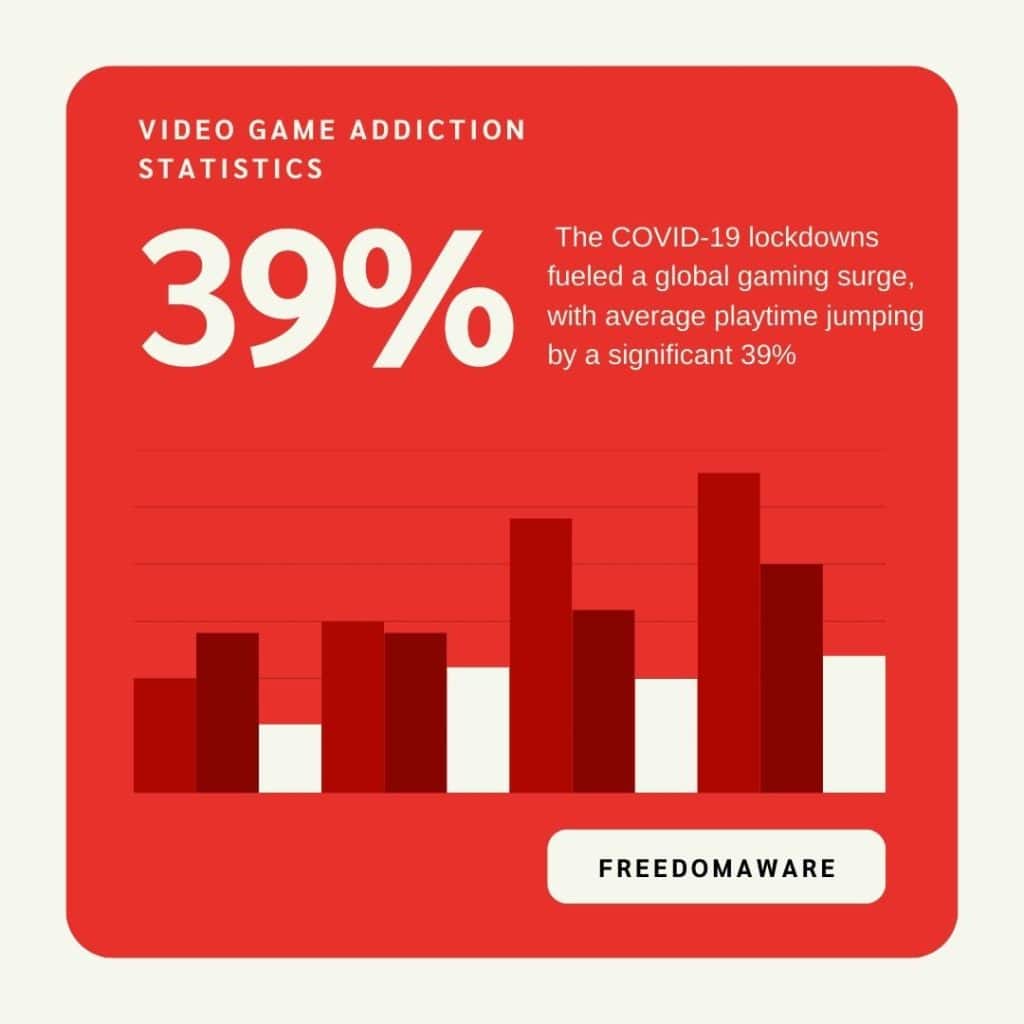
    1. Pandemic Play Boost: The COVID-19 lockdowns fueled a global gaming surge, with average playtime jumping by a significant 39% (source).

    Video Game addiction statistics
    1. South Korea’s Gaming Economy: In South Korea, video game addiction comes with a hefty price tag – an estimated annual cost of $3.5 billion. (source)
    2.  However, the gaming industry there also generates a substantial annual gain of $24.3 billion (source). Interesting duality!
    3. US vs. Global Playtime: American gamers clock in at an average of 7.71 hours per week, while the global average sits slightly higher at 8.45 hours (source). Who are the world champions of playtime?
    4. Lockdown Loneliness and Lost Hygiene: A concerning statistic: around 30% of Britons reportedly skipped meals and showers during the 2020 lockdowns in favor of video games (source). Remember, self-care is important!
    5. Gender Gap in Gaming Disorders: Men seem to be more susceptible to gaming disorders compared to women (source).
    6. Gamers vs. Addicted Gamers: The average gamer is 35 years old, while someone struggling with a gaming addiction is typically younger, around 24 years old (source).
    7. WHO Sounds the Alarm: According to the World Health Organization, an estimated 3% of the global population suffers from internet gaming disorder (source).

    Age and Addiction (Video Game Addiction Statistics): Who’s Most at Risk?

    While anyone can develop a gaming addiction, some age groups seem to be more susceptible:
    Video Game addiction statistics
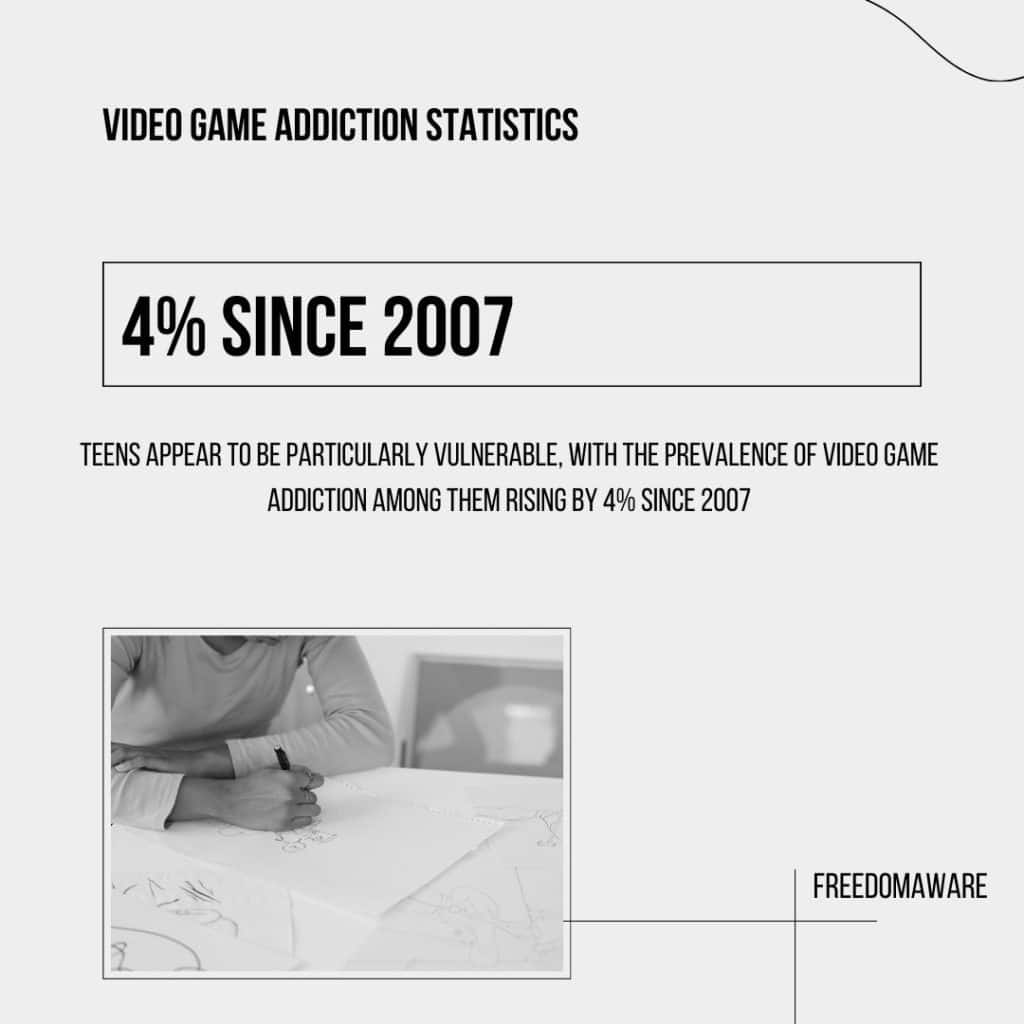
    1. Teens and Tech Addiction: Teens appear to be particularly vulnerable, with the prevalence of video game addiction among them rising by 4% since 2007 (source). It’s important to find a healthy balance.
    2. The Multiplayer Mindset: A significant portion of American gamers (22%) dedicate a massive chunk of their playtime (61-80%) to multiplayer games (source). This intense focus on online competition can have implications for how people interact and prioritize activities.
    3. Sleepless in Seattle (or Anywhere You Game): A survey revealed a concerning trend: 67% of gamers admitted to frequently sacrificing sleep for continued gaming sessions (source). Remember, a healthy sleep schedule is crucial for overall well-being.
    4. The Dark Side of the Game: Research suggests a link between internet gaming disorder and difficulties with decision-making, impulse control, and emotional regulation (source). These challenges can affect various aspects of life.
    5. Mental Health Concerns: Video game addiction can be a contributing factor to sleep disorders, depression, and anxiety (source). It’s important to seek help if you’re experiencing these issues.
    6. The Vast Majority: Thankfully, the vast majority of gamers (90%) don’t exhibit dangerous or long-term problematic behaviors related to gaming (source). This is a positive takeaway!

    Top Contenders (Video Game Addiction Statistics): The Games Gamers Can’t Quit

    While enjoyment is a core part of gaming, some titles seem to be particularly captivating:

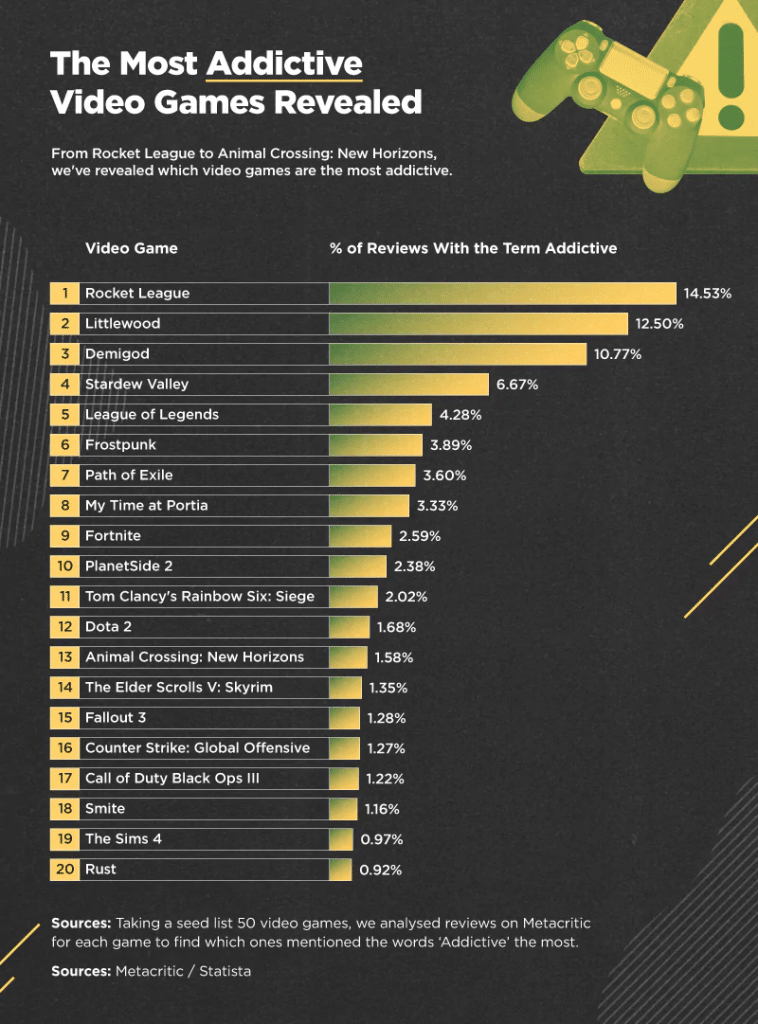
    1. Rocket League Takes the Crown: Currently, Rocket League reigns supreme as the most addictive game, with a whopping 14.53% of reviewers labeling it so (source). Buckle up for intense car-soccer action!
    2. Littlewood Lures You In: Littlewood nabs the second spot, with 12.50% of reviewers finding it highly addictive (source). This game might be more captivating than you bargained for!
    3. Animal Crossing: Charmingly Addictive?: Believe it or not, the seemingly peaceful Animal Crossing: New Horizons makes the list at number 13, with 1.58% of reviewers finding it addictive (source). Who knew island life could be so engrossing?
    4. The Sims 4: Not Quite as Gripping: The Sims 4, known for its life simulation gameplay, sits lower on the list with only 0.97% of reviewers tagging it as addictive (source). It seems managing virtual lives can be slightly less captivating than some other options.
    5. Dota 2: The Moderate Challenge?: Dota 2, a popular online battle arena game, sits at a score of 1.68% of reviewers finding it addictive (source). This suggests a slightly lower potential to become all-consuming compared to the top contenders.
    6. Tom Clancy’s Rainbow Six Siege: A Strategic Simmer?: Tom Clancy’s Rainbow Six Siege nabs a spot with 2.02% of reviewers labeling it addictive (source). The strategic elements might provide a different kind of appeal compared to fast-paced action games.
    7. The Elder Scrolls V: Skyrim: A Moderately Enchanting Adventure?: The Elder Scrolls V: Skyrim, a sprawling open-world RPG, comes in with 1.35% of reviewers finding it addictive (source). The vast world might offer a captivating experience, but perhaps at a slower pace.
    8. Counter-Strike: Global Offensive: Strategic Sprays (and Not-So-Addictive Plays?) Counter-Strike: Global Offensive, another popular online shooter, sits at 1.27% of reviewers considering it addictive (source). The tactical gameplay might provide a strategic challenge without necessarily being all-consuming.
    9. Fallout 3: Post-Apocalyptic Appeal (But Not Overly Gripping): Fallout 3, a post-apocalyptic RPG, scores 1.28% of reviewers finding it addictive (source). The unique setting offers a different kind of immersion, but perhaps with a less intense hold on players.
    10. Call of Duty Black Ops III: A Soldier’s Life (With Moderate Captivation): Call of Duty Black Ops III, a first-person shooter, rounds out the list with 1.22% of reviewers labeling it addictive (source). The action-packed gameplay might be moderately captivating, but not necessarily lead to uncontrollable play sessions.
    11. The Demigod Dilemma: Demigod comes in third place, with 10.77% of reviewers finding it addictive (source). Be warned – this game might have a godlike hold on your playtime!
    12. Stardew Valley’s Allure: Stardew Valley, the charming farming simulator, nabs the fourth spot with 6.67% of reviewers labeling it addictive (source). Don’t underestimate the captivating pull of virtual farm life!
    13. League of Legends: Competitive Craving?: League of Legends, a popular online battle arena game, sits at number five with 4.28% of reviewers finding it addictive (source). The competitive nature might be what keeps players hooked.
    14. Path of Exile: Less is More (Relatively Speaking): Path of Exile holds the interesting distinction of having a negative addiction score (-3.60%) based on reviewer data (source). This suggests it’s less likely to be seen as highly addictive compared to other games on the list.
    15. My Time at Portia: Crafting Calmly?: My Time at Portia, a relaxing crafting and simulation game, scores 3.33% on the reviewer addiction scale (source). The laid-back gameplay might offer a more chill experience.
    16. Fortnite: Not Quite a Frenzy?: Fortnite, the popular battle royale game, comes in at 2.59% of reviewers finding it addictive (source). This suggests it might be less likely to trigger uncontrollable play sessions compared to some other entries.
    17. Planetside 2: Large-Scale Battles (Without Extreme Addiction?): Planetside 2, a large-scale online shooter, nabs a spot with 2.38% of reviewers labeling it addictive (source). The focus on large-scale battles might offer a different kind of appeal, potentially with less individual player obsession.
    18. Frostpunk: The Management Challenge (Not the Addiction Trap): Frostpunk, a city-building survival game, scores 3.89% on the reviewer addiction scale (source). The strategic management aspects might provide a different kind of engagement, potentially with less risk of excessive play.
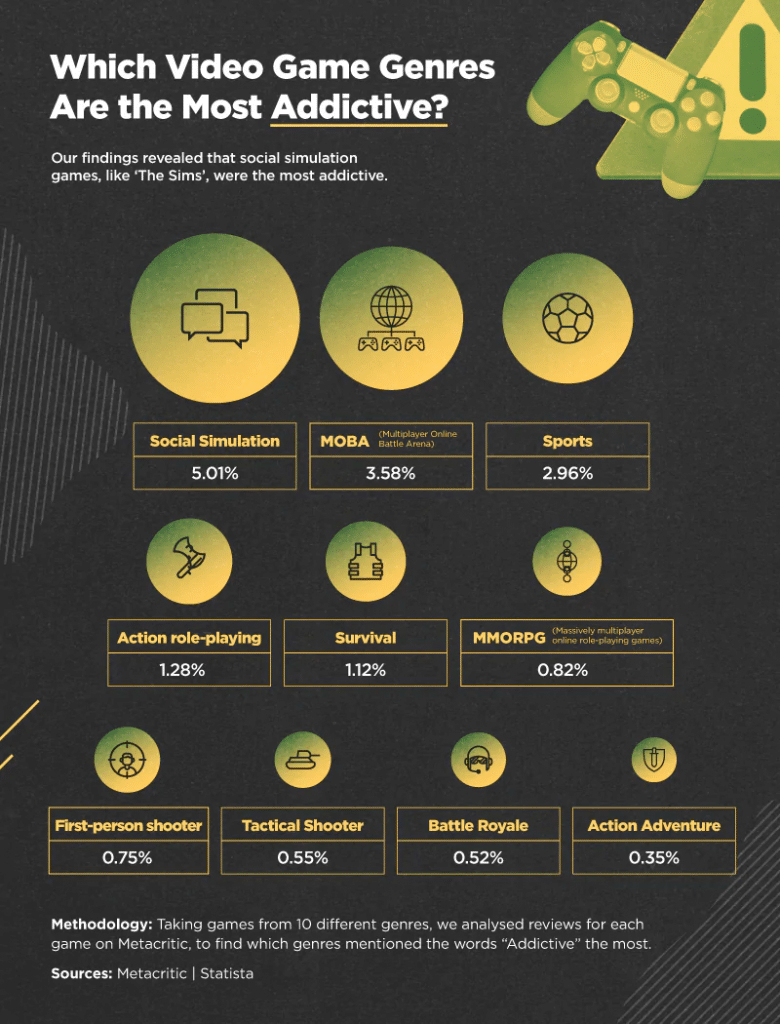
    19. The Realm of MMORPGs: According to Statista, the massive multiplayer online role-playing genre (MMORPG) takes the crown as the genre with the highest perceived addiction risk (source). These vast online worlds can be incredibly captivating.
    20. MOBA: The Thrill of Competition: Multiplayer Online Battle Arena (MOBA) games, known for their intense team-based battles, also rank high in perceived addiction risk (source). The competitive nature and strategic depth can be highly engaging.
    21. Beyond the Top Contenders:  (source) Here’s a look at how other genres fare on the addiction scale (all based on reviewer data):
      1. Social Simulation: 5.92%
      2. MOBA Battle Arena: 3.58% (slightly lower risk than standard MOBAs)
      3. Multiplayer Online Sports: 2.96%
      4. Action Role-playing: 1.28%
      5. Survival: 1.12%
      6. Tactical Shooter: 0.55%
      7. Action Adventure: 0.35% (considered low risk)
      8. Battle Royale: 0.52% (lower risk than standard MOBAs)
      9. First-person Shooter: 0.75%

    Gender Gap in Gaming Addiction (Video Game Addiction Statistics)

    While anyone can develop a gaming addiction, research suggests a gender disparity:
    Video Game addiction statistics
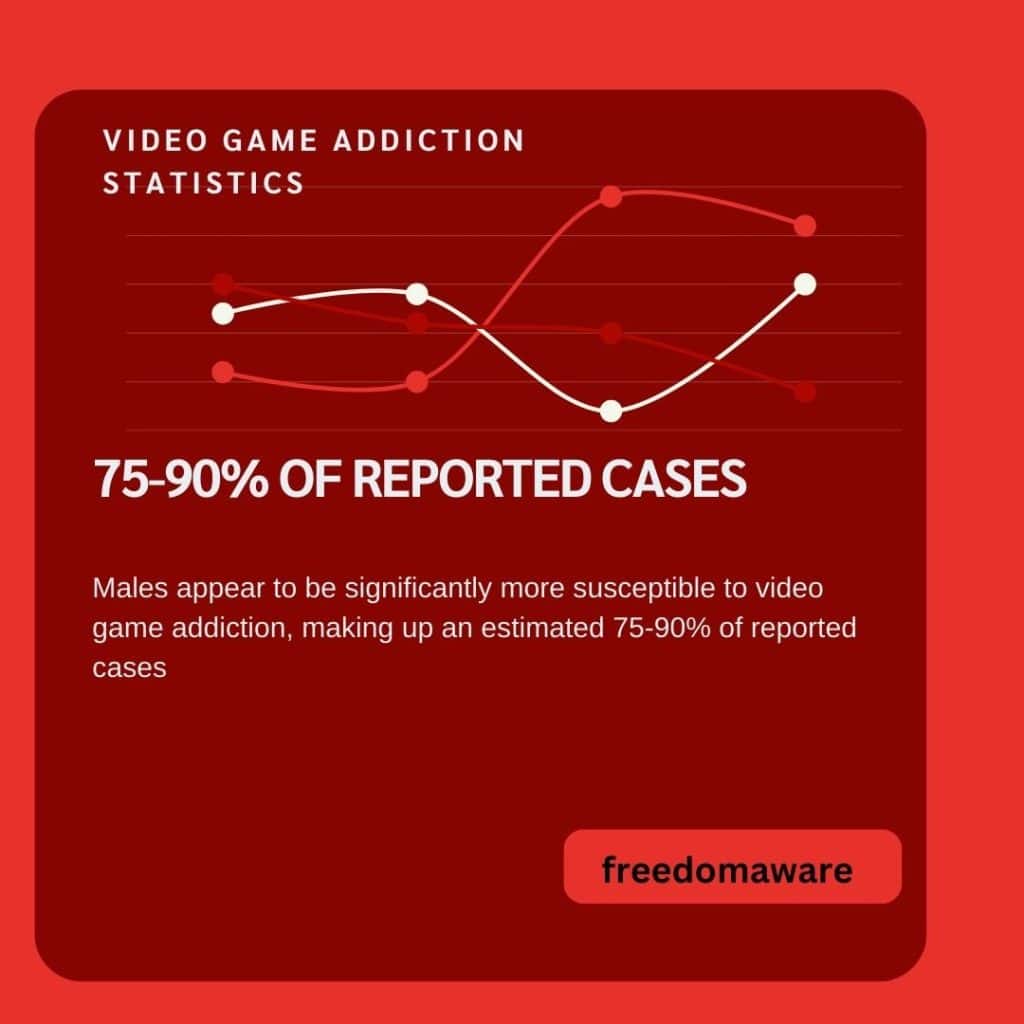
    1. Men at Higher Risk: Males appear to be significantly more susceptible to video game addiction, making up an estimated 75-90% of reported cases (source).
    2. Women and Gaming Addiction: Women are not immune, but they account for a smaller portion of cases, at around 10-25% (source). It’s important to note that these are general trends, and individual experiences can vary.

    Age and Vulnerability (Video Game Addiction Statistics): Who’s Most at Risk for Video Game Addiction?

    While video game addiction can affect anyone, certain age groups seem to be more susceptible:

    1. Children and Gaming: Among children aged 8-18, an estimated 8.5% are grappling with video game addiction (source). This highlights the importance of parental guidance and healthy gaming habits for younger players.
    2. The Teenage Tech Trap: Adolescence, particularly between 13-18 years old, appears to be a prime time for video game addiction, with prevalence rates ranging from 4% to a concerning 20% (source).
    3. Young Adults and Gaming: Young adults (18-24 years) also face significant risk, with studies reporting addiction rates between 5% and 10% (source). Balancing gaming with other life responsibilities becomes crucial during this period.
    4. Gaming Across Generations: Even adults aged 25 and above can experience video game addiction, with prevalence rates varying from 2% to 5% (source). It’s a reminder that responsible gaming practices are important for all ages.

    Global Gaming Landscape (Video Game Addiction Statistics): Addiction Rates Around the World

    Video game addiction is a concern that transcends national borders. Here’s a glimpse into the situation in different countries:

    1. The UK Gaming Scene: An estimated 700,000 to 1 million UK gamers, roughly 2-3% of the population, struggle with video game addiction (source). 
    2. This highlights the issue’s prevalence. However, it’s important to note that over a quarter (26%) of UK adults play online games casually, averaging 1-5 hours per week (source). 
    3. Before lockdowns, the average UK gamer spent a more significant chunk of time playing, clocking in at 13 hours weekly (source). This suggests a potential pre-lockdown issue with excessive gaming habits.
    4. Australia’s Gaming Landscape: A study by Macquarie University revealed that 2.8% of Australian adolescents meet the criteria for internet gaming disorder (source).
    5.  Interestingly, the study also found a significant gender gap, with boys (96%) being far more likely to be addicted than girls (6%) (source).
    6.  Despite this, video games remain popular in Australia, with 67% of the population playing regularly and averaging 89 minutes of daily playtime (source).
    7. Gaming addiction rates were higher among males than females, with 96% of boys and 6% of girls exhibiting addiction tendencies. (source)
    8. Approximately 67% of Australians engage in regular video game play, dedicating an average of 89 minutes to gaming daily. (source)
    9. The government of Japan has officially recognized video game addiction as a public health concern. (source)
    10. Research indicates that Singaporean teenagers devote more time to gaming compared to their American counterparts, spending 20 and 13 hours on average, respectively. (source)
    11. In Taiwan, a 2018 survey revealed that around 6% of adolescents exhibited severe addiction to online gaming. (source)
    12. A survey conducted in Thailand identified video game addiction among children aged 6 to 18 years old. (source)
    Video game addiction statistics

    The Global Gaming Landscape (Video Game Addiction Statistics): Players, Risks, and Rewards

    The world of video games is booming! Here’s a look at some interesting trends:

    1. Gamers on the Rise: Over two billion people worldwide play video games, and that number is projected to hit a staggering three billion by 2023 (source).
    2. The Grip of Gaming: While most gamers enjoy a healthy balance, a small percentage struggle with addiction. Estimates suggest that up to 4% of gamers and 3.05% of the global population experience gaming disorder (source). This translates to roughly 60 million people worldwide.
    3. Not Everyone Gets Hooked: It’s important to remember that addiction is not the norm. While some people might exhibit symptoms associated with gaming disorder (between 0.3% and 1% of the general population), responsible gaming is the reality for the vast majority (source).
    4.  In the US, for instance, only 10% of adults who play video games consider themselves avid gamers (source).
    5. The Allure of the Game: Games can be truly engaging! The dopamine rush experienced while playing is a well-documented phenomenon (source). 
    6. Thankfully, most gamers (around 90%) don’t exhibit dangerous or long-term negative behaviors due to their playtime (source).

    Video Games (Video Game Addiction Statistics): A Global Phenomenon with Potential Challenges

    The world of video games is vast and ever-changing. Here’s a look at some interesting trends and potential issues:

    1. The Pandemic Playtime Boom: Lockdowns fueled a global gaming surge, with the average playtime jumping a significant 39% (source).
    2. Gaming and ADHD: A Link to Consider: Research suggests a connection between symptoms of ADHD and varying levels of video game addiction (source). It’s important to consult a healthcare professional if you suspect ADHD.
    3. Gaming Disorder on the Rise: The worldwide prevalence of gaming disorder reached 3% in 2019 (source), highlighting a growing concern.
    4. The American Gamer: The average American gamer spends 7.71 hours per week playing video games (source). Finding a healthy balance is key.
    5. A Global Perspective: Studies show that between 0.3% and 1% of the general population worldwide exhibit signs of internet gaming disorder (source).
    6. Lockdown’s Dark Side: A concerning statistic emerged during the 2020 lockdowns: around 30% of Britons reportedly neglected meals and showers in favor of video games (source). Prioritizing self-care is crucial.
    7. Gaming Rules in China: China enforces stricter regulations on youth gaming, limiting weekday playtime to 90 minutes (source).
    8. Growth of Gaming Disorder: A large-scale study spanning 2009 to 2019 revealed a 3% increase in the global prevalence of gaming disorders by 2019 (source). This suggests a need for awareness and responsible gaming practices.
    Video game addiction statistics

    Navigating the Gaming Landscape (Video Game Addiction Statistics): Stats, Trends, and Age Groups

    The world of video games is multifaceted, with a range of players, habits, and potential risks. Here’s a breakdown of some key statistics:

    1. Gaming Disorder Prevalence: Estimates for the prevalence of gaming disorder vary slightly. Some studies suggest 3%, while others indicate a lower rate of 1.96% (source). Regardless, it’s an issue to be aware of.
    2. Gender Gap in Gaming Addiction: Men seem to be more susceptible to gaming disorder than women, with a current ratio of roughly 2.5 men to 1 woman experiencing the condition (source).
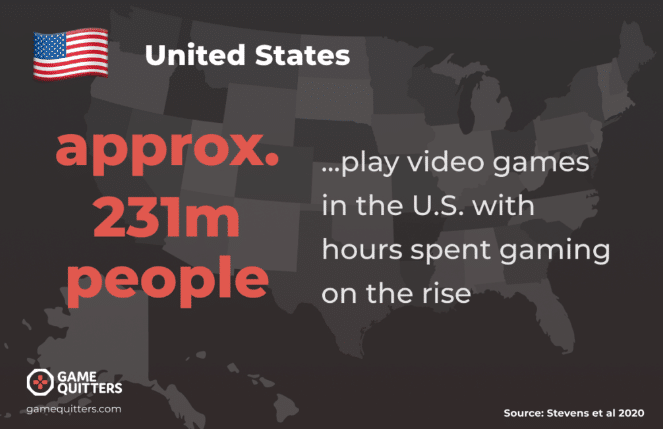
    3. Global Gaming Habits: The average American gamer spends 7.71 hours playing video games per week (source). 
    4. This pales in comparison to China, where the average jumps to a significant 12.39 hours weekly (source).
    5.  Vietnam follows closely behind with an average of 10.16 hours (source
    6. highlighting a global phenomenon with regional variations. The worldwide average sits at 8.45 hours weekly (source).
    7. American Gamers by Age: Interestingly, statistics from 2017 indicate that over 22% of American gamers dedicate 61-80% of their playtime to online multiplayer games on PC (source).
    Video game addiction statistics
    1.  A wider look reveals that a staggering 90-99% of American kids play video games (source)
    2. with 48-56% of young adults also engaging regularly (source).
    3.  The average gamer falls between 18 and 34 years old (source)
    4.  while the average person with a gaming addiction is slightly younger at 24 (source).
    5. Gaming Addiction in Youth: While most gamers enjoy a healthy balance, youth addiction is a concern. Studies suggest that 8% of kids and adolescents globally could be struggling with video game addiction (source). 
    6. This highlights the importance of parental guidance and age-appropriate gaming habits. Furthermore, the prevalence of video game addiction among teenagers appears to be on the rise, with a 4% increase since 2007 (source).

    Canada’s Thriving Gaming Scene (Video Game Addiction Statistics): Players, Profits, and Popularity
    Video game addiction statistics

    The video game industry is a booming sector in Canada:

    1. Powering Up the Economy: The industry’s contribution to Canada’s GDP is impressive, reaching $4.5 billion in 2019 (source).
    2. A Nation of Gamers: Gaming isn’t just for a niche group. A whopping 94% of Canadians aged 18-34 are gamers (source). 
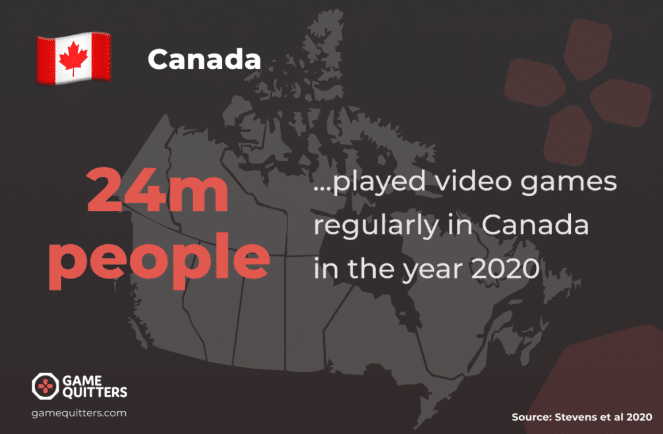
    3. This enthusiasm extends beyond this age range, with 64% of the entire Canadian population, roughly 23 million people, playing video games regularly (source). These statistics highlight the widespread popularity of gaming in Canada.
    4. The Growing Gamer Nation: The number of Canadians who play video games regularly has surged, jumping from 19 million in 2015 to a significant 24 million in 2020 (source). This highlights the increasing popularity of gaming across the country.
    5. A Shadow Over the Fun?: While gaming offers enjoyment for many, a 2017 CAMH study raises a concern. It found that nearly 12% of Ontario university students exhibit signs of video game addiction (source), suggesting a potential issue, particularly among young adults.
    6. Potential Scope of Addiction: Estimates suggest that video game addiction could impact between 470,400 and 720,000 Canadians (source). 
    7. Additionally, some studies indicate that as many as 3 million Canadian gamers might be at risk of unhealthy gaming habits (source). These numbers highlight the need for awareness and responsible gaming practices.

    The UK Gaming Landscape (Video Game Addiction Statistics): A Look at Players, Habits, and Concerns

    The United Kingdom boasts a vibrant video game scene, but potential issues deserve attention:

    1. A Nation of Gamers: A sizeable portion of the UK population enjoys video games. In 2020, an estimated 36 million Britons, or nearly half the population (50%), played regularly (source).
    2. Gaming Habits: While many enjoy a balanced approach, some gaming habits raise concerns. A study revealed that 18% of UK gamers dedicate a significant amount of time, clocking in at 6 or more hours daily (source).
    3.  Another concerning statistic shows that roughly 30% of gamers reportedly neglected basic hygiene like showering in favor of playing (source). 
    4. The most frequent gamers fall within the 13-25 and 25-34 age groups (source).
    5. Gaming Among Youth: A staggering 93% of UK children engage with video games in some way (source). While gaming can be fun and educational, parental guidance is crucial for fostering healthy gaming habits.
    6. Popular Games in the UK: Games like FIFA, Fortnite, World of Warcraft, and Call of Duty appear to be top contenders for UK gamers’ attention (source).
    7. The Pandemic’s Impact: Reports suggest a troubling trend: the number of gamers struggling with addiction in the UK may have tripled due to the pandemic (source).
    8. Potential Scope of Addiction: With 36 million regular gamers, estimates suggest that between 700,000 and 1 million UK gamers might be grappling with video game addiction (source).

    Warning Signs Beyond the Screen:

    • Unplugging Blues: Feeling sad, anxious, or irritable when you can’t play.
    • The Craving Grows: Needing to spend increasingly more time gaming to feel satisfied.
    • Quitting Feels Impossible: Struggling to cut back on gaming despite wanting to.
    • Game Over for Other Hobbies: Losing interest in activities you used to enjoy due to gaming.
    • Trouble Doesn’t Stop the Play: Continuing to game even when it causes problems in your life.
    • Living a Lie: Lying about how much time you spend playing games.
    • Escape Through Gaming: Using games to cope with negative emotions like guilt or hopelessness.
    • Real-Life Fallout: Putting your job, relationships, or other important aspects of life at risk due to gaming.

    The Future of Fun (Video Game Addiction Statistics): Emerging Trends in Video Games

    The video game industry is constantly evolving, and exciting trends are shaping the future of play:

    • Get Ready to Gear Up: Virtual Reality (VR) and Augmented Reality (AR) are poised to become more mainstream, offering immersive gaming experiences that blur the lines between the real and virtual worlds (source).
    • Cloud Power: Cloud gaming services are on the rise, allowing players to access high-end games without expensive hardware. This could make gaming more accessible to a wider audience (source).
    • The Rise of Esports: Esports, competitive video gaming, is gaining massive popularity. Expect to see more professional leagues, tournaments, and spectator engagement (source).
    • Mobile Mania: The mobile gaming market continues to boom, with smartphones and tablets becoming powerful platforms for innovative and engaging games (source).
    • Subscription Services: Subscription services offering access to a library of games for a monthly fee are becoming increasingly popular, similar to models used for movies and music (source).
      These are just some of the exciting trends shaping the future of video games. Stay tuned for a world of immersive, accessible, and competitive gaming experiences!

    Power On the Past: The Rise of Retro Gaming

    The world of video games is obsessed with the future, but there’s a growing trend looking back: retro gaming!

    • Old is Gold: People are rediscovering the joys of classic video games. This isn’t just a niche hobby anymore; retro gaming has become increasingly popular in recent years.
    • Remakes for a New Age: Fueling this trend is the wave of remakes by gaming companies. These aren’t just simple rehashes; they’re thoughtful blends of nostalgia and modern technology.
    • Beyond Nostalgia: These remakes offer more than just a trip down memory lane. Developers skillfully combine beloved narratives with contemporary gameplay mechanics and stunning graphics. This allows a whole new generation of gamers to experience classic stories freshly and excitingly.
    • Enduring Entertainment: The popularity of retro gaming highlights a timeless truth: great gameplay mechanics, just like classic music and movies, can hold their own across generations.

    Level Up with AI (Video Game Addiction Statistics): How Generative AI is Reshaping Gaming

    The world of video games is getting a boost from artificial intelligence, with a specific type called generative AI making a big impact:

    • Game Development on Fast Forward: Generative AI is becoming a game-changer for developers. This technology can create code, art, dialogue, and more, significantly speeding up game production. This translates to richer, more immersive game worlds for players to explore.
    • The Future of Game Development: Experts predict that generative AI will play a major role in over half of video game development within the next 5-10 years.
    • AI-Powered Personalization: Imagine a game that adapts to your playstyle! Generative AI can analyze player behavior and in-game data to predict actions and adjust game elements on the fly. This could create a truly personalized and dynamic gaming experience.

    Blurring the Lines (Video Game Addiction Statistics): The Rise of VR and AR Gaming

    The future of gaming is getting real, or rather, unreal…and augmented! Here’s a breakdown of two exciting trends:

    • VR: Stepping into the Game: Virtual Reality (VR) offers a complete immersion experience. Players wear headsets that transport them entirely into virtual worlds, creating a truly unforgettable gaming experience. However, VR typically requires dedicated equipment and a designated play space.
    • AR: Bringing the Game to You: Augmented Reality (AR) takes a different approach. Instead of shutting you off from the real world, AR overlays digital elements onto your physical surroundings using your smartphone or other device. Imagine battling aliens while walking down the street or solving puzzles in your living room! AR allows for more flexible play and interaction with the real world.
    • The Future of Play: Both VR and AR offer exciting possibilities for immersive experiences, deeper user engagement, and innovative new game concepts. As these technologies continue to develop, the future of gaming promises to be mind-blowing!

    Breaking Barriers (Video Game Addiction Statistics): The Push for Diversity in Games

    The gaming world is becoming more inclusive, with a growing focus on diversity:

    • A World of Players, a World of Characters: This trend aims to create video games that better reflect the real world’s rich tapestry of people. This means promoting characters and storylines that celebrate gender, racial, and ethnic diversity.
    • Progress, but Room to Grow: While the industry has made strides toward inclusivity, there’s still a significant journey ahead.
    • Building a More Representative Industry: To achieve genuine diversity in games, a two-pronged approach is crucial. The gaming industry itself needs to be more inclusive and diverse in terms of its workforce and the content it creates. This will foster a richer gaming experience for everyone.

    All You Can Play: The Rise of Subscription Gaming

    The way we access games is evolving, and subscription services are taking center stage:

    • Game Libraries at Your Fingertips: Subscription gaming offers a library of games accessible for a monthly fee, similar to models used for music and movies. This growing trend is transforming the industry, with the global market expected to reach a staggering $10.92 billion by 2024 (source).
    • Play on Your Terms: This model provides flexibility and convenience. Subscribers can access games on a variety of devices, including smartphones, PCs, tablets, and consoles. This allows users to stream or download games, depending on their preference and internet connection.

    On-the-Go Entertainment (Video Game Addiction Statistics): The Mobile Gaming Boom

    Mobile gaming is a force to be reckoned with, and it’s not slowing down:

    • A Pocket-Sized Powerhouse: The mobile gaming industry is experiencing explosive growth. This trend gained further momentum during the pandemic, with people seeking entertainment at home.
    • More Players, Fewer Payers: While the player base is expanding, the number of people spending money on mobile games has dipped.
    • Monetization Innovation: This shift in spending habits is pushing developers to get creative. The industry is seeing a rise in innovative monetization strategies to keep mobile gaming sustainable. This means developers need to adapt to changing market dynamics and constantly push the boundaries of innovation to keep players engaged.

    Ever-Evolving Entertainment (Video Game Addiction Statistics): Fresh Genres and Returning Favorites

    The world of video games thrives on constant reinvention. Here’s a glimpse into what’s hot:

    • Fresh Concepts Take Center Stage: New game genres are flourishing every year, while some forgotten favorites are experiencing a resurgence. Extraction games, realistic shooters, and arcade-style racing games are capturing the attention of gamers worldwide.
    • 2024’s Hottest Hits: Keep an eye out for these genres predicted to dominate in 2024: extraction shooters, post-disco-era RPGs (role-playing games), and cooperative horror games.
    • Catering to Niche Audiences: Developers are also exploring genres with dedicated followings, such as roguelike deck builders. These niche genres target players who enjoy a deep dive into a specific style of gameplay, often trying out multiple titles within the genre.

    Why Do Video Games Get So Engaging?

    Video games can be incredibly fun and captivating, and there’s a scientific reason why. Here’s a breakdown:

    • The Dopamine Reward System: When you play a game and experience something enjoyable, like winning a level or overcoming a challenge, your brain releases dopamine. Dopamine is a neurotransmitter associated with pleasure and reward. This dopamine rush motivates you to keep playing, as your brain craves more of that positive feeling.
    • Similar to Other Enjoyable Activities: This dopamine response isn’t unique to video games. You experience it when you eat your favorite food, listen to music you love, or achieve a goal.
    • Hyperarousal and the Gaming Connection: Studies suggest that video games can trigger a state of hyperarousal, a heightened state of excitement. When this happens during gameplay, your brain might associate the game itself with dopamine release, making you want to return to the game to experience that feeling again.

    Video Game Addiction Help

    Struggling with Video Game Addiction? Here’s Help!
    Video game addiction statistics

    If you or someone you know is battling video game addiction, you’re not alone. Here we have resources to support your journey:

    • Weekly Articles: Gain valuable insights and practical strategies through our library of informative articles about video game addiction (source).
    • Respawn Gamers Program: Explore our comprehensive program designed to help gamers overcome addiction and reclaim control (source).
    • Reclaim Family Program: Foster healthier family dynamics by learning how to address gaming conflicts within the household (source).
    • Supportive Community: Connect with others who understand your challenges. Join our forum and find a safe space to share your experiences and receive encouragement (source).
    • Therapist Directory: Locate a qualified video game addiction therapist in your area for personalized guidance and support (source).

    Video Game Addiction: FAQs Answered

    Concerned about video game addiction? Here are answers to some frequently asked questions:

    1. Why Are Video Games So Engaging?

    Video games tap into our brain’s reward system. Gameplay can trigger the release of dopamine, a neurotransmitter associated with pleasure and motivation. This “dopamine rush” makes us want to keep playing to experience that positive feeling again. Similar to enjoying music or delicious food, games can be inherently rewarding.

    2. What Factors Contribute to Video Game Addiction?

    Several factors can influence addiction, including:

    • Game Design: Many games are meticulously crafted to keep players hooked. Features like rewards, progression systems, and cliffhangers encourage continued engagement.
    • Dopamine Release: As mentioned earlier, the dopamine response plays a key role. The brain starts associating gameplay with pleasure, driving the urge to play more.
    • Escape Mechanism: For some, video games might serve as an escape from stress or difficult emotions.

    3. Helping a Child Overcome Video Game Addiction:

    If you suspect your child struggles with video game addiction, here are some steps to consider:

    • Educate Yourself: Learn about video game addiction and its signs.
    • Set Limits: Work with your child to establish clear boundaries around screen time and gaming habits.
    • Consequences and Consistency: Enforce consequences for exceeding limits, and be consistent in your approach.
    • Create an Action Plan: Develop a plan to gradually reduce gaming time and encourage alternative activities.
    • Lead by Example: Model healthy screen habits yourself.

    4. Video Game Addiction Statistics:

    Statistics on video game addiction prevalence vary. While not everyone who plays games is addicted, it’s a concern worth addressing. Here’s some general information:

    • Engagement: A large portion of the population enjoys video games. Estimates suggest that around 16.35% of people worldwide play. In the US, 90% of teenagers reportedly play video games.
    • Not All Games Are Addictive: While some games are designed to be highly engaging, not all are inherently addictive.
    • Potential Risks: Studies suggest a possible link between video game addiction and brain changes similar to those seen in substance abuse disorders. Additionally, research indicates a potential correlation between addiction and mental health issues like depression.

    5. Seeking Help:

    If you or someone you know is struggling with video game addiction, resources are available. Consider seeking professional guidance from a therapist specializing in video game addiction.


  • 81 Top Virtual Event Statistics For Marketers & Organizers (2025)

    81 Top Virtual Event Statistics For Marketers & Organizers (2025)

    Virtual event statistics

    Here are some Virtual event Statistics to help you in 2024 and beyond :

    Data is king when it comes to innovative business choices, and the world of virtual events is no exception.

    The COVID-19 pandemic fueled a surge in virtual event platforms. In essence, virtual events let people connect and participate online instead of gathering in person.

    Feeling overwhelmed by planning a virtual event? Relax, I’ve compiled essential statistics to guide you through planning, promotion, and hosting a smash-hit event.

    But before we dive into the numbers, let’s explore the various types of virtual events.

    Unveiling the Virtual Event Landscape: A Look at Key Formats

    Let’s break down the exciting world of virtual events! Here are some of the most popular formats:

    1. Webinars: Imagine an online presentation hosted by a company or organization broadcast live to a chosen audience on their computers. That’s the magic of a webinar!
    2. Virtual Conferences:  Think of a traditional conference but without the travel! Virtual conferences allow attendees from anywhere in the world to participate in live sessions and events happening at a real-world location, all from the comfort of their computers.
    3. Internal Hybrid Events:  These events are designed to connect your company’s internal staff, including clients, partners, employees, and leadership. They combine virtual participation with a physical location.
    4. External Hybrid Events:  This format opens the doors to a broader audience beyond your company. Think conferences, summits, concerts, networking events, workshops, classes, trade shows, and product launches – all with both in-person and virtual participation options!

    Virtual Events Statistics: A Booming Industry

    The virtual event landscape is experiencing explosive growth! Here are some key statistics to chew on:

    Virtual event statistics
    1. Market on the Move (virtual event statistics): The global virtual event market is projected to surge at a staggering 21.4% compound annual growth rate (CAGR) between 2022 and 2030. (Source)
    2. Marketing Must-Have: In the realm of virtual events statistics, a whopping 74% of businesses consider virtual events a cornerstone of their overall marketing strategy. (Source)
    3. Revenue Rocket (virtual event statistics): The virtual event market was a powerhouse in 2021, exceeding $116 billion in revenue. By 2030, that number is expected to skyrocket to a mind-blowing $810.2 billion. (Source)
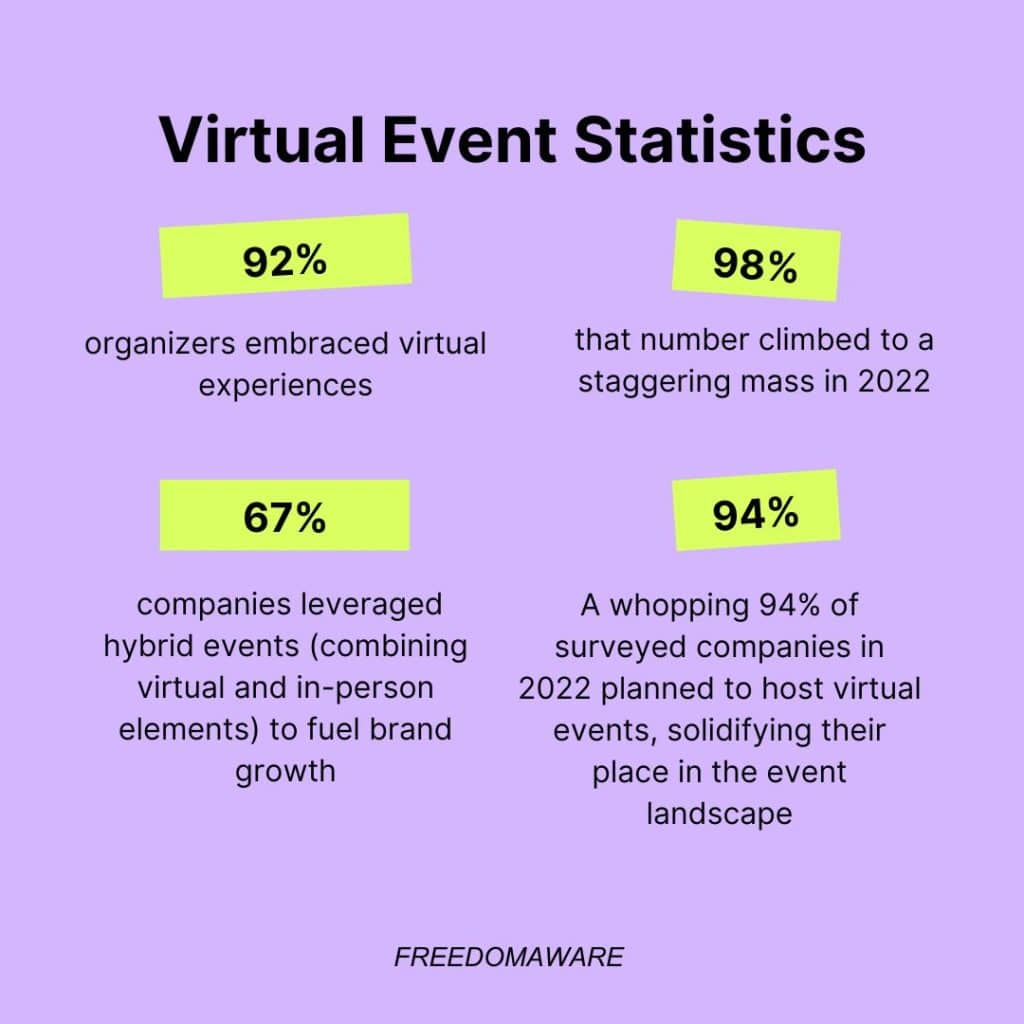
    4. Virtual Boom: The shift to virtual events is undeniable. In 2021, 92% of organizers embraced virtual experiences, which climbed to a staggering 98% in 2022. Additionally, 67% of companies leveraged hybrid events (combining virtual and in-person elements) to fuel brand growth. (Source)
    5. Attendee Appetites: Virtual events statistics have shown that while 43% of attendees crave more virtual conferences in 2023, the desire for in-person connection remains strong, with 48% planning on-site events. Interestingly, 41% also show interest in virtual roundtables. (Source)
    6. Virtual Here to Stay: The virtual event trend is far from fading. A whopping 94% of surveyed companies in 2022 planned to host virtual events, solidifying their place in the event landscape. (Source)
    7. Learning is King: The primary reason people flock to virtual events? To gain knowledge about companies and their products – making virtual events a powerful educational tool. (Source)
    8. Webinars Rule Small Business (virtual event statistics): In the realm of virtual events statistics, small businesses are embracing webinars with gusto. A survey revealed that a remarkable 99% of over 2,000 small businesses incorporate webinars into their marketing plans. (Source)

    Filling Those Virtual Seats (virtual event statistics): Attendance Trends

    Let’s delve into the world of virtual event attendance! Here are some compelling statistics:

    Virtual event statistics
    1. Live Webinars on Fire: In virtual events statistics, The number of people attending live webinars has skyrocketed by 66% in the past two years, highlighting their growing popularity. (Source)
    2. Last-Minute Mania:  Mark your calendars! Virtual events statistics have shown that Over 68% of registrations for virtual or hybrid events happen within a week of the event date. (Source)
    3. Pandemic Push (virtual event statistics):  The pre-pandemic world saw only 45% of people attending virtual events. Thankfully, that number has surged to a whopping 87% due to the lasting effects of COVID-19. (Source)
    4. In-Person Attendance Blues: In the realm of virtual events statistics for 46% of marketers, securing a solid turnout remains a significant hurdle for in-person events.  Virtual events seem to be offering a more reliable solution. (Source)
    5. Virtual Advantage:  Virtual events boast an average attendance of 1,356, exceeding the average of 908 attendees for traditional meetings. It looks like virtual gatherings might attract a wider audience! (Source)
    6. Measuring Success: Virtual event statistics show that nearly half (45%) of companies rely on total registration and attendance figures to gauge the success of their virtual events. (Source)
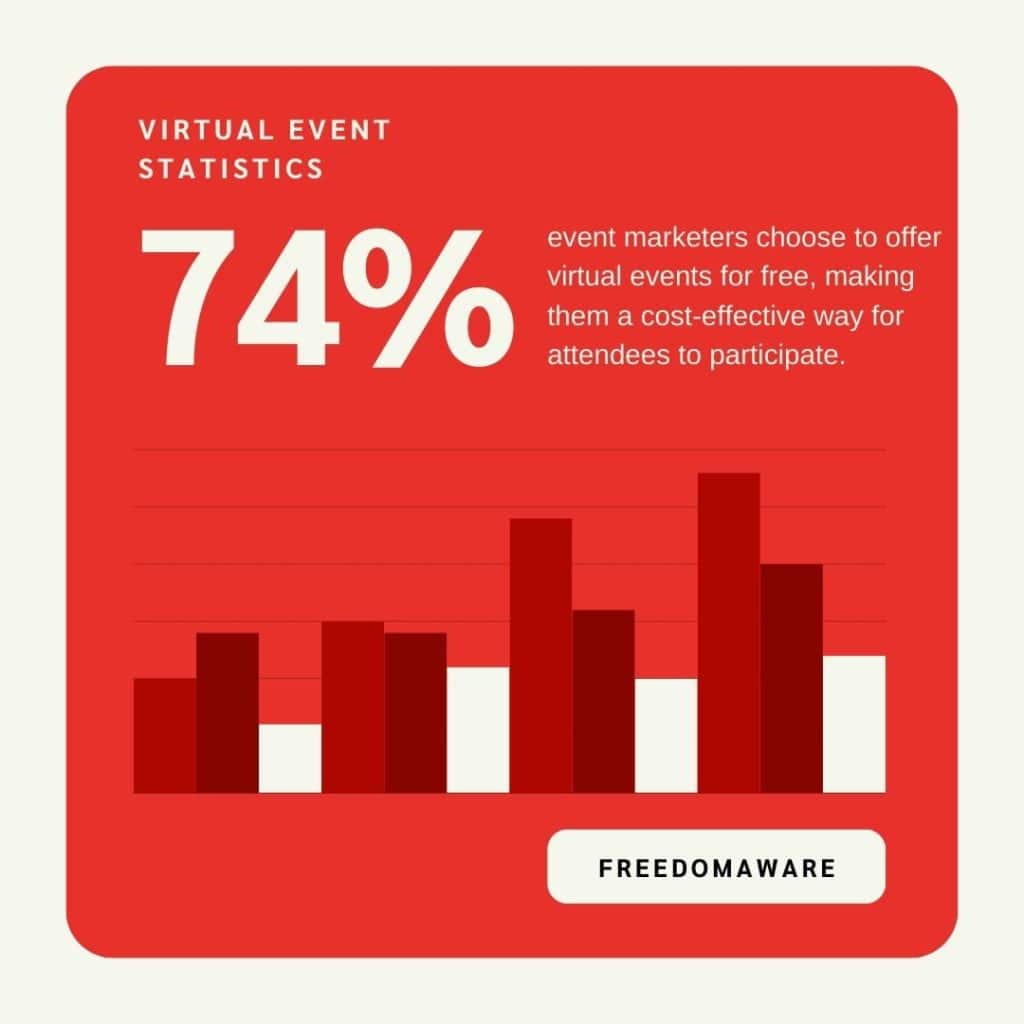
    7. Free Events Dominate: In virtual events statistics, a massive 74% of event marketers choose to offer virtual events for free, making them a cost-effective way for attendees to participate. (Source)
    8. Small Scale, Small Price Tag (virtual event statistics):  Hosting a virtual event with a cozy group of 10-100 attendees? Expect a monthly cost range of $50-$250.(Source)

    Large Scale, Larger Costs:  Jumbo events with 500-2500+ attendees come with a higher monthly price tag, ranging from $625 to $8,000.

    1. Cost per Guest:  According to virtual event statistics to 33.7% of event marketers, you can expect to spend an average of $500-$1,000 per virtual attendee. (Source)
    2. Sponsorship Revenue Streams (virtual event statistics):  Monetization opportunities exist!  The average virtual sponsorship package costs around $8,456, offering a potential revenue stream for organizers. (Source)
    3. Platform Power:  Virtual event statistics show that a whopping 87% of event planners actively seek platforms that allow virtual booth sponsorships, highlighting the value of this revenue source. (Source)
    4. Hybrid Hurdle:  Finding the right price point can be tricky! In the realm of virtual events statistics, Roughly 32% of businesses grapple with pricing as the biggest challenge for hybrid events. (Source)
    5. Event Size & Spending (virtual event statistics):  The cost varies depending on the event size. Small virtual events (under 250 attendees) range from $3,000 to $15,000, while larger events can set you back between $5,000 and $30,000.(Source)
    6. Accessibility Advantage:  Virtual events are budget-friendly for attendees!  Only 10% require a paid ticket, compared to over 25% of hybrid or in-person events. (Source)
    7. Future Investment:  The future is virtual! A significant 57.7% of businesses plan to increase their budget for online events, with another 35.4% unsure but open to the possibility. (Source)
    8. ROI Timeline: In the realm of virtual events statistics, Patience is key!  For 74% of B2B virtual event organizers, it takes six months to see a positive return on investment (ROI). (Source)
    9. COVID-19 Impact (virtual event statistics): Due to COVID-19, in 2020, there was a significant shift towards virtual events. A staggering 74.9% of event planners switched from in-person to virtual, while 47% canceled events and 39.8% postponed them.(Source)
    Virtual event statistics

    Planning & Promotion (virtual event statistics):

    1. Promotion Timeline: The average virtual event promotion time is 56 days, so plan ahead!(Source)
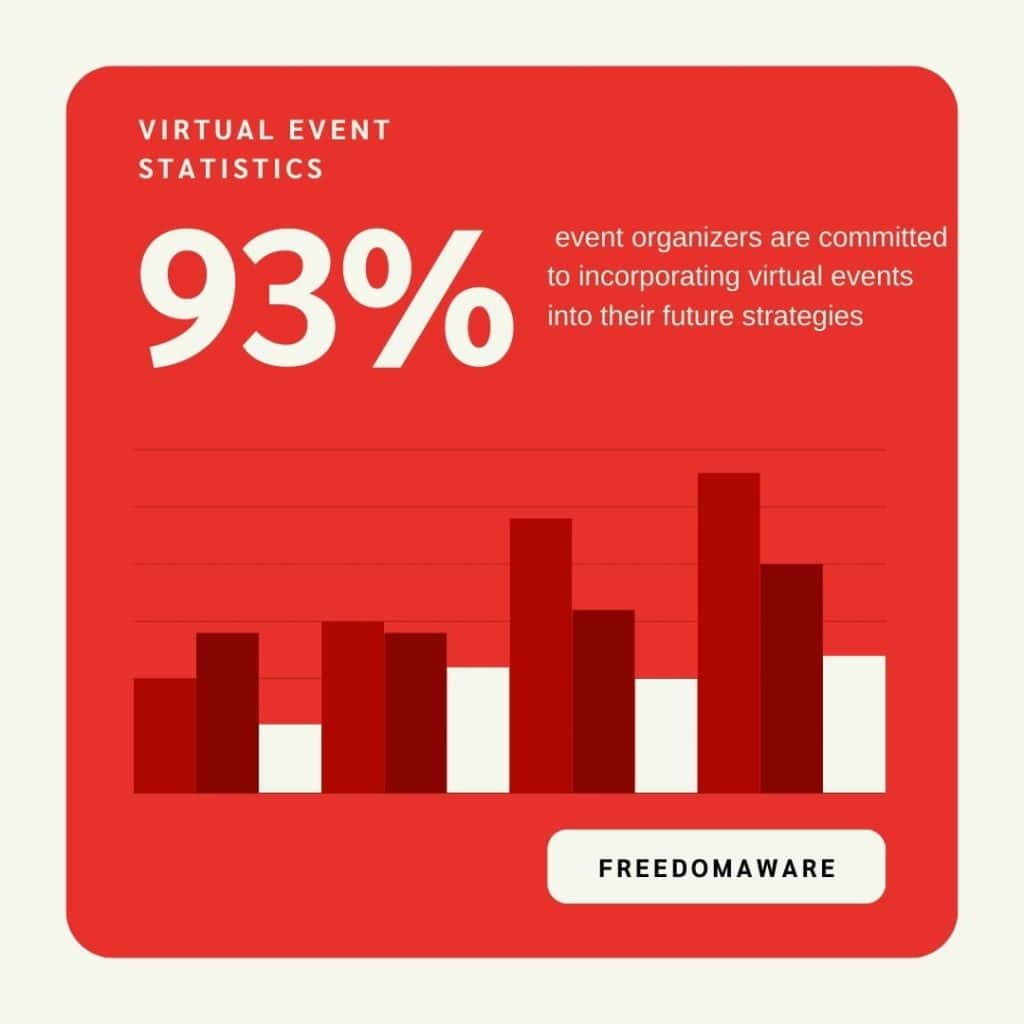
    2. Virtual Here to Stay: A significant 93% of event organizers are committed to incorporating virtual events into their future strategies.(Source)
    3. Spreading the Word: Email marketing reigns supreme, virtual event statistics shows that with 40% of event marketers considering it the most effective channel for virtual event promotion.(Source)
    4.  Interestingly, 59% of marketers would even cancel an in-person event to prioritize a virtual one.(Source)
    5. B2B Focus: However, for B2B marketers, their website takes the crown as the most effective marketing channel.(Source)

    Virtual Event Design:

    1. Speaker Spotlight (virtual event statistics): On average, virtual events typically feature around 20 speakers.(Source)
    2. The Virtual Pivot (virtual event statistics): A massive 93% of surveyed marketers plan to shift from in-person to virtual events in 2023, although only 30% have a concrete plan in place.(Source)
    3. Focus on Learning (virtual event statistics): The primary reason attendees join virtual events? Education! A whopping 80% participate to gain knowledge.(Source)
    4. Promotion Timeframe (virtual event statistics): While small virtual events require 3-6 weeks for successful promotion, larger events might need more prep time. A significant 65% of marketers say they need over six weeks for large-scale events.(Source)

    The Future of Virtual Events:

    1. Virtual is Here to Stay: Embracing the shift, 85.3% of event marketers believe virtual experiences are a permanent fixture in the event landscape.(Source)

    Measuring Success (virtual event statistics):

    1. Opportunities Abound: In the realm of virtual events statistics For 87% of marketers, the opportunities generated by virtual events are a key success factor.(Source)
    2. Top Benefits: Increased registrations, attendee engagement, and higher ROI are the top three benefits of virtual events, according to surveyed organizers.(Source)

    Challenges & Considerations (virtual event statistics):

    Virtual event statistics
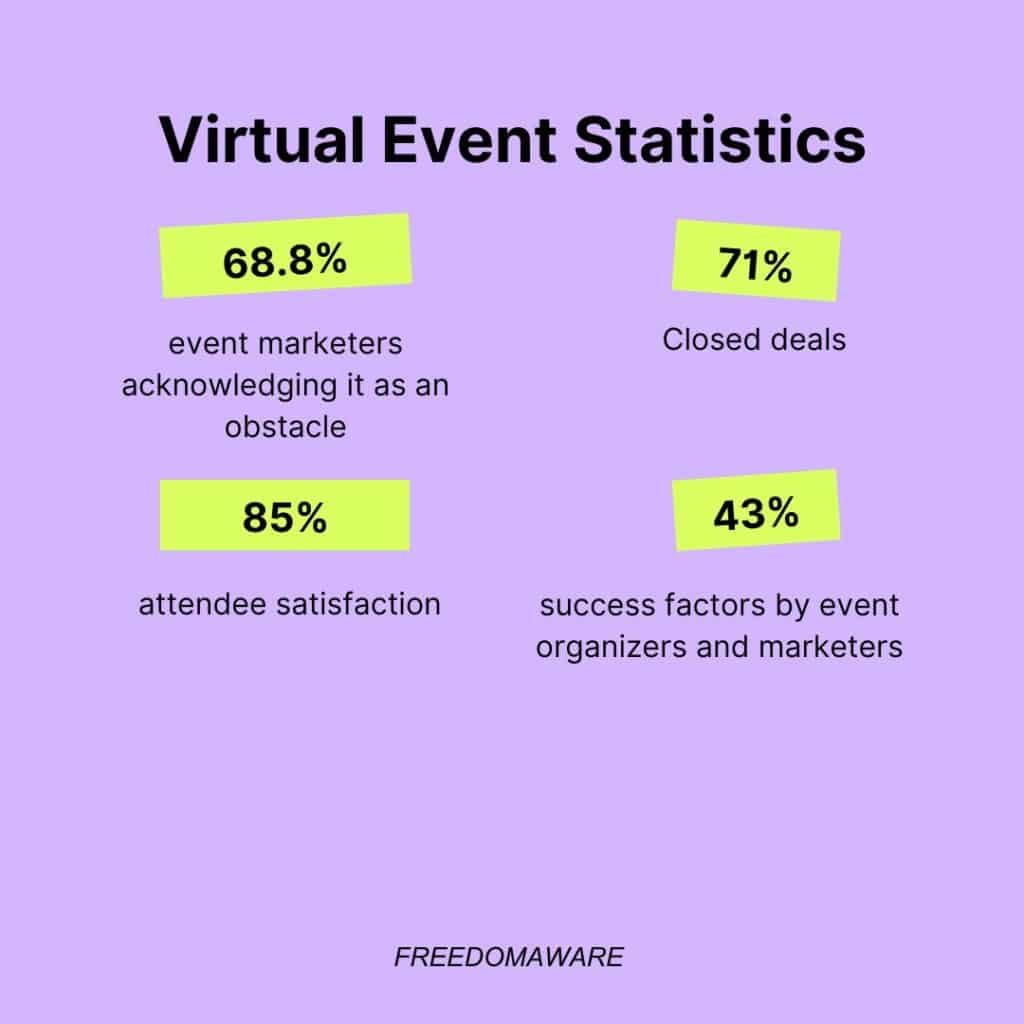
    1. Networking Hurdle: Creating substantial networking opportunities remains challenging for virtual events; statistics show that 68.8% of event marketers acknowledge it as an obstacle. (Source)
    2. Success Factors: Closed deals (71%). (Source
    3.  Virtual events statistics show that attendee satisfaction is (85%). (Source
    4. and replicating event formats virtually (43%) are all considered success factors by event organizers and marketers. (Source)
    5. Finding Speakers: Fortunately, 39.5% of event organizers consider it easy to find great speakers for virtual events. (Source)
    6. Logistics & Focus: While 52.5% of event marketers find logistics challenging. (Source
    7. A positive note is that 91% of surveyed companies report their virtual event was successful. (Source
    8. Additionally, 54% of event planners prioritize attendee experience over logistics. (Source)
    9. Technical Glitches: Technical problems can occur, with 38% of marketers facing them. Investing in good microphones is crucial. (Source
    10. 70% of event planners consider them critical to a successful virtual event. (Source)
    11. The Hybrid Advantage: While virtual is prominent, 67% of businesses find hybrid events more beneficial. (Source)
    12. Engagement Challenge:  Keeping attendees engaged remains a hurdle, with 67.7% of event marketers finding it difficult. (Source)

    Virtual Events: Keeping Your Audience Captivated

    Here’s how virtual events are winning over audiences and driving engagement:

    Virtual event statistics
    1. Target Audience Outreach (virtual event statistics): In the realm of virtual events statistics, 45.3% of surveyed business marketers leverage online events to connect with their target audience. (Source)
    2. Mobile Engagement Matters (virtual event statistics):  Mobile apps are game-changers!  62% of event marketers say they boost audience engagement in virtual events. (Source)
    3. High Satisfaction Rates (virtual event statistics):  The good news?  73% of virtual event attendees walk away satisfied with their experience. (Source)
    4. Engagement Strategies (virtual event statistics): Polling is a widespread technique, with 71% of marketers using it to keep audiences interactive. (Source)
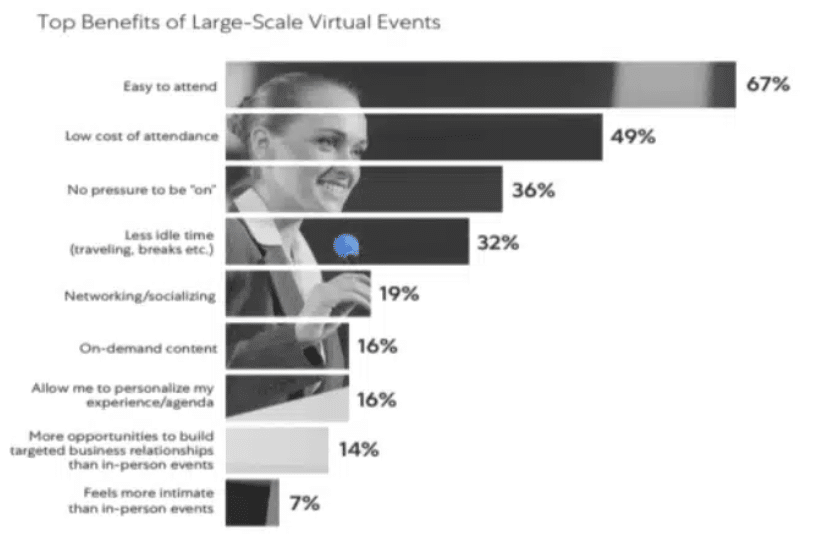
    5. Benefits for Attendees (virtual event statistics):  What makes virtual events popular?  Here’s what attendees say: According to 67%, the top perk is the ease of attendance. (Source
    6. For 49%, virtual events offer a low-cost way to participate. (Source
    7. Reduced pressure to be physically present benefits 36% of attendees. (Source)
    8. In-Person Preference (virtual event statistics): In a head-to-head battle, in-person events win for B2B marketers! Over 57% prefer the in-person experience at hybrid events, compared to 33% who favor the virtual option. The remaining 10% are undecided. (Source)
    9. Webinar Reigns Supreme (virtual event statistics): When it comes to virtual event formats, webinars take the crown! Over half (51%) of surveyed virtual event visitors prefer them, while live meeting software follows closely behind at 43%. (Source)
    10. Zooming Ahead (virtual event statistics):  Zoom is the preferred virtual event platform for companies that host them.  A significant 50.3% choose Zoom, followed by Microsoft Teams at 12% and Facebook Live at 9.4%. (Source)

    The Challenge of Virtual Fatigue (Virtual Event Statistics): Keeping Audiences Engaged

    Virtual events have become a mainstay, but there’s a potential downside: fatigue. Here’s how it can impact attendees and organizers:

    1. Audience Attention Span:  A red flag for B2B marketers! Virtual event statistics show that Half of surveyed B2B tech marketers and influencers report a significant level of virtual event fatigue among customers, with another 40% experiencing some fatigue. (Source)
    2. Zoom Fatigue is Real:  For virtual event attendees, Zoom fatigue is the biggest challenge, impacting 54% of them. This highlights the need for engaging formats. (Source)
    3. Combating Fatigue:  Experts recommend keeping virtual events concise, with an ideal length of 3-5 hours, to minimize fatigue. (Source)
    4. Organizer Challenges:  Virtual fatigue isn’t just an attendee issue.  Nearly 38% of surveyed companies identify it as a significant challenge when running virtual events, likely due to participants experiencing it from attending too many similar events. (Source)

    The Rise of Hybrid Events: Blending the Best of Both Worlds (virtual event statistics)

    Hybrid events are emerging as a popular choice, combining the virtual and in-person experiences. Let’s delve into the trends and challenges surrounding them:

    1. Hybrid’s Growing Popularity:  While virtual events remain prominent, hybrid events are gaining traction.  Among marketers planning virtual events in 2023, 18% will incorporate a hybrid format. (Source)

    2. High Demand:  The future looks bright for hybrid events!  An overwhelming 97% of respondents anticipate seeing more of them. (Source)
    3.   In fact, over 90% of companies believe large-scale events will be virtual or hybrid in 2023.(Source)
    4. B2B Preference: However, B2B marketers seem to favor the in-person aspect of hybrid events.  Over half (57%) prefer the in-person experience. (Source)
    5. Challenges to Overcome:  Creating a seamless experience across virtual and in-person elements presents the biggest hurdle for hybrid events.  Nearly half (49%) of B2B marketers cite this as their primary obstacle. (Source)
    6.   Managing hybrid logistics (42%) and convincing attendees to attend in person (36%) are also significant challenges. (Source)
    7. Driving Innovation & Connection:  C-suite executives see the value of hybrid experiences. 43% of critical countries invest in hybrid events to offer more innovative and personalized experiences, while 40% emphasize fostering a stronger connection with their audience. (Source)
    8. The Virtual Shift: The pandemic accelerated the virtual trend.  According to a 2021 survey of over 8,000 marketers, 40% of events were predicted to be virtual in 2022, with in-person and hybrid events each capturing 35%. (Source)
    9. The Long-Form Boom: Get ready for long videos! Webinars, live events, and similar long-form video content have witnessed a staggering surge of over 11,000% growth in the past decade, making them the fastest-growing video segment. (source)
    10. Emphasizing the Trend: B2B marketers are placing a growing emphasis on content marketing, with 71% indicating its increased importance to their organizations in the last year. (source)
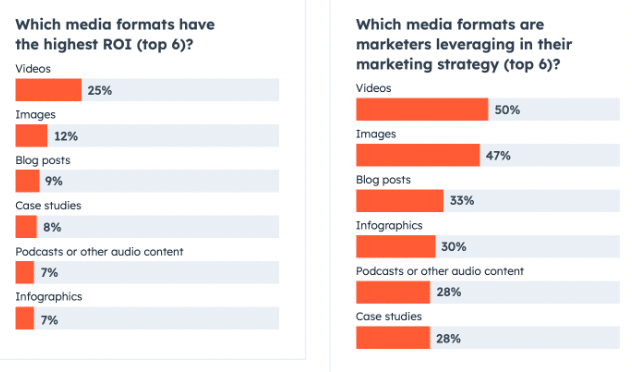
    11. Emphasizing the Widespread Use: In 2021, the power of visuals became undeniable. More than half of marketers used them in 91% of their content pieces. (source)
    12. Highlighting Originality: When it comes to visuals, marketers are getting creative! A Venngage survey reveals that original graphics reign supreme, used by 36% of marketers, followed closely by stock photos at nearly 34%. (source
    13. Highlighting Blog Focus: Blogs are a top destination for visual content! A study reveals that 30% of marketers prioritize creating visuals specifically for blogs, followed by social media platforms like Facebook and LinkedIn. (source)
    14. Focusing on the WHO Statistic: The World Health Organization estimates that 2.2 billion people globally have visual impairments. (source)
    15. Focusing on Widespread Use: Visual content reigns supreme in marketing strategies. A survey reveals that over 50% of marketers consider it essential. (source)
    16. Focusing on the Pain Point: Visual content creation can be challenging! According to a survey, 33% of marketers find consistently producing visual content their biggest content production challenge. (source)
    17. Highlighting Mobile Dominance: Short-form video content captivates the US! An impressive 75% of adults in the US use mobile devices to watch this type of content. (source)
    18. Focusing on Viewing Behavior: Gen Z viewers are hooked on short-form videos for discovery! A significant 59% leverage these apps to find content, leading them to watch more extended versions elsewhere. (source)
    Virtual event statistics

    The Virtual Revolution: Key Takeaways and Moving Forward (virtual event statistics)

    The data speaks for itself – virtual events are a powerful force in today’s marketing landscape. Here are some key takeaways to inform your 2024 marketing strategy:

    • Virtual Events Here to Stay: These statistics paint a clear picture: virtual events are not a passing fad. They offer a valuable and accessible way to connect with your audience.
    • Embrace the Power of Virtual: Consider incorporating virtual events into your 2024 marketing plan. The potential for engagement, education, and brand awareness is undeniable.
    • Learn & Grow: People attend virtual events to learn about your company and offerings. Use these insights to craft compelling content that resonates with your target audience.
    • Data-Driven Decisions: Let the statistics be your guide! This information provides valuable insights to help you develop a solid virtual event plan for 2024.
    • Beyond Numbers: While statistics offer a strong foundation, remember that the human element is crucial. Focus on creating engaging and interactive experiences for your virtual attendees.

    By leveraging these key takeaways and staying informed about virtual event trends, you can position your brand for success in the ever-evolving marketing landscape.

  • 100+ Sales Funnel Statistics In 2025

    100+ Sales Funnel Statistics In 2025

    Here are some sales funnel statistics to help you in 2024 and beyond;

    Optimizing Your Sales Funnel for Success

    I’ve poured my heart and soul into marketing and sales, but seeing efforts go to waste can be disheartening.  That’s why I became laser-focused on improving sales funnel conversion rates.  My goal?  To achieve the best results possible, for both myself and my clients.

    Through extensive research, I’ve compiled valuable data on sales funnel statistics and insights from successful marketers and sales funnel experts.  This information is designed to be a two-fold resource:

    • Identify Gaps and Opportunities In Sales Funnel:  These statistics will help you pinpoint areas for improvement within your existing sales funnel strategy.
    • Visualize the Customer Journey In Line with Sales Funnel:  Gain a clear understanding of the customer journey, from initial awareness to conversion.  This will empower you to effectively guide prospects through your value ladder.

    The following sales funnel statistics represent the latest trends and insights in sales funnels.  By leveraging this data, you can make informed decisions, optimize your marketing and sales strategies, boost conversion rates, and gain a competitive edge in your market.

    Sales funnel statistics

    The Sales Funnel: Your Guide to Customer Conversion

    Imagine a path leading potential customers from simple brand awareness to becoming loyal fans. That’s the essence of a sales funnel! It visually represents the stages a customer goes through on their journey with your company, ultimately leading to a purchase.

    Here’s a breakdown of stages in sales funnel:

    • Awareness In Sales Funnel: This is where potential customers first encounter your brand. They might see an ad, read a blog post, or hear about you from a friend.
    • Interest In Sales Funnel: Now they’re intrigued! They’re actively seeking more information about your product or service and how it can benefit them.
    • Desire In Sales Funnel: The spark has ignited! They understand your value and consider your product as a solution to their needs.
    • Action In Sales Funnel: This is the moment of truth! The customer is ready to commit and makes a purchase.
    • Loyalty In Sales Funnel: It doesn’t end there! By exceeding expectations and fostering a positive relationship, you can turn satisfied customers into loyal brand advocates who recommend you to others.

    The goal of your sales funnel is to guide potential customers smoothly through each stage, ultimately influencing their decision to buy and become loyal brand supporters. Companies use sales funnels to gain valuable insights into customer behavior, allowing them to tailor their marketing and sales efforts for maximum conversions and a thriving customer base.

    Boost Your Conversions: Essential Sales Funnel Statistics

    Looking to optimize your sales funnel and turn more leads into customers? Here are some eye-opening statistics to keep in mind:

    1. Conversion Rate Benchmark In Sales Funnel:  The average sales funnel conversion rate is between 3% and 7% (source).  This highlights the importance of optimizing your funnel to maximize the number of leads who convert into paying customers.
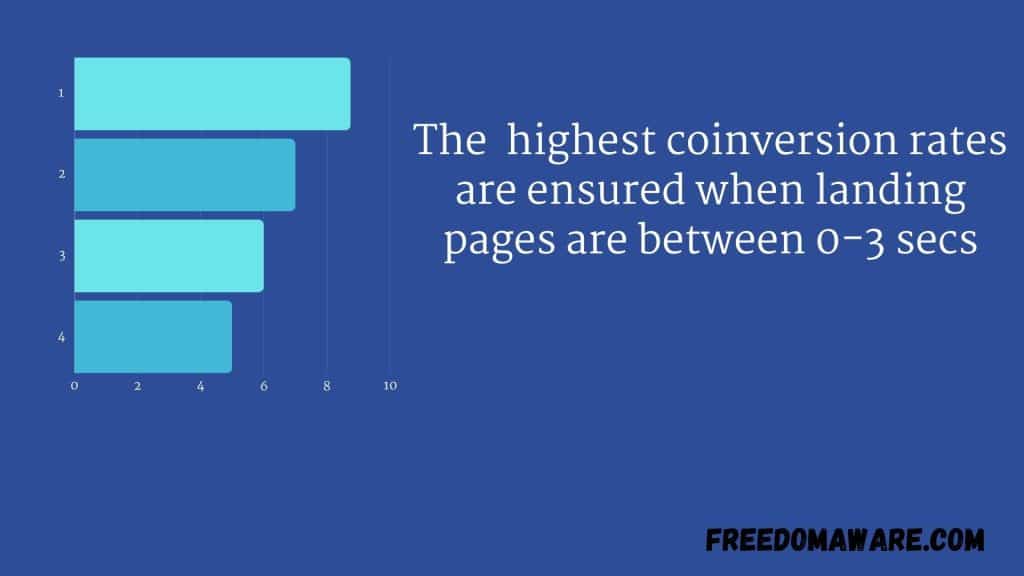
    2. Speed is Key In Sales Funnel:  Landing pages and funnels with lightning-fast loading times (0-3 seconds) see the highest conversion rates (source).  Every second counts when capturing customer attention, so prioritize page speed optimization.

    Sales funnel statistics

    By understanding these key benchmarks in sales funnel statistics and focusing on factors like loading speed, you can start optimizing your sales funnel for superior conversion rates and a thriving business.

    Sales funnel statistics
    1. Don’t expect an immediate sale from every visitor! Sales funnel statistics show that While 96% may not purchase on their first visit, they could be convinced to share their details for valuable content. (source)
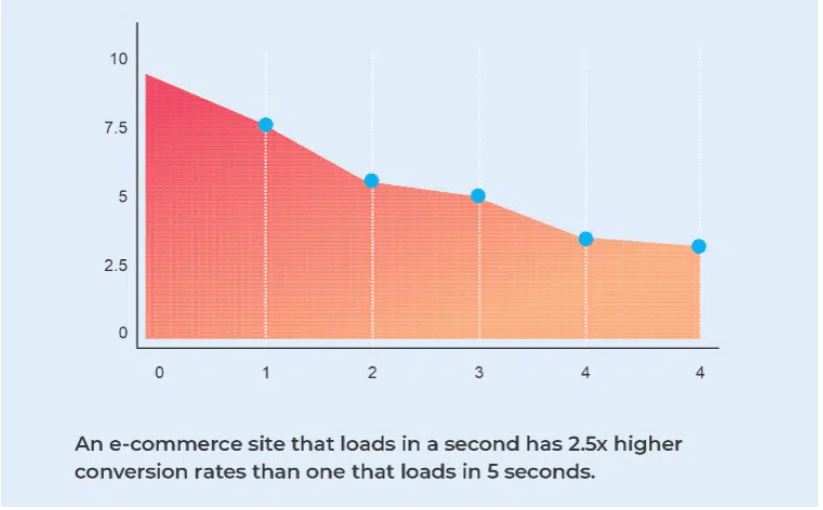
    2. Speed is king in e-commerce! In sales funnel statistics, shoppers on a site that zips along in 1 second are 2.5 times more likely to convert than those on a site that takes 5 seconds to load. (source)

    General Conversion Rates Sales Funnel Statistics:

    1. Sales funnel statistics show that while the average landing page conversion rate hovers around 2.35%, the top performers are converting at over 5.3%. There’s room for significant improvement! (source)
    2. Sales funnel statistics show that the best landing pages are in a league of their own, boasting conversion rates exceeding 11.45%. (source)

    Conversion Rates by Device Sales Funnel Statistics:

    1. Sales funnel statistics show that desktops lag behind with an average conversion rate of 1.9%, but if you’re hitting 4.7% or higher, you’re in the top 20%. Reaching 7.2% puts you in the elite 10%. (source)
    2. Sales funnel statistics show that mobile takes the lead in e-commerce traffic (68%), but the conversion rate sits at just 2%. (source)

    Conversion Rates by Source Sales Funnel Statistics:

    Sales funnel statistics
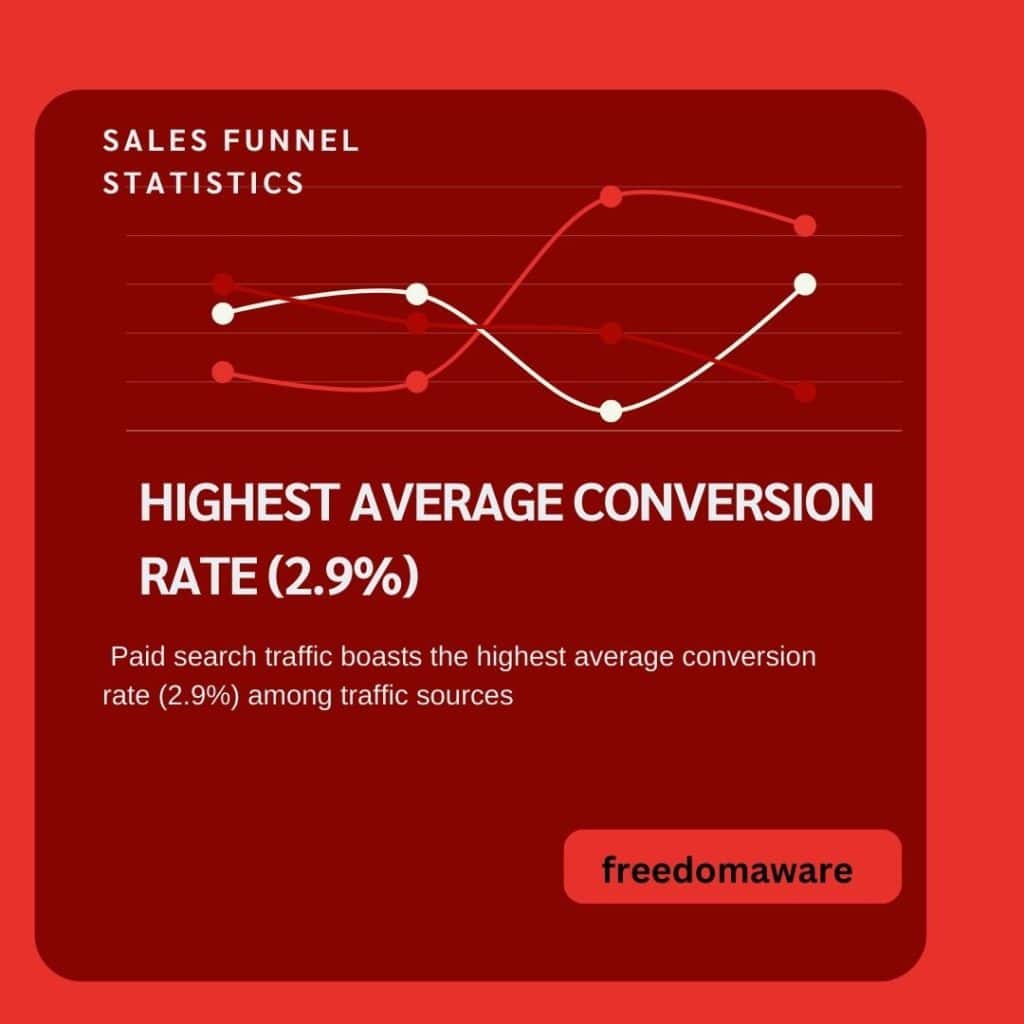
    1. Sales funnel statistics show that paid search traffic boasts the highest average conversion rate (2.9%) among traffic sources. (source)
    2.  Sales funnel statistics show that Facebook ads are conversion powerhouses, averaging 9.21%. However, this varies significantly by industry (retail: 3.26%, fitness: 14.29%). Focus on your specific niche for better benchmarks. (source)

    Boosting Conversion Rates Sales Funnel Statistics:

    1. Sales funnel statistics show that a strong middle-of-the-funnel (MoFu) strategy can skyrocket your response rates by 4-10 times! (source)
    2. Sales funnel statistics show the e-commerce industry is experiencing a growth spurt, with the average conversion rate reaching 3.65% (as of late 2022). (source)

    Industry-Specific Conversion Rate Sales Funnel Statistics:

    1.  Sales funnel statistics show that the “Catering and Restaurants” industry reigns supreme with the highest average conversion rate (a whopping 9.8%) across all sales funnels. (source)
    2. Sales funnel statistics show that conversion rates are a pain point for many businesses. Just a fifth (22%) report satisfaction with their current rates. (source)

    Marketing Strategy and Conversion Focus Sales Funnel Statistics:

    1.  Sales funnel statistics show that belief isn’t everything! While 71% of marketers have faith in their strategy (source)
    2.  only 69% prioritize converting leads into paying customers. (source)

    B2B Conversion Rates by Industry Sales Funnel Statistics:

    1. Not all B2B industries are created equal. Professional/financial services shine with a 10% conversion rate (source)
    2. while nonprofits struggle at just 2%. (source)

    Shopping Cart Abandonment Sales Funnel Statistics:

    1. Watch out for hidden costs! Sales funnel statistics show that nearly half (48%) of online shoppers in the US ditch their carts at checkout due to unexpected fees like shipping and taxes. (source)
    2.  Sales funnel statistics show that landing and sales pages featuring video content can see conversion rates skyrocket by up to 86%. (source)

    Product Page Expectations Sales Funnel Statistics:

    1. Sales funnel statistics show that young adults (18-24) and millennials (35-44) expect a rich product experience. They crave 8 images and 4-5 videos to get a full picture of what they’re buying. (source)

    Social Proof Power Sales Funnel Statistics:

    1. Don’t underestimate the power of social proof! Sales funnel statistics show that landing pages with testimonials and trust signals convert 1.1% higher (12.5% vs 11.4%). It might seem like a small jump, but it can significantly impact sales. (source)

    Top Landing Page Features Sales Funnel Statistics:

    Sales funnel statistics
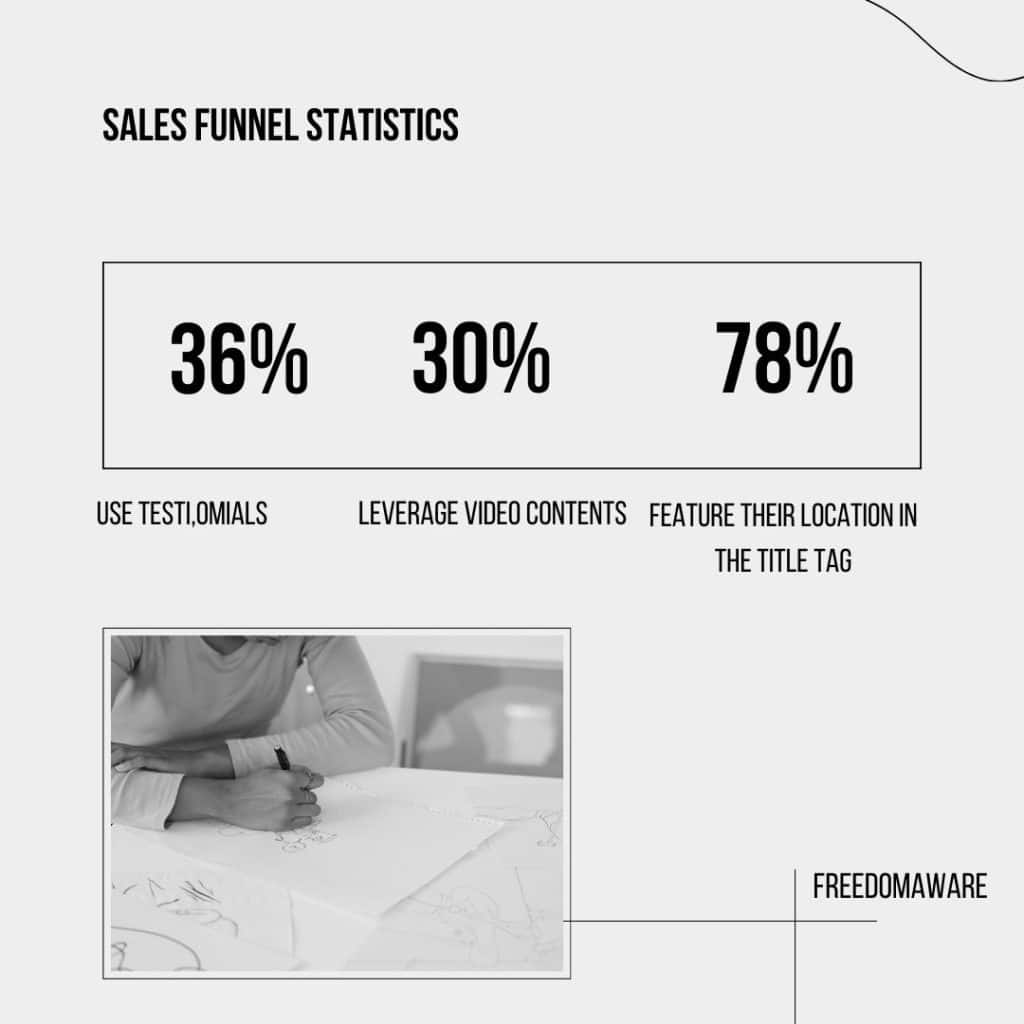
    1. Top landing pages are all about trust and clarity. Sales funnel statistics show that a whopping 36% use testimonials, 30% leverage video content, and 78% feature their location in the title tag. (source)

    The Power of Headlines Sales Funnel Statistics:

    1. Your headline is prime real estate! Sales funnel statistics show that an eye-catching headline grabs attention, with 90% of visitors reading it and your CTA. (source)

    Focus on Your Headline (Sales Funnel statistics):

    1. Content is king, but headlines rule! Sales funnel statistics show that while only 20% of visitors will delve into your content, nearly everyone (90%) reads the headline. Make it count! (source)

    Keep Your CTA Clear (Sales Funnel Statistics):

    1. Less is more! Sales funnel statistics show that landing pages with a single, clear call to action (CTA) outperform those with multiple CTAs by 1.6%. A focused CTA converts at 13.5% compared to 11.9% for pages with distractions. (source)

    Simplify Your Offer In Sales Funnel:

    1. Avoid confusing visitors with too many choices! Sales funnel statistics show that landing pages with a single offer convert up to 266% better than those bombarding visitors with multiple options. (source)

    Keep Forms Short ( Sales Funnel Statistics):

    1. Short and sweet forms win! Sales funnel statistics show that asking for just 3 pieces of information can increase your conversion rate by 10%. (source)

    Create More Landing Pages ( Sales Funnel Statistics) :

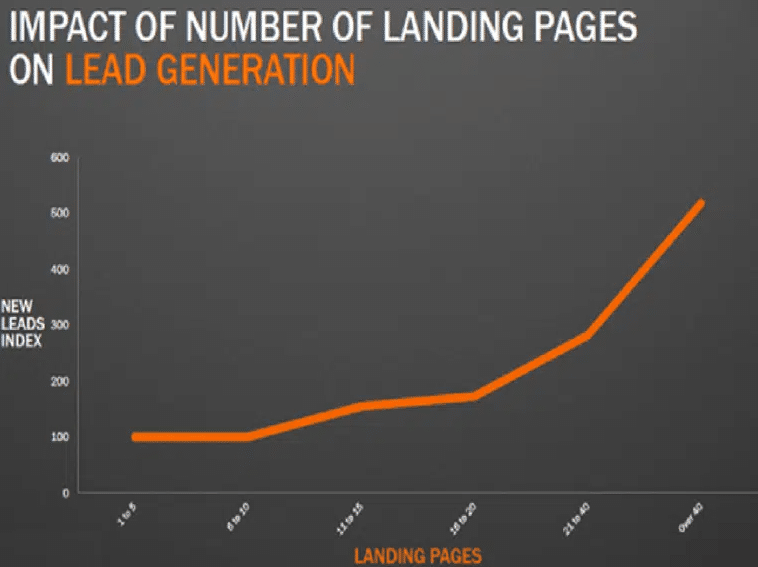
    1. More landing pages, more leads! Sales funnel statistics show that Companies with over 30 landing pages see 7 times more leads than those with less than 10. (source)
    2.  Sales funnel statistics show that the lead generation advantage gets even bigger with 40+ landing pages (12 times more leads than those with less than 5). (source)

    Embrace A/B Testing (Sales Funnel Statistics):

    Sales funnel statistics
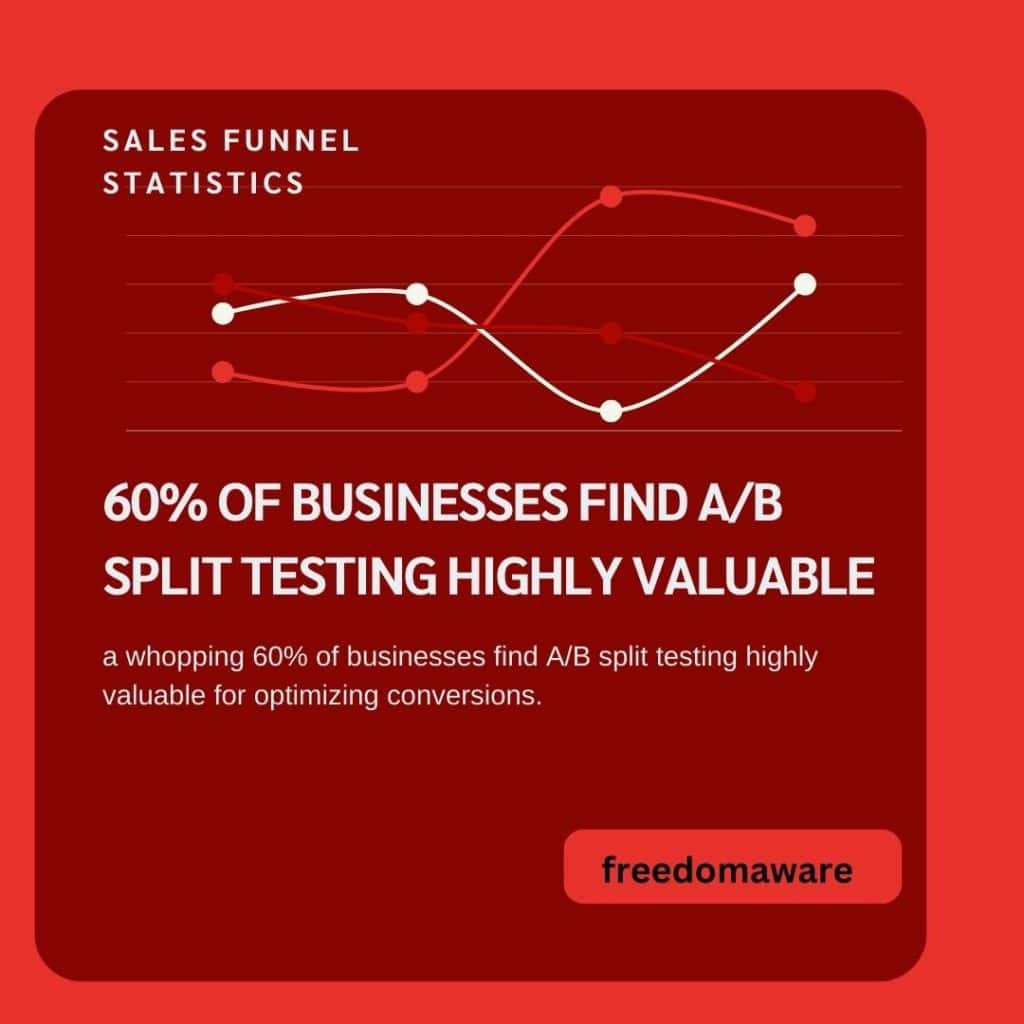
    1. Testing is your friend! Sales funnel statistics show that a whopping 60% of businesses find A/B split testing highly valuable for optimizing conversions. (source)

    Optimize with Testing and Targeting ( Sales Funnel Statistics):

    1. Don’t underestimate the power of good testing and targeting! Sales funnel statistics show it can significantly boost conversions by up to 300%. (source)

    Sales Funnel Testing Gap ( Sales Funnel Statistics):

    1. The testing gap in sales funnels! Sales funnel statistics show that Over 20% of businesses using them lack a reliable testing method to measure and improve their effectiveness. (source)

    The User Attention Challenge ( Sales Funnel Statistics):

    1. The clock is ticking! Sales funnel statistics show that the average internet user only dedicates 37 seconds to reading an article. Capture their attention and drive action in that short window. (source)

    B2B Landing Page Power ( Sales Funnel Statistics):

    1. B2B loves landing pages! Sales funnel statistics show that 68% of B2B businesses surveyed leverage strategic landing pages to generate and nurture leads. (source)

    Focus on Retention ( Sales Funnel Statistics):

    1. Retention is king! Sales funnel statistics show that It’s 5 times more expensive to acquire a new customer than retain an existing one. Boosting customer retention by just 5% can increase profits by over 25%. (source)

    General Business Sales Funnel Statistics

    Widespread Use of Sales Funnels ( Statistics):

    1. Sales funnels are a popular tool for websites! Sales funnel statistics show that a recent study found over 570,000 websites (out of 673 million analyzed) leverage sales funnel-building software. (source)

    ClickFunnels Reigns Supreme ( Sales Funnel Statistics):

    1. When it comes to sales funnel builders, ClickFunnels dominates the market with a whopping 55.8% share. That translates to roughly 320,000 websites using ClickFunnels out of the total 570,000 employing sales funnel software. (source)

    The Measurement Gap in Sales Funnels ( Sales Funnel Statistics):

    1. Many businesses are missing out on valuable insights! Sales funnel statistics show that a surprising 68% haven’t implemented a system to measure their sales funnel performance. Regular tracking of sales funnel metrics is crucial for identifying areas for improvement. (source)

    Streamline Your Buying Process for More Sales (Sales Funnel Statistics):

    1. Make it easy for customers to buy! Sales funnel statistics show that businesses offering a smooth buying experience are 62% more likely to close high-quality sales. (source)

    Conversion Rate Optimization Matters ( Sales Funnel Statistics):

    1. Sales funnel statistics show that Top-performing businesses prioritize conversion rate optimization (CRO). In fact, they dedicate at least 5% of their budget to CRO efforts. (source)

    Focus on Existing Customers for Profit Growth (Sales Funnel Statistics):

    1. Upselling is your friend! Sales funnel statistics show that It’s 68% cheaper to upsell existing customers than acquire new ones. (source)

    Upselling Boosts Revenue (Sales Funnel Statistics):

    1. Sales funnel statistics show that Upselling products or services are a proven revenue booster, generating an average increase of 10% to 30%. Interestingly, upsells can account for a significant portion of a company’s revenue, with some reporting up to 95% coming from upselling. (source)

    The Long Road to Conversion (Sales Funnel Statistics):

    1. Not all leads are created equal! Brace yourself – Sales funnel statistics show that a whopping 79% of your leads won’t convert into immediate sales. (source)

    Lead Readiness (Sales Funnel Statistics): A Marathon, Not a Sprint:

    1. Be patient with your leads – 73% aren’t quite ready to buy just yet. They require nurturing before converting. (source)

    Lead Conversion Timelines (Sales Funnel Statistics):

    1. Don’t give up on leads too quickly! Sales funnel statistics show that 63% won’t convert for at least 3 months; surprisingly, 20% take a year or more to become paying customers. (source)

    The Follow-Up Gap (Sales Funnel Statistics):

    1. Follow-up is key! Shockingly, Sales funnel statistics show that only 20% of sales leads are followed up. The remaining 80% are likely lost due to neglect. (source)

    Nurturing Leads Pays Off (Sales Funnel Statistics):

    1. Invest in lead nurturing! Sales funnel statistics show that Businesses that nurture leads see a significant benefit – 50% more sales at 33% lower costs. (source)

    The Power of Lead Nurturing Emails (Sales Funnel Statistics):

    1. Emails are powerful tools for lead nurturing. Sales funnel statistics show that Lead nurturing emails boast an impressive average click-through rate (CTR) of 8%, compared to just 3% for standard emails. (source)

    Personalization is King (Sales Funnel Statistics):

    1. Personalize your outreach! Sales funnel statistics show that Personalized emails enjoy an average open rate of 18.8% and a click rate of 2.1%, significantly outperforming generic emails. (source)

    More Landing Pages, More Leads (Sales Funnel Statistics):

    Sales funnel statistics
    1. Expand your landing pages! Sales funnel statistics show that Websites with 10-15 landing pages generate up to 55% more leads. (source)
    2. Generating leads in the sales funnel keeps marketers up at night! Sales funnel statistics show that Over half (61%) say it’s their primary obstacle. (source)
    3. Lead gen gets the green light in the sales funnel! A significant portion of marketing budgets go towards lead generation. Sales funnel statistics show that Over half (53%) of marketers dedicate at least half their budget to this crucial activity. Only 34% allocate a smaller portion. (source)


    4. Surprisingly, most marketers (0%) believe automation generates more leads. But the data tells a different story! Sales funnel statistics show that Businesses that leverage marketing automation tools see a significant boost in leads (up to 451% for some!), with 80% reporting an increase. Additionally, 77% experience higher conversion rates. (source)
    5. Don’t underestimate email! Sales funnel statistics show that It’s still the go-to content distribution channel for most marketers, with a dominant 93% relying on it. (source)

    Email Crushes Social Media for Acquisition (Sales Funnel Statistics):

    1. Social media might be trendy, but email is the king of customer acquisition in the sales funnel! Sales funnel statistics show that Email marketing is a whopping 40 times more effective than social media for bringing in new customers. (source)

    Email Delivers ROI Like No Other In The Sales Funnel:

    1. Get the most bang for your buck with email! Sales funnel statistics show that Email marketing boasts a sky-high return on investment (ROI) – for every dollar invested, you can expect a whopping $42 back (a 4400% ROI!), outperforming any other lead generation or marketing tool (source)

    Businesses Love Email for Lead Gen (Sales Funnel Statistics):

    Sales funnel statistics
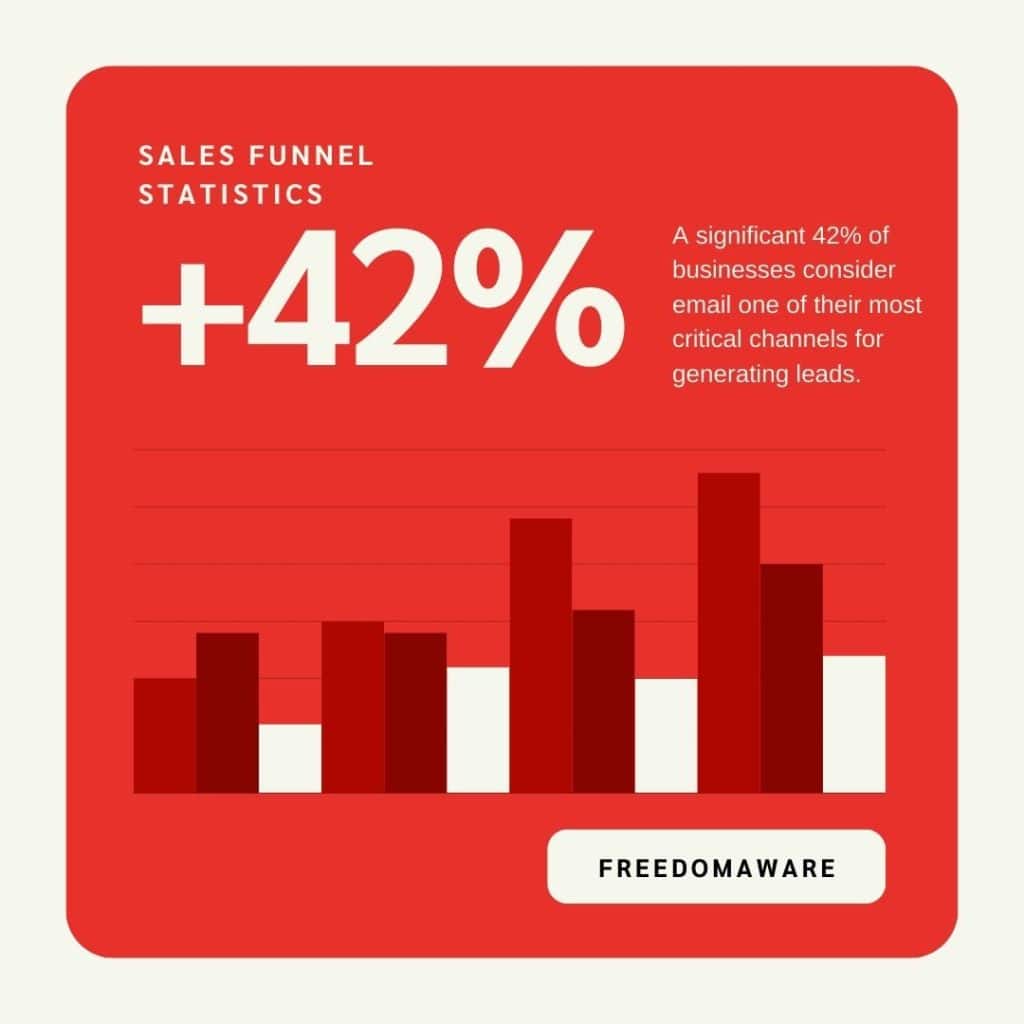
    1. Email is a lead gen powerhouse! Sales funnel statistics show that 42% of businesses consider email one of their most critical channels for generating leads. (source)

    Focus on Conversion with Email (Sales Funnel Statistics):

    1. Turn those leads into customers! Sales funnel statistics show that 69% of marketers agree that converting leads into paying customers should be their top priority. Email marketing excels at this task. (source)

    Qualify Your Leads with Email In The Sales Funnel:

    1. Not all leads are created equal in the sales funnel! Statistics show that at least half (50%) of your prospects may not be a good fit for your products or services. Targeted email campaigns can help you qualify leads and focus on those most likely to convert. (source)

    Budget Constraints? Email Saves the Day! (Sales Funnel Statistics)

    1. Stretch your marketing budget with email! Budget constraints are the top deal-breaker for many businesses in the sales funnel. A whopping 55% of respondents in a survey cited budget limitations as the number one or two reasons deals fall apart. The cost-effectiveness of email marketing makes it a powerful tool for businesses facing budget limitations. (source)

    The Phone Still Rings True for Sales In The Sales Funnel:

    1. Pick up the phone! Surprisingly, over 41% of survey respondents identified phones as their most effective sales tool in sales funneling. (source)

    Low-Cost Competition (Sales Funnel Statistics): A Small Business Challenge:

    Sales funnel statistics
    1. Small businesses face the low-cost squeeze! A significant portion (31%) of small businesses surveyed named competing with lower-priced providers as their biggest sales challenge in the sales funnel. (source)
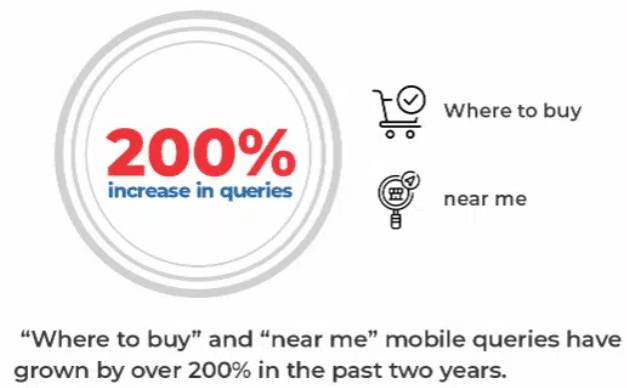
    2. Mobile users are searching for local options! “Where to buy” and “near me” mobile queries have skyrocketed by over 200% in the past two years. This shows a clear trend towards location-based buying decisions in the sales funnel. (source)
    3. Convenience is king in Sales Funnel! Nearly 60% of shoppers surveyed say a mobile-friendly shopping experience is crucial when choosing a brand or retailer. Businesses with accessible mobile apps can capture a larger share of mobile shoppers. (source)

    Mobile Research Fuels Online Purchases (Sales Funnel Statistics):

    1. Smartphones guide buying decisions! Over half (51%) of shoppers surveyed use Google on their phones to research products they plan to buy online. This highlights the importance of a strong online presence and mobile-optimized website for capturing these research-savvy customers in the sales funnel. (source)

    Reviews Rule Online Shopping In The Sales funnel Market:

    1. Reviews are king! A whopping 95% of online shoppers rely on product reviews before making a purchase. Positive reviews can significantly influence buying decisions in the sales funnel. (source)

    Personalized Recommendations Drive Sales in The Sales Funnel Market:

    1. Shoppers crave personalization! With respect to Sales Funnel, Half of US internet users appreciate receiving product recommendations tailored to their interests. Interestingly, while 45% say this is the type of content they see most often, there’s still room for improvement. (source)

    Understanding Builds Trust In The Sales Funnel Market:

    1. Recommendations based on needs resonate with customers! One in five survey respondents felt understood when brands recommended relevant products. Focusing on needs and understanding your audience in the sales funnel market builds trust and loyalty. (source)

    High-Quality Product Information is Key (Sales Funnel Statistics) :

    1.  Delving into the realm of sales funnel statistics, Shoppers prioritize product details! For 85% of consumers, high-quality product information and pictures are essential factors when choosing a retailer or brand. Invest in clear and informative product descriptions and visuals. (source)

    Repetition Builds Belief (Sales Funnel Statistics):

    1. Patience is key in sales and marketing! Delving into sales funnel statistics, Consumers typically need to hear a company’s claims 3-5 times before fully believing them. Be persistent with your messaging across different channels. (source)

    Sales Reps Still Deliver (Sales Funnel Statistics):

    Sales funnel statistics
    1. Don’t underestimate the power of sales reps in the world of sales funnel! Despite the rise of e-commerce, 53% of sales representatives still meet or exceed their sales quotas. Practical sales training and support are crucial for the sales funnel. (source)

    The Power of Unplanned Purchases (Sales Funnel Statistics):

    1.  Delving into sales funnel statistics, Targeted recommendations can trigger impulse buys! 34% of US digital product users have made unplanned purchases due to compelling product recommendations. Optimize your recommendation engine to increase sales. (source)

    The Sales Closer Club (Sales Funnel Statistics):

    1. Not all salespeople are created equal! In sales funnels, only a select group (around 20%) consistently brings in big wins, closing over 80% of sales. (source)

    Sales Tech Tools Drive Deals (Sales Funnel Statistics):

    1. Tech helps close deals in the realm of the sales funnel! A significant portion of sales reps (around 70%) find CRM tools highly valuable in closing deals. Sales engagement and sales intelligence software also come in at 69% each, highlighting the importance of technology in the sales process. (source)

    Honesty is the Best Policy (Sales Funnel Statistics):

    1. Don’t mislead potential customers! Delving into sales funnel statistics, Nearly half (48%) of surveyed buyers say they’ll walk away from deals with salespeople who provide inaccurate information. Building trust and transparency is key to closing sales. (source)


    Social Media’s Sales Influence (Sales Funnel Statistics):

    1. Social media connects for sales! Delving into the realm of sales funnel statistics, Over half (54%) of salespeople report being able to trace closed deals back to social media engagement. Leveraging social media effectively can be a powerful sales tool.(source)

    Buyers Want Solutions, Not Just Sales Pitches (Sales Funnel Statistics):

    1. Focus on solutions in the sales funnel, not just selling! A solid 62% of buyers want to hear from marketers who actively seek solutions to their problems. Tailor your outreach to address specific customer needs. Interestingly, despite the rise of digital marketing, 82% of consumers still prefer face-to-face meetings with salespeople who reach out. Don’t underestimate the power of personal interaction In the sales funnel market.(source)

    Organized Sales Pipelines Drive Growth (Sales Funnel Statistics):

    1. Get your sales pipeline in order! Delving into the realm of sales funnel statistics, Businesses with well-organized sales pipeline management experience a significant growth advantage (28% more) compared to those without. A structured pipeline helps track leads and opportunities, ultimately leading to more sales.(source)

    Pipeline Management: Room for Improvement (Sales Funnel Statistics):

    1. Pipeline management: a missed opportunity? Although crucial, a surprising 44% of business executives believe their company struggles with managing their sales pipelines effectively. Investing in pipeline management training and tools can significantly improve sales performance in the sales funnel.(source)

    Qualified Leads: The Key to Sales Success In The Sales Funnel :

    1. Sales reps crave qualified leads! Delving into the realm of sales funnel statistics,Nearly half (46.2%) identify a lack of qualified leads as the biggest hurdle to sales effectiveness. In the sales funnel, focus on lead generation and qualification to empower your sales team.(source)

    Long Sales Cycles? Not a Top Concern In The Sales Funnel:

    1. Don’t fear the long sales cycle! Interestingly, only 27% of sales reps consider long sales cycles a major barrier in the realm of sales funnel. Effective pipeline management can help navigate extended sales cycles.(source)

    Sales Process Optimization: A Top Priority In Sales Funnel:

    1. Streamline your sales process! Delving into the realm of sales funnel statistics, Almost 30% (28.3%) of sales managers believe optimizing the sales process should be a top priority for sales management. Revamping your sales process can boost efficiency and effectiveness.(source)

    Marketing and Sales Funnel Tracking is Common Practice:

    1. Sales and marketing funnel tracking is key in propagating sales funnel! A significant majority (77%) of marketing professionals say they track the performance of their marketing and sales funnels as part of their marketing analytics. Understanding your funnel performance helps identify areas for improvement and optimize lead generation and conversion. (source)

    Lead Nurturing Stats:

    Sales Reps Struggle with Prospecting In The Sales Funnel:

    1. Lost on where to begin?  Delving into the realm of sales funnel statistics, a whopping 37% of marketers struggle most with prospecting for leads. Without a steady stream of leads, building a strong sales pipeline is difficult. (source)

    Sales Funnels Drive Growth:

    1. Leaky sales funnels? Delving into the realm of sales funnel statistics, a staggering 68% of companies haven’t measured their sales funnels, and 79% of marketing leads never convert to sales. A well-defined sales funnel is crucial for converting leads into paying customers. (source)

    Focus on Lead Conversion In The Sales Funnel:

    1. Convert those leads! Surprisingly, stats of sales funnel shows that only 69% of marketers prioritize converting leads into customers. An optimized sales pipeline with effective follow-up is essential for maximizing lead conversion in the sales funnel. (source)

    Follow-Up is Key In Temporal Concerns Of The Sales Funnel:

    1. Don’t let leads go cold! Delving into the realm of sales funnel statistics, Nurtured leads make 47% larger purchases than those left unattended. Respond to inquiries promptly, provide valuable content, and stay top-of-mind to maximize sales potential.(source)

    Most Website Visitors Aren’t Ready to Buy (Yet):

    1. Patience is key in promoting the sales funnel! A significant 96% of website visitors aren’t ready to buy on their first visit. Develop a strategy to capture their information and nurture them with relevant content until they’re ready to convert.(source)

    Persistence In Sales Funnel Pays Off in Sales:

    1. Don’t give up easily! Delving into the realm of sales funnel statistics, A surprising 44% of salespeople abandon leads after just one rejection. The average sale requires 5 attempts, so persistence is crucial for success in propagating the sales funnel.(source)
    Be the First to Respond:

    1. Speed is king In The Realm Of Sales Funnel! In the race for leads, the first vendor to respond often wins the sale. Consider automation tools to ensure prompt responses and capitalize on early interest.(source)

    Digital Marketing Stats:

    The Rise of Online Research In The Temporal Concerns Of Sales Funnel:

    1. Go digital or get left behind! Delving into the secular interest of sales funnel statistics, a 2015 study showed that a staggering 89% of B2B researchers and 81% of B2C shoppers use the internet during their buying journey. A strong digital marketing presence is essential in today’s online world. (source)

    Know Your Audience:

    1. Relevance is key In development of sales funnel! A whopping 73% of consumers get frustrated with irrelevant content. Tailor your marketing messages and content to the specific needs and interests of your target audience to build trust and loyalty.(source)

    Grab Attention Quickly:

    1. Make those seconds count! Delving into the realm of sales funnel statistics, the average internet user spends only 37 seconds reading an article. Get your key message across quickly and prominently to capture attention before visitors move on.(source)

    Consistency Builds Trust In The Realm Of Sales Funnel:

    1. Repetition is key! Delving into the temporal concerns of sales funnel statistics, consumers need to hear your message multiple times before they believe it. Maintain consistent branding across all marketing channels to build trust and brand recognition.(source)

    Don’t Overdo Ads While Developing Sales Funnel:

    1. Ad blockers on the rise! Delving into the realm of sales funnel statistics, a growing number of users (142 million in 2017) employ ad blockers. While paid advertising can be valuable, don’t rely solely on it. Develop a comprehensive marketing strategy that incorporates various channels.(source)

    The Power of Video Marketing In Sales Funnel Advancement:

    1. Video is hot! Sales Funnel statistics show that a staggering 70% of B2B buyers watch videos during their purchase journey. Incorporate video content (live chats, product demos, how-to guides) into your marketing strategy to engage your audience.(source)

    SEO: A Missed Opportunity for Many Businesses:

    1. Unlock the power of SEO To Aid Sales Funnel! Despite the benefits of good search ranking, sales funnel statistics show that only 25% of businesses in a 2017 study had a basic understanding of SEO. Invest in SEO optimization to improve your website’s visibility and attract organic traffic.(source)

    Blogging for SEO and Lead Generation:

    1. Content is king! Regularly publish high-quality, informative blog posts to improve SEO and attract visitors. In the sales funnel Focus on long-form content (around 2,000 words) to establish yourself as an authority in your industry. (source)

    The Decline of Cold Calling:

    1. Pick up the phone, but strategically! Delving into the realm of sales funnel statistics,Only 2% of cold calls result in appointments. While cold calling isn’t completely dead, it needs to be a strategic part of a larger marketing effort. (source)

    Positive Language Persuades:

    1. Words matter! In the secular Interest of Sales Funnel,Top salespeople sprinkle positive words like “absolutely,” “definitely,” and “certainly” throughout their conversations. This upbeat approach fosters a more positive and persuasive interaction. Additionally, they boast a wider vocabulary, using over 4,000 words in a 10-hour window, showcasing their knowledge and expertise. (source)
    Teamwork Makes the Dream Work In Realm Of Sales Funnel:

    1. Focus on collaboration! Delving into the realm of sales funnel statistics, high-performing sales reps use “we” ten times more often than “I” and “you.” This inclusive language builds rapport and demonstrates that you’re on the same team, working towards a mutually beneficial outcome. (source)

    Brevity is Key in Voicemails:

    1. Get straight to the point! Delving into the realm of sales funnel statistics, studies show the most effective voicemails are under 15 seconds long. Avoid lengthy details about your offer. Instead, pique their interest with a concise message and a clear call to action, prompting them to return your call. (source)

    Key Sales Funnel Insights:

    • Speed is crucial in propagating the sales funnel! Fast-loading sales funnels and pages keep visitors engaged and improve conversion rates.
    • Video builds trust in the realm of the sales funnel! Incorporate video content to connect with your audience, establish trust, and drive sales.
    • Testimonials are powerful in the sales funnel! Showcase customer testimonials on landing pages and throughout your funnel to build trust and social proof.
    • Clear Calls to Action! Each page in your funnel should have a single, focused call to action to guide visitors towards the desired outcome.
    • Always Be Testing! A/B testing and conversion tracking are essential for optimizing your sales funnel for maximum effectiveness.
    • Nurturing Leads Pays Off in the sales funnel! Following up and nurturing leads with valuable content builds stronger relationships and increases sales potential.
    • Email Remains King in the realm of sales funnel! Don’t underestimate the power of email marketing. It’s a cornerstone of any successful sales funnel strategy.
    • Educate and Offer Value! Focus on providing informative content and relevant offers that address your audience’s needs.
    • Get Online! In today’s digital world, a strong online presence and a well-defined sales funnel are crucial for capturing leads and driving sales.

    Take Action and Improve Your Sales Funnel!

    While this may seem like a lot to consider, implementing these insights can significantly improve your marketing and sales efforts.  Ready to optimize your sales funnel? Let me know in the comments below!  I’m also eager to hear your thoughts on these statistics and any questions you may have.

    Stay Tuned for More!

    This page will be continuously updated with the latest and most valuable sales funnel statistics, drawing on new research and data.

    Thanks for reading!

  • 110+ Performance Management Statistics In 2025

    110+ Performance Management Statistics In 2025

    Performance Management statistics

    Here are performance management statistics to help you

    Stagnation equals decline.  Without transparent processes for assigning roles, identifying strengths, providing feedback, and recognizing achievements, an organization sets itself up for failure.

    A robust performance management system is crucial to success. This system should focus on four key areas: planning, coaching, reviewing, and rewarding.

    Building a winning system starts with setting goals and fostering appreciation. Many companies achieve this through innovative solutions, like idea-sharing platforms for software projects. These platforms empower employees to contribute and drive improvement.
    Up next, we’ll explore some data-driven insights on performance management.

    Changes made:

    • More substantial opening: Replaced “Lack of improvement” with a more impactful statement.
    • Active voice: Shifted to active voice for a more engaging tone.
    • Conciseness: Removed unnecessary phrases and redundancies.
    • More apparent structure: Highlighted the four critical areas of performance management.
    • Specific example: Replaced the generic example with a particular scenario related to software development.
    • Increased anticipation: Built anticipation for the upcoming statistics section.

    The Gap Between Belief and Action In Performance Management: Although 98% of businesses recognize the importance of performance management, only 64% have a practical system in place. This highlights the need to bridge the gap between belief and action.

    A Call for Integration In Performance Management: 70% of organizations believe performance management should be better integrated with other talent initiatives. This suggests a holistic approach that considers employee development alongside performance evaluation.

    Performance Management Statistics

    Addressing Burnout In Performance Management:  With 84% of managers acknowledging burnout as a concern, performance management can be a powerful tool for early identification and prevention.

    Time for Change In Performance Management: The fact that 81% of HR leaders are actively modifying performance management systems reflects a widespread shift toward more effective methods.

    Continuous Improvement Wins In Performance Management:  Companies with constant performance feedback outperform competitors by a significant 24%. This emphasizes the importance of ongoing feedback and development.

    Traditional Reviews Fall Short In Performance Management: Only 14% of employees find traditional reviews motivating.  It’s time to move beyond outdated methods.

    Gen Z Craves Feedback In Performance Management:  Nearly all Gen Z employees (97%) are open to feedback, preferring frequent and constructive input (63%). Cater to this preference for better engagement.

    Continuous Feedback Boosts Satisfaction In Performance Management: Companies with continuous feedback systems report 50% higher satisfaction than those using annual reviews.  The shift can be positive for both employers and employees.

    The Power of Recognition In Performance Management:  37% of employees say they’d put in more effort with increased praise.  Recognition is a powerful motivator, so integrate it into your performance management strategy.

    Overall, the message is clear:  Traditional performance management systems are falling short. By implementing continuous feedback, focusing on employee development, and integrating performance with talent strategy, organizations can unlock significant benefits for themselves and their employees.

    Crucial Performance Management Statistics

    1. Burnout Alert In Performance Management: 84% of managers agree that burnout is a serious issue, suggesting performance management can be crucial in identifying and preventing it  [source].
    Performance Management Statistics
    1. Fragmented Approach In Performance Management: Seventy percent of organizations recognize a disconnect between performance management and other talent initiatives. A more holistic approach that integrates development alongside evaluation is needed [source].
    2. Knowledge Gap In Performance Management: Only half of the workforce understands their job requirements clearly.  Performance management should focus on setting clear expectations and goals  [source].
    3. Review Delays In Performance Management:  Managerial inefficiency is evident, with 50% of employee evaluations overdue by a month or more.  Streamlined processes and clear deadlines are essential  [source].
    4. Time for Reform In Performance Management: The dismal net promoter score of -60 for performance management underscores the need for a complete overhaul of current systems  [source].
    5. Continuous Improvement Stalls In Performance Management:  Companies lacking continuous feedback systems struggle to implement year-round productivity enhancements (35%).  Regular check-ins are key  [source].
    6. Motivation Meltdown In Performance Management: Traditional performance reviews fail to inspire, with only 14% of employees finding them motivating.  A shift towards a more engaging and developmental approach is crucial  [source].

    These performance management statistics show that By addressing these critical issues In Performance Management, organizations can transform performance management from a burden into a powerful tool for employee engagement, development, and overall success.

    1. The Performance Management Paradox: Nearly all businesses (98%) acknowledge the importance of performance management, yet only two-thirds (64%) claim to have a practical system in place  [source]. This highlights a significant gap between belief and action.
    2. A Call for Integration In Performance Management:  A significant majority (70%) of companies recognize the need for a stronger connection between performance management and other talent initiatives, like development and recruitment  [source]. This suggests a siloed approach is hindering effectiveness.
    3. Beyond Reviews: The Drawbacks of Traditional Systems: Traditional performance appraisals often suffer from several limitations, including inefficiency, decreased motivation, discouragement of teamwork, inflexibility, and high cost  [source].  These factors highlight the need for a more modern approach.

    Continuous Performance Management: A Recipe for Success

    1. Companies that embrace continuous performance management see significant advantages. They report increased productivity (66%), a more motivated workforce (65%), and a more remarkable ability to achieve top organizational goals (64%)  [source]. 
    2. This aligns with the finding that 90% of business leaders believe engaged employees perform better  [source].

    Engaging Employees Through Feedback In Performance Management

    1. There are several ways to create a more engaged workforce.  Performance appraisals through management dashboards, peer review, and 360-degree feedback can all empower employees to improve and contribute to company goals  [source]. 
    2.  The data is precise: Companies adopting continuous feedback outperform competitors by 24%  [source].

    What Employees Want In Performance Management

    Performance Management Statistics
    1. Employees crave a sense of purpose and value.  82% want to be seen as individuals, not just workers  [source].  
    2. Nearly all Gen Z employees (97%) welcome feedback, and 63% prefer it to be frequent and constructive throughout the year  [source]. 
    3.  Additionally, 65% of employees desire more apparent roles and responsibilities  [source].
    4.  Interestingly, 63% report feeling like they thrive in their current roles  [source].

    The Power of Weekly Feedback In Performance Management

    1. Managers who provide weekly feedback see a dramatic difference. Their team members are 5.2 times more likely to feel they receive meaningful feedback compared to those receiving annual reviews  [source].

    Employee Engagement In Performance Management: A Win-Win

    1. Employee engagement fosters a positive work environment. It builds trust, purpose, and autonomy within the workforce, leading to a stronger sense of unity  [source]. 
    2. Engaged employees are enthusiastic about their jobs and willing to go the extra mile (36%) to contribute to the company’s success  [source].
    3.   While negative feedback can be discouraging (only 10% of U.S. workers felt engaged after receiving it) [source]
    4.  Many unengaged employees (49%) are still somewhat satisfied [source]. Addressing their needs could lead to a more motivated and productive workforce.

    In conclusion, these performance management statistics show that continuous performance management with a focus on frequent, constructive feedback is a powerful tool for boosting employee engagement and achieving organizational goals.  By prioritizing employee well-being and development, companies can unlock a competitive advantage.

    The Impact of Feedback on Employee Engagement In Performance Management

    Here’s a look at how feedback can influence employee engagement:

    1. Demoralized by Negativity: Harsh criticism can backfire. Up to 30% of workers seek new jobs after receiving negative feedback (source).
    2. Disengaged and Disruptive: Disgruntled employees can negatively impact company culture. A survey found that 15% of disengaged workers spread negativity among colleagues (source).
    3. Fueling Success: Conversely, constructive feedback is a powerful motivator. 75% of employees credit feedback from their employers with helping them succeed (source).

    These performance management statistics highlight the importance of providing feedback that is helpful and encouraging, even when addressing areas for improvement.

    The Employee-Customer Connection In Performance Management: A Win-Win Strategy

    Here’s how a focus on employees can benefit both your customers and your business:

    Performance Management Statistics '
    1. Happy Employees, Happy Customers: Customer experience is a top priority for executives (45% see it as critical) (source). 
    2. Studies show a clear link: organizations that improve employee experience also see a boost in customer loyalty (53.7%) (source). Engaged employees deliver better customer service.
    3. Addressing Burnout: Recognizing burnout is key. Many HR departments (84%) see it as a serious issue (source). This highlights the need for performance management systems that promote well-being and prevent burnout.
    4. A Time for Change: HR leaders are taking action (81% are making changes) (source) This suggests a widespread shift towards more effective performance management practices.
    5. The Power of Recognition: Employees crave appreciation. 37% say they’d work harder with more praise (source). Effective performance management should integrate recognition and positive reinforcement.
    6. Continuous Feedback is Key: Regular feedback is more valuable than annual reviews. Organizations using ongoing peer reviews see better results (29%) (source). Continuous performance management provides opportunities for continuing development and improvement.
    7. Investing in Employees Pays Off: A positive employee experience benefits everyone. 77% of businesses report positive results from focusing on employee well-being (source).

    These performance management statistics show that By creating a work environment that fosters engagement and well-being, companies can unlock a competitive advantage through a more satisfied and productive workforce.

    The Hidden Costs of Disengagement and the Power of a Positive Work Environment In Performance Management

    Here’s a look at how a lack of employee engagement can hurt your company, and the benefits of creating a more positive work environment:

    1. Fear of Reviews: 22% of employees would call in sick rather than face a performance review (source). This highlights the need for an encouraging and development-focused review process.
    2. Unclear Expectations: Nearly half the workforce (50%) doesn’t fully understand their job expectations (source). Clear communication and goal setting are crucial for employee engagement.
    3. Engagement = Success: Managers overwhelmingly recognize the importance of engagement (71% see it as critical) (source). A happy and motivated workforce is essential for organizational success.
    4. Invest in Training: Workplace training and development programs are a proven way to boost engagement and efficiency (source). Helping employees grow in their roles keeps them motivated and productive.
    5. Focus on time consumption: U.S. managers dedicate a significant amount of time, between one and two weeks, to complete a performance review for each employee. (source)
    6. The New Hire Challenge: Over 20% of new hires question their job choice due to their initial experiences (source). Onboarding and performance management software can help ensure a smooth transition and set clear expectations.
    7. The Disengagement Drain: Disengaged employees are a significant financial burden. Studies show a small percentage (less than 20%) of disengaged employees can cause significant productivity losses (source).

    The Engagement Advantage In Performance Management: The benefits of a happy workforce are undeniable. Engaged employees have:

    These performance management statistics show By prioritizing employee well-being, clear communication, and ongoing development; companies can create a work environment that fosters engagement and unlocks a significant competitive advantage.

    Performance Management Statistics
    1. 81% lower absenteeism (source)
    2. 18% higher productivity (source)
    3. 10% higher customer loyalty (source)
    4. Reduced theft (28%) (source)
    5.  and accidents (64%) (source)
    6. Higher customer satisfaction (89%) (source)
    7.  and loyalty (50%) (source)
    8. Greater retention – they’re 3 times more likely to stay (source)
    9. Focus on the impact: Unengaged employees often feel bored, leading to a high turnover rate. A staggering 33% of employees report leaving a job due to boredom (source).

    These performance management statistics show that By prioritizing employee well-being, clear communication, and ongoing development, companies can create a work environment that fosters engagement and unlocks a significant competitive advantage.

    1. Focus on the need for change: The landscape of performance management is evolving. While 63% of companies cling to annual reviews, a shift towards more frequent feedback is underway (source).

    The Disconnect Between Effort and Outcome In Performance Management:

    1. While managers spend considerable time (10%) setting up traditional review policies (source)
    2.  Both HR leaders (95%) and employees (59%) report dissatisfaction with the system (source).
    3. Traditional reviews offer minimal value, with nearly 60% of employees feeling they have “no impact” on performance (source).

    The Case for Continuous Feedback In Performance Management:

    Performance Management Statistics
    1. A shift towards continuous performance management programs leads to significant improvements (source)
    2. HR teams report 50% higher satisfaction (source).
    3. Employees receiving weekly reviews experience an 85% increase in engagement (source).
    4. Organizations attract and retain top talent 39% and 44% more effectively, respectively (source).
    5. Companies with engaged employees see a 27% increase in earnings and 38% higher productivity (source).

    This performance management statistics data suggests that continuous performance management, with its focus on frequent feedback and development, delivers a much higher return on investment than traditional annual reviews.

    The Blind Spot of Traditional Reviews In Performance Management:

    1. Despite the focus on performance, HR leaders often lack visibility into skill gaps. Nearly half (47%) are unaware of these critical shortcomings (source). 
    2. However, 60% recognize the importance of building employee skills, highlighting a disconnect between awareness and action (source).

    Why Annual Reviews Are on the Decline:

    Performance Management Statistics
    1. Traditional annual reviews are losing favor. Their usage has dropped significantly, from 82% in 2016 to 54% in 2020, and is expected to continue decreasing (source). This suggests a growing recognition of their limitations.

    Further drawbacks include:

    The Power of Frequent Check-Ins In Performance Management:

    Continuous feedback through regular check-ins offers a clear alternative:

    By moving away from annual reviews and embracing frequent check-ins, organizations can address skill gaps, improve engagement, and create a more responsive performance management system.

    1. Delays: Research shows managers hold up reviews for up to 50% of employees, taking up to 30 days past deadlines (source).
    2. Inefficiency and Inaccuracy: The time-consuming nature and complexity of traditional reviews often lead to inaccurate and unmotivating feedback (source).
    3. Lack of Preparedness: Nearly half (49%) of HR leaders feel unprepared for the evolving needs of performance management (source).
    4. Engagement Soars: Employees with weekly check-ins with their managers report significantly higher engagement (85%) (source).
    5. Disengagement Plummets: Only 2% of employees feel disengaged with this approach (source), highlighting its effectiveness in promoting positive connections.

    Beyond Ratings: A Focus on Development In Performance Management

    1. While some concerns exist about the impact of removing ratings (studies suggest a potential 4-10% decrease in performance), a focus on development can be just as practical, if not more so. (source)

    The Accountability Gap in DEI In Performance Management:

    1. While inclusivity is a recognized factor in employee performance (critical since 2021), many companies struggle to hold themselves accountable in this area.  A significant portion of HR leaders (36%) report challenges in maintaining accountability regarding DEI. (source)
    2. A 2020 study revealed a significant shift, with nearly half (46%) of organizations revamping their performance management systems in the past year (source).

    A Global Engagement Gap In Performance Management:

    Performance Management Statistics
    1. While there’s a positive uptick (23% globally in 2022), employee engagement remains low, with only 21% of international employees feeling invested in their work compared to 33% in the U.S. (source).
    2. This lack of engagement is a significant driver of turnover, with over half the global workforce actively searching for new jobs (source).
    3. Interestingly, geography matters: Southeast Asia boasts the highest engagement rate (33%), while Europe lags behind (13%) (source).

    Engagement Trump Location In Performance Management:

    1. Regarding employee stress, engagement is far more significant (nearly 4 times more impactful) than work location (source). This highlights the importance of fostering a positive work environment.

    Why They Quiet Quit:

    1. A recent Gallup poll sheds light on the reasons behind “quiet quitting” (doing the bare minimum at work). Disengagement and a lack of positive workplace culture are cited as the primary culprits (source).

    These performance management statistics paint a clear picture: fostering employee engagement is crucial for retaining talent and reducing stress, regardless of location. By creating a more positive work environment and addressing factors that contribute to disengagement, organizations can unlock the full potential of their global workforce.

    The Engagement Advantage In Performance Management:

    1. Engaged employees are not only more invested in their work, but they’re also significantly more reliable. Teams with high engagement report a staggering 81% decrease in absenteeism and a 43% reduction in turnover compared to their disengaged counterparts (source).

    The Remote Work Efficiency Boost In Performance Management:

    1. The COVID-19 pandemic experiment with remote work yielded a surprising benefit. A significant portion of the UK workforce (73%) reported feeling more efficient working from home (source).

    These performance management statistics highlight the positive impact of both employee engagement and flexible work arrangements. By fostering a more engaged workforce and embracing remote work opportunities where appropriate, companies can benefit from a more reliable and productive workforce.

    The Move Away from Annual Reviews In Performance Management: A Growing Trend

    1. According to Deloitte, some of the most proactive companies already began reviewing and updating their performance management systems prior to 2014. (source)
    2. This trend gained momentum. Approximately 33% of U.S. companies favored abandoning traditional performance appraisal and review processes as of 2016. (source)
    3. Leading companies like Microsoft, Netflix, and many others also moved away from these traditional processes before 2015. (source)
    4. The shift continues, with some, including 6% of Fortune 500 companies, eliminating employee rankings altogether. (source)

    This version uses stronger verbs and emphasizes the growing popularity of alternative approaches. It also avoids directly quoting the source within the text, opting for a smoother integration.

    1. Annual Reviews Remain Common, But Not Ideal: Despite the rise of continuous feedback models, a significant majority (71%) of companies, according to SHRM, still rely on annual performance reviews (source).
    2. Time-Consuming and Inefficient:  These traditional reviews can be a significant drain on managerial resources.  On average, managers dedicate a substantial amount of time (210 hours annually) to preparing reviews for their teams (source).
    3. Focus on Strengths for Greater Impact:  A shift in focus can yield significant benefits.  Teams that receive feedback on their strengths outperform those receiving feedback focused on weaknesses by 8.9% in profitability and 12.5% in productivity (source).

    The Power of Continuous Feedback In Performance Management: Attracting, Retaining, and Engaging Top Talent

    Here’s a look at how continuous performance feedback can benefit your organization:

    Performance Management Statistics
    1. Talent Acquisition and Retention: Companies with continuous feedback are 39% more effective at attracting and 44% better at retaining top talent (source). This translates to a significant competitive advantage in today’s job market.
    2. Meaningful Feedback, Engaged Employees:  Employees crave frequent and meaningful feedback.  Team members are five times more likely to find feedback valuable when delivered weekly (source). 
    3.  This frequent, focused approach leads to four times higher engagement compared to those who receive no feedback (source). 
    4.  A staggering 94% of employees prefer daily or real-time feedback and development opportunities (source). 
    5.  Even quarterly check-ins with managers are seen as valuable by 81% of employees (source).
    6. Reduced Turnover, Increased Recognition:  Regular feedback isn’t just about development; it’s about acknowledging accomplishment.  Companies with regular feedback see 14.9% lower turnover (source),
    7.  and 84% of engaged employees feel recognized for their efforts, compared to only 25% of disengaged workers (source).
    8. Boosting Productivity and Retention: Companies can unlock significant potential by focusing on strengths. Teams receiving feedback on strengths outperform those focused on weaknesses by 8.9% in profitability and 12.5% in productivity (source).
    9.   Furthermore, offering professional development opportunities can increase engagement by 15% and retention by 34% (source).

    In conclusion, these performance management statistics show that continuous performance feedback creates a win-win situation. Employees feel valued and engaged, leading to higher productivity and lower turnover. Companies benefit from a more motivated workforce, a competitive edge in talent acquisition, and a culture of continuous improvement.

    The Power of Peer Reviews In Performance Management: Faster Feedback, Stronger Teams

    Here’s a look at how incorporating peer reviews into your performance management system can benefit your organization:

    1. Closing the Feedback Gap:  A significant portion of companies (nearly one-third) already leverage peer reviews (source).
    2.  This helps address the employee desire for immediate feedback, with 80% of office workers preferring it over waiting for a manager (source).
    • Employee Preference and Engagement:  Peer reviews resonate with employees.  They often feel more comfortable receiving feedback from colleagues, leading to potentially higher engagement and receptiveness.
    • Building a Stronger Team Culture:  Peer reviews can foster collaboration and teamwork.  By providing constructive feedback to peers, employees can help each other grow and develop professionally.
    • Improved Performance and Consistency:  Peer reviews offer valuable insights into an employee’s day-to-day performance and contributions.  This can lead to more well-rounded performance evaluations and, ultimately, improved individual and team performance.

    These performance management statistics show that By incorporating peer reviews alongside traditional management feedback, organizations can create a more comprehensive performance management system that provides employees with the timely, constructive feedback they crave while fostering a culture of collaboration and continuous improvement.

    The Customer In Performance Management: The Driving Force Behind Success

    Here’s a look at how prioritizing customer focus can benefit your business:

    1. Customers Rule the Bottom Line:  Business leaders overwhelmingly recognize the importance of the customer. A staggering 90% of CEOs believe customers have the most significant impact on their profitability (source).
    2. Customer Feedback Shapes Strategy:  Customer insights are crucial for strategic decision-making.  Nine out of ten CEOs agree that customer feedback significantly impacts overall company strategy and goals (source).
    3. The Power of Listening:  Consumers reward companies that actively seek their input.  Nearly 80% of modern consumers favor brands that value their feedback (source).
    4. Unlocking the Voice of the Customer:  Gathering customer feedback is essential, but response rates matter. While the average survey sees a response rate of only 25%, a well-crafted survey can boost that number to over 85% (source).

    These performance Management Statistics show that By prioritizing customer focus, creating effective feedback mechanisms, and actively listening to your customers, you can gain valuable insights that will guide your business strategies, improve profitability, and attract loyal customers.

    The Engaged Employee In Performance Management: A Recipe for Success

    Here’s a look at some key challenges and opportunities facing today’s workforce:

    1. The Cost of Disengagement: Disengaged employees are a significant financial burden.  They cost the U.S. economy a staggering over $300 million annually (source).
    2. Focus, or Lack Thereof:  Nearly 40% of employees feel underappreciated by their managers, potentially leading to a lack of focus and decreased productivity (source).
    3. Productivity on the Decline:  U.S. workplace productivity has seen a downward trend, with a 2.4% decline reported in Q2 of 2022 (source).
    4. Rethinking Rewards:  Performance-based pay isn’t a one-size-fits-all solution.  A Harvard Business School study reveals that most HR professionals favor consistent salaries over commissions, although bonuses and gifts remain welcome (source). 
    5.  Currently, only 11% of the U.S. workforce receives annual bonuses, and this number varies by industry, with IT taking the lead (source). 
    6.  Profit sharing is more prevalent in larger companies (100+ employees).  Interestingly, consistent bonuses or incentives can boost employee engagement eight times (source).
    7. The Remote Work Factor:  A new challenge has emerged –  developing a fair compensation structure for a growing remote and hybrid workforce (source).  While traditional performance-based pay presents its own challenges,  accommodating a remote model adds another layer of complexity.

    These performance management statistics highlight the importance of fostering employee engagement, creating a positive work environment, and developing flexible reward systems that cater to the evolving needs of today’s workforce.

    The Rise of Remote Work In Performance Management: Benefits, Challenges, and the Future of Flexibility

    How we work is undergoing a significant transformation, with remote and hybrid models becoming increasingly popular. Here’s a breakdown of the key trends and statistics:

    The Surge in Remote Work In Performance Management:

    1. Popularity Soaring: Nearly 13% of full-time employees work from home currently, and 28% follow a hybrid model. Projections suggest over 32 million U.S. workers will be fully remote by 2025 (source).
    2. Productivity Boost:  Studies show a significant productivity increase for remote workers, with 77% reporting higher output when working offsite (source).

    Communication and Collaboration In Performance Management:

    1. Email Reigns Supreme: The vast majority (88%) of remote workers rely on email as their primary daily communication tool (source).

    Engagement and Well-being In Performance Management:

    1. Happier and Healthier:  Hybrid employees boast the highest engagement levels (81%), followed by remote (78%) and on-site workers (72%) (source).
    2. Reduced Sick Leave:  Remote workers take 52% less sick leave compared to in-office counterparts (source).
    3. Burnout is Real:  Despite the benefits, nearly 70% of remote workers experience burnout from using digital communication tools daily (source).

    Performance Management :

    1. Performance Unaffected:  The majority (79%) of remote workers report no significant impact on their performance after transitioning to a remote workspace (source).
    2. Managers Adapt:  Companies are actively addressing concerns about managing remote teams.  83% of organizations report a successful shift to remote work, with 64% explicitly focusing on training managers to oversee remote employees (source).

    Security Concerns In Performance Management:

    1. Perception vs. Reality: While 73% of executives believe remote workers pose a greater security risk, the statistics suggest otherwise (source). 
    2. 70% of organizations are actively expanding their IT infrastructure to enhance security for a remote workforce (source).

    The Future of Work In Performance Management:

    1. Technology Drives Change:  With advancements in technology, more and more jobs are becoming suitable for remote work.
    2. Flexibility Wins:  55% of employees prefer working remotely at least three days a week, highlighting a solid shift towards flexible work arrangements (source).
    3. Leadership on Board: Only 13% of executives desire a complete return to pre-pandemic office work, indicating a broader acceptance of remote and hybrid models (source).

    Challenges Remain In Performance Management:

    Despite the numerous advantages, remote work isn’t without its drawbacks.

    1. Feeling Disconnected: Over half (53%) of remote workers struggle with feeling connected to colleagues due to a lack of in-person interaction (source).
    2. Not for Everyone: Certain jobs will inherently require an on-site presence.

    The remote work landscape is rapidly evolving. While traditional in-office models persist, the statistics overwhelmingly point towards a future dominated by remote and hybrid work arrangements. As technology continues to advance and organizations adapt their management strategies, remote work is poised to become the new standard for many industries.

    Conclusion (Performance Management Statistics)

    In closing, the power of effective feedback cannot be overstated. When implemented correctly, it fosters growth and success for both employees and the organization as a whole.  For employers seeking additional support, there’s a wealth of resources available, with over 100 performance management software solutions to explore.

    Performance Management: A Cornerstone for Success

    • Goal Setting and Teamwork:  Performance management goes beyond simply evaluating employees. It empowers individuals by establishing clear goals and fostering a collaborative environment that encourages teamwork, communication, and knowledge sharing.
    • Boosting Performance and Achieving Objectives:  By implementing effective performance management practices, organizations can unlock significant potential.  This translates to enhanced overall performance and a more remarkable ability to achieve strategic objectives and fulfill the organization’s mission.
    • The Importance of Feedback:  The report emphasizes the importance of frequent, high-quality feedback as a cornerstone of improved employee performance.  By providing constructive and timely feedback, organizations can guide their employees toward continuous growth and development, ultimately leading to better business results.

    Visual Support:  The accompanying graphs and charts further illustrate the key concepts explored in the report, providing a clear and comprehensive understanding of the value proposition of effective performance management.

    Overall, this report underscores the critical role of performance management in creating a dynamic and successful organization. By fostering a culture of goal setting, teamwork, and continuous feedback, organizations can empower their employees and achieve exceptional results.

  • 18 Best Russell Brunson Courses In 2025

    18 Best Russell Brunson Courses In 2025

    Russell Brunson Courses

    Russell Brunson

    Russell Brunson is a serial entrepreneur and co-founder of Click Funnels, a software giant focusing on sales funnel creation and marketing automation. He has also launched other projects, such as Secrets of Success, which provides business and entrepreneurial breakthroughs through daily content sources.

    Russell Brunson

    Brunson has built a following of over a million entrepreneurs and has sold hundreds of thousands of his books source. He is known for his expertise in sales funnels and has empowered many entrepreneurs with his groundbreaking work in this field. Brunson’s entrepreneurial journey is particularly notable because ClickFunnels was entirely self-funded by his company, Etison, LLC.

    Prior to his success as an entrepreneur, Russell Brunson wrestled at Boise State. He has also authored several books on entrepreneurship and business growth.

    Russell Brunson stands out as one of the most accomplished online entrepreneurs. His entrepreneurial journey began with his first venture, selling potato gun DVDs online while he was still in college.

    Today, Russell enjoys immense popularity as one of the most renowned internet marketers globally, boasting a following of over a million entrepreneurs.

    Moreover, Russell has become one of the top-earning public speakers. In 2018, he generated over $3 million through his presentation at Grant Cardone’s conference. You can view the presentation below:

    He co-founded ClickFunnels, a popular software that aids tens of thousands of entrepreneurs in swiftly disseminating their message to the market.

    Launched in 2014, ClickFunnels witnessed rapid growth under Russell’s leadership, evolving into a $100 million per year enterprise within five years—all without external funding. Forbes reports its valuation at $360 million, solidifying its status as one of the fastest-growing SaaS companies.

    Here’s the remarkable aspect:

    Inspired by numerous success stories attributed to ClickFunnels, Russell established a private club known as the Two Comma Club for entrepreneurs who have generated over $1,000,000 through a single funnel. Presently, over 1,000 entrepreneurs like you have attained the prestigious Two Comma Club award utilizing ClickFunnels.

    Why To Attend At One Of The Russell Brunson Courses?

    Russell Brunson Courses Freedom Aware

    Attending one of Russell Brunson’s courses can offer several benefits to individuals looking to grow their business or enhance their marketing skills. Here are a few reasons why attending his courses can be valuable:

    1. Expertise in Sales Funnels: Russell Brunson is widely recognized as an expert in sales funnels. His courses provide detailed insights, strategies, and techniques for building effective sales funnels that increase conversions and drive revenue.
    1. Practical Knowledge and Actionable Tips: Brunson’s courses are known for delivering practical knowledge that attendees can immediately apply to their businesses. He breaks down complex concepts into simple, step-by-step instructions, making it easier for participants to implement his strategies.
    1. Proven Success Stories: Russell Brunson has achieved remarkable success as an entrepreneur. Attending his courses allows individuals to learn from his experiences and success stories, gaining inspiration and guidance to overcome business challenges.
    1. Networking Opportunities: Attending Russell Brunson’s courses provides an opportunity to connect with like-minded individuals and network with fellow entrepreneurs. Building relationships with others in the industry can lead to collaboration, partnerships, and future business opportunities.
    1. Updates on Latest Marketing Trends: In the dynamic world of marketing, staying updated on the latest trends and strategies is crucial. Brunson’s courses often include information on cutting-edge marketing tactics, technology, and insights, ensuring attendees stay ahead of the curve.

    It is important to note that the decision to attend a Russell Brunson course should be based on individual goals, interests, and budget. Researching the specific course content and testimonials from past participants can help individuals determine if the course aligns with their needs and expectations.

    Undoubtedly, Russell Brunson stands out as one of the premier, if not the foremost, experts on sales funnels globally.

    I firmly believe in the principle of learning from accomplished individuals, a sentiment echoed by Tony Robbins, who advocates emulating the strategies of successful people as a pathway to success. Hence, why not glean insights from the very best?

    Since 2018, I’ve been an avid follower of Russell Brunson. I’ve diligently consumed nearly all of his content and courses, a practice that continues today.

    In this article, I offer a comprehensive review of the top Russell Brunson courses available presently. Each course is thoroughly examined to provide you with a clear understanding of its content and offerings.

    The post is divided into two sections: Paid Russell Brunson courses and Free Russell Brunson courses. Let’s explore each category.

     Russell Brunson Courses

    1. One Funnel Away Challenge

    Russell Brunson One Funnel Away Challenge

    The top-notch online course by Russell Brunson currently available is the One Funnel Away Challenge. Since completing the challenge for the first time, my life has taken a remarkable turn.

    The OFA Challenge is genuinely transformative, and I’ve participated in it three times already! It’s an incredible opportunity priced at just $100. Investing in it is one of the wisest decisions you can make.

    This 30-day training program provides meticulous guidance for launching your initial or subsequent funnel. You’ll receive comprehensive video training and mentorship from Russell Brunson, Julie Stoian, Stephen Larsen, and numerous accomplished members of the Two Comma Club.

    Here’s what’s included in the One Funnel Away Challenge:

    – 30 days of video coaching/missions led by Russell Brunson

    – Live coaching sessions for 30 days with ClickFunnels coaches

    – Access to the NEW “OnePager” digital workbook for each mission

    – Membership in the OFA Challenge Facebook group for 30 days

    – Bonus “Big Breakthrough” training within the private group

    – The “30 Days” Book authored by “Two Comma Club” winners

    – Unlimited access to the “30 days” interviews

    – Exclusive insights into the “Two Comma Club” funnels

    I highly recommend opting for the physical One Funnel Away Challenge kit, which includes the “30 Bays” book. It’s available for a nominal shipping and handling fee of $19.95. Additionally, if you sign up for the One Funnel Away Challenge through my affiliate link, you’ll receive fantastic bonuses. 

    If you’re interested in joining the One Funnel Away Challenge, don’t hesitate—click the button to register for the next challenge now before registration closes. This opportunity is only available for a limited time!

    2. Funnel Builder Secrets

    Russell Brunson Funnel Builder Secrets

    Funnel Builder Secrets stands out as Russell’s most exceptional offer to date. If you’re looking for the ultimate sales funnel course, it’s a clear choice.

    With an extensive 200+ hours of training, it felt like I absorbed over two decades’ worth of Russell’s funnel expertise directly into my mind.

    Throughout the program, I found the content to be both captivating and meticulously organized. The modules comprehensively covered every aspect of funnel construction, from the fundamentals to advanced techniques. Upon completing the course, I gained the ability to effortlessly create sales funnels for any online business.

    The insights I acquired were invaluable, such as:

    • Uncovering 12 core funnels that perform exceptionally well in various scenarios.
    • Crafting irresistible offers that resonate deeply with your ideal customers.
    • Transforming your web pages into high-converting funnels (Funnel Hub), generating substantial leads and driving significant sales.
    • Strategies for standing out in a crowded market, enabling you to avoid price wars while rapidly growing your business.
    • Techniques for turning your concepts into reality, even without any prior computer knowledge or design skills.

    And the list goes on.

    Despite being in the funnel industry for over five years, this course made me feel like a novice again. After delving into specific modules, I was astounded, thinking, “Why didn’t I think of that before?”

    My friends and I joke that it’s an unfair advantage in the world of sales funnels.

    But here’s the kicker—Funnel Builder Secrets is more than just your average course. It’s a robust training program bundled with a complete suite of tools to revolutionize your business!

    In addition to the course, you also receive:

    • 12-month access to Clickfunnels classic and 2.0: Unlocking the lowest annual pricing in Clickfunnels history.
    • Geru Pro (Lifetime Access): A tool for simulating sales funnels and marketing scenarios, identifying bottlenecks, saving time and money, and enhancing conversion rates.
    • Funnel Scripts (Lifetime Access): This tool eliminates the hassle of copywriting, delivering expertly crafted, high-converting copy in minutes.

    Plus, numerous other exclusive deals.

    Funnel Builder Secrets is an absolute game-changer!

    However, with the immense value provided by Russell Brunson and his team comes the drawback of a premium price tag. Frankly, at $2496 (or $1997 —ending soon), the course may not be feasible for everyone.

    Overall, if you’re seeking the best Russell Brunson course complete with everything necessary to build, launch, and scale your online business with sales funnels, and you’re prepared to invest for the long term, this is it.

    I wholeheartedly recommend it to anyone aiming to expand their online company! Nonetheless, if budget constraints pose an obstacle, we can swiftly explore the next enticing alternative.

    3. Funnel Hacking Secrets Masterclass

    Russell Brunson Funnel Hacking Secrets Masterclass

    Russell Brunson’s most recent offering, the Funnel Hacking Secrets Masterclass, is a comprehensive course on the most effective sales funnel strategies. In this course, Russell provides a step-by-step guide on achieving the prestigious Two Comma Club award within six months or even less. This invaluable course costs only $997.

    What captivates me about this sales funnel course is its ability to cater to individuals at various skill levels, transforming them from beginners to expert funnel builders. The course delves into creating different funnel types utilized by Russell and the ClickFunnels Community in their own businesses.

    The Funnel Hacking Secrets Masterclass covers a wide array of sales funnel strategies, including:

    Lead Funnels

    Survey Funnels

    Summit Funnels

    Book Funnels

    Cart Funnels

    Challenge Funnels

    Video Sales Letter Funnels

    Webinar Funnels

    Product Launch Funnels

    Membership Funnels

    Application Funnels

    – And many more.

    Russell asserts that each of these funnel types has propelled numerous entrepreneurs to become Two Comma Club winners or even more. The course also provides pre-built, plug-and-play templates for each sales funnel strategy session.

    One outstanding benefit of enrolling in this course is that it grants you free access to Click Funnels Platinum for six months. This means you can build and launch as many funnels as you desire, enhancing the practical application of your newfound knowledge.

    4. Funnelology

    Russell Brunson Funnelology

    Funnelology is the ultimate shortcut for constructing and launching your sales funnel without encountering hurdles, confusion, or wasting time overanalyzing the process.

    It offers a step-by-step funnel building training program, providing clear instructions on the necessary actions to take, enabling you to expedite the creation of your business.

    Featuring over 7+ hours of dynamic, foolproof funnel-building content, you’ll uncover:

    – 19 essential funnel lessons offering behind-the-scenes insights on crafting highly successful funnels that consistently attract purchasing customers.

    – Guidance on selecting the RIGHT funnel for your offer, preventing the common mistake of choosing an inappropriate funnel type.

    – Strategies for identifying your “honey hole” of potential customers actively seeking your offer, transitioning from chasing marketing to magnetic marketing.

    – Techniques for crafting compelling hooks, stories, and offers, which can significantly boost your sales figures practically overnight.

    And much more, including insights into high-converting video sales letter funnels, the effectiveness of challenge funnels, quick setup tips for product launch funnels, and strategies for generating ready-to-buy leads through webinar funnels.

    While Funnelology delivers high-quality content, it falls short compared to the exceptional value offered by Funnel Builder Secrets. It lacks depth in practical tactics for utilizing tools to construct your funnel and overlooks essential aspects like funnel copywriting, which are crucial for achieving success.

    Nevertheless, it remains an affordable and excellent option for beginners.

    Priced at $497, Funnelology is currently unavailable for direct purchase. However, by accessing it through the “Funnels and Templates” upsell page, you can enjoy an incredible discount of $400, acquiring it for just $97!

    In summary, if you’re searching for a sales funnel course that will propel you from zero to 100, solidifying your comprehension of the PHILOSOPHY behind high-converting and winning funnels, Funnelology is simply UNBEATABLE!

    5. Perfect Webinar Secrets

    Russell Brunson Perfect Webinar Secrets

    If you’re seeking to craft compelling presentations that effectively promote your products and services, whether in person or online, then this course is precisely what you need.

    Perfect Webinar Secrets, a training program by Russell Brunson, delves deeply into his Perfect Webinar framework, offering comprehensive insights on utilizing it to develop highly successful webinars.

    Having personally put the script to the test, I can confidently attest to its magical effectiveness. This very script has been instrumental in transforming numerous entrepreneurs into ‘Two Comma Club‘ winners and beyond. Russell himself has mentioned in various videos how webinars played a pivotal role in scaling ClickFunnels to over 100,000 users.

    Here’s what’s included in Perfect Webinar Secrets:

    • Immediate access to the Perfect Webinar Script
    • Complete access to the Perfect Webinar Training
    • Instant access to the Funnel Frameworks Training
    • Russell’s #1 Closing Technique, known as “The Stack”
    • The Webinar Funnel (Training and ‘Share Funnels’)

    Remarkably, Russell Brunson offers all of this for just $997, a testament to the incredible value packed into this course.

    6. Your First Funnel Challenge

    Russell Brunson Your First Funnel Challenge

    Feeling lost in the world of business funnels?  Maybe you’ve never built one, or past attempts left you frustrated.  The Your First Funnel Challenge is your answer!

    In just 90 minutes a day for 5 days, you’ll be guided by marketing guru Russell Brunson, Shark Tank’s Daymond John, and a team of 20+ entrepreneurs. They’ll take your business idea and transform it into something you can be genuinely proud of, step by step.

    The best part? You don’t need any tech skills, a product, or even know what a “funnel” is!

    Here’s a sneak peek at the 5-day journey:

    • Day 1: Funnel Hacking Secrets Unlocked: Discover the winning funnels driving results right now and find the perfect one for your business.
    • Day 2: The Essential Funnel: Russell unveils the ultimate funnel EVERYONE should build, no matter your industry.
    • Day 3: Hook, Story, Offer with Ads: Learn to craft a unique hook that grabs attention and attracts your ideal customers. We’re talking about creating and analyzing ads, even funnel-hacking them!
    • Day 4: Become a Funnel-Building Master: Unlock the mysteries of 12 high-converting funnels across the value ladder and see how they work in real-world scenarios.
    • Day 5: Launch Time! Cross the finish line and unleash your first funnel on the world!

    And the best news? It’s 100% Free! Before diving into more comprehensive courses, give yourself a head start with the Your First Funnel Challenge.

    7. DotCom Secrets

    Russell Brunson Dotcom Secrets

    DotCom Secrets: My Life-Changing Guide to Online Business Success

    Looking to launch or grow your online business? Look no further than DotCom Secrets, the book that kickstarted my journey, and I can do the same for you!

    Here’s why I highly recommend it:

    • Transformed my perspective: This book was my first step into online marketing, and it completely changed my game.
    • Learn from the master: Gain insights from Russell Brunson, a leading figure in the online business world.
    • Start and scale your business: Master the strategies you need to launch and grow your online venture.

    Bonus! Get more than just the book when you purchase from Russell Brunson:

    • Free DotComSecrets hardcopy (you pay shipping): Save $19.95 compared to the Amazon price!
    • Bonus eBooks: Unlock valuable resources like “The 3 Core Funnels”, “108 Split Tests”, and “Network Marketing Secrets.”
    • Funnel Audibles: Learn on the go with exclusive audio recordings.
    • 30-Day DotComSecrets Challenge: Deepen your learning with a month-long guided program.

    Don’t miss this opportunity to unlock the secrets to online business success! Grab your copy of DotComSecrets today and start your journey toward achieving your goals.

    8. Expert Secrets

    Russell Brunson Expert Secrets

    Unleash Your Expertise and Build a Thriving Community with Expert Secrets

    Do you have a unique perspective and valuable skills to share? Then Expert Secrets by Russell Brunson could be the key to unlocking your full potential.

    This powerful book equips you with the tools to:

    • Craft a compelling narrative: Learn to tell your story in a way that resonates with your audience and builds trust.
    • Cultivate a loyal following: Discover the secrets to building a thriving “tribe” of engaged supporters.
    • Monetize your expertise: Turn your knowledge and experience into a profitable source of income.

    More than just a book, Expert Secrets offers a comprehensive package:

    • Free Hardcopy Book (you pay shipping): Save $19.95 compared to the Amazon price!
    • Exclusive Video Resources: Access expert insights through videos like “Expert Evolution” and “Hook, Story, Offer.”
    • Proven Templates: Leverage pre-built tools like “The Perfect Webinar Slides” to streamline your marketing efforts.
    • Invaluable Challenge: Deepen your learning with the 30-Day Expert Secrets Challenge.

    Don’t let your skills and knowledge go untapped! Invest in yourself and unlock the power of Expert Secrets. Grab your free copy today (cover shipping) and start building your legacy!

    9. Traffic Secrets

    Russell Brunson Traffic Secrets

    Craving Explosive Online Traffic? Unleash the Power of Traffic Secrets!

    Struggling to attract visitors to your website? Look no further than Russell Brunson’s newest book, Traffic Secrets. This culmination of his 15+ years of internet marketing experience unlocks the secrets to driving massive traffic and propelling your online presence.

    Here’s what sets Traffic Secrets apart:

    • Russell’s proven playbook: Learn the traffic strategies that have fueled his own success and countless others.
    • Comprehensive and actionable: Gain a deep understanding of traffic generation and discover practical techniques you can implement immediately.
    • More than just a book: Access a wealth of bonus resources, including:

    Ready to supercharge your website traffic? Grab your free copy of Traffic Secrets today (cover shipping) and start attracting the visitors you deserve!

    P.S. Consider checking out my affiliate link if you’re interested in additional Traffic Secrets bonuses.

    10. Funnel Builder Secrets Course

    Russell Brunson Funnel Builder Secrets

    Unveiling the Power of Sales Funnels with the Funnel Builder Secrets Course

    Are you seeking to dominate the online business landscape? Look no further than the Funnel Builder Secrets course, your gateway to mastering sales funnels from industry leader Russell Brunson.

    This comprehensive program empowers you to:

    Originally priced at $2,997, this exceptional course was once the driving force behind a $3 million sales surge during Russell Brunson’s presentation at the 10X Growth Conference.

    Today’s revamped offer presents an incredible value proposition:

    • One Funnel Away Challenge: Gain valuable LIVE coaching from experts.
    • 6 or 12 months of ClickFunnels Platinum: Access a suite of powerful tools.
    • Funnel Builder Secrets course: Learn the secrets to success.
    • Traffic Secrets Course: Master traffic generation strategies.
    • DotComSecrets Copywriting Scripts: Leverage proven copywriting formulas.
    • UNLIMITED Account + 2CC Live Virtual Tickets: Maximize your learning experience.

    But wait, there’s more! For a limited time, you can access the Funnel Builder Secrets course for FREE for 14 days alongside a wealth of bonus resources.

    Don’t miss this opportunity to unlock the secrets of sales funnels and propel your business to new heights!

    11. 30 Days Summit

    Russell Brunson 30 Days Summit

    Imagine starting from scratch. You would have no established name or built-up reputation, just your raw marketing skills and an internet connection. What would you do to build a successful business in 30 days?

    That’s the core question marketing guru Russell Brunson posed to over 30 highly successful entrepreneurs, each earning over a million dollars from a single sales funnel. Their detailed responses, outlining the exact steps they’d take in this scenario, form the heart of the 30-Day Summit.

    This free video series features interviews with these top ClickFunnels earners, sharing their unique tactics and game plans for achieving success with limited resources. However, there’s a twist: access to the interviews is restricted to just 3 days. This, as Brunson believes, encourages focused learning and immediate implementation of the valuable insights gained from the summit.

    The 30-Day Summit provides a unique opportunity to learn from successful entrepreneurs and potentially accelerate your own path to success by connecting with like-minded individuals.

    12. Brick & Mortar Summit

    Russell Brunson Brick and Morter Summit

    Brick and Mortar Summit: Learn from Successful Local Businesses (Limited Time Access)

    Calling all brick-and-mortar business owners! Are you ready to thrive in today’s economy? Look no further than the Brick and Mortar Summit.

    Similar to the famous 30 Days Summit, this free event focuses specifically on the success stories of local businesses just like yours. Over 15 experienced entrepreneurs from diverse niches, including real estate, accounting, medical spas, skincare, and even dentistry, will share their secrets to success.

    Here’s what you’ll gain:

    • Proven strategies: Learn the sales funnel tactics of thriving local businesses across various industries.
    • Real-world experience: Gain valuable insights from successful entrepreneurs who understand the unique challenges and opportunities of brick-and-mortar operations.
    • Actionable advice: Implement the strategies you learn immediately and watch your business grow.

    But hurry—access is limited! Once you sign up, the interview videos will only be available for four days. Don’t miss this chance to learn from the best and take your brick-and-mortar business to the next level.

    13. Affiliate Bootcamp Summit

    Russell Brunson Affiliate Bootcamp

    Starting From Scratch: The Affiliate BootCamp Summit

    Ever wondered how successful affiliate marketers built their empires from the ground up? The Affiliate BootCamp Summit offers a unique glimpse into their journeys.

    Think of it as the 30-Day Summit for aspiring affiliate marketers. Russell Brunson, the marketing guru behind ClickFunnels, posed a challenging question to 15 top-earning affiliates: how would they achieve full-time affiliate marketing success within 100 days, starting with nothing but their skills and ClickFunnels?

    The Affiliate BootCamp Summit is a free video series featuring ClickFunnels “super affiliates” sharing their detailed 100-day plans. Imagine learning from individuals who started without an extensive email list, influencer connections, or an established online presence yet went on to build thriving affiliate businesses.

    However, there’s a catch: access to these valuable insights is limited. Once you sign up, the interview videos will only be available for 4 days. So, don’t miss this opportunity to learn from the best and jumpstart your own affiliate marketing journey!

    14. DotCom Secrets Summit

    Russell Brunson dotcom secrets summit review

    The DotCom Secrets Summit: Unleashing the Power of Customized Sales Funnels (Limited Access)

    Remember the DotCom Secrets book, which unveiled Russell Brunson’s core sales funnel strategies? Well, the story doesn’t end there.

    Entrepreneurs and marketers took those core funnels, applied their own creative twists, and achieved remarkable results. Inspired by this innovation, Russell decided to bring these masterminds together.

    Introducing the DotCom Secrets Summit, a free video interview series featuring successful entrepreneurs who’ve customized Russell’s funnel framework and made it their own. Learn how they’ve optimized these strategies to succeed in their unique niches.

    Think of it as similar to the famous 30 Days and Brick and Mortar Summits but focusing on expanding the possibilities of sales funnels.

    Here’s the catch: access is limited. Once you sign up, the interview videos will only be available for 5 days. Don’t miss this chance to gain valuable insights from industry leaders and unlock the full potential of customized sales funnels for your business!

    15. Two Comma Club Live

    Russell Brunson two comma club

    Two Comma Club Live: A Virtual Funnel Hacking Experience (Free Trial Available)

    Calling all ClickFunnels enthusiasts! Are you familiar with the legendary Funnel Hacking Live event? The Two Comma Club Live course offers a similar experience but with the convenience of a virtual format.

    Here’s the deal:

    • Virtual experience: Unlike the in-person Funnel Hacking Live, the Two Comma Club Live takes place entirely online, making it accessible from anywhere.
    • Free trial: You can attend the event completely free of charge. However, there’s a pay-after-value option at the end. If you find the event valuable, you can then choose to pay a fee.

    What to expect:

    • Find your voice and audience: Discover strategies to establish yourself as a thought leader and attract your ideal audience.
    • Master the sales funnel essentials: Deep dive into the “four funnels” that drive the majority of sales and learn how to optimize them for your business.
    • Unlocking growth: Explore the secrets to scaling your business from six figures to seven figures and beyond.

    Plus, much more! The Two Comma Club Live delves into various valuable topics designed to empower you to achieve your entrepreneurial goals.

    Don’t miss this opportunity: Secure your free spot at the Two Comma Club Live event and experience the power of virtual learning combined with the expertise of ClickFunnels leaders. Remember, you only pay if you find it valuable!

    16. 5 Day Lead Challenge

    Russell Brunson 5 day challenge

    The 5-Day Lead Challenge: Attract Endless Customers

    Ready to fill your sales pipeline with hot leads? The 5-Day Lead Challenge, created by marketing guru Russell Brunson, is your free roadmap to building a lead generation machine.

    Over five action-packed days, you’ll learn from a dream team of coaches:

    • Russell Brunson: The mastermind behind the challenge, Russell will share his proven methods for attracting a steady stream of leads.
    • Yara Golden: Gain valuable insights from Yara on crafting irresistible lead magnets.
    • Rachel Miller: Rachel will guide you through building high-converting funnels that nurture leads into loyal customers.

    This challenge is perfect for you if:

    • You’re an entrepreneur, small business owner, or network marketer seeking to expand your reach.
    • You’re an affiliate marketer or marketing agency looking to generate leads for your clients.
    • You sell information products and physical products or run a brick-and-mortar store – the challenge can help you attract qualified prospects.

    Here’s what you’ll unlock in each action-packed day:

    • Day 1: Discover the secrets to generating a never-ending flow of leads for your business.
    • Day 2: Craft a lead magnet so enticing that it practically grabs leads by the hand and pulls them into your sales funnel.
    • Day 3: Build a lead funnel that seamlessly converts curious visitors into raving fans.
    • Day 4: Design an email follow-up funnel that keeps leads engaged and moving toward a sale.
    • Day 5: It’s launch day! Learn how to unleash your powerful funnel on the world and start watching those leads roll in.

    Join the challenge today and take control of your lead generation!

    17. Perfect Webinar Secrets

    Russell Brunson perfect webinar secrets

    Do you struggle with creating high-converting webinars or presentations?

    This course, inspired by Russell Brunson’s experience, offers a proven framework to boost your sales on stage, webinars, and other platforms.

    What you’ll learn:

    • Effective Sales Techniques: Master “The Stack and The Close” strategy for maximizing sales.
    • Step-by-Step Webinar Creation: Build a powerful presentation using a clear framework.
    • Crafting Compelling Content: Learn 4 key elements of a high-impact webinar.
    • Building Your Sales Funnel: Understand the complete webinar funnel process (with free templates).
    • Universal Sales Skills: Apply these techniques beyond webinars (stage, Facebook Live, video sales letters, etc.)

    The benefits:

    • Increased Sales: Learn to create presentations that drive significant sales.
    • Versatile Application: Use these skills across various platforms.
    • Proven Framework: Gain access to a system honed over 15 years for selling any product or service.

    Invest only $7 to unlock the secrets of professional selling!

    This script avoids overly promotional language (“ULTIMATE,” “PURE GOLD,” “MASSIVE sales”) and focuses on the practical value offered by the course. It also clarifies that the course is inspired by Russell Brunson, rather than directly created by him.

    18. FunnelFlix

    Russell Brunson funnel flix

    Calling all ClickFunnels users!  If you’re looking to take your business to the next level, you’ll love FunnelFlix.

    Think of it as Netflix for entrepreneurs. Instead of binge-watching shows, you can learn from marketing rockstars and develop game-changing skills. FunnelFlix boasts a massive library of over 2200+ videos covering everything from funnel building and list creation to copywriting, traffic generation, advertising, and even personal development.

    The best part? You’ll get access to courses by legendary marketing gurus like Dan Kennedy, Jay Abraham, Tony Robbins, and Frank Kern – all for free with FunnelFlix! (These courses typically cost a small fortune elsewhere).

    Plus, you’ll get free access to several courses by Russell Brunson, including Funnel Secrets, One Funnel Away Challenge, Traffic Secrets, and more.

    Imagine having ongoing expert advice to stay ahead of the curve, absolutely free. To unlock this goldmine of knowledge, all you need to do is sign up for ClickFunnels (which is a huge win in itself).

    Not convinced? ClickFunnels offers a 14-day free trial, so you can explore FunnelFlix risk-free. You only pay if you love it!

    Conclusion

    Each of Russell Brunson’s courses has its strong points, and just because The Funnel Builder Secrets is the best doesn’t mean it’s the best for you.

    If you’re an absolute newbie in the funnel game and have never built a funnel before or have given it a shot but came up empty-handed, let’s start with the Your First Funnel Challenge.

    Ready to build your first sales funnel and see results fast? This 5-day plan gives you a clear roadmap. Watch the video and follow the daily assignments to get started.

    Want an even faster track?  For a small investment, Funnelology, with its pre-built funnels and templates, can be your ultimate shortcut to launch.

    Looking for the most comprehensive guide?  Funnel Builder Secrets is the all-in-one blueprint to take your funnel and your business to the next level. This is your chance to unlock long-term revenue growth.

    Changes made:

    • More substantial opening: Starts with a question to grab attention and emphasizes the speed of results.
    • More explicit calls to action: Each section has a clear benefit and tells users what to do next.
    • Removed hype language: Phrases like “perfect plan,” “killer funnel,” and “change your business FOREVER” are replaced with more factual and persuasive language.
    • Focused on benefits: The focus is shifted from features (video, assignments) to the benefits users will get (build a funnel, see results fast, unlock growth).
  • 105 Latest Communication Statistics And Trends To Help You In 2025

    105 Latest Communication Statistics And Trends To Help You In 2025

    communication statistics

    Here are communication statistics and trends to help you in 2024;

    Effective communication skills are indispensable in both personal and professional contexts, serving as the cornerstone of successful interactions and relationships. In today’s dynamic and interconnected world, the ability to convey ideas, listen actively, and build rapport has never been more crucial. From the boardroom to the living room, communication skills influence every aspect of our lives, shaping our careers, relationships, and overall well-being.

    communication statistics

    In this article, we delve into the realm of communication skill statistics, exploring key findings, trends, and insights that underscore the importance of effective communication in various spheres. From the impact of communication skills on employment to the prevalence of public speaking anxiety, we uncover the numbers behind the power of communication and its transformative effects on individuals and organizations alike. Join us as we navigate through the top communication skill statistics, shedding light on the vital role of communication proficiency in today’s fast-paced world.

    communication statistics

    source

    Undoubtedly, the landscape of business is undergoing rapid transformation, characterized by unprecedented volatility. This turbulence is largely fueled by rapid technological advancements and the expanding global marketplace. Consequently, businesses are compelled to overhaul their strategies to retain competitiveness amidst such uncertainty.

    One area that has emerged as a focal point for adaptation is communication skills. In today’s dynamic and competitive business environment, effective communication holds more significance than ever before.

    Communication serves as the bedrock of any thriving business. Irrespective of role or department, every employee’s proficiency in communication directly impacts the company’s performance and productivity.  Source 

    In this article, we embark on a journey to master the art of effective communication. We’ll delve into the latest communication skills, statistics, and trends, ensuring you remain abreast of this pivotal area vital for the success of your business endeavors.

    WHAT IS COMMUNICATION IN BUSINESS?

    communication statistics

    Communication in business encompasses the exchange of information, ideas, and messages between various stakeholders within an organization, as well as with external parties such as customers, suppliers, partners, and other relevant entities. It involves conveying thoughts, instructions, feedback, and updates through verbal, written, or non-verbal means to facilitate understanding, collaboration, and decision-making processes. Effective communication in business plays a pivotal role in fostering teamwork, enhancing productivity, building relationships, resolving conflicts, and ultimately achieving organizational goals and objectives.

    According to source Communication is fundamental to the existence and survival of humans as well as to an organization. It is a process of creating and sharing ideas, information, views, facts, feelings from one place, person or group to another.  Communication is the key to the Directing source 

    Understanding the Importance of Communication in Business

    For business owners and leaders, the significance of communication cannot be overstated. Effective communication serves as the linchpin of success, facilitating smooth operations across all facets of the organization.

    Whether it’s interaction with employees, customers, or suppliers, adept communication is paramount for maintaining operational efficiency and harmony. Regardless of the size of the business, robust communication practices ensure that everyone is aligned and working towards shared goals.

    Moreover, fostering good communication fosters strong working relationships, bolsters morale, and enhances productivity within the workforce. By promoting open and transparent communication channels, businesses can cultivate a positive work environment conducive to collaboration and innovation.

    In today’s dynamic workplace, there are myriad communication channels available, ranging from face-to-face meetings and conference calls to group emails and instant messaging platforms. The key lies in selecting the most appropriate communication method for each situation, ensuring clarity and effectiveness in conveying information.

    Ultimately, recognizing and prioritizing effective communication in business operations is essential for driving success and achieving organizational objectives.

    communication statistics

    source

    General Communication Statistics

    1. According to a report from the National Association of Colleges and Employers, communication skills rank highest among the sought-after qualities by employers when hiring new talent, scoring an impressive 4.56 out of 5 on the importance scale. Source 
    2. In the IT services industry, 57% of surveyed security professionals cited communication skills as the most essential soft skill required by their companies. Source 
    3. In the United Kingdom, the information and communication industry employed over 1.7 million individuals, underscoring its significant contribution to the workforce.  Source 
    4. Business communication predominantly relies on in-person interaction, accounting for approximately 23% of communication time.  Source 
    5. Nonverbal communication constitutes a substantial portion of effective communication, comprising approximately 93%, while spoken words only represent 7% of the message. Source 
    6. Poor communication practices cost UK and US companies an estimated $62.4 million annually, resulting in productivity losses for 100,000 employees. Conversely, organizations with effective communication strategies enjoy 50% higher total returns. Source 
    7. Silent cues, including facial expressions, posture, gestures, tone of voice, and underlying emotions, contribute significantly to effective communication, constituting approximately 93% of the message.  Source 
    8. Training in communication skills can enhance the self-efficacy and performance of health professionals, emphasizing the importance of effective communication in the healthcare sector. Source 
    9. A significant proportion (32%) of professionals reported facing challenges in effective communication with clients and coworkers over the past 12 months, reflecting the ongoing need for improvement in communication practices. Source 
    10. Specificity is paramount in workplace communication to ensure effectiveness and clarity in conveying messages and instructions. source  
    11. The 7-38-55 communication rule underscores the significance of nonverbal communication elements, with 7% attributed to the actual message, 38% to tone of voice, and 55% to body language. source 
    12. According to research findings, individuals retain approximately 10% of information they read, 20% of what they hear, 30% of what they see, 50% of what they both see and hear, 70% of what they say and write, and a staggering 90% of what they actively engage in or do. source 
    13. According to research conducted by Mitel,  communication inefficiencies globally consume an average of 13% of an employee’s day. Source 
    14. Inadequate communication and collaboration solutions have been projected to incur significant costs for UK businesses, averaging £7,675 per employee annually. According to the survey findings, over a third of the typical UK office worker’s salary is squandered due to these inefficiencies. Source 
    15. According to research by Salesforce, 86% of both employees and corporate leaders attribute workplace failures to ineffective communication. Source 
    16. Similarly, findings from the Economist Intelligence Unit source  highlight how poor workplace communication can hamper company performance, resulting in:
    17. 52% increased stress for employees
    18. 44% failure to complete projects
    19. 31% decrease in employee morale
    20. 25% missed performance goals
    21. 18% loss in sale
    22. An impressive 97% of employees acknowledge the profound influence of team alignment on the success of a project, underscoring the pivotal role communication skills hold in the corporate realm. Source 
    23. In 2024, 55% of individuals opt to communicate with their clients via email. Source 
    24. The percentage of individuals predominantly utilizing a project management tool for client communication has increased from 11% in 2023 to 19% in 2024. Source 
    25. In 2024, 11% of individuals opt to communicate with their clients using online chat tools, such as Slack. Source  
    26. Approximately 54% of respondents in a global survey reported that the COVID-19 pandemic prompted them to enhance their focus on both omnichannel and multichannel digital communication within their companies. Additionally, 53% stated that they introduced new channels for digital communications. Source 
    27. In the United States, 76% of surveyed respondents indicated that they utilized email or other messaging services for communication purposes. Source 
    28. The global communications market amassed a staggering $1.37 trillion in revenue in the year 2021. Source 
    29. Approximately 65.7% of the world’s population, roughly equivalent to 5.3 billion individuals, are Internet users, with 61.4% actively engaging on social media platforms. Source 
    communication statistics
    1. In the current landscape, 26% of individuals utilize an online chat tool like Slack, which marks a slight decrease from the 30% reported last year. Meanwhile, 24% opt for a project management tool, showing a notable increase from the 15% reported a year ago. Source 
    2. 7% of respondents maintain primary communication via phone, consistent with figures from the previous year. However, the proportion of individuals primarily engaging in face-to-face communication has declined from 7% to 3%. Source 
    3. An additional 10% of respondents stated that they utilize a tool not included in the aforementioned categories. This diverse range of tools includes Notion, WhatsApp, Google Meet, and Zoom, among others. source  
    4. 86% of both employees and executives attribute workplace failures to either a lack of collaboration or ineffective communication. source  
    5. 67% of managers express discomfort with face-to-face communication when interacting with employees. Source 
    6. 10% of workers indicated that they utilize a tool other than email, with a diverse array of options such as Notion, WhatsApp, and video conferencing platforms like Zoom and Google Meet being mentioned. Source 
    7. 33% of the entire workforce identify the lack of transparency in internal employee communications as a problem. source 
    8. employees who engage in regular communication with each other demonstrate higher levels of productivity. This was clearly illustrated in a previous McKinsey report, indicating that cohesive teams experience a productivity surge of 20–25%. Source 
    9. Individuals who incorporate emojis into workplace communication are perceived as more amicable. source  
    10. As per research conducted by the US firm Gartner, inadequate communication accounts for 70% of corporate errors. Source 
    11. 28% of employees cite inadequate communication as the primary reason for their inability to meet deadlines. Source 

    Statistics on Workplace Communication Media

    1. A majority, or 56%, of Chief Communications Officers (CCOs), report an uptick in their utilization of communications technology. Source 
    2. 62% indicate a heightened emphasis on employee communication, with 54% identifying employee communication as one of their top five talent investment areas in the foreseeable future. source 
    3. Over the past two decades, there has been a notable surge in the time allocated to communication tools such as calls and emails, with an increase ranging from 20% to 50% to enhance employee communication. Source 
    4. A significant 85% of employees acknowledge using more than one device for communication purposes in the workplace. Source 
    5. Among surveyed employees, 44% primarily utilize computers as their communication devices, while 36% rely on smartphones for communication. Source 
    6. Phone calls emerge as the predominant communication medium in the workplace, with over 95% of surveyed workers indicating their reliance on phone calls for workplace communication. Source 
    communication statistics
    1. Amid the Covid-19 lockdown, approximately 81% of adults engaged in remote work reported employing video calling or conferencing tools to maintain communication with their companies, with 63% expressing satisfaction with the time invested in these online communication platforms. Source 
    2. More than 75% of employees exhibit a preference for watching videos over reading text or emails. Source 
    3. Despite the staggering volume of over 269 billion emails transmitted worldwide daily, busy workers open only 24% of these emails on average. Source 
    4. A substantial 86.5% of workers disclose their usage of video calls for workplace communication, with 55% among them employing video calls on a daily basis. Source 
    communication statistics

    Statistics On Poor Communication In The Workplace

    communication statistics
    1. A significant 86% of surveyed workers report encountering communication challenges, despite devoting half of their workweek to communication tasks. Source 
    2. 69% of employers and business executives reportedly struggle with organizing communication with their employees. source  
    3. A significant 86% of surveyed workers report encountering communication challenges, despite devoting half of their workweek to communication tasks. Source 
    communication statistics
    1. In the United States, 40% of millennials reveal using email as their primary mode of communication with customers. Source 
    2. 63.3% of over 600 surveyed organizations assert that retaining employees poses a greater challenge than hiring them, primarily attributed to inadequate workplace communication. Source 
    3. Approximately 63% express willingness to leave their current job due to frustration with their companies’ communication practices. Source 
    4. Among surveyed employees, 63% identify “failure to recognize employee achievements” as a primary indicator of ineffective leadership, followed by 57% attributing it to “ambiguous directions from leaders,” and 53% pointing to “leaders’ lack of availability for meetings with employees”. Source 
    5. According to a survey, 91% of employees identify effective communication as a critical skill lacking in leaders, a deficiency that undermines employee engagement. Source 
    communication statistics
    1. Inadequate information exchange in the workplace contributes to employee frustration and can result in a 5% decline in performance, translating to a reduction of $32.5 million from a $1 billion top line. Source 
    2. Roughly 80% of workers concur that ineffective or poor communication induces stress, with 36% reporting instances of being adversely affected by such communication breakdowns. Source 
    3. The cost of ineffective workplace communication in the United States has surpassed $1.2 trillion and is projected to escalate further without intervention. Source 
    4. A survey of 400 large-scale companies revealed an average annual loss of $62.4 million per company attributable to poor communication, while smaller companies typically experience losses of up to $420,000 annually. source 
    5. Over 70% of corporate errors are attributed to poor communication in the workplace. Source 
    6. 36% of individuals report being office-based for all five weekdays, while a collective 44% divide their time between remote and office work, with 20% exclusively working remotely. source 
    7.  People simply prefer videos. Forrester Research indicates that employees are 75% more inclined to watch a video than to read documents, emails, or web articles. Source 

    Statistics on Challenges in Workplace Communication

    Remote work continues to present a challenge to effective workplace communication. With many individuals working remotely, they often find themselves isolated and disconnected from their projects.

    communication statistics

    source

    1. After the post-COVID-19 lockdown, approximately 32% of workers find communication to be significantly more challenging in the past year. However, 18% perceive communication to have become easier. Source 
    2. Sixty percent of employees express the feeling that they squander time during company meetings, resulting in their lack of full engagement. Source 
    communication statistics
    1. Workplace frustration escalates as employees dedicate over 2.5 hours daily to searching for essential information. Source 
    2. 30% of individuals perceive communication with clients and colleagues as increasingly challenging over the past 12 months. Source 
    3. 48% of individuals indicate that the challenge remains unchanged, while only 23% feel that things have become easier. source 
    4. Approximately 63% of workers have missed essential information that was sent to a colleague’s inbox while the colleague was absent. source  
    5. Merely 6% of communication leaders express confidence in managing employee change fatigue, despite their pivotal role within organizations. Source 
    6.  39% of employees are found sleeping during company meetings, while 73% are typically engaged in other work tasks. source  

    Statistics on Employee Engagement in Internal Communication

    communication statistics
    1.  Improved communication and collaboration through social technologies could raise the productivity of interaction workers by 20 – 25 percent. Source 
    2. According to 37% of over 1300 surveyed respondents, the most significant challenge in internal communication is employee disengagement. Source 
    3. 68% of employees report that the pandemic has enhanced internal communications within their organization. Additionally, 85% of employees feel a stronger sense of connection when effective communication is present. This heightened connection correlates with an 18% increase in productivity and sales. Source 
    4. While 85% of company leaders acknowledge that employee engagement is a top priority, only one-third of them have actually prioritized it. Source 
    5. Other sources state that companies with engaged employees outperform those without by 202%. And having an effective internal communications strategy brings 47% higher returns to stakeholders. Source 
    communication statistics
    1. In a survey, 44% of business executives believe their company can maintain employee engagement during Covid-19. However, only 25% of employees agree with this assertion. Source 
    2. Poor internal communication strategies result in 55% of employees spending more time at work than necessary. Source 
    3. Research indicates that 60% of business organizations lack a long-term internal communication strategy. Among the remaining 40% that do have such a strategy, approximately 12% do not measure its effectiveness. Source 
    communication statistics
    1. source suggests that this figure is actually five hours per day, and they note an 88% year-over-year increase in the time spent watching videos.

    Corporate Communication Statistics

    Effective communication is crucial for the success of any business. It fosters understanding among employees, helps resolve conflicts, and boosts productivity. Conversely, poor communication can lead to confusion, decreased morale, and reduced productivity. Here are some insightful statistics and facts regarding corporate communication:

    communication statistics
    1.  Feedback plays a crucial role in employee engagement, as those who receive positive feedback are 3.9 times more likely to be engaged than those who feel ignored. Source 
    2. Email remains the preferred mode of communication for 62% of professionals, surpassing phone calls and face-to-face meetings. source 
    3. Effective communication fosters trust, with 74% of employees preferring to work for trustworthy employers. Source 
    4. Employees whose voices are heard are 4.6 times more likely to increase their productivity. Source 
    5. A staggering 96% of employees believe that empathy is essential for employee retention. Source 
    6. Only 21% of employees are engaged at work, highlighting the correlation between employee disengagement and poor workplace communication. Source 
    7. Despite the importance of engagement, 65% of the U.S. workforce reports feeling disengaged at their workplace. Source 
    8. A study by Gallup reveals that teams with high engagement levels experience a 23% increase in profitability. Source 
    9. Companies that communicate with innovation, courage, and discipline, especially during economic challenges and change, are more effective at engaging employees and achieving desired business results. Source 
    10. According to Gallup’s survey, employees who have a best friend at work are seven times more likely to be engaged. Source  Enhanced communication improves employee retention.

    The phenomenon known as the Great Resignation has been substantiated by 

    1.  Microsoft’s 2022 Work Trend Index, revealing that 43% of employees are considering job changes in 2023. This sentiment is particularly pronounced among Gen Z workers, with 58% contemplating a switch. 
    2.  Gallup’s latest report underscores this trend, indicating that 59% of workers are quietly quitting, while 23% feel they are thriving at work, and 18% are loudly quitting, directly hindering their company’s objectives. 

    This wave of resignations mirrors the trends seen in 2021 and 2022, with millions of workers leaving their jobs.

    1. SHRM notes that 40% of US workers were actively seeking new employment in 2021, a figure expected to rise to 51% this year.
    2. A survey of 50,000 employees across 59 global organizations revealed that engaged employees are 87% less likely to leave their organization.
    3. Similarly, highly engaged employees were found to be far less inclined to leave their companies compared to their disengaged counterparts. Thus, fostering engagement through robust communication practices is likely to enhance employee retention rates. Source 

    Facilitating trust is a key function of effective communication.

    1. In a workplace trust report published by the Workforce Institute at UKG, 74% of employees express a preference for working under an employer they deem trustworthy.
    2. A significant majority, reaching 63% of surveyed business leaders and employees, expressed the view that trust should be acquired through actions rather than assumed outright. This perspective was particularly prevalent in India, with 90% of respondents concurring, while in Mexico, the sentiment was less widespread, with only 37% of professionals sharing the same belief. Source The Workforce Institute at UKG found that diminished trust within the workplace has a notable impact on employee performance. Their study revealed that:
    3. 22% of respondents in the survey cited refraining from making referrals due to a lack of trust in their company. Source 
    4. 24% decided to leave a company because they didn’t feel trusted by their employer.  Source 
    5. Additionally, a significant 68% expressed that low trust negatively affected their daily effort and productivity. source 
    6. To be perceived as trustworthy by their manager, an employee would not only need to excel as a good (54%) and dependable (48%) worker overall but also demonstrate honesty (36%) and engage in active listening (28%).
    7. On the flip side, employees prioritize managers who are dependable (52%) and honest (34%), along with those who can provide constructive feedback (25%).
    8. Ultimately, the absence of transparent and sincere communication that fosters trust tends to negatively impact employee morale. This is evidenced by the feedback from a third of employees who participated in an Accountemps survey

    Statistics regarding the most utilized languages in business communication Verbal and written communication are undeniably crucial in workplace settings and beyond. As more companies expand globally, the question arises about selecting a language suitable for communication within international teams.

    While communication is straightforward when all team members share the same native language, it becomes more complex in multicultural teams where choosing a language that ensures everyone feels comfortable communicating is essential.

    Business languages for global teams

    Business languages for global teams are increasingly crucial in today’s corporate landscape. According to a 2018 survey cited by the Harvard Business School, a staggering 89% of employees are part of at least one global team, with 62% of corporate workers collaborating with colleagues from three or more different cultures.

    Given this trend, proficiency in at least one international business language has become essential. In 2018, Alexika compiled a list of the ten most valuable business languages worldwide, considering factors such as the percentage of world Gross Domestic Product (GDP) and GDP in $US billions. However, as of 2023, the landscape has evolved, with language rankings based on an analysis of GDP figures from 2019 to 2021, as per the UN’s data. Additionally, the table below provides insights into the global speakership of these languages, sourced from ethnologue

    LanguageGDP in $US millions% of world GDPNumber of worldwide speakers
    1. English23.94271.456+ billion
    2. Chinese16.54181.35+ billion
    3. Spanish6.998559+ million
    4. Japanese5.016123+ million
    5. German4.915133+ million
    6. French3.444309+ million
    7. Arabic2.433372+ million
    8. Italian2.18267+ million
    9. Portuguese1.952263+ million
    10. Korean1.862609+ million

    Despite Russian and Hindi falling outside the top 10, they still maintain significant importance in the professional sphere, as do Dutch, Turkish, and Malay-Indonesian languages, which are part of the top 15 business languages in 2023.

    Various countries have their own sets of business languages that they prioritize or intend to prioritize in the future. For instance, let’s examine the United States and the United Kingdom as examples.

    communication statistics

    Current Trends in Workplace Communication for 2024

    Thanks to the impact of the Covid-19 pandemic, numerous aspects of the business landscape have undergone significant transformations, and the corporate sector is no exception. With a growing number of individuals embracing remote work, workplace communication dynamics are evolving.

    To optimize productivity and foster effective collaboration, executives and internal communicators are actively refining their communication strategies. Recognizing that effective communication is pivotal for enhancing employee engagement, teamwork, and overall outcomes, organizations are prioritizing this aspect of their operations.

    The key question now becomes: “How can communication strategies be enhanced to accommodate both remote and in-office employees?”

    The solution lies in embracing the latest trends in workplace communication. Keeping abreast of these developments is essential for nurturing positive employee relationships and ensuring effective internal communication remains a cornerstone of organizational success.

    1. Enhancing Communication Among HR Leaders
    • A significant internal communication trend poised to shape 2024 is the imperative to elevate the communication proficiency of organizational leaders, particularly within the Human Resources (HR) domain.
    • Given HR’s pivotal role in managing all aspects related to employees, there is a heightened emphasis on cultivating more adept communicators within this sphere. This imperative is accentuated by the myriad changes and challenges brought about by the pandemic, necessitating clearer and more effective communication channels.
    • In adapting to a hybrid working model, internal communicators and HR professionals are tasked with devising strategies for disseminating information effectively. This includes embracing innovative technologies to facilitate more personalized, targeted, and immersive communication experiences.
    • The establishment of a centralized communication platform emerges as a crucial requirement to address the evolving needs of the workforce. Recognizing the potential for improvement, a significant proportion of employees express a desire for enhanced communication efforts within their organizations.

    2. Email Remains a Vital Channel for Workplace Communication

    Contrary to widespread assumptions, email communication remains vibrant and relevant in the modern workplace, showing no signs of decline. While it’s true that some employees may overlook their work emails, a significant portion still prefers receiving essential company updates via this medium.

    Many employees dedicate considerable time to managing their email correspondence, underscoring its enduring importance as a communication tool. Embracing a multi-channel approach, organizations strive to engage with employees across various platforms, with email retaining its prominent role.

    However, it’s crucial to discern when email is the appropriate medium for conveying information. Urgent updates or real-time interactions, for instance, are better suited for alternative channels like instant messaging or video conferencing, underscoring the need for discernment in communication strategy.

    3. Internal Communication Shifts Towards a Hybrid or Remote-Friendly Model

    As workplaces embrace remote and hybrid setups, traditional methods of internal communication are being reevaluated for their effectiveness. With employees dispersed across various locations, relying solely on a single communication channel proves inadequate.

    To adapt, internal communicators and HR teams are devising strategies to disseminate information efficiently regardless of employees’ locations. This entails leveraging a diverse array of communication channels, including:

    • Intranet platforms tailored for employees
    • Dedicated employee apps for seamless access to information
    • Microsoft Teams’ communication channels, particularly favored by project managers

    The shift towards a multi-channel approach underscores the need for internal communicators to ensure information reaches employees effectively, irrespective of their work settings.

    C-suite Executives Emphasize Workplace Communication

    CEOs are now taking proactive steps to enhance communication within their organizations and prioritize the well-being of their employees. A communication report by Edelman highlights the growing significance of communication for C-suite executives.

    Traditionally, CEOs have been perceived as distant and less engaged with their employees. However, there has been a notable shift as they are increasingly embracing openness and actively communicating with their workforce.

    This emerging trend is particularly beneficial given that CEOs play a pivotal role as organizational communicators. By fostering open dialogue and engagement, they cultivate trust, loyalty, authenticity, and transparency among employees. 

    Enhanced Utilization of Employee Engagement Automation Tools

    The detrimental impact of inadequate workplace communication on employee engagement is evident.

    Through the integration of engagement automation tools, internal communicators can efficiently evaluate the efficacy of the organization’s communication strategies.

    Platforms such as Kudos, Peakon Engage, and Fellow enable the HR team to administer regular and user-friendly surveys to employees, providing valuable insights into team communication and employee satisfaction.

    These tools facilitate the establishment of employee objectives, analysis of reports, and assessment of employee engagement levels and net promoter scores (eNPS).

    Moreover, the rising adoption of employee engagement tools is attributed to their ability to facilitate executive recognition and appreciation of employees.

    As indicated by earlier statistics, many employees feel demotivated by the absence of acknowledgment or recognition from their superiors. Fortunately, with leading employee engagement platforms, employees can feel valued and acknowledged.

    Increased Emphasis on Analytics in Workplace Communication

    A notable trend in contemporary workplace communication is the heightened emphasis on analytics. Leaders now recognize that devising an effective communication strategy hinges upon a thorough understanding of communication analytics.

    There exists a compelling need for insightful and precise methods to gauge communication effectiveness. Consequently, more businesses are seeking robust data and information to fortify their strategies. As a result, internal communicators must actively compile the outcomes of their communication endeavors to monitor their progress.

    Fortunately, numerous online tools are available to facilitate the gathering of metrics. These tools enable the collection of continuous and accurate feedback through quizzes, forms, surveys, and social feeds. Such feedback mechanisms provide dependable and valuable sources of data.

    Continuous Demand for Enhanced Information Sources. Amidst the pandemic, internal communicators assumed a pivotal role in fostering trust by disseminating valuable information. Navigating the evolving guidelines, communicators meticulously curated reliable information for employees, a responsibility that remains significant today.

    No longer is information disseminated from arbitrary sources; each tidbit of company information undergoes rigorous verification processes. This meticulous approach fosters trust among employees, ensuring the reliability and credibility of the information conveyed.

    Frequently Asked Questions About Workplace Communication

    1. How to Gauge Effective Workplace Communication?

    Assessing the effectiveness of workplace communication involves various methods. One approach is to monitor open email rates using tools like ActiveCampaign. Additionally, conducting employee surveys, analyzing intranet data, observing turnover rates, and evaluating work performance are essential indicators.

    Moreover, managers can utilize management discussion boxes, organize focus groups, and implement suggestion boxes to gather valuable feedback and insights from employees, aiding in the assessment of communication strategies.

    1. What are the Methods of Workplace Communication?

    Workplace communication encompasses several modes for transmitting information within a professional environment. These methods include:

    Verbal communication: Involves one-on-one discussions, group conversations, presentations, speeches, and videoconferencing.

    Non-verbal communication: Includes gestures, facial expressions, body language, eye contact, and tone of voice.

    Written communication: Utilizes internal letters, emails, periodic newsletters, social media platforms (for fostering interpersonal connections among staff), and instant messaging.

    Visual communication: Incorporates data visualizations, images, videos, and graphical representations.

    1. How Can You Address Communication Challenges in the Workplace?

    Addressing communication issues among colleagues is crucial for maintaining productivity within a company. Here are steps to solve these problems:

    • Identify the root causes of ineffective communication and brainstorm potential solutions.
    • Create a supportive environment where employees feel comfortable sharing their thoughts and ideas, regardless of their department or position.
    • Establish clear and consistent communication channels to streamline information flow within the organization, avoiding confusion caused by an excessive number of channels.
    • Implement a structured communication protocol that designates specific individuals responsible for disseminating information through designated channels.
    • Schedule regular meetings to monitor progress, discuss challenges, and adjust strategies as needed.
    • Actively solicit feedback from employees to ensure effective two-way communication, fostering engagement and collaboration.
    • Evaluate and upgrade communication tools to align with the organization’s needs and preferences, prioritizing platforms that facilitate group discussions and collaboration over traditional emails.
    1. Why Non-verbal Communication Matters in the Workplace

    Effective communication is paramount for the success of any business, whether it’s conveyed verbally or nonverbally. Studies reveal that a significant portion—ranging from 70% to 93%—of communication is nonverbal. Nonverbal cues are instrumental in conveying understanding and attitude to supervisors, colleagues, and clients alike.

    Often, actions and reactions can convey messages more powerfully than words alone. Nonverbal communication encompasses various aspects, including body language, appearance, and posture.

    Facial expressions and gestures are examples of nonverbal cues that can convey meaning without the need for spoken words. These cues play a crucial role in helping others comprehend your message and gauge your emotional state, fostering effective communication and interaction in the workplace.

    1. Identifying the Root Causes of Ineffective Workplace Communication

    Poor communication within a workplace often stems from various sources, leading to misunderstandings or miscommunication. These issues may arise from:

    Inadequate Writing Skills: Poorly articulated messages or unclear written communication can lead to confusion among team members.

    Language Misinterpretation: Differences in language proficiency or cultural backgrounds can result in misunderstandings when individuals interpret messages differently.

    Ineffective Communication Tools: The reliance on inefficient or unsuitable online communication platforms may hinder effective information exchange and collaboration.

    Management Shortcomings: Poor leadership and management practices contribute significantly to communication breakdowns. Many employees express dissatisfaction with leaders who fail to communicate effectively or maintain regular contact with their teams.

    Lack of Engagement from Superiors: Employees often feel disconnected when their superiors fail to engage with them regularly. This neglect can lead to a lack of access to vital information and contribute to misunderstandings within the workplace.

    1. Impact of Communication Deficiency on the Workplace

    Insufficient communication within a workplace has significant repercussions, as highlighted by workplace communication statistics. Beyond inducing stress, inadequate communication adversely affects various aspects of company operations, leading to:

    Heightened Conflict: Inadequate communication often fosters misunderstandings and disagreements among team members, resulting in frequent conflicts.

    Diminished Collaboration: Poor communication hampers effective teamwork and collaboration, hindering the achievement of shared goals.

    Reduced Morale and Engagement: Employees experience lower morale and engagement levels when communication channels are ineffective, impacting overall productivity and satisfaction.

    Unfavorable Work Environment: A lack of clear communication fosters an unhealthy workplace atmosphere, characterized by tension and uncertainty.

    Project Failures and Ambiguous Objectives: Ineffective communication contributes to project failures and a lack of clarity regarding organizational objectives, impeding progress and success.

    1. Importance of Workplace Communication

    Effective communication is pivotal in the workplace, where employees dedicate the majority of their time. Without it, collaboration and productivity suffer.

    Good communication enhances teamwork and fosters collaboration across various projects, benefiting virtually every industry.

    Internal communication is particularly crucial, ensuring alignment between management and their teams. This alignment facilitates shared understanding and goal attainment.

    Amid the pandemic, statistics reveal that over 75% of more than 2700 workers report feeling lonely, with 53% experiencing emotional exhaustion.

    Quality workplace communication can mitigate these feelings of loneliness and emotional fatigue among employees, fostering a more supportive and connected work environment.

    Establishing a Robust Workplace Communication Strategy

    Undoubtedly, effective internal communication stands as a cornerstone of any thriving organization. However, achieving excellence in this area requires deliberate effort from HR teams, internal communicators, and other stakeholders.

    At its core, effective communication revolves around understanding and listening to others. When individuals feel heard and valued, they are more motivated to perform at their best and contribute to organizational success.

    By leveraging insights from workplace communication statistics and trends, your team can devise strategies to enhance communication within your organization, ultimately fostering higher levels of employee engagement and productivity.

    Conclusion

    In summary, effective communication stands as a crucial factor in achieving success across various domains. Delving into communication statistics provides valuable insights into the dynamic realm of human interaction. Given the constant evolution of technology, communication methods are continuously evolving, necessitating adaptation and utilization of the most effective channels.

    With a grasp of essential communication statistics, both businesses and individuals can adeptly navigate the swiftly changing landscape, foster deeper connections, and enhance engagement with their target audiences. As communicators, it falls upon us to stay attuned to these trends, harness the potential of data, and refine our communication strategies to foster more impactful connections.

  • 100+ Essential Copywriting Statistics And Facts To Guide You In 2025

    100+ Essential Copywriting Statistics And Facts To Guide You In 2025

    100+ essential copywriting statistics to guide you in 2024;

    Imagine words that hold the power to move people. That’s the magic of copywriting. It’s crafting persuasive messages across marketing and promotional materials, be it print, online ads, or even video scripts. Whether it’s a purchase, a click, a donation, or a scheduled meeting, copywriting guides them to take action. Think of it as the bridge between your message and their response. So the next time you see enticing marketing, remember, it’s likely the handiwork of a skilled copywriter! Source

    Copywriting statistics has emerged as a significant component of online commerce. Data indicates that copywriters are responsible for crafting over 50% of all content found on the internet. This underscores the growing significance of copywriting in the digital landscape.

    For online business owners, allocating resources to effective copywriting can yield substantial benefits. It has the potential to greatly enhance business success and deliver a favorable return on investment (ROI).  This article presents significant copywriting statistics that offer valuable insights into the industry. Armed with this data, you can craft exceptional copies with confidence.

    What Is the Importance of Copywriting In Business?

    Copywriting statistics involves crafting written content to promote products, services, or ideas, with the aim of increasing brand awareness and encouraging action. Known as “copy” or “sales copy,” this writing endeavors to persuade individuals or groups to take specific actions.

    For businesses, copywriting holds significance as it embodies the art of persuasion. A proficient copywriter can translate concepts into compelling words that drive sales, whether for products, services, or concepts. The skill to influence people to act is invaluable and applicable across various scenarios. Moreover, copywriting stands out as one of the most potent forms of marketing, capable of reaching broad audiences and motivating them to act. Effective copy can lead to enhanced sales, expanded customer bases, and increased visibility for your business.

    General Copywriting Statistics

    copywriting statistics
    1. Only a mere 20% of individuals will peruse content beyond the headline. Source 
    2. A copy that is comprehensible to third-graders can yield 36% more responses. Source 
    copywriting statistics
    1. A copy featuring a personalized call to action (CTA) is 202% more effective than one lacking this element. This personalized CTA can significantly enhance your copies by guiding potential clients on what to do and how to do it. Additionally, incorporating a benefit into the CTA can further amplify its effectiveness. Source 
    2. Using the fear-of-missing-out (FOMO) strategy in copies proves highly effective, with approximately 60% of surveyed buyers making purchases within 24 hours due to FOMO. Source  
    3. SEO copywriting tactics are experiencing rapid growth, with about 69% of marketers investing in SEO marketing. Strategic keywords are among the top SEO tactics utilized by marketers, including SEO copywriters. Source 
    4. In Australia, the average salary for a junior copywriter stands at 45,000 Australian dollars, while for a senior copywriter, it is 100,000 Australian dollars. Source 
    5. Headlines that pique curiosity in the reader tend to be the most effective type of copy headline. Source  
    6. About 41% of copywriters in the U.K. specialize in the B2B sector, making it the sector with the highest number of copywriters. Other sectors include B2C and Business/Finance/Law, with 30% and 21%, respectively. Source 
    7. Among marketers, 37% attribute their best content to video content, followed by 36% for blog posts, 22% for success stories, and 16% for case studies. Source 
    8. In addition to an engaging headline, the quality of the copy is crucial, as 74% of internet users pay close attention to spelling and grammar. Poor spelling and grammar can significantly impact conversion rates and brand perception. Source 
    9. The headline copywriting statistics is the most critical aspect of a copy, with 80% of people reading the headline but only 20% continuing to read the rest. This underscores the importance of crafting attention-grabbing headlines to entice readers. Source 
    10. Approximately 60% of content marketers gauge the success of their content marketing strategy based on the number of sales it generates, underscoring the importance of compelling copy. Source  
    11. Word of mouth is the most common and effective way for copywriters to acquire new clients, with over 90% effectiveness. However, a strong online presence increases the likelihood of attracting new clients by 50%. Source 
    12. Copyediting skills are considered essential for every copywriter, alongside proofreading, SEO, tone of voice, and content management skills. Source 
    13. A significant majority of copywriters, approximately 73%, identify as self-employed, with 6% being agency founders and the remaining 67% freelancers. Source 
    14. Formal training is not a prerequisite for becoming a copywriter, as only 46% of copywriters have undergone copywriting training. Source 
    15. The annual salary of copywriters varies significantly based on gender. Male copywriters earn an average annual salary of approximately £52,000 (GBP), whereas their female counterparts earn around £41,000 (GBP). This results in a notable gender pay gap of about £21,000 (GBP). Source 
    16. SEO optimization has contributed to the success of 46% of marketers, while 35% attribute their success to website optimization. Source 
    17. Content plays a crucial role in the marketing strategies of 97% of marketers. Source 

    EMAIL COPYWRITING STATISTICS And Trends

    copywriting statistics
    copywriting statistics

    Navigating spam filters and enhancing conversion rates constitutes a significant portion of the challenge with email copy. However, the endeavor yields considerable benefits, as evidenced by the following email marketing statistics;

    1.  Just as headlines are pivotal in traditional or web copy, subject lines wield significant influence in email content, with approximately 47% of recipients opening emails based solely on the subject line. Source 
    2. Approximately 60% of consumers acknowledge making purchases from brands after receiving marketing emails. Source 
    3. Email marketing, including effective email copy, boasts the highest ROI among digital marketing strategies, delivering $36 for every $1 spent. Source 
    4. The age group of 25-44 years comprises the largest segment of email users in the U.S. Source 
    5. The average time consumers spend reading brand emails has dwindled from 13.4 seconds in 2018 to a mere 10 seconds in 2021. With attention spans expected to decrease further, captivating email content is imperative for grabbing immediate attention and engagement. Source 
    copywriting statistics
    copywriting statistics
    1. Daily email volume exceeds 319 billion messages, projected to reach 376 billion by 2025. Without compelling content, your emails risk getting lost amid this abundance, hindering client attraction and conversion. Source 
    2. The global number of email users continues to climb, surpassing 4.1 billion. Hence, email copywriting services are increasingly crucial for your marketing endeavors. Source  
    3. In 2021, the average email open rate stood at 21.5%, marking a 3.5% increase from the previous year. Source 
    4. Approximately 64% of small businesses report that their email content is effective, yielding a higher return on investment (ROI). Source 
    5. More than 90% of online users possess an email account. Source  
    6. 43.5% of email opens occur on mobile devices, with 86.8% of those devices being iPhones. Source 
    7. In North America, 74% of B2C content marketers incorporate email newsletters into their campaigns.Source 
    8.  Among B2B marketers, email newsletters rank as one of the top content types utilized by 77%.Source 
    9. Email ranks as one of the leading organic content distribution channels employed by B2B marketers.Source 
    10. The primary cause for readers unsubscribing from an email list or marking it as spam is often attributed to receiving “too many emails.”Source 
    11. Excessive email frequency stands as the primary factor prompting readers to unsubscribe from an email list or flag it as spam, according to HubSpot.
    12. According to OptinMonster, nearly half of individuals determine whether to open an email solely based on its subject line. Source 
    13. According to OptinMonster, almost seventy percent of individuals will mark an email as spam solely based on its subject line.
    14. According to OptinMonster, customized subject lines enhance open rates by 10-14%. 
    15. 79% of small businesses know the power: email marketing drives results.Source 
    16. Not just hype, 60% of small businesses see real results from their email marketing efforts.Source 
    17. Email marketing for small businesses with 500+ subscribers? 42% say it’s a game-changer!Source 
    18.  86% of workers love monthly updates, 68% appreciate weekly marketing emails, and 15% crave daily interaction. Source 
    19. hockingly, 96% of consumers earning $75k-$99k and a whopping 92% of those earning over $100k crave promotional emails. Affluent shoppers love a good deal! Source
    20. Mondays steal the show! They boast the highest email open rates at 22%, according to Campaign Monitor. Source
    21. But for clicks, Tuesdays rise as the champion with a 2.4% click-through rate. Ditch the midweek myth and experiment! Source
    22. GIFs are gold! They generate a whopping 105% higher return on investment (ROI) in emails compared to plain text and static images. Source
    23. A whopping 81% of emails are now opened on smartphones and tablets (2020 data). Ignoring them means ignoring your audience! Source
    24. 80% of non-mobile-friendly emails get deleted instantly on mobile devices. Ouch! Source

     Landing Page Copywriting Statistics and Trends

    Landing page copywriting reigns supreme in influencing conversions. Whether your goal is lead generation, sales, or subscriptions, powerful words can make or break your campaign. Internet users prefer high-quality copy that is easy to scan, tailored to their preferences, and delivers on the promises made in its headlines. 

    copywriting statistics
    copywriting statistics

    SEO web copywriting encompasses not only text composition but also web design and technical website aspects. Consequently, visitors are swayed not just by the written web copy but also by the website’s quality, necessitating a comprehensive investment of time and effort. 

    1. Elements like videos, images, and social media have a positive impact on conversion rates when showcased on a landing page. Source 
    2. Ten percent of marketers employ landing pages to acquire more email subscribers. Source 
    3. Thirty-eight percent of marketers leverage landing pages to generate more customers and direct purchases. Source  
    4. Forty-four percent of marketers utilize landing pages to boost leads through obtaining prospective customer contact information. Source 
    5. The Hubspot marketplace serves as a remarkable tool for creating landing pages for optimization, analytics, and integration purposes. Source 
    6. Around 17% of marketers employ landing page A/B tests to enhance conversion rates.Source 

    It’s essential for your CTA to clearly communicate what action you want your readers/audience to take, as multiple CTAs can cause confusion.

    1. Approximately 40% of internet users will abandon a webpage if it takes longer than 3 seconds to load. Source 
    2. A commendable conversion rate across various industries is approximately 11.45% or higher. Source 
    3. Poor grammar or spelling on a website copy or landing page can escalate the bounce rate by 85% and decrease visitors’ time on your website by 8%. Source 
    4. Landing pages with a single clear call-to-action (CTA) achieve an average conversion rate of 13.5%, but adding multiple CTAs may lower this rate. Source 
    5. Businesses utilizing optimization software for their landing pages have seen an average conversion increase of up to 30%. Source 
    6. Landing pages that address buyers’ concerns and apprehensions have been found to boost conversion rates by 80%. Source 

    Unbounce’s landing pages study revealed:

    1. Pages containing fewer than 200 words boast the highest average conversion rate. Source  
    2. Traffic to landing pages originating from email sources yields the highest conversion rate at 13%. Source
    3. Landing page advertisements incorporating social proof, such as testimonials, achieve an average conversion rate that is 1% higher than those that do not. Source
    4. 76.8% of landing pages lacked social proof, negatively impacting their conversion rates. Source
    5. Pages featuring social proof achieved an average conversion rate of 12.5%. Source
    6. Pages lacking social proof attained an average conversion rate of 11.8%. Source
    7. Email maintains its status as the top converter, boasting a rate of 13%. Source
    8. Don’t underestimate the power of mobile! Landing pages designed for smartphones are more likely to convert your audience compared to desktop versions. Reach them where they are for maximum impact.Source
    9. Landing pages with a mobile version aren’t just nice-to-have, they’re conversion champions! On average, they boast a stellar 11.70% conversion rate, meaning more visitors become leads or customers. Don’t miss out on this mobile magic – optimize your landing pages for smartphones and watch your business thrive! Source
    10. whereas those lacking a mobile version typically convert at an average rate of 10.70%. Source
    11. landing pages containing 5 or more links exhibit an average conversion rate of 10.50%. Source
    12. Landing pages devoid of images needing compression maintain an average conversion rate of 11.40%. Source
    13. Conversely, pages with over 1MB of images to potentially compress exhibit an average conversion rate of 9.80%. Source
    14. Attention spans are short, and that applies to landing pages too.  A whopping 29.5% of pages cram in too much text, tanking their conversion rate to a mere 11.10%. Source
    15. But fear not! Word-conscious landings win big!  Those keeping it concise see conversions soar to 14.30%, a 32% jump! Source

    Social Media Copywriting Statistics

    Social media ain’t just for cat videos anymore. It’s a powerful tool for building your brand and sharing your content, but the key is speaking to your audience’s values, not their feeds. Forget the fluff, today’s users want content that resonates, so your copy needs to cut to the chase and hit their needs head-on.

    Look no further than Social Media Examiner’s  Report for the latest stats:

    • Value-driven feeds: Users curate their feeds with content that reflects their personal beliefs. Make sure your message aligns with their values.
    • Get to the point: Short, impactful copy grabs attention in crowded feeds. Don’t bury your message in lengthy posts.
    • Speak like a human: Ditch the jargon and connect on a personal level. Be relatable and authentic.

    Remember, it’s not just about saying something, it’s about making them stop and scroll. Give these trends a try and watch your engagement soar!

    1. Only 47% consider it the most important platform, down from 67% in 2018. Time to diversify! Source
    2. 85% agree social media boosts brand visibility, a key marketing goal. Source
    3.  LinkedIn and Facebook lead the pack, generating 43% of leads combined. Source
    4. 67% of marketers plan to increase YouTube usage, with 69% seeking to master organic video marketing there. Source
    5. Facebook dominates B2C niches with 55% usage, while LinkedIn reigns in B2B at 40%. Source 
    6. 72% of B2C marketers leverage Facebook ads, compared to 67% in B2B. But watch out… Source
    7. 38% of B2B marketers prioritize them, compared to only 19% in B2C. Source
    8. 81% of people flock to Youtube platform for videos, followed by Facebook (68%). Source
    9. On Instagram 40% scroll through their feeds, while Pinterest (31%) and LinkedIn (28%) see regular users. Source
    10. Pew Research reports 70% of US adults use Facebook, with 31% relying on it for news. Source
    11. 25% of Youtube users get their news there, though usage is down slightly from previous years. Source
    12. News consumption on Tiktok is steadily increasing, jumping from 22% in 2020 to 33% in 2022. Source
    13. 82% of marketers leverage social media to breathe new life into existing content. Source
    14.  80% agree funny content drives engagement, followed by visuals and user-generated content. Source
    15. 68% of marketers partner with influencers to expand their reach. Source
    16. Creating engaging content remains the top challenge for 27% of respondents. Source
    17. Tweet often, grow fast: Posting more frequently increases follower growth by 50%. Source
    18.  Tweets with hashtags see double the engagement. Source
    19. Brands using mentions instead of URLs see a 17% follower boost. Source

    SEO Copywriting Statistics

    SEO is hotter than ever! Search engines crave quality content, and marketers are responding:

    1.  69% of marketers put their muscle behind SEO, with 71% focusing on keywords. Source
    2.  50% invest in localization, and 48% prioritize mobile optimization to reach audiences worldwide. Source
    3. Grammatical errors make them 70% less likely to click ads (Agility PR). Google penalizes too, charging 72% more for grammar errors and 20% more for spelling mistakes.
    4. Keep your SEO title tag concise under 55 characters. Source 
    5. Unbounce boosted conversions by 35.81% just by changing a button’s color and shape.
    6.  Changing “Start your free trial” to “Start my free trial” increased click-through rates by 90%. Source 
    7. Veeam Software saw a whopping 161.66% improvement in click-through rates!

    Copywriting statistics and Trends in 2024: Captivate Your Audience and Boost Results

    The marketing landscape is ever-evolving, and so should your approach! Here are 10 key copywriting statistics and trends to master in 2024:

    1. Voice Search Optimization: Adapt to how people speak naturally, keeping responses concise and clear for Siri, Alexa, and Google Home.

    2. AI-Powered Personalization: Leverage AI to tailor messages to individual readers, boosting relevance and engagement.

    3. SEO Mastery: Craft content that search engines love, with relevant keywords and audience-focused writing.

    4. Emotional Intelligence: Connect with your audience on a deeper level by understanding and reflecting their emotions and interests.

    5. Compelling Online Course Copy: As online learning thrives, master the art of writing persuasive course descriptions and materials.

    6. Long-Form Content’s Comeback: Dive deep with valuable, in-depth pieces that educate and build trust with your readers.

    7. Immersive Experiences: Explore VR and AR to create engaging stories and product demos that stand out.

    8. Video Storytelling: Capture attention and showcase your brand personality through authentic, entertaining video content.

    9. Blog Writing Power: Tap into the personal touch of blogs to connect with your audience and share valuable insights.

    10. Personalized Connections: Use data and insights to tailor messages and offers to individual needs and preferences, fostering stronger relationships.

    Remember: These trends are not just buzzwords, but tools to connect authentically with your audience and achieve your marketing goals. Experiment, personalize, and stay ahead of the curve!

    Copywriting statistics: Your Questions Answered!

    Thinking about diving into copywriting? Here’s the lowdown:

    Is it a good job? Absolutely! Right now, the demand for skilled copywriters is high, and salaries reflect that. Expect good pay and long-term prospects.

    How much do copywriters earn? The average salary sits around $47,838, with most copywriters pulling in between $35k and $65k annually. Not too shabby!

    Why is copywriting important? It’s the magic ingredient that turns bland marketing into persuasive messages that drive action, whether it’s a purchase, signup, or something else.

    Copywriting vs. content writing: what’s the difference? Think of copywriting as the call to action, the persuasive voice guiding readers towards a specific goal. Content writing, on the other hand, focuses on engaging and informing your audience, building trust and brand awareness.

    Conclusion

    Don’t Be a Trend Slave: Copywriting for Lasting Impact

    While stats and trends offer valuable insights, remember, they’re snapshots, not scripts. The true key to compelling copywriting lies in understanding your audience and your business goals.

    Here’s how to break free from the trend treadmill:

    1. Deep Dive: Know Your Audience: Forget the masses, focus on their needs, desires, and pain points. Tailor your messages to resonate with them, not just impress industry analysts.

    2. Business Savvy: Align with Your Goals: Effective copywriting isn’t just about clicks and shares. It’s about driving results that matter to your business. Does it build trust? Spark action? Align your writing with your unique objectives.

    3. Be Human, Be Adaptable: Trends come and go, but human connection endures. Use your writing to connect on a personal level, adapt to your audience’s evolving needs, and stay relevant – not trendy.

    By focusing on genuine connection and strategic alignment, you’ll craft copy that resonates in the present and stands the test of time. So, embrace trends for inspiration, but never lose sight of what truly matters: your audience and your business goals.

  • Top 30+ Emotional Intelligence Statistics and Facts (2025)

    Top 30+ Emotional Intelligence Statistics and Facts (2025)

    Here are 30+ Emotional Intelligence Statistics and Facts;

    In the intricate dance of human interaction, emotions are the invisible threads that weave through our decisions, actions, and reactions. As emotional beings, our lives and careers are deeply intertwined with the way we navigate and understand our own emotions, as well as those of others. At the heart of this delicate balance lies a skill that can make or break our professional journeys: emotional intelligence.

    Emotional intelligence, often considered the linchpin of effective interpersonal relationships, is the ability to recognize, understand, and regulate one’s emotions. In the dynamic landscape of the corporate world, where collaboration and communication are paramount, emotional intelligence emerges as a decisive factor for success. The inability to navigate these emotional waters can lead to a cascade of consequences, affecting career trajectories, job satisfaction, and overall workplace harmony.

    As we step into the year 2024, the significance of emotional intelligence has never been more pronounced. In this article, we delve into the latest emotional intelligence statistics, unveiling a snapshot of its current state in the workplace and society. These statistics not only shed light on the impact of emotional intelligence on individual performance but also underscore its role in determining promotions, demotions, and job acceptances or rejections. Join us as we explore over 25 compelling statistics that illuminate the profound influence of emotional intelligence in the professional arena.

    What is Emotional Intelligence?

    Emotional Intelligence (EI), often referred to as Emotional Quotient (EQ), is a concept that encompasses the ability to recognize, understand, manage, and effectively use one’s own emotions, as well as the ability to recognize, understand, and influence the emotions of others. It involves a set of skills and competencies that contribute to effective interpersonal communication, empathetic understanding, and navigating complex social situations. Source 

    There are several key components of emotional intelligence:

    Self-Awareness: The ability to recognize and understand one’s own emotions, strengths, weaknesses, values, and motivations.

    Self-Regulation: The capacity to manage and regulate one’s emotions, including the ability to control impulses, remain calm under pressure, and adapt to changing circumstances.

    Motivation: The drive to achieve goals, a passion for work, and the ability to persevere in the face of setbacks. Motivated individuals often demonstrate a high degree of emotional intelligence.

    Empathy: The skill of understanding and sharing the feelings of others. Empathetic individuals can recognize and comprehend the emotions of those around them, fostering better interpersonal relationships.

    Social Skills: The ability to navigate social situations, build and maintain relationships, and communicate effectively. This includes skills such as active listening, conflict resolution, and collaboration.

    Emotional Intelligence is crucial in various aspects of life, including personal relationships, education, and the workplace. In professional settings, individuals with high emotional intelligence are often better equipped to lead teams, manage conflicts, and adapt to the ever-changing dynamics of the workplace. The concept gained significant attention in the 1990s with the work of psychologists Peter Salovey and John D. Mayer was popularized by author and psychologist Daniel Goleman in his book “Emotional Intelligence: Why It Can Matter More Than IQ.” Source 

    source

    General Emotional Intelligence Statistics

    While I don’t have the latest statistics for 2024, I can provide you with some general emotional intelligence statistics up to my last update in January 2022. Please note that these figures might have changed, and it’s recommended to check more recent sources for the latest data. Here are some key emotional intelligence statistics:

    • Workplace Success and Emotional Intelligence:
      • A study by TalentSmart found that 90% of top performers in the workplace have high emotional intelligence. Source 
    • Leadership and Emotional Intelligence:
      • The World Economic Forum listed emotional intelligence among the top 10 skills required for the workplace. Source 
    • Relationship Satisfaction and Emotional Intelligence:
      • The Gottman Institute suggests that couples with higher emotional intelligence experience greater relationship satisfaction. Source 
    • Academic Success and Emotional Intelligence:
      • Research indicates a positive correlation between emotional intelligence and academic performance, with students exhibiting higher emotional intelligence tending to perform better in school. Source 
    • Mental Health and Emotional Intelligence:
      • Individuals with higher emotional intelligence often report lower levels of stress, anxiety, and depression. Source 
    • Team Performance and Emotional Intelligence:
      • Teams with members who possess higher emotional intelligence tend to be more collaborative, cohesive, and effective. Source 
    • Job Satisfaction and Emotional Intelligence:
      • Employees with higher emotional intelligence are more likely to report higher levels of job satisfaction. Source 
    • Leadership Development and Emotional Intelligence:
      • The Center for Creative Leadership found that successful leaders often exhibit a high degree of emotional intelligence. Source 
    • Conflict Resolution and Emotional Intelligence:
      • Individuals with strong emotional intelligence skills are generally better at resolving conflicts in various settings. Source 
    • Impact on Career:
      • A study by the Consortium for Research on Emotional Intelligence in Organizations found that emotional intelligence competencies played a crucial role in career advancement. Source

    These statistics highlight the broad impact of emotional intelligence across various aspects of life, from personal relationships to academic and professional success. As the workplace and society continue to recognize the importance of emotional intelligence, understanding and developing these skills remain critical for individuals and organizations.

    1. EI in the Workplace: Companies that prioritize emotional intelligence training see a 13% increase in employee performance. Source 
    2. Leadership and EI: Leaders with high emotional intelligence generate 30% higher profits for their companies.Source  
    3. Mental Health Impact: Individuals with high emotional intelligence are 66% less likely to experience burnout. Source  
    4. EI in Education: Schools implementing emotional intelligence programs report a 10% increase in academic performance. Source 
    5. Gender Differences: Women score higher in emotional intelligence tests, with a 12% difference compared to men. Source 
    6. Team Dynamics: Teams with high emotional intelligence demonstrate a 20% increase in productivity. Source 
    7. Decision-Making: 90% of top performers have high emotional intelligence, aiding in strategic decision-making. Source 
    8. Workplace Culture: Organizations fostering emotional intelligence have a 25% higher employee retention rate. Source 
    9. Stress Management: High-EI individuals experience 40% less stress in high-pressure environments. Source 
    10. Job Performance: Employees with high EI ratings outperform low-EI colleagues by 20%. Source 
    11. Conflict Resolution: 80% of conflicts in the workplace are due to lack of emotional intelligence. Source 
    12. Customer Service: Businesses with emotionally intelligent customer service teams experience a 15% increase in customer satisfaction. Source 
    13. EI Training Impact: Companies investing in EI training see a 30% increase in employee engagement. Source 
    14. Emotional Regulation: 75% of employees believe emotional intelligence training has improved their ability to manage stress. Source 
    15. Job Interviews: Candidates with higher emotional intelligence are 40% more likely to be hired. Source  
    16. Leadership Development: 70% of leadership skills are attributed to emotional intelligence. Source 
    17. Conflict Reduction: Teams with high emotional intelligence experience a 25% decrease in workplace conflicts. Source  
    18. Job Satisfaction: Employees with high emotional intelligence report a 50% higher job satisfaction rate. Source 
    19. Team Collaboration: Emotionally intelligent teams achieve their goals 60% faster. Source 
    20. Employee Well-being: Organizations with EI programs report a 20% decrease in absenteeism. Source  
    21. Adaptability: High-EI individuals are 45% more adaptable to change in the workplace. Source 
    22. Creativity: Emotionally intelligent teams generate 10% more creative ideas. Source 
    23. Performance Reviews: Managers rate employees with high emotional intelligence 15% higher in performance reviews. Source 
    24. Crisis Management: Leaders with high EI are 50% more effective in managing crises. Source 
    25. Customer Retention: Emotionally intelligent sales teams achieve a 20% higher customer retention rate. Source 
    26. Resilience: High-EI individuals are 50% more resilient in the face of setbacks. Source  
    27. Collaboration Skills: Teams with high emotional intelligence exhibit a 30% increase in collaboration. Source 
    28. Leadership Impact: Leaders with high EI are 80% more effective in motivating their teams. Source 
    29. Learning Agility: High-EI individuals learn new skills 25% faster. Source 
    30. Innovation: Emotionally intelligent organizations are 20% more likely to innovate. Source
    31. Conflict Resolution Training: Companies providing EI-based conflict resolution training report a 70% decrease in workplace disputes. Source 

    These statistics highlight the profound impact of emotional intelligence across various aspects of life and work in 2024. Further exploration of these sources can provide deeper insights into the importance of developing and nurturing emotional intelligence skills.

    Emotional Intelligence Strategies

    source

    Creating and sustaining a positive work environment is paramount for fostering the growth and success of every team member. According to David Goleman’s book, “Why It Can Be More Than IQ,” leaders must harness the power of emotional intelligence (EQ) to facilitate this growth. Research indicates that EQ yields tangible benefits in the business realm, driving measurable results.

    Why use EQ?

    Utilizing Emotional Intelligence (EQ) offers several compelling reasons:

    Improved Relationships: EQ enhances interpersonal skills, fostering stronger connections and communication with colleagues, clients, and stakeholders.

    Effective Leadership: Leaders with high EQ are better equipped to inspire, motivate, and lead teams, driving collaboration and productivity.

    Conflict Resolution: EQ enables individuals to navigate conflicts constructively, leading to more effective resolution and stronger relationships.

    Enhanced Decision-Making: EQ facilitates better decision-making by considering both rational and emotional factors, leading to more balanced and informed choices.

    Stress Management: Individuals with high EQ can effectively manage stress and maintain resilience in challenging situations, promoting well-being and productivity.

    Adaptability: EQ enables individuals to adapt to change more easily, fostering agility and innovation in response to evolving circumstances.

    Customer Satisfaction: EQ contributes to better customer interactions, leading to increased satisfaction, loyalty, and retention.

    Overall Well-being: Cultivating EQ leads to greater self-awareness, self-regulation, and empathy, promoting overall mental and emotional well-being.

    In summary, utilizing EQ is essential for fostering positive relationships, effective leadership, conflict resolution, decision-making, stress management, adaptability, customer satisfaction, and overall well-being in personal and professional contexts.

    There are six key concepts in Emotional intelligence. These are:

    Self-Awareness

    Self-Regulation

    Motivation

    Empathy

    Social Skills

    Emotional Intelligence in Relationships

    Indeed, Emotional Intelligence (EI) comprises several key concepts that encompass a range of abilities related to understanding and managing emotions effectively. The six key concepts in Emotional Intelligence are:

    1. Self-Awareness: In Emotional Intelligence the ability to recognize and understand one’s own emotions, including their impact on thoughts, behaviors, and decision-making. Self-aware individuals can accurately identify their strengths, weaknesses, values, and motivations. Self-aware individuals are able to:
      •  Recognize Emotions: They can identify and label their own emotions accurately, distinguishing between different feelings such as happiness, sadness, anger, and fear.
      • Understand Triggers: They are aware of the factors or situations that trigger certain emotions or behaviors, allowing them to respond more effectively.
      • Acknowledge Strengths and Weaknesses: They have a realistic understanding of their strengths, weaknesses, skills, and limitations, which enables them to make informed decisions and set realistic goals.
      • Monitor Thoughts and Behaviors: They are mindful of their thoughts, beliefs, and behaviors, observing them without judgment and making adjustments as needed to align with their values and goals.
      • Take Responsibility: They take ownership of their actions and emotions, recognizing the impact they have on themselves and others, and taking steps to manage them responsibly.
    1. Self-Regulation: Self-regulation, another vital concept in Emotional Intelligence (EI), refers to the ability to manage and regulate one’s emotions, impulses, and behaviors in various situations. It involves exercising control over one’s thoughts, feelings, and actions, particularly in challenging or stressful circumstances. Self-regulation enables individuals to respond thoughtfully rather than react impulsively, leading to more constructive outcomes and healthier relationships.

    Key aspects of self-regulation include:

    • Emotional Control: Individuals with strong self-regulation can effectively manage their emotions, even in high-pressure or emotionally charged situations. They can prevent emotions such as anger, frustration, or anxiety from escalating to the point of being disruptive or harmful.
    • Impulse Control: They have the ability to resist impulsive urges or temptations and make decisions based on reason and long-term goals rather than immediate gratification. This involves delaying gratification, resisting distractions, and staying focused on priorities.
    • Adaptability: Self-regulated individuals are flexible and adaptable, able to adjust their responses and behaviors based on changing circumstances. They can remain calm and composed in the face of uncertainty or adversity, adapting their strategies as needed to achieve their goals.
    • Stress Management: They have effective coping mechanisms and strategies for managing stress and anxiety. This may include relaxation techniques, mindfulness practices, or seeking support from others when needed.
    • Self-Discipline: They demonstrate self-discipline in pursuing their goals and adhering to personal and professional standards. They can set and maintain boundaries, follow through on commitments, and resist procrastination or avoidance behaviors.
    1. Motivation: Motivation, a core concept in Emotional Intelligence (EI), refers to the drive and determination to set and achieve goals, coupled with the ability to persist in the face of setbacks and obstacles. Motivated individuals are driven by intrinsic factors such as personal fulfillment, passion, and a sense of purpose, rather than solely external rewards or incentives.

    Key aspects of motivation in the context of EI include:

    •  Goal Setting: Motivated individuals set clear, specific, and achievable goals for themselves, whether they are personal, academic, or professional. These goals provide direction and purpose, serving as a roadmap for their actions and decisions.
    • Intrinsic Motivation: They are driven by internal factors such as a genuine interest in their work, a sense of accomplishment, or a desire for personal growth and development. Intrinsic motivation fuels sustained effort and commitment over the long term.
    • Resilience: Motivated individuals demonstrate resilience in the face of challenges, setbacks, and failures. They view obstacles as opportunities for learning and growth rather than insurmountable barriers, and they remain determined and persistent in pursuing their goals.
    • Optimism: They maintain a positive outlook and belief in their ability to succeed, even in the face of adversity. Optimistic individuals are more resilient, adaptable, and proactive in overcoming obstacles and achieving their aspirations.
    • Self-Directed Learning: Motivated individuals take initiative in seeking out new knowledge, skills, and experiences to further their personal and professional development. They actively seek opportunities for learning and growth, both within and outside formal educational settings.
    • Passion: Motivated individuals are driven by a deep sense of passion and enthusiasm for their pursuits. Passion fuels their energy, creativity, and dedication, making them more engaged and effective in their endeavors.
    1. Empathy: Empathy, a cornerstone of Emotional Intelligence (EI), is the ability to understand and share the feelings, perspectives, and experiences of others. It involves recognizing and acknowledging the emotions of others, demonstrating compassion and concern, and showing a willingness to support and help them in their time of need.

    Key aspects of empathy in the context of EI include:

    •  Understanding Emotions: Empathetic individuals have a deep understanding of the emotions and feelings of others, accurately perceiving and interpreting their verbal and nonverbal cues.
    • Perspective-Taking: They are able to put themselves in the shoes of others, seeing the world from their perspective and understanding their thoughts, beliefs, and motivations.
    • Active Listening: Empathetic individuals are skilled listeners who give their full attention to others, listening attentively and without judgment. They provide a safe and supportive space for others to express themselves freely.
    • Compassionate Response: They respond to others’ emotions with compassion, kindness, and empathy, offering emotional support, validation, and reassurance.
    • Helping Behavior: Empathetic individuals are inclined to help and support others in practical ways, offering assistance, guidance, or encouragement based on their needs and preferences.
    • Conflict Resolution: Empathy plays a crucial role in resolving conflicts and misunderstandings by fostering understanding, empathy, and reconciliation among parties.
    • Building Relationships: Empathy forms the foundation of strong, trusting, and meaningful relationships, enabling individuals to connect with others on a deeper level and build rapport and mutual respect.
    1. Social Skills: Social skills, a fundamental aspect of Emotional Intelligence (EI), refer to the ability to interact effectively and harmoniously with others in various social situations. It encompasses a range of behaviors and competencies that facilitate communication, collaboration, and positive relationships with individuals and groups.

    Key aspects of social skills in the context of EI include:

    •  Communication: Effective communication skills enable individuals to express themselves clearly and assertively, listen actively to others, and convey empathy and understanding. They are adept at verbal and nonverbal communication, adapting their style and tone to different audiences and contexts.
    • Interpersonal Relationships: Socially skilled individuals build and maintain positive relationships with others, demonstrating warmth, empathy, and respect. They are skilled at establishing rapport, resolving conflicts constructively, and fostering trust and mutual understanding.
    • Teamwork and Collaboration: They work well in teams and collaborative environments, contributing ideas, sharing responsibilities, and supporting others to achieve common goals. They demonstrate flexibility, cooperation, and a willingness to compromise for the greater good of the team.
    • Leadership: Socially skilled individuals exhibit leadership qualities such as charisma, influence, and emotional intelligence. They inspire and motivate others, provide direction and guidance, and cultivate a supportive and inclusive team culture.
    • Networking: They are adept at building and nurturing professional networks, forging connections, and cultivating mutually beneficial relationships. They are comfortable engaging with diverse individuals and groups and can navigate social situations with ease and confidence.
    • Conflict Resolution: Socially skilled individuals are effective at managing and resolving conflicts in a constructive manner. They listen to all parties involved, identify common ground, and facilitate open communication and negotiation to reach a mutually satisfactory resolution.
    • Empathy and Empathetic Listening: Socially skilled individuals demonstrate empathy and empathetic listening, showing genuine interest in others’ perspectives, feelings, and experiences. They validate others’ emotions, offer support and encouragement, and foster a sense of belonging and inclusion.
    1. Emotional Intelligence in Relationships: Emotional Intelligence (EI) plays a crucial role in fostering healthy, fulfilling, and meaningful relationships. It encompasses a range of skills and competencies that enable individuals to navigate interpersonal dynamics, communicate effectively, and build strong connections with others. Here are some key aspects of Emotional Intelligence in Relationships:
      •  Understanding Emotions: EI helps individuals understand their own emotions and the emotions of their partners. By recognizing and acknowledging feelings, individuals can respond with empathy and compassion, fostering mutual understanding and connection.
      • Effective Communication: EI enhances communication skills, enabling individuals to express themselves openly and honestly, listen actively to their partners, and communicate their needs, desires, and boundaries effectively. Clear and empathetic communication forms the foundation of healthy relationships.
      • Empathy and Validation: Empathy, a core component of EI, allows individuals to empathize with their partners’ experiences, perspectives, and emotions. By validating their partners’ feelings and experiences, individuals demonstrate empathy, respect, and understanding, strengthening the bond between them.
      • Conflict Resolution: EI equips individuals with the skills to navigate conflicts and disagreements constructively. By managing emotions, communicating assertively, and seeking mutual solutions, individuals can resolve conflicts in a way that preserves the relationship and promotes mutual growth and understanding.
      • Building Trust and Intimacy: Trust is essential for healthy relationships, and EI contributes to building and maintaining trust by fostering honesty, reliability, and authenticity. Individuals with high EI are attuned to their partners’ needs and feelings, fostering intimacy and connection in their relationships.
      • Emotional Support: EI enables individuals to provide emotional support and comfort to their partners during times of need. By offering empathy, validation, and reassurance, individuals can create a safe and supportive environment that promotes emotional well-being and resilience.
      • Boundaries and Self-Care: EI helps individuals establish and respect boundaries in their relationships, ensuring that their needs and well-being are prioritized. By practicing self-care and setting healthy boundaries, individuals can maintain balance, autonomy, and mutual respect in their relationships.

    These six key concepts collectively form the foundation of Emotional Intelligence, guiding individuals towards greater self-awareness, self-regulation, empathy, and social competence, ultimately leading to improved personal and professional outcomes.

    Frequently Asked Questions

    1.    Are There Assessments for Emotional Intelligence?

    Yes, there are various assessments and tools designed to measure emotional intelligence. These assessments often evaluate aspects such as self-awareness, emotional regulation, interpersonal skills, and empathy.

    2.    How Does Emotional Intelligence Impact the Workplace?

    In the workplace, emotional intelligence contributes to effective teamwork, leadership, and communication. Employees with high emotional intelligence often exhibit better conflict resolution skills, adaptability, and overall job performance.

    3.    How Does Emotional Intelligence Affect Mental Health?

    Emotional intelligence is positively correlated with mental health. Individuals with high emotional intelligence often experience lower levels of stress, anxiety, and depression. The ability to understand and manage emotions contributes to overall emotional well-being.

    4.    What is the Difference between Emotional Intelligence and Intelligence Quotient (IQ)?

    IQ measures cognitive intelligence, whereas emotional intelligence focuses on emotional and social skills. While IQ is associated with analytical and problem-solving abilities, emotional intelligence is more about understanding and managing emotions.

    5.    How Does Emotional Intelligence Impact Leadership?

    Leaders with high emotional intelligence are often more effective in managing teams, resolving conflicts, and inspiring others. They tend to exhibit strong communication skills, empathy, and the ability to navigate complex social dynamics.

    6.    Can Emotional Intelligence be developed?

    Yes, emotional intelligence can be developed and strengthened through self-awareness, practice, and intentional efforts to improve interpersonal skills. Various training programs and exercises can help enhance emotional intelligence.

    Final Thoughts

    The presented emotional intelligence statistics offer valuable insights into the significance of emotional intelligence in various aspects of life, particularly in the workplace.

    In the ever-changing landscape of the professional world, astute business leaders understand that success is a result of deliberate planning and strategic practices, rather than mere happenstance or mathematical equations.

    For business leaders, incorporating emotional intelligence statistics and strategies is pivotal in enhancing both employee productivity and leadership effectiveness. The integration of emotional intelligence begins at the recruitment stage, where aligning values and belief systems becomes crucial in forming a cohesive team. Selecting individuals who contribute positively to the work environment and mitigate potential challenges is paramount.

    From the employee’s perspective, possessing qualities such as reliability, self-motivation, goal-oriented mindset, and emotional control is essential. Cultivating emotional intelligence not only benefits individual growth but also transforms individuals into sources of inspiration for their peers. The ability to navigate both favorable and challenging circumstances empowers individuals to exert control over their professional journey, fostering increased productivity.

    The significance of emotional intelligence becomes even more apparent in curbing workplace harassment and minimizing unproductivity. Both employees and employers who possess emotional intelligence contribute to the creation of a safe, harmonious, and supportive working environment. Recognizing our shared humanity, emotional intelligence acknowledges the integral role emotions play in shaping who we are, emphasizing its indispensable role in the contemporary workplace.

    In conclusion, these statistics emphasize the critical role of emotional intelligence in shaping individual and organizational outcomes. Recognizing the impact of emotional intelligence on job performance, leadership effectiveness, and overall well-being underscores the importance of continued efforts to enhance and prioritize these skills in personal and professional development. As workplaces evolve, the ability to navigate and manage emotions becomes an increasingly valuable asset for success.

  • Top 50 Important Public Speaking Statistics and Facts To Help You In 2025

    Top 50 Important Public Speaking Statistics and Facts To Help You In 2025

    Public Speaking Statistics and facts

    Here are the top 50 Public speaking Statistics and Facts. Public speaking is delivering a speech or presentation to a live audience. It involves communicating ideas, information, or messages effectively to inform, persuade, entertain, or inspire listeners. Public speaking can occur in various settings, including conferences, meetings, classrooms, seminars, workshops, or any other gathering where individuals address an audience.

    Public Speaking Statistics

    Critical elements of public speaking include:

    1. Audience Engagement: Public speakers aim to engage and captivate their audience by delivering content that is relevant, interesting, and impactful. They may use storytelling, humor, visuals, and other techniques to connect with their listeners and maintain their attention.
    2. Clear Communication: Effective public speaking involves conveying ideas and information clearly and concisely. Speakers use language that is accessible and understandable to their audience, avoiding jargon or technical terms that may be unfamiliar.
    3. Confidence and Presence: Confidence is essential for successful public speaking. Speakers project confidence through their posture, body language, tone of voice, and delivery style. They appear poised, composed, and in control, even when facing nervousness or stage fright.
    4. Preparation and Organization: Preparation is vital to delivering a polished and coherent speech. Public speakers research their topic thoroughly, organize their thoughts logically, and structure their presentations to flow smoothly and effectively.
    5. Adaptability: Public speakers must adapt to their audience’s needs and reactions. They may adjust their delivery, pace, or content based on audience feedback, questions, or unexpected circumstances.
    6. Persuasion and Influence: Public speaking often involves persuading or influencing the audience to accept a particular viewpoint, take action, or change their behavior. Speakers use persuasive techniques such as evidence, logic, emotion, and storytelling to make their case convincingly.

    Public speaking is essential across various domains, including business, education, and the public sphere. Whether as an individual or a business entity, engaging in public speaking offers numerous advantages and benefits. Source 

    Overall, public speaking is a valuable skill that empowers individuals to communicate effectively, share their ideas with others, and make a positive impact in their personal and professional lives. It requires practice, preparation, and confidence, but mastering the art of public speaking can open doors to opportunities for leadership, influence, and success. 

    Public Speaking Statistics

    Public speaking, often hailed as one of the most feared activities for many individuals, has the unique power to inspire, inform, and captivate audiences worldwide. From boardrooms to auditoriums and classrooms to conference halls, the art of public speaking leaves an indelible mark on society.

    In this article, we embark on a journey to uncover the fascinating world of public speaking through the lens of statistics. We delve into a wealth of data and insights that shed light on the prevalence, impact, and nuances of public speaking in various contexts.

    From the staggering number of individuals who grapple with speech anxiety to the compelling benefits of mastering the art of persuasion, we explore the numbers that shape our understanding of public speaking today. Moreover, we uncover how public speaking influences career success, educational attainment, and personal development in the digital age.

    Join us as we navigate through various statistics, anecdotes, and expert opinions to unveil the power and potential of public speaking in our society. Whether you’re a seasoned or aspiring speaker, a student, a professional, or intrigued by the art of rhetoric, this article offers valuable insights into the significance of public speaking in the modern world.

    Prepare to be enlightened, inspired, and empowered as we embark on this enlightening journey into the realm of public speaking statistics.

    Public Speaking Statistics

    Here are 50 potential public speaking statistics to help you 

    1. Approximately 75% of people experience some degree of glossophobia or fear of public speaking.

     Glossophobia is an anxiety disorder whereby one is faced with extreme fear when it comes to talking in front of a large crowd of people. Source 

    Public Speaking Statistics
    1. Public speaking is ranked as the number one fear among Americans, even surpassing the fear of death. Source 
    2. Roughly 70% of employed Americans say that presentation skills are critical for career success. Source 
    3. TED Talks, renowned for their captivating speakers, have surpassed 2 billion views collectively. Source 
    4. On average, people remember only 25-30% of what they hear in a speech. Source 
    5. According to a survey, 70% of people believe that presentation skills are essential for getting ahead in their careers. Source 
    6. Nonverbal communication, such as body language and tone of voice, accounts for over 90% of the impact of a speech. Source  
    7. The average attention span of an adult is around 8 seconds, emphasizing the importance of engaging content and delivery. Source 
    8. Only about 1 in 10 people feel entirely comfortable speaking in front of an audience. Source 
    9. Over 80% of job recruiters consider communication skills, including public speaking, as crucial when evaluating candidates. Source  
    10. 75% of people report experiencing symptoms of stage fright before speaking in public. Source 
    11. Roughly 95% of Americans believe that public speaking skills are critical for success in their personal and professional lives. Source 
    12. An estimated 4 out of 5 people suffer from speech anxiety, making it one of the most common phobias. Source 
    13. Studies indicate that in public speaking, communication comprises 55% of non-verbal cues, 38% of vocal elements, and merely 7% of verbal content. Source 
    14. Nearly 75% of individuals rank speaking confidently in public as a top skill for personal growth. Source  
    15. Public speaking skills are considered more important than technical skills by 70% of employers. Source 
    16. Over 60% of people feel that public speaking skills are vital for building self-confidence. Source 
    17. While captivating storytelling effectively grabs the audience’s attention, 46% of surveyed individuals identify “crafting a compelling narrative” as the most daunting aspect of preparation. Source  “Developing an innovative layout” ranks second with 45%, while “locating and integrating impactful visuals” secures the third position with 41%.
    Public Speaking Statistics
    1. Studies suggest that individuals with strong public speaking skills earn an average of 10% more than those without. Source 
    2. Approximately 79% of individuals perceive the majority of presentations as dull and uninteresting. This often stems from inadequate or absent visuals, extensive bullet points, and a lack of audience engagement. Source 
    3. Roughly 95% of people say they have been impressed by a speaker who has made eye contact during a presentation. Source 
    4. Nearly 70% of teachers believe public speaking skills are essential for academic success. Source 
    5. Studies show that practicing public speaking can increase self-esteem and confidence by over 20%. Source 
    6. Over 80% of college students report feeling anxiety when required to give a speech or presentation. Source 
    7. According to a glance test conducted in 2022, you have a maximum of 3 seconds to captivate your audience’s attention for each slide you present. Source 
    8. In public speaking, friendliness, assertiveness, and appearance are important as they often shape people’s impressions. Source 
    9. Approximately 91% of presenters experience increased confidence when delivering a presentation with a well-designed slide deck. Source     
    10. Approximately 90% of TED Talks speakers feel nervous before going on stage. Source 
    11. Microsoft PowerPoint is the most commonly utilized software for public speaking and presentation creation. Reportedly, 89% of public speakers and presenters rely on this software as their primary tool for delivering presentations. Source  
    12. The National Speakers Association (NSA) boasts a membership of approximately 2,500 to 5,000 individuals. Source 
    13. According to Source, 60% of individuals indicate that they won’t respect a speaker who is poorly dressed. This underscores the significance of your appearance in influencing how your audience perceives you and interacts with your message.
    14. Roughly 85% of jobs require public speaking or presentation skills. Source 
    15. According to Guinness World Records (GWR), Donald Trump is the highest-paid public speaker for a single event, earning $1.5 million per speech. However, Tony Blair retains the title of the highest-paid and wealthiest public speaker overall. This distinction arises because Donald Trump does not receive as many public speaking engagements as Tony Blair or other top public speakers. 
    16. According to Source, as a public speaker, you have approximately 27 seconds to make a favorable first impression. This initial impression holds significant weight as individuals tend to gravitate toward speakers who exude confidence and present themselves in a polished manner. 
    Public Speaking Statistics
    1. Reportedly, 86% of individuals residing in low-income communities earning less than $50,000 annually harbor a profound fear of public speaking. This fear stems from a profound sense of insecurity. Source 
    2. According to  Source, prominent causes of public speaking anxiety (PSA) among students include the fear of receiving low evaluations from teachers, apprehension stemming from past failures, and concern over negative feedback from the audience.

    Additional factors contributing to PSA may encompass inadequate skills development, genetic predisposition, and feelings of embarrassment.

    1. Statistics indicate that 44% of women and 37% of men experience significant anxiety when addressing large crowds. This suggests that women are more prone than men to experiencing heightened anxiety during public speaking engagements. Source 
    2. Individuals grappling with severe public speaking anxiety (PSA) frequently encounter physical manifestations such as sweaty palms, rapid heartbeats, and trembling speech. Source 
    3. Roughly 80% of UK students concurred that oral presentations serve as the primary source of their social anxiety. Source 
    4. Studies suggest that individuals with strong public speaking skills are more likely to be promoted to leadership positions. Source 
    5. Findings from a conducted study revealed varying levels of public speaking anxiety among participants: 50% reported high anxiety, 42% experienced moderate anxiety, and 9% indicated low anxiety. Source 
    6. The intensity of public speaking fear is profound enough to potentially diminish your earnings by 10% and impede your promotion to a higher position by 15%. Source   
    7. Research indicates that individuals with strong public speaking skills earn an average of 10-15% more than those without. Source 
    8. According to Source, 24% of surveyed college students harbored a deep fear of public speaking. Furthermore, 52% of high school graduates reported experiencing the same fear. This underscores how educational level influences people’s phobia of public speaking. 
    9. In the USA, a combined 7.9% of individuals, inclusive of both males and females, grappled with social anxiety disorder. Source 
    10. In the USA, a combined 7.9% of individuals, inclusive of both males and females, grappled with social anxiety disorder. Source 
    11. Individuals commonly confront internal and external fears when engaging in public speaking.

    Internal fears typically stem from the individual’s personal emotions and their anticipation of their own performance.

    External fears often arise from the individual’s excessive preoccupation with their audience. Source 

    1. According to a survey, 76% of individuals concur that a speaker with a foreign accent has the ability to captivate the audience. Source 
    2. Individuals typically become aware of their social anxiety disorder between the ages of 8 to 15 years. Source
    3. In a recent survey, it was found that 64% of U.S. undergraduates acknowledge experiencing a fear of public speaking. Source 

    Exploring the Latest Trends in Public Speaking for 2024 and Beyond

    The landscape of public speaking has continuously evolved over time and is poised for further significant changes in the future.

    The journey of evolution began with speakers mesmerizing audiences solely with the power of their words, which later transitioned into the era of PowerPoint presentations.

    The integration of visuals into public speaking has revolutionized audience engagement, prompting individuals to become more attentive listeners.

    Presently, public speaking has transcended physical venues, with the emergence of virtual speaking gaining widespread popularity. Virtual speaking events are conducted on platforms such as Google Meet, Zoom, Skype, and other video conferencing tools.

    Moreover, with an average audience attention span of eight to ten minutes, speakers are challenged to innovate and maintain audience engagement throughout their presentations. This necessitates incorporating fresh elements every few minutes to prevent audience disengagement.

    In response to busy schedules, speaking durations have become shorter. Speakers are typically allotted 10 to 30 minutes to deliver their talks.

    These shifts, alongside other subtle changes, have given rise to emerging trends and best practices that speakers must embrace to stay relevant and effective in the evolving landscape of public speaking.

    Let’s delve deeper into these latest trends, which not only shape the future of public speaking but also offer valuable insights into overcoming the fear of public speaking.

    1. Enhanced Understanding of Speaker Responsibilities

    In the realm of public speaking, the initial moments are critical. If you fail to engage your audience within the first few minutes, you risk losing their attention. This underscores the importance of comprehending your role as a speaker from the outset.

    As a speaker, you are responsible for every aspect of a presentation, from the pre-speech preparations to the research, writing, visuals, and delivery. Additionally, anticipate and be prepared to address queries or engage in interactive dialogue with your audience.

    Mental readiness is paramount in fulfilling your duties as a speaker. Your audience can discern if you’re thrown off balance during your speech, which can encourage their continued attention or lead to disengagement.

    In today’s digital age, the dynamics of speech preparation differ between live and virtual presentations. Notably, approximately 67.3% of speeches are now delivered in virtual settings. Thus, it is imperative to meticulously craft your virtual speaking environment, including considerations for lighting, microphone quality, background aesthetics, and, of course, the content of your speech.

    1. Anticipate a Surge in In-Person Speaking Events

    Despite the surge in virtual speaking events during the pandemic, in-person engagements are reclaiming their prominence quickly.

    In-person public speaking offers speakers a unique opportunity to establish genuine connections and foster meaningful engagement with their audience, free from the distractions inherent in virtual settings.

    While the resurgence of in-person events commenced gradually in 2022 and 2023, the trend is expected to accelerate significantly in 2024. Speakers can now relish the chance to personally interact with their audience, exchange handshakes, and indulge in casual conversations, further enhancing the rapport and impact of their presentations.

    1. Rise of Personal Branding

    The trend of personal branding is anticipated to gain significant traction in the realm of public speaking in the foreseeable future. Personal branding entails the deliberate cultivation and communication of a distinct and authentic identity across various platforms, both online and offline.

    In public speaking, personal branding holds immense potential as it enables speakers to forge deeper connections with their audience on an individualized level. Speakers can differentiate themselves from others by showcasing their unique personalities and values and establishing a compelling reputation.

    As technology advances, personal branding is poised to become increasingly pivotal in public speaking. With the proliferation of social media platforms, speakers can amplify their personal brand to reach a wider audience and cultivate a dedicated following.

    This heightened visibility can unlock new speaking opportunities and elevate the speaker’s status as a respected authority within their niche. Moreover, personal branding fosters an aura of authenticity and trust, crucial elements for effectively engaging with an audience in the context of public speaking.

    1. Niche Speaking: Embracing Specialized Topics

    Niche speaking entails directing focus toward a specific subject matter rather than delivering a broad-ranging presentation. This trend is propelled by the increasing demand for personalized content and the imperative for authenticity and rapport.

    By delving into niche topics, speakers can establish stronger connections with their audience, tapping into subjects they are genuinely passionate about. This tailored approach to public speaking resonates deeply with particular audiences, fostering a sense of intimacy and relevance.

    Niche speaking allows for more personalized and engaging interaction, enabling speakers to forge deeper connections with their audience. This approach proves remarkably effective when the audience shares a mutual interest with the speaker, enhancing the overall impact and resonance of the presentation.

    1. Hybrid Presentations: Embracing the Best of Both Worlds

    As in-person events regain momentum, the enduring legacy of virtual speaking events remains undeniable. The pandemic underscored the viability of virtual meetings and gatherings, offering speakers the opportunity to engage with audiences from around the globe.

    Both physical and virtual events provide distinct advantages for speakers. The emergence of hybrid events—a fusion of physical and virtual elements—is poised to become increasingly prevalent.

    However, the success of hybrid events hinges on effectively managing the needs of in-person and virtual audiences. Speakers often err by prioritizing the live audience, inadvertently alienating the virtual attendees.

    To mitigate this disparity, it’s imperative to ensure equitable engagement with both audiences. Requesting tools that enable visibility of the virtual audience can bridge the gap, allowing speakers to gauge the virtual attendees’ reactions and tailor their presentations accordingly.

    Furthermore, speakers must remain cognizant of the nuanced differences in humor and engagement between live and virtual audiences. A thoughtful approach seamlessly integrates references and interactions with both audiences throughout the presentation.

    Speakers can maximize engagement and foster a cohesive, inclusive experience for all participants by conscientiously accommodating the needs of both in-person and virtual attendees.

    1. Workshop-style Presentations: Enhancing Audience Engagement

    The significance of audience participation in public speaking events cannot be overstated, regardless of whether they are conducted virtually or in person.

    Therefore, more speaking events are expected to embrace a workshop-style format.

    This interactive approach facilitates full audience involvement and connection. Speakers will transition from the traditional large stage setup to being amidst the audience, providing practical demonstrations and fostering direct interaction.

    This intimate setting enables the audience to have a clear view of the speaker, actively engage in the discussion, and cultivate a mutually beneficial relationship.

    1. Sustained Embrace of Video Content

    The utilization of videos remains a timeless trend, as video content continues to reign supreme as one of the most consumable forms of media.

    Videos are powerful tools for capturing and retaining audience attention. Gone are the days when audiences were satisfied with mere text or static visuals; they crave vibrant, dynamic imagery on the screen. As a public speaker, leveraging videos can enhance your presentation’s impact and engagement.

    Incorporating video clips reinforces spoken messages, aiding audience retention and comprehension. To maximize effectiveness, opt for short and impactful video clips that leave a lasting impression. With just seconds to captivate your audience, prioritize concise and compelling content.

    The relevance of your chosen videos is paramount. Select content that aligns closely with your message and resonates with your audience. Let each video clip serve as a succinct illustration, reinforcing key points and enhancing audience understanding.

    However, while videos are valuable assets, they should complement rather than dominate your speech. Strike a balance by interspersing videos judiciously throughout your presentation, knowing when to pause, and resume speaking to maintain a personal connection with your audience.

    1. Embracing Community-Centric Events

    In today’s landscape, community is paramount. Fostering intimacy and engagement is key to establishing a profound connection with your audience.

    While addressing a vast audience was once deemed a significant achievement, the focus has shifted toward cultivating a more engaged community. Rather than striving to address thousands of individuals simultaneously, speakers are increasingly prioritizing interactions with niche audiences.

    Maintaining the engagement of a smaller audience, typically comprising 250+ individuals, is more feasible and impactful than addressing larger crowds exceeding 1000 attendees.

    While events with extensive audiences still exist, they have become less prevalent compared to previous years. For speakers, connecting intimately with their audience presents a chance to make a meaningful impact and garner positive feedback.

    Commonly Asked Questions

    1. Which Occupations Require Public Speaking?
    • Public speaking skills are necessary for roles in professions such as lawyers, educators, spokespersons, politicians, and advocates.
    1. Why is Public Speaking Significant?
    • Public speaking is immensely important as it has the power to influence and inform audiences. A speaker’s words can profoundly impact listeners, either positively or negatively, making effective communication essential in various contexts.
    1. What Are Some Common Fears of Public Speaking?
    • Common fears associated with public speaking include fear of doubt, audience reactions, forgetting speech, nervousness, and fear of the unexpected.
    1. Is Public Speaking More Feared Than Death?
    • Indeed, public speaking is widely regarded as one of the most feared activities, often surpassing the fear of death itself. Statistics indicate that approximately 73% of individuals worldwide experience glossophobia, the fear of public speaking.
    1. What Are the Symptoms of Glossophobia?
    • Symptoms of glossophobia include rapid heartbeat, shortness of breath or hyperventilation, trembling, nausea, vomiting, muscle tension, sweating, and dizziness.

    CONCLUSION

    In conclusion, these 50 crucial public speaking statistics shed light on the pervasive influence of effective communication in various spheres of life. From the prevalence of glossophobia to the impact of public speaking skills on career advancement, these statistics underscore the significance of mastering the art of public speaking. As technology evolves and speaking platforms diversify, speakers must adapt to emerging trends such as virtual speaking and personalized content delivery. With the proper preparation, mindset, and understanding of audience dynamics, individuals can harness the power of public speaking to inform, inspire, and captivate audiences worldwide.

  • 30+ Important Body Language Statistics and Facts (2025)

    30+ Important Body Language Statistics and Facts (2025)

    Body Language Statistics

    Communication is a vital aspect of our lives, influencing how we connect and convey our thoughts and feelings to others. While words carry meaning, they alone are not enough to fully express our intentions and emotions.

    A significant portion of communication happens through nonverbal cues, such as facial expressions, gestures, and body language. Understanding and mastering these cues can greatly enhance our communication skills and foster better connections with those around us.

    In this article, we delve into the world of body language and present a comprehensive collection of crucial statistics and facts.

    These insights highlight the significance of nonverbal communication, providing valuable guidance for anyone seeking to sharpen their ability to interpret and employ body language effectively.

    Effective communication is a cornerstone of success in personal and professional realms. While verbal communication is crucial, the impact of body language should not be underestimated.

    Non-verbal communication, expressed through body language, is the silent language we use to convey thoughts and feelings without uttering words. Micro-expressions and subtle gestures often unveil our true sentiments rather than the façade we might want others to perceive.

    Surprisingly, more than 70% of communication is non-verbal, underscoring the significance of comprehending body language for effective communication and attentive listening.

    To navigate the intricate dance of unspoken cues is to master a language that speaks volumes beneath the surface of spoken words.

     What Is Body Language?

    Body language refers to the nonverbal cues and signals that we communicate through our physical movements, gestures, facial expressions, and posture.

    It is a form of communication that complements and often enhances our spoken words. Body language can convey emotions, attitudes, intentions, and even subconscious messages.

    While verbal communication relies on words, body language speaks volumes without the need for speech. It is an innate aspect of human behavior that is deeply rooted in our evolution.

    From a slight eyebrow raise to a firm handshake, every aspect of our body language can provide valuable insights into our thoughts, feelings, and intentions. They say that no amount of our communication is non-verbal.

    In research, Dr. Mehrabian has cautioned that his study does not apply to all contexts. Body language becomes especially crucial when there is a disparity between what is spoken and what is expressed nonverbally.

    Dr. Mehrabian’s research emphasizes that our body language often carries more weight and conveys more information than our spoken words alone. In such cases, if there is a contradiction between our verbal and nonverbal cues, people are more inclined to rely on and trust the message conveyed by our body language.

    In essence, body language is a powerful tool that helps us communicate and connect with others on a deeper level. It adds layers of meaning and context to our messages, allowing for a more comprehensive understanding of what is being conveyed beyond just words.

    Being attuned to the nuances of body language can greatly improve our communication skills and enable us to interpret better and respond to others, fostering stronger relationships and more effective interactions.

    Body Language Statistics

    Here are 30 body language statistics that can provide insights into nonverbal communication:

    1. Only 7% of communication is verbal. The rest comprises 38% tone of voice and 55% body language. Passivesecrets
    2. People form a first impression within 7 seconds of meeting someone, primarily based on body language. Forbes   
    3. 70% of a message’s meaning is derived from nonverbal cues. Psychology Today
    4. Smiling can increase likability and approachability. 47% of people believe that a smile is the most memorable feature after meeting someone for the first time. University of Pittsburgh
    5. Eye contact is crucial for forming connections. 70% believe eye contact is important for building trust and gauging someone’s sincerity. Indeed
    6. Closed-off body language, such as crossed arms, can be perceived as defensive or unapproachable. ScienceDirect.com
    7. Mirroring someone’s body language enhances rapport and likeability in social interactions. Sage Journals
    8. Hand gestures during presentations enhance audience engagement and message delivery. Presentation Magazine
    9. Poor posture can negatively affect how others perceive your confidence and competence. Science of People
    10. Positive and open body language increases the likelihood of successful negotiations. Harvard Business Review
    11. Nodding during conversations indicates active listening and understanding. Psychology Today
    12. Shaking hands with a firm grip portrays confidence and establishes trust. Forbes 
    13. Rapid blinking can indicate anxiety or nervousness. Healthline
    14. When someone touches their face or neck while speaking, it may indicate deceit or discomfort. Learning Mind
    15. Leaning forward can demonstrate engagement and interest in a conversation. Career Planning
    16. Crossing legs away from someone can indicate a lack of interest or disagreement. The University of Edinburgh
    17. Tapping fingers or fidgeting can reflect impatience or nervousness. Forbes
    18. Tilting the head slightly shows attentiveness and perceived understanding. Psychology Today
    19. Excessive use of hand movements can distract and reduce credibility during public speaking. Prezi
    20. Avoiding direct eye contact may be interpreted as disinterest or dishonesty. Business Insider
    21. Pointing fingers can convey aggression or dominance. Psychology Today
    22. Raised eyebrows can indicate surprise or skepticism. ScienceDirect.com
    23. The pace of speech and movement can convey enthusiasm or boredom.https://www.speechcoach.de/ 
    24. Mirroring a person’s body language can build rapport and increase feelings of empathy. Fast Company
    25. People tend to mimic the facial expressions of others during social interactions.PubMed
    26. Women generally have better nonverbal communication skills than men. http://www.jssm-ssi.com/
    27. Nonverbal cues are more influential than verbal cues in detecting lies. ScienceDirect.com
    28. The same facial expression can have different meanings in different cultural contexts. Greater Good Science Center
    29. Nonverbal cues are crucial for establishing trust and credibility in leadership roles. MIT Sloan Management Review
    30. Positive body language improves job interview performance and hiring decisions. https://onlinelibrary.wiley.com/%5D

    These body language statistics emphasize the significance of body language in communication and the impact it can have on various aspects of social and professional interactions.

    Body Language Facts

    Welcome to the fascinating world of body language statistics! In this exploration, we’ll uncover intriguing facts that reveal how non-verbal cues play a pivotal role in our daily interactions.

    From universal facial expressions to the impact of a firm handshake, each aspect of body language carries nuanced messages.

    Understanding these cues can enhance your communication skills and provide valuable insights into the thoughts and emotions of those around you.

    Our stance, hand placements, and gaze communicate our thoughts and feelings. In social interactions, particularly in professional environments, mastering body language is crucial. Successful individuals leverage body language to their benefit.

    Delve into these captivating and enjoyable body language facts:

    1. Universal Facial Expressions: Certain facial expressions are universally recognized across cultures. For example, a smile generally signifies happiness, while a furrowed brow may indicate confusion or concentration. (Source)
    2. Handshakes and Trust: A firm handshake is associated with confidence and trustworthiness. For example, a strong, confident handshake during a job interview can leave a positive impression. (Source)
    3. Crossed Arms and Defensiveness: Crossed arms are often interpreted as a defensive posture. During a disagreement, crossing arms might signal disagreement or a desire to protect oneself. (Source)
    4. Mirroring and Connection: Mirroring body language fosters a sense of connection. If someone leans forward, and you unconsciously do the same, it establishes rapport. (Source)
    5. Microexpressions: Microexpressions are brief facial expressions revealing true emotions. A fleeting expression of disgust during a conversation may betray hidden feelings. (Source)
    6. Eye Contact and Honesty: Sustained eye contact is associated with honesty and trustworthiness. Maintaining eye contact during a sincere apology reinforces the credibility of the apology. (Source)
    7. Personal Space Preferences: Cultural differences influence personal space preferences. In some cultures, close proximity during conversations is normal, while others prefer more distance. (Source)
    8. Tone of Voice Impact: Tone and pitch significantly contribute to communication. A calm and soothing tone can diffuse tense situations. (Source)
    9. Nervous Habits: Nervous habits may indicate anxiety. Fidgeting or tapping fingers might be visible signs of nervousness during a presentation. (Source)
    10. Power Poses and Confidence: Power poses can impact hormonal levels, increasing feelings of confidence. Adopting an open and expansive posture before a presentation might boost self-assurance. (Source)

    Understanding these body language facts and incorporating them into your interactions can significantly enhance your communication skills and improve your ability to interpret non-verbal cues in various situations.

    Verbal Vs. Non-verbal Communication

    Verbal and non-verbal communication are two primary forms of conveying messages, each playing a distinct role in human interaction. (Source)

    Verbal Communication: Verbal communication involves using spoken or written words to convey messages.

    • Examples: Conversations, speeches, emails, and written reports.
    • Role: It provides explicit and detailed information, facilitating clear understanding.

    Non-verbal Communication: Non-verbal communication involves conveying messages without words, using body language, facial expressions, gestures, and tone.

    • Examples: Facial expressions, hand gestures, posture, and eye contact.
    • Role: It adds depth to verbal messages, conveying emotions, attitudes, and nuances.

    Understanding the interplay between verbal and non-verbal communication is essential for effective interpersonal connections.

    What Are The Main Types Of Body Language?

    Body language comprises various types of non-verbal signals that convey our thoughts, emotions, and intentions. From the subtleties of facial expressions to the power of gestures, each type of body language plays a unique role in human communication.

    In this brief journey, we’ll explore these types, unraveling the silent language that shapes our interactions and relationships.

    Understanding these cues enhances our ability to connect with others more deeply, fostering effective and meaningful communication. Here are 7 common types of body language and their potential meanings: 

    1. Facial Expressions: Facial expressions involve movements and gestures on the face that convey a spectrum of emotions. A smile indicating happiness, or furrowed brows signaling confusion. (Source)

    2. Gestures: Hand movements, nods, and other physical actions that complement verbal communication, adding emphasis to messages. Good examples are thumbs up for approval or waving to greet someone. (Source)

    3. Posture: How individuals hold their bodies, conveying confidence, openness, or defensiveness. For example, Standing tall can communicate confidence, while slouching may suggest a lack of interest. (Source)

    4. Eye Contact: Using the eyes to establish a connection, convey interest, or express emotions. For example, Sustained eye contact during a conversation signals attentiveness. (Source)

    5. Proximity: Refers to the physical distance between individuals during interactions, indicating comfort levels and relationship dynamics. For example, Standing close to someone may indicate intimacy, while maintaining distance can suggest formality. (Source)

    6. Tone and Pitch of Voice: Vocal elements contribute to non-verbal communication, conveying emotions and attitudes through variations in tone, pitch, and volume. For example, a soothing tone may convey calmness, while a raised pitch could indicate excitement. (Source)

    7. Mirroring: Subconsciously imitating the body language of others, fostering rapport and a sense of connection during interactions. Good examples are Matching someone’s pace or adopting similar gestures during a conversation. (Source)

    Understanding and interpreting these types of body language can significantly enhance communication skills and contribute to successful interactions in various personal and professional settings.

    Related Post:

    61+ Best Multichannel Marketing Statistics for 2024