Need help to capture leads from your TikTok marketing efforts? This guide integrates your Gohighlevel CRM with TikTok’s new Lead Ads program.
By connecting these two powerful tools, you can:
Effortlessly Capture Leads: Simplify lead capture directly within your existing CRM. No more manual data entry or juggling different platforms!
Automated Follow-Up: Set up automated workflows within your CRM to nurture leads captured through TikTok Ads. This ensures timely engagement and maximizes your marketing ROI.
Ready to streamline your lead capture process and leverage the power of TikTok Lead Ads? Let’s dive into the integration steps!
Streamline Your Lead Capture: Integrating Your CRM with Lead Ads (Gohighlevel Tiktok Lead Ads Integration)
Once you’ve connected your CRM with the new Lead Ads program (like TikTok Lead Ads), you can unlock powerful benefits:
Data-Driven Optimization: Leverage your CRM’s built-in analytics and reporting features to fine-tune your Lead Ads performance for maximum impact.
Growth on Autopilot: Generate leads for your products, services, events, or webinars – all while nurturing them with automated CRM workflows. This translates to faster and easier business growth.
Ready to Integrate? Here’s How:(Gohighlevel Tiktok lead ads integration)
Head to Settings (Gohighlevel Tiktok lead ads integration): Locate the “Settings” section within your CRM platform.
This avoids mentioning GoHighLevel specifically and provides a general starting point for most CRM platforms.
2. Locate and Access the Integration (Gohighlevel Tiktok lead ads integration):
Within your CRM’s settings section, find the “Integrations” tab or a similar menu option related to connecting external tools. Here, you should be able to locate the integration specific to the Lead Ads program you’re using (e.g., TikTok Lead Ads).
Initiate the Connection:
Click on the “Connect” button associated with the Lead Ads integration. This might trigger a pop-up window requesting login credentials for your Lead Ads platform account.
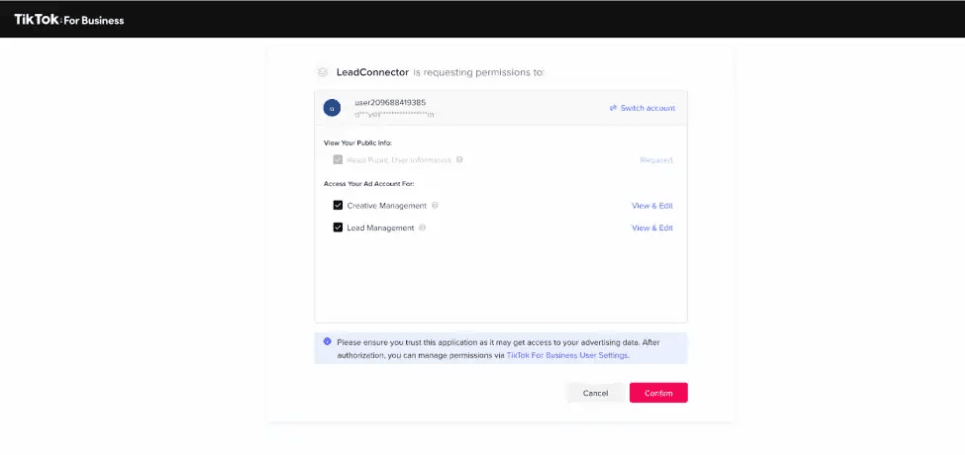
Grant Permissions:
Log in to your Lead Ads platform account using your usual credentials. You’ll likely be prompted to grant permissions for your CRM to access your Lead Ads data. Carefully review the requested permissions (usually pre-selected) and confirm if you’re comfortable granting them.
If you manage multiple Lead Ads accounts, you might be asked to choose the specific account you want to connect with your CRM.
By following these general steps, you can initiate the integration process between your CRM and the Lead Ads program you’re using.
3. Mapping Your Lead Fields: Tailoring the Connection(Gohighlevel Tiktok lead ads integration)
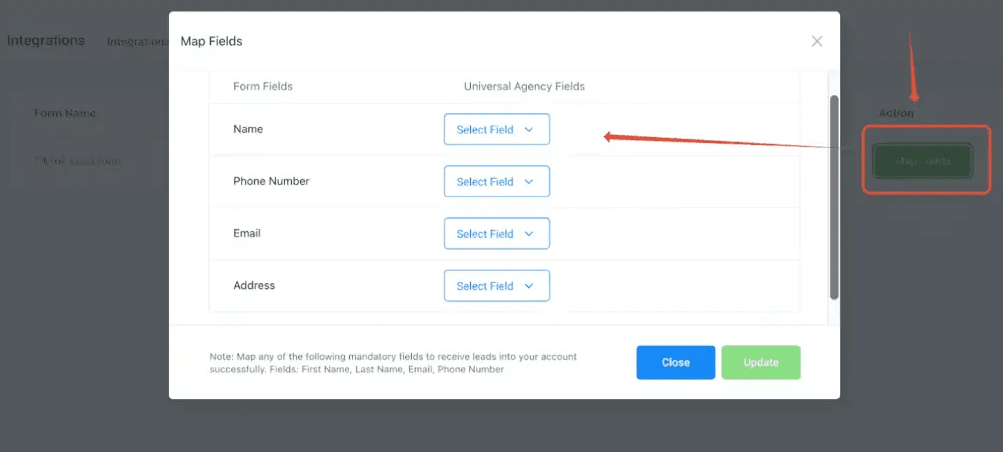
Once your Lead Ads platform account is connected, locate the section dedicated to mapping fields. This is where you’ll establish how information captured through your Lead Ads forms translates into your CRM.
Here’s a breakdown of the general process:
Identify Your Forms: You’ll likely see a list of available pages and forms from your Lead Ads platform.
Map Existing Fields: Click the “Map Fields” button (or similar option) to match the corresponding fields between your Lead Ads form and your CRM. This ensures the data is captured and stored correctly in your CRM.
Create Custom Fields (if needed): If your CRM doesn’t have a pre-existing field type that perfectly aligns with a specific Lead Ads form field, you might be able to create a custom field within your CRM to accommodate the data.
Supported Field Types: The specific types of custom fields supported will vary depending on your CRM, but common options might include text, long text, numerical, phone, monetary, single-choice selections, and date fields.
Save Your Changes: Once you’ve completed the mapping process, confirm your selections by clicking the “Update” button (or similar option) to finalize the connection.
4. Automating Lead Nurture: Building Your CRM Workflow(Gohighlevel Tiktok lead ads integration)
Now that your Lead Ads platform and CRM are connected and field mapping is complete, you can leverage the power of automation! Here’s how to create a workflow triggered by new leads:
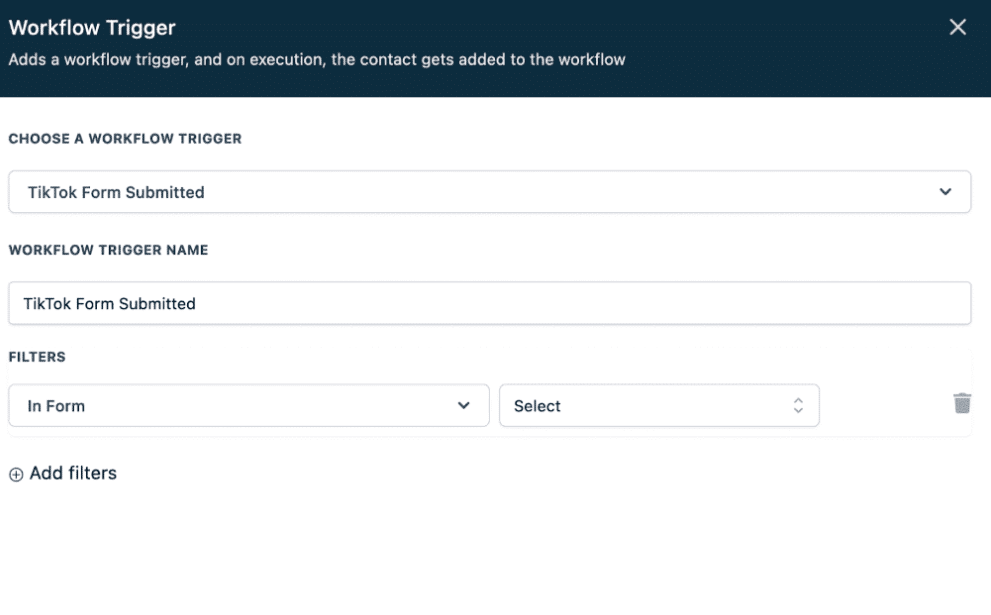
Locate the Triggers Section: Navigate to the section within your CRM that allows you to set up workflow triggers. These triggers initiate automated actions based on specific criteria.
Choose Your Trigger: Select the trigger option that aligns with your Lead Ads program (e.g., “Lead Ad Form Submitted”).
Apply Filters (Optional): Some CRMs allow you to define filters within your triggers. This lets you tailor the workflow to target specific leads captured through your Lead Ads.
Completion Message: Once you’ve configured the trigger and any filters, you’ve successfully connected your Lead Ads program with your CRM! Leads generated through your Lead Ads will automatically flow into your CRM, ready for nurturing and conversion.
Unveiling the Power of TikTok Lead Ads with Your CRM(Gohighlevel Tiktok lead ads integration)
Imagine seamlessly capturing leads from your TikTok marketing efforts and nurturing them with automated workflows – that’s the magic of integrating your CRM with TikTok Lead Ads! Here’s how this powerful combo can supercharge your business:
Streamlined Automation: Effortlessly integrate your TikTok Lead Ads with your CRM using a user-friendly integration tool. Say goodbye to manual data entry and hello to automated lead capture!
Customized Data Capture: Map existing lead fields or create custom fields within your CRM to perfectly store the data captured through your TikTok Lead Ads forms. This ensures you have all the crucial information you need to nurture your leads.
Automated Lead Engagement: Design automated workflows triggered by new leads from your TikTok Ads. This allows you to send personalized emails, SMS messages, or notifications right away, keeping your brand top-of-mind.
Data-Driven Optimization: Track and analyze the performance of your TikTok Lead Ads campaigns directly within your CRM’s dashboard and reports. Gain valuable insights to refine your targeting and maximize conversions.
Beyond Capture: Nurturing Potential: Don’t stop at capturing leads! Leverage the full potential of your CRM’s features like landing pages, campaigns, and pipelines to nurture your TikTok leads and convert them into loyal customers.
By harnessing the combined power of TikTok Lead Ads and your CRM, you can connect with your target audience on a booming platform and cultivate a thriving business.
Conquering Common Hiccups: Troubleshooting TikTok Lead Ads with Your CRM(Gohighlevel Tiktok lead ads integration)
Integrating your CRM with TikTok Lead Ads can be a game-changer, but occasional bumps in the road are inevitable. Here’s a breakdown of some common errors and how to tackle them:
“No Pages for This Account” Error:
This message pops up if you haven’t created an instant form within your TikTok Business Account. Solution: Simply create an instant form to connect your Lead Ads with your CRM.
Expired TikTok Access Token:
If your connection seems broken due to an expired token, fear not! Solution: Disconnect and reconnect your TikTok account from your CRM. This will prompt GoHighLevel to generate a fresh access token. Still, facing issues? Reach out to customer support for further assistance.
Updated Lead Ad Form During Campaign?
Made changes to your Lead Ad form mid-campaign, adding a new question. Solution: Create a custom field within your CRM sub-account settings to accommodate the new response data. Once created, revisit the “TikTok Form Fields Mapping” section, edit the mapping, and link the new custom field accordingly.
Connecting One TikTok ID to Multiple Sub-Accounts:
Yes, you can connect a single TikTok account ID to multiple GoHighLevel sub-accounts, even across different agencies! Just make sure both accounts have the necessary TikTok form fields mapped correctly.
Maintaining Access Permissions:
Only the LeadConnector tool needs permission, granted during the initial integration process. User permissions and access won’t affect token expiration.
Preventing Token Expiration and Ensuring Stability:
The good news: TikTok provides a permanent access token to your CRM, ensuring a stable connection unless you manually disconnect it. If this happens, you’ll see an “Integration Expired” message. Simply reconnect your accounts to resolve the issue.
By understanding these common troubleshooting steps, you can navigate any bumps in the road and ensure a smooth integration between your CRM and TikTok Lead Ads.
Should You Integrate TikTok Lead Ads with Your CRM?(Gohighlevel Tiktok lead ads integration)
Considering connecting your CRM to TikTok Lead Ads? This decision can significantly impact your business. Here’s why it might be a smart move:
Harnessing TikTok’s Power: Tap into the explosive growth of TikTok to reach a broader audience for your brand.
Streamlined Lead Capture: Effortlessly import leads generated through your TikTok Ads directly into your CRM, eliminating manual data entry.
Automated Lead Nurturing: Design automated workflows triggered by new leads, ensuring timely engagement and maximizing conversion potential.
If you’re serious about maximizing the functionality of both TikTok Lead Ads and your CRM, integration is worth exploring. This guide provides clear steps to connect your GoHighLevel CRM with your TikTok Business Account, allowing you to start receiving leads directly from your TikTok Ads campaigns.
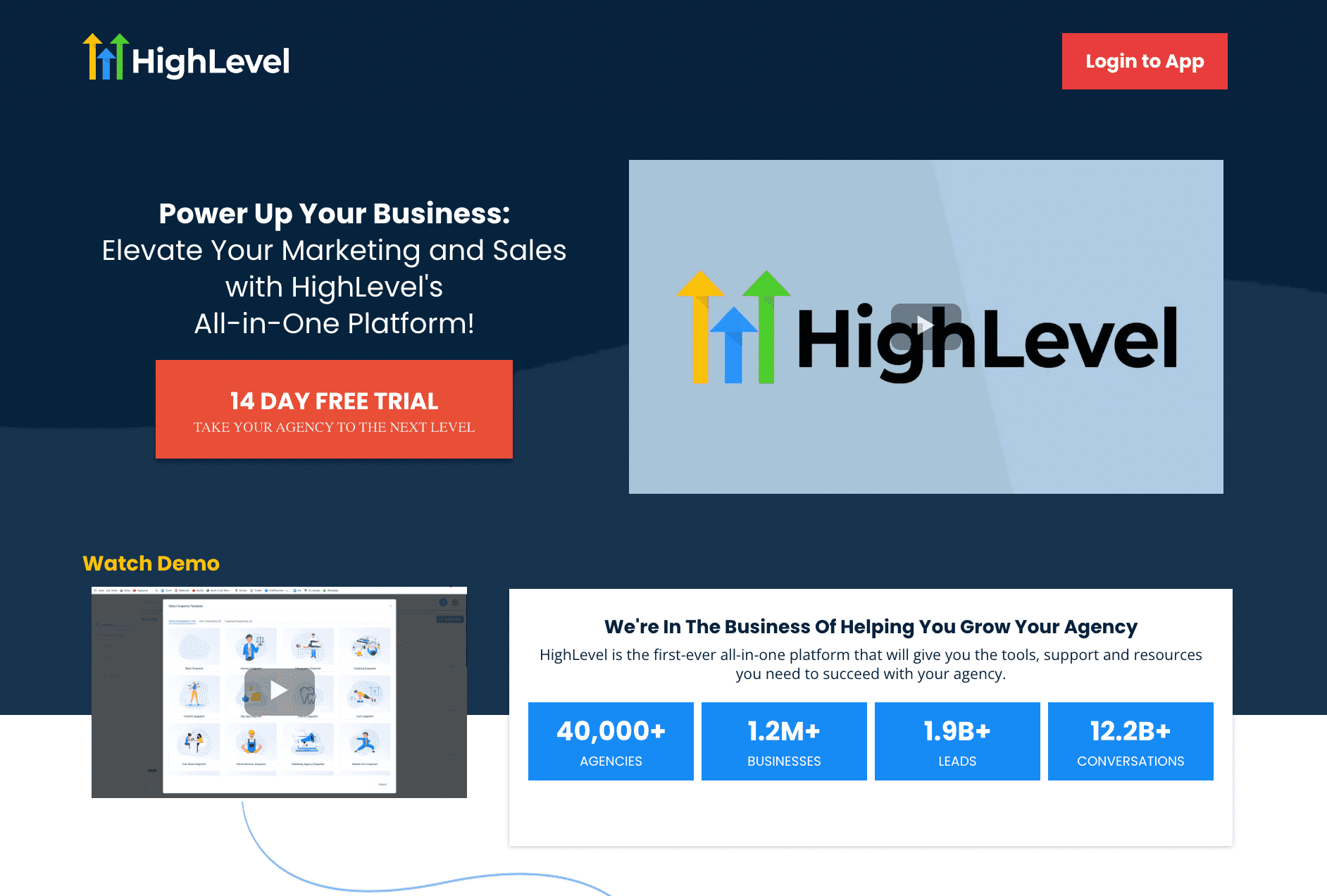
GoHighLevel: Streamline Your Agency Workflow in One Powerful Platform
Imagine consolidating most of your marketing, sales, and management tasks under one roof. GoHighLevel, created by a marketing agency that understands your struggles firsthand, makes this a reality.
Focus on Growth, Not Busywork:
GoHighLevel empowers agencies to shift their focus from managing multiple tools (IN their business) to working strategically ON their business.
All-in-One Marketing Powerhouse:
Client Acquisition & Retention: Effortlessly attract new clients, nurture leads, and cultivate lasting customer relationships.
Automation & Efficiency: Streamline workflows, automate repetitive tasks, and free up valuable time for strategic growth.
Data-Driven Marketing: Track key metrics (calls, leads, clicks, etc.) and optimize your campaigns for maximum ROI.
Reputation Management & Customer Service: Build trust and cultivate positive client experiences through effective reputation management and exceptional customer service tools.
Go beyond the limitations of multiple platforms! GoHighLevel offers a comprehensive solution at a fraction of the typical cost, with an intuitive interface accessible to both technical and non-technical users. Consolidate your tech stack, streamline operations, and unlock significant growth for your agency.
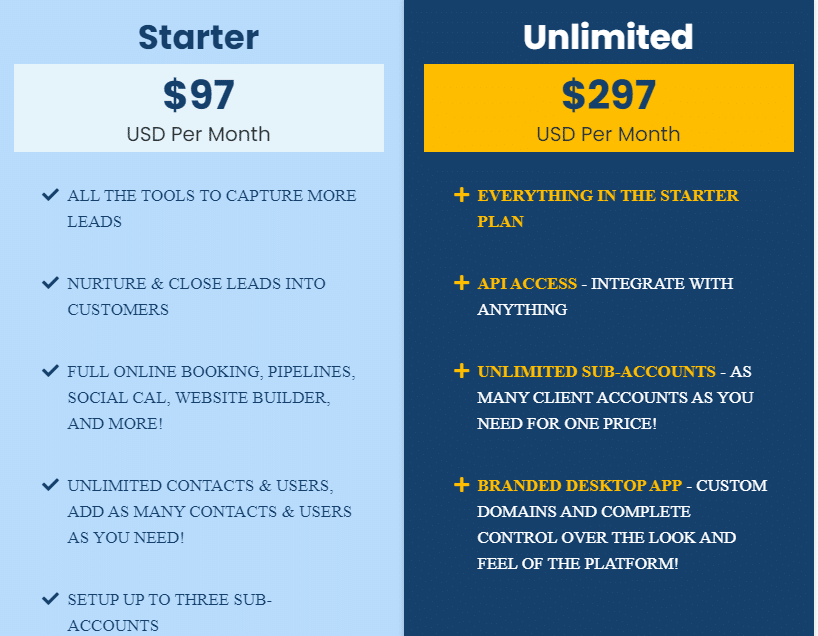
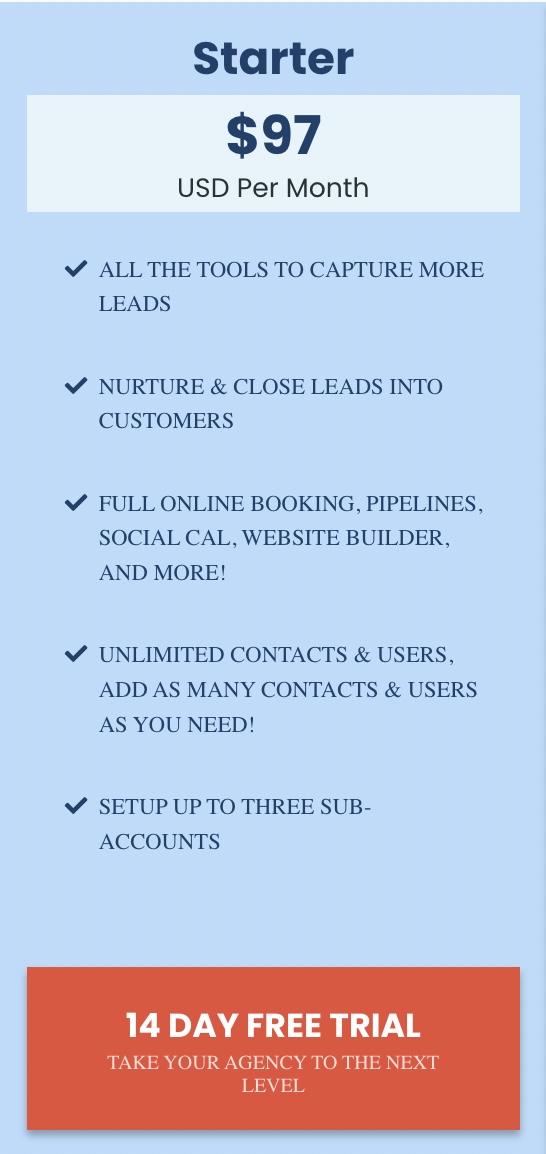
GoHighLevel’s Starter Plan ($97/month): offers essential tools for agencies and businesses to jumpstart their marketing and sales efforts. Key features include:
Lead Capture & Nurturing: Attract potential clients and convert them into loyal customers with lead capture tools and nurturing campaigns.
Sales Pipeline Management: Manage all stages of the sales process with online booking, pipelines, and other functionalities.
Website Builder: Create a professional website to showcase your business.
Scalability: Add unlimited contacts and users as your business grows.
Multi-Account Management (Optional): Manage up to 3 sub-accounts for team members or clients.
This plan provides the core functionalities to streamline workflows, attract new clients, and convert them into long-term customers.
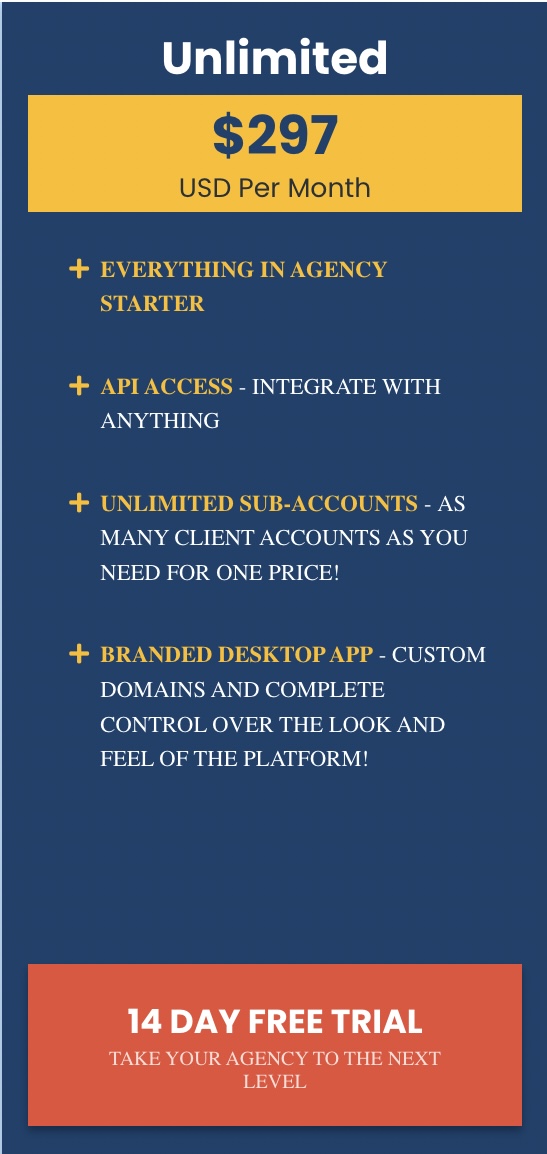
Unlimited Plan ($297/month): The Unlimited Plan offers everything in the Starter Plan, plus advanced features for agencies and growing businesses
Unmatched Scalability: Manage an unlimited number of clients and users as your business expands.
Enhanced Flexibility: Integrate GoHighLevel with your existing tools and services using API access.
Complete Client Management: Manage all your clients efficiently with unlimited sub-accounts under one plan.
White-Labeled Solutions: Deliver a professional branded experience with a custom desktop app and platform branding for your clients.
This plan allows you to streamline workflows, manage unlimited clients, integrate your existing tools, and provide a fully branded experience – all within a single platform.
GoHighLevel promises an all-in-one solution for agencies and marketers, streamlining workflows and saving time. But is it the perfect fit for you?
This post dives into 15 top GoHighLevel Alternatives. By comparing features, you can make an informed decision and find the ideal sales and marketing toolset for your needs.
GoHighLevel Alternatives: Unveiling Your Options
In the ever-evolving marketing landscape, GoHighLevel is a prominent player. But with so many tools available, you might wonder if there’s a better fit. Here’s a breakdown of some compelling GoHighLevel alternatives:
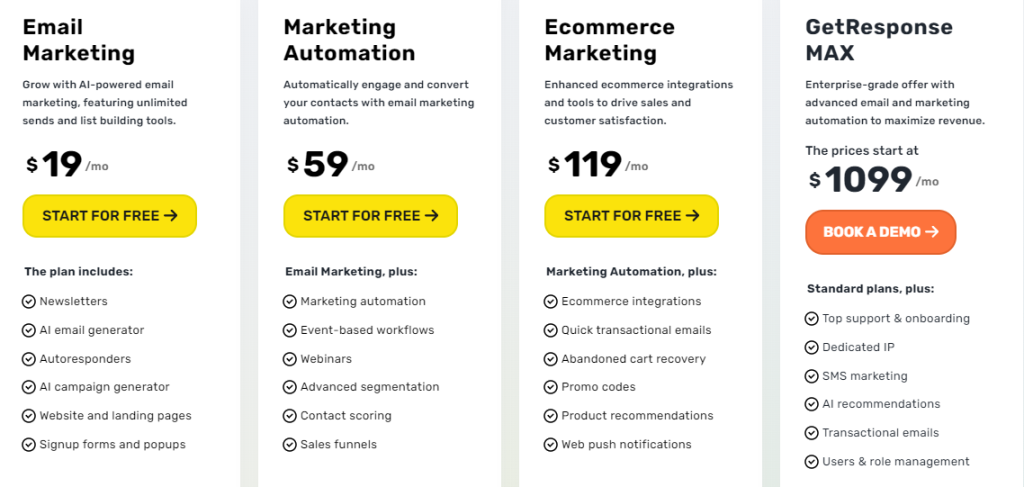
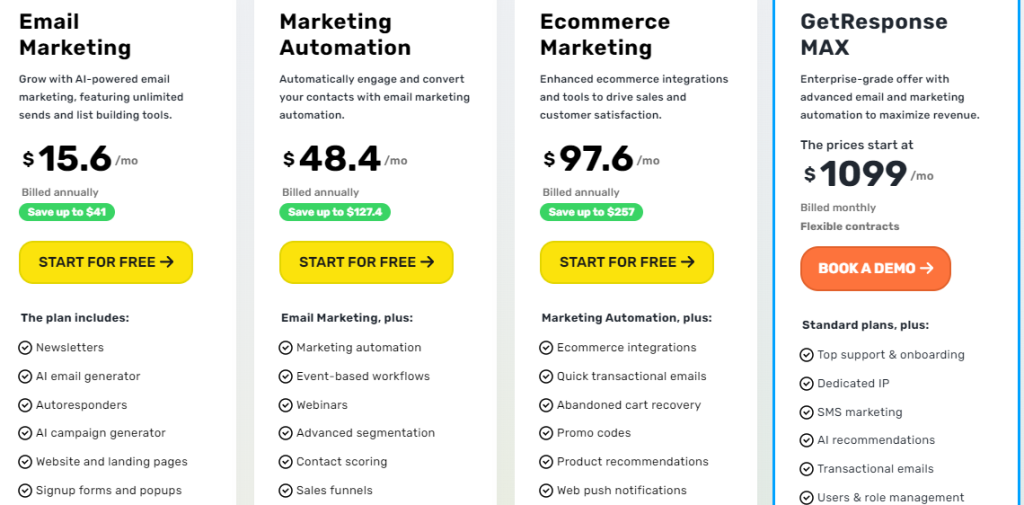
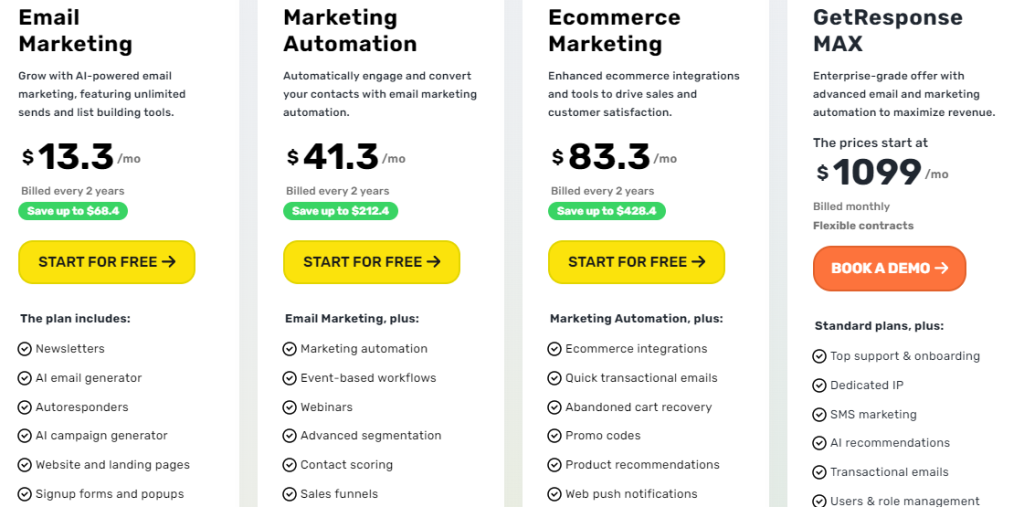
GetResponse: While not a direct GoHighLevel replacement, GetResponse is a solid option for businesses focused on affiliate marketing and lead generation.
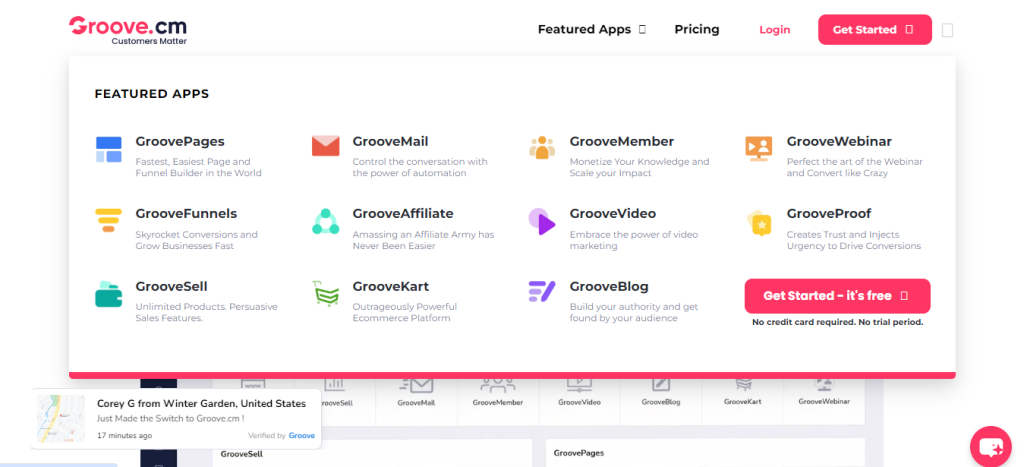
GrooveFunnels: GrooveFunnels integrates seamlessly with email marketing features, allowing you to create and send targeted email campaigns to nurture leads and grow your audience.
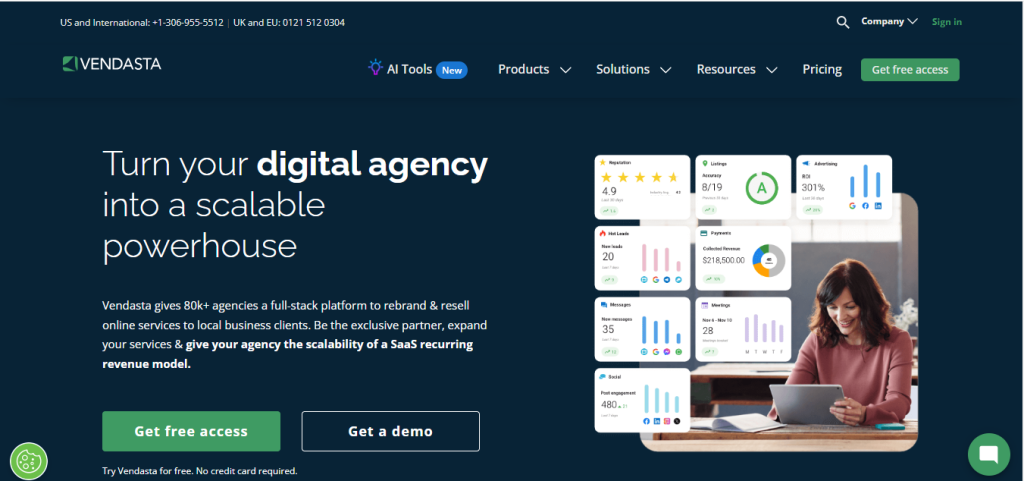
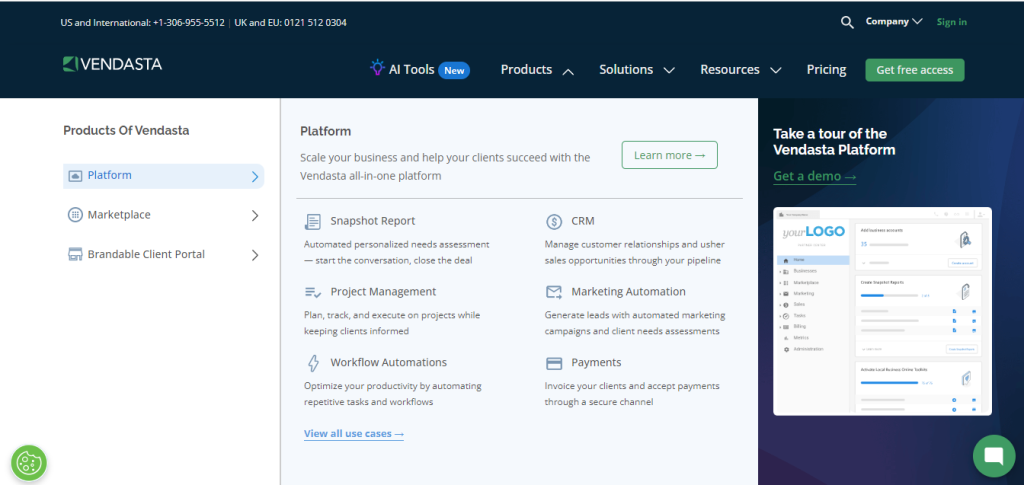
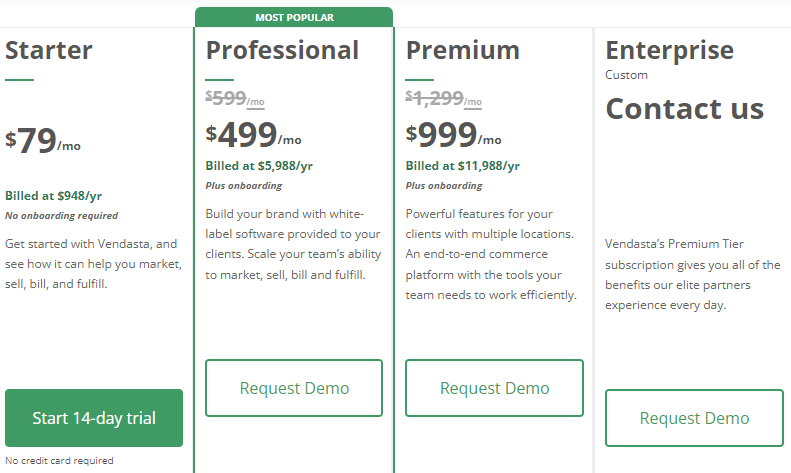
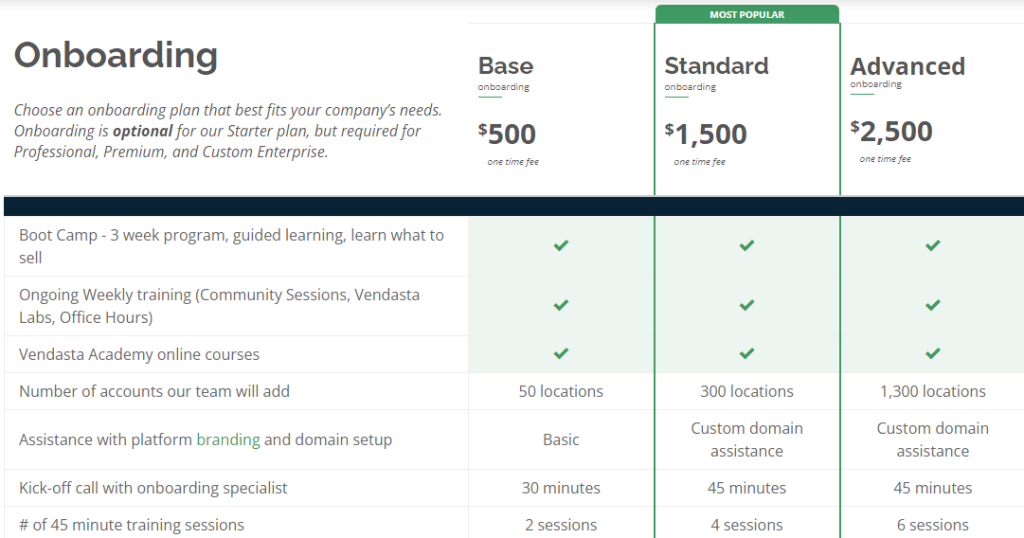
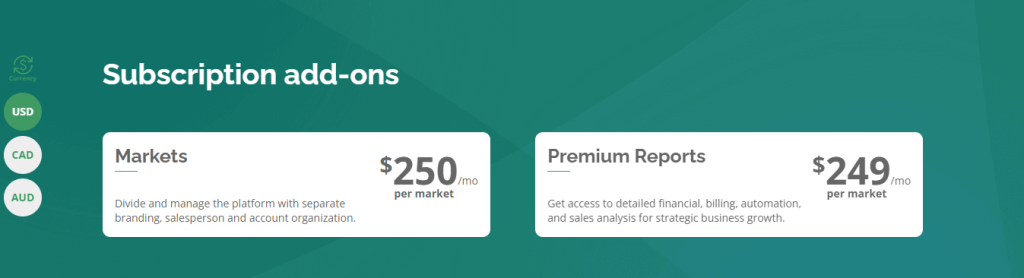
Vendasta:The platform allows agencies to rebrand Vendasta’s services and resell them to local businesses under their brand.
Remember, the best tool depends on your specific needs and budget. Consider the features, pricing, and white-labeling options to find the perfect match for your marketing strategy.
Finding the Perfect Fit: GoHighLevel Alternatives for Your Business
The business world thrives on variety, offering a plethora of tools and methods to achieve your goals. When it comes to online success, GoHighLevel is a powerful contender. But what if it’s not the perfect match?
This guide explores 15 top alternatives to GoHighLevel, catering to diverse needs and budgets. We’ll delve into their features, compare functionality, and highlight key advantages.
Seeking a Cheaper Option? We’ve got you covered, showcasing cost-effective alternatives.
Need More Features? Explore feature-rich options to elevate your marketing capabilities.
Prioritizing Ease of Use? We’ve identified user-friendly platforms to simplify your workflow.
Top-Notch Support Essential? Our rankings consider exceptional support teams to ensure you’re never left hanging.
Free Options to Get Started? We haven’t forgotten affordability. Discover 3 free alternatives to kickstart your online journey.
With this comprehensive analysis, you’ll be well-equipped to find the ideal GoHighLevel alternative that propels your business forward!
GoHighLevel Challengers: Exploring Top Alternatives
GoHighLevel is a powerful marketing tool, but it might not be the only game in town. In today’s dynamic landscape, several alternatives offer compelling features and functionalities.
Ready to Uncover Your Perfect Match?
This guide dives deep into the top GoHighLevel competitors, helping you make an informed decision. We’ll explore:
Feature Powerhouses: Unveiling alternatives that rival GoHighLevel’s functionality.
Unique Value Propositions: Discovering platforms with distinct strengths to address specific needs.
Budget-Friendly Options: Finding cost-effective alternatives that won’t break the bank.
Free Solutions to Get Started: Exploring free tiers or freemium options for beginners.
By considering your specific requirements and budget, you’ll be able to identify the ideal GoHighLevel alternative to propel your marketing efforts and achieve your business goals.
In the ongoing quest for the best marketing tool, Kartra emerges as a strong competitor to GoHighLevel. It stands out:
The White-Label Edge:Kartra boasts a white-label feature, allowing you to rebrand the platform for your clients, similar to GoHighLevel.
My Experience Matters: Based on my exploration of various marketing tools (including personal use, testing, and in-depth research), Kartra stands out as exceptional.
All-in-One Powerhouse:Kartra offers a comprehensive suite of features, making it easy to build effective sales funnels quickly.
User-Friendly Approach: Navigating and utilizing Kartra’s features is known for being intuitive and user-friendly.
Reliability You Can Count On: Regarding performance and stability, Kartra delivers dependable service.
This overview highlights Kartra’s strengths, but exploring the other alternatives in this guide will give you a more comprehensive picture. Consider your specific needs and preferences to find the perfect marketing tool to fuel your success.
Kartra: Streamline Sales, Deepen Engagement, Grow Your Business
Kartra offers an all-in-one marketing platform to:
Effortlessly build high-converting sales funnels with drag-and-drop tools and pre-made templates.
Boost revenue by optimizing conversion rates through effective funnels.
Nurture leads and build strong customer relationships with email marketing, memberships, and webinars.
Increase customer retention by offering white-labeled solutions under your own brand (Agency feature).
Kartra empowers businesses to streamline sales, cultivate deeper customer connections, and achieve sustainable growth.
Kartra: All-in-One Marketing Platform for Streamlined Business Growth
Kartra goes beyond marketing, offering a comprehensive suite to streamline your entire business. Here are its key features:
Sales & Marketing Automation: Build high-converting sales funnels (drag-and-drop builder, templates), create supercharged checkouts, and automate email campaigns for lead nurturing.
Content & Course Creation: Design landing pages and courses with ease using pre-made templates, host high-quality videos, and build membership sites.
Growth & Engagement Strategies: Recruit affiliates to expand your reach, offer convenient appointment scheduling, and optimize campaigns with A/B testing and analytics.
Exceptional Customer Support: Provide excellent customer service through a dedicated helpdesk with ticketing and live chat.
In short, Kartra empowers you to streamline sales, automate marketing, create engaging content, and build strong customer relationships – all under one roof.
Unveiling kartra’s Pricing Plans: Find Your Perfect Fit (Gohighlevel Alternatives)
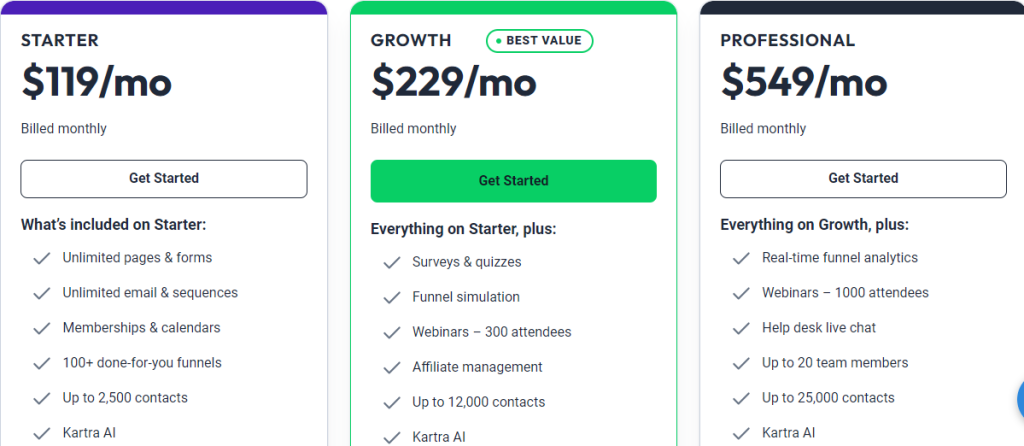
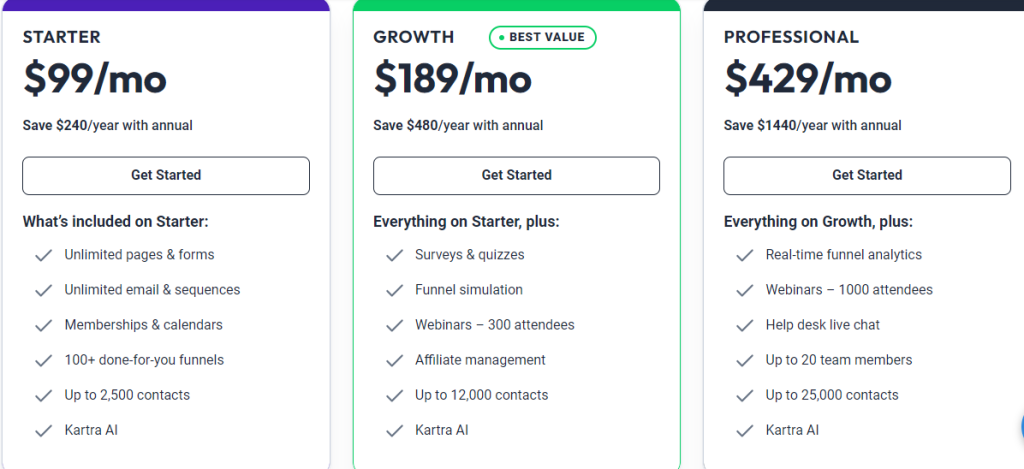
Kartra offers a tiered pricing structure to cater to different business needs. Here’s a breakdown:
Test Drive Before You Commit: Unsure if Kartra is right for you? They offer a 14-day trial for just $1 on any plan, allowing you to explore the platform firsthand.
Starter Plan ($199/month): Kartra’s Starter Plan ($199/month) is a solid option for beginners and solopreneurs. It offers essential tools for building an online presence, including:
Unlimited pages and forms
Unlimited email marketing and automation
Membership site creation and management
Over 100 pre-built sales funnels
Management of up to 2,500 contacts
(Optional) Access to kartra’s AI features
This plan allows you to launch marketing campaigns, capture leads, and nurture customer relationships.
Kartra’s Growth Plan ($299/month) builds on the Starter Plan’s features to help businesses scale their marketing. Key additions include:
Audience insights via surveys and quizzes
Funnel simulation tool for optimization
Webinar hosting for up to 300 attendees
Affiliate management program
Increased contact limit to 12,000
Access to advanced Kartra AI features (if applicable)
This plan is ideal for businesses ready to expand their reach, gather deeper customer data, and explore advanced marketing tactics.
Professional Plan ($549/month): Kartra’s Professional Plan targets established businesses with growing teams and audiences. It unlocks advanced features to achieve significant marketing growth:
Deeper campaign insights: Optimize marketing with real-time performance data.
Large-scale webinars: Engage wider audiences with webinars for up to 1,000 attendees.
Improved customer service: Offer exceptional support via live chat, boosting customer satisfaction.
Teamwork features: Collaborate effectively with up to 20 team member accounts.
Massive audience reach: Scale your marketing to a massive 25,000 contacts.
Advanced AI capabilities (if applicable): Automate tasks and personalize marketing messages for increased efficiency.
This plan empowers businesses to take their marketing strategy to the next level with advanced functionalities.
Annual (save up to 22%)
Consider your business size, audience reach, and marketing goals when selecting a Kartra plan. The 14-day trial allows you to experiment and discover the plan that best aligns with your needs.
Kartra: An All-in-One Marketing Solution
Kartra positions itself as a comprehensive and cost-effective marketing toolkit for businesses. Here’s why:
All-encompassing features: Manage various aspects of your online business with tools like video hosting, membership sites, and an affiliate management system.
Competitive Pricing: Kartra offers its features at an attractive price point, potentially compared to competitors like GoHighLevel.
Email Marketing Strength: Kartra excels in email marketing automation, allowing for targeted campaigns and lead nurturing.
In the realm of sales funnel creation, ClickFunnels reigns supreme in terms of popularity. Here’s why it stands out:
Market Leader in Funnel Building:ClickFunnels has carved a niche as the most widely used sales funnel builder currently available.
Trusted by Marketing Experts: Top marketers like Dan Kennedy, Tony Robbins, Grant Cardone, and Alex Harmozi leverage ClickFunnels, signifying its credibility within the industry.
Crafting High-Converting Funnels:ClickFunnels empowers you to design and build sales funnels optimized for maximum conversions, propelling your online business forward.
ClickFunnels: Effortless Funnel Creation for Business Growth
ClickFunnels simplifies the process of building high-performing sales funnels for your online business. Here’s what makes it so user-friendly:
Drag-and-Drop Design: The intuitive interface eliminates the need for coding knowledge. Simply drag and drop elements to create visually appealing and effective marketing campaigns.
Pre-Built Templates for Efficiency: Save time with ClickFunnels‘ extensive library of done-for-you templates. Customize these templates to fit your specific brand and marketing goals.
All-in-One Marketing Suite:ClickFunnels goes beyond just funnel building. It provides a comprehensive suite of tools including autoresponders for email marketing, landing page creation to capture leads, and robust tracking systems to monitor your progress and optimize your campaigns with confidence.
Predictable Results: With everything you need for successful online marketing at your fingertips, ClickFunnels empowers you to create predictable sales pipelines and track your revenue growth.
ClickFunnels: Empower Your Team & Leverage Expert Insights
ClickFunnels isn’t just about creating individual success – it fosters team growth as well. Here’s how:
Effortless Affiliate Management: Expand your reach by leveraging ClickFunnels‘ affiliate management system. Set custom commission structures, invite affiliates with a single click, and reward them for contributing to your business growth.
Beyond the Software:
ClickFunnels offers more than just a toolset. Here’s what sets it apart:
Russell Brunson’s Expertise: ClickFunnels is the brainchild of Russell Brunson, a highly respected marketer.
Extensive Training Resources: ClickFunnels provides a wealth of training and resources, covering topics like mindset, marketing, advertising, and sales. Explore their offerings, such as the “Your First Funnel Challenge,” to gain valuable insights and accelerate your learning curve.
A Compelling Choice for Entrepreneurs with its All-in-One Appeal
ClickFunnels has emerged as a strong competitor to GoHighLevel, particularly for entrepreneurs and business owners. It stands out:
All-encompassing solution:ClickFunnels offers a comprehensive suite of tools, eliminating the need for multiple subscriptions and simplifying online business management.
User-Friendly Interface: The intuitive drag-and-drop interface makes ClickFunnels accessible even for those with limited technical experience.
Knowledge at Your Fingertips:ClickFunnels goes beyond software. They provide extensive training courses, empowering you to develop the marketing expertise needed to thrive online.
Supportive Community: ClickFunnels fosters a strong user community, offering valuable peer-to-peer learning and support.
Popularity for a Reason: ClickFunnels’ popularity is a testament to its effectiveness. It’s a proven solution for entrepreneurs seeking to build successful online businesses.
Bonus Incentive: ClickFunnels offers a unique reward system. Their “Two Comma Club Award” recognizes members who achieve the impressive feat of generating one million dollars in sales through a single funnel using their software.
ClickFunnels: The Undisputed Champion of Sales Funnels
With over 1,000 members achieving the coveted Two Comma Club Award, ClickFunnels has cemented its place as a symbol of entrepreneurial success. It’s revolutionized the industry, making it easier than ever to build high-converting sales funnels.
The question isn’t whether you should use ClickFunnels, it’s when. Are you ready to join the ranks of successful entrepreneurs and unlock your full potential? ClickFunnels empowers you to take control, streamline your marketing, and watch your business soar.
Considering ClickFunnels?
With its user-friendly approach, comprehensive features, and commitment to ongoing education, ClickFunnels is a compelling option for entrepreneurs seeking a well-rounded solution to manage and grow their online businesses.
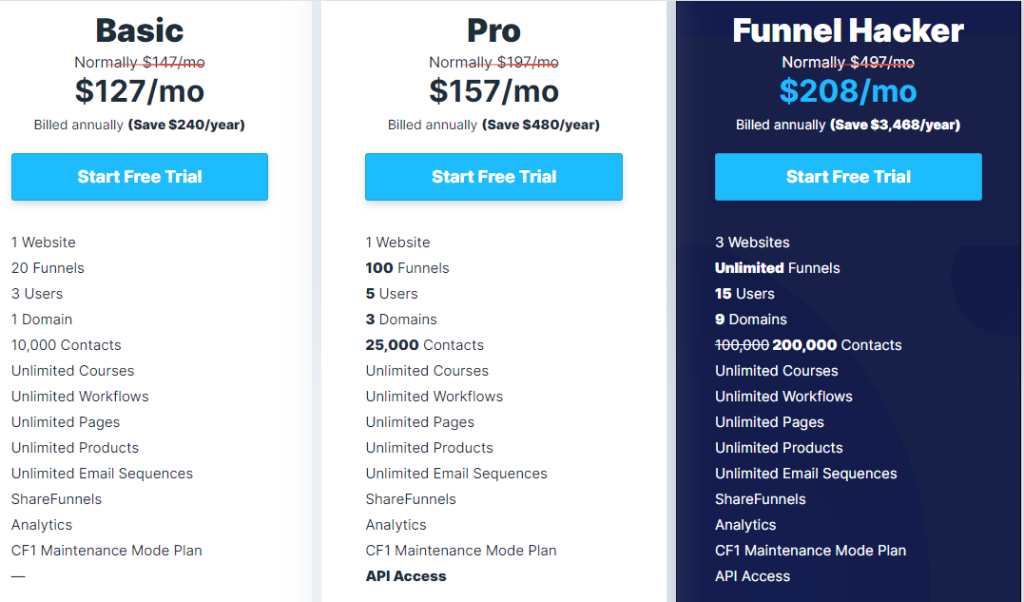
ClickFunnels offers a tiered pricing structure to cater to businesses of all sizes. Here’s a quick breakdown:
Basic Plan ($127/month): Ideal for starting your sales funnel journey. This plan provides the essentials to build funnels, capture leads, and launch your marketing efforts.
Pro Plan ($157/month): Perfect for growing businesses. This plan unlocks additional features for advanced lead management, funneling strategies, and team collaboration.
Funnel Hacker Plan ($208/month): Designed for high-volume entrepreneurs. This top-tier plan offers everything in Pro, plus advanced features and exclusive benefits to maximize your sales funnel potential.
Experience ClickFunnels Risk-Free
All ClickFunnels plans come with a generous 14-day free trial, allowing you to explore the platform and see if it fits your needs before committing.
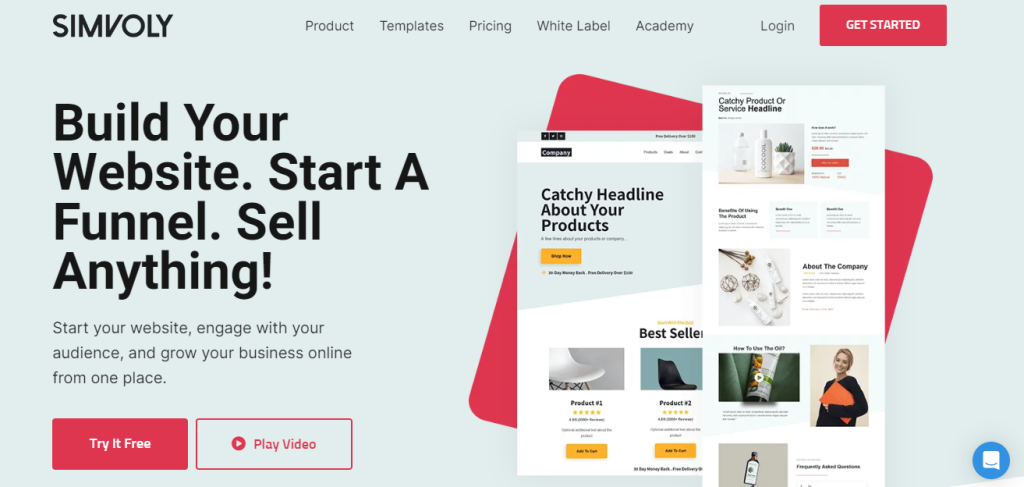
Simvoly: A Budget-Friendly GoHighLevel Alternative
Seeking a cost-effective solution for managing your online business? Look no further than Simvoly. It stands out as one of the most affordable options compared to GoHighLevel.
Established in 2016 by Stan Petrov and Ivan Nikolchov, Simvoly has gained traction amongst small businesses and agencies. Over 35,000 users currently leverage Simvoly’s features to streamline their operations.
Simvoly: Build Powerful Funnels with Unmatched Ease
Simvoly isn’t just another funnel builder. It’s designed with user-friendliness at its core, making it easy for anyone to create high-converting sales funnels, even without technical expertise.
All-in-One Marketing Powerhouse:
Manage your entire online business from one platform. Simvoly integrates essential tools like CRM software for customer relationship management, email marketing automation to nurture leads, and membership site software to deliver exclusive content.
White-Labeling for Enhanced Control:
Take your business to the next level, just like GoHighlevel, with Simvoly’s white-label functionality. Not only can you resell the software under your brand, but you can also customize its appearance to seamlessly integrate with your existing workflow and branding, creating a unified experience for your clients.
Simvoly stands out as a leader in white-label funnel builders, empowering agencies and entrepreneurs to offer comprehensive marketing solutions with unmatched flexibility.
Simvoly: Unveiling Your All-in-One Marketing Arsenal
Build, Brand, and Sell with Unmatched Flexibility:
Simvoly empowers you to craft high-converting sales funnels with total control. Here’s what sets it apart:
100% White-Label & Reseller Rights:Simvoly is your brand, your way. Resell or customize the software to seamlessly integrate with your existing business identity.
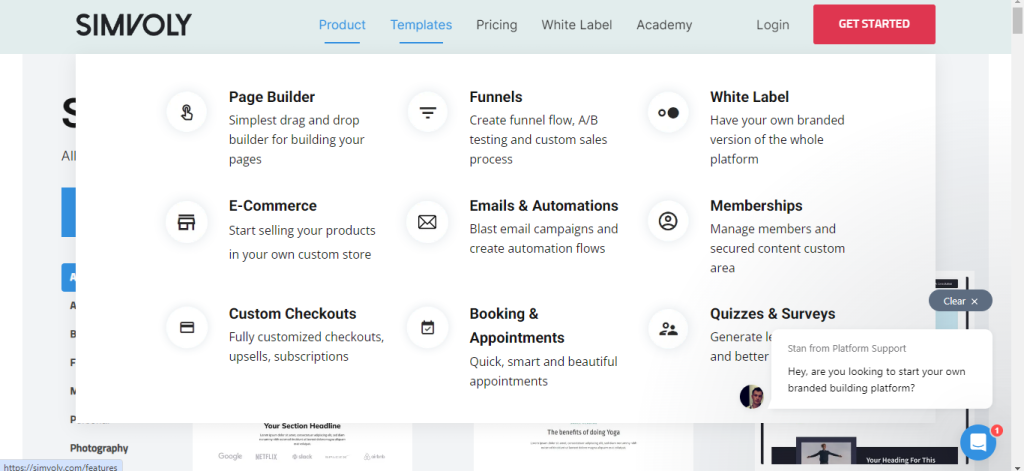
Conversion-Boosting Features: Landing pages, multistep forms, order bumps, and one-click upsells—Simvoly equips you to maximize conversions and boost average order value.
Frictionless E-Commerce: Sell physical products effortlessly with Simvoly’s e-commerce store functionality and intuitive Add-to-Cart feature.
Drag-and-Drop Design Freedom: No coding required! Simvoly’s user-friendly editor allows anyone to easily create stunning landing pages and funnels.
Nurturing Customer Relationships: Automate email marketing campaigns with exceptional deliverability rates. Build trust and loyalty with targeted messaging.
Membership Site Builder: Deliver exclusive content and online courses through a simple membership site builder.
Streamlined Scheduling: Manage appointments and bookings with ease using Simvoly’s built-in calendar and appointment booking features.
Data-Driven Optimization: Make informed decisions with Simvoly’s robust reporting, analytics, and A/B split testing capabilities.
Powerful Affiliate Management: Build an army of affiliates and leverage their reach to expand your customer base.
Seamless Payment Processing: Accept payments from all major providers like PayPal, Stripe, and many more.
Integrate with Your Favorite Tools: Connect Simvoly with your existing marketing arsenal, including Mailchimp, GetResponse, and more.
Pre-Designed Templates: Jumpstart your funnel creation process with a library of professionally designed website and funnel templates.
Simvoly is more than just a funnel builder. It’s a comprehensive marketing suite that empowers you to build, brand, and sell with unmatched flexibility. Take control of your online business today!
Simvoly offers a tiered pricing structure to cater to businesses of all sizes. Here’s a breakdown of their plans:
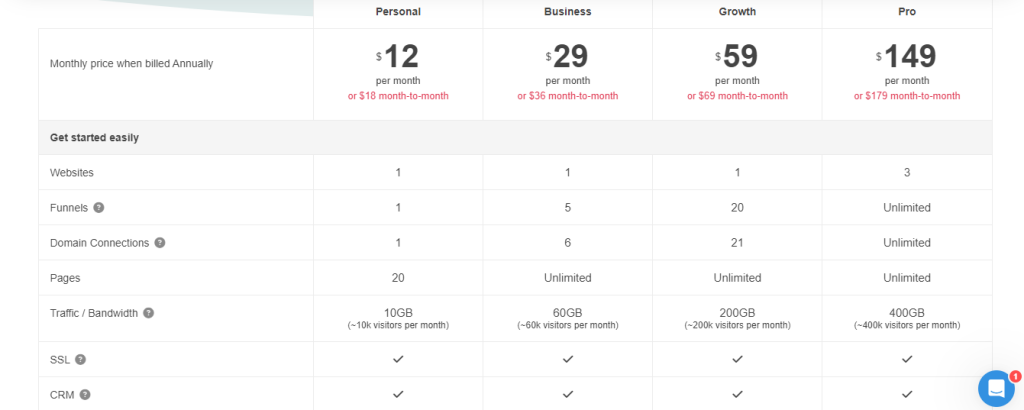
Personal ($12/month): Ideal for starting your online journey. Build basic landing pages, capture leads, and establish your online presence.
Business ($29/month): Perfect for growing businesses. Unlock additional features for advanced funnel creation, membership sites, and email marketing automation.
Growth ($59/month): Designed for scaling businesses. This plan offers everything in Business, plus increased limits on features and the ability to manage multiple client accounts.
Pro ($149/month): The ultimate solution for agencies and high-volume businesses. Pro includes all Growth plan features with even higher limits, priority support, and white-label capabilities for complete brand customization.
ActiveCampaign goes beyond just marketing automation. It’s a comprehensive suite that equips you with everything you need to nurture leads, drive sales, and manage customer relationships effectively.
Landing Pages Made Easy:
The built-in landing page builder empowers you to create high-converting landing pages that seamlessly integrate with your marketing campaigns.
Unleash Your Brand Identity:
ActiveCampaign isn’t just powerful, it’s flexible. Leverage their white-label services to transform the platform into your own branded marketing solution. This is perfect for both regular customers and marketing agencies.
Complete Customization Control:
Take complete control of the user experience. Customize the entire software with your custom domain and logo, and remove any references to ActiveCampaign. This ensures your clients have a seamless, brand-consistent experience.
ActiveCampaign empowers you to manage your marketing efforts and client relationships from a single, powerful platform. Take control of your brand and unlock the full potential of marketing automation.
ActiveCampaign: More Than Just Landing Pages
ActiveCampaign isn’t just about creating beautiful landing pages (although it excels at that too!). It’s a comprehensive marketing automation platform designed to empower your business. Here’s what sets it apart:
Unlimited Email Marketing: Reach your audience at scale. Send targeted emails without worrying about limitations.
Sophisticated Automation Builder: Craft powerful automations with a user-friendly workflow builder. Simplify repetitive tasks and nurture leads effortlessly.
Best-in-Class White-Label CRM: Elevate your agency’s offerings or seamlessly integrate ActiveCampaign with your existing brand. With a single checkbox, you can remove all mentions of ActiveCampaign, creating a truly white-labeled solution.
ActiveCampaign offers unmatched flexibility, catering to both agencies and direct customers. It’s your one-stop shop for building landing pages, managing email marketing, and streamlining sales with a powerful white-labeled CRM.
ActiveCampaign: Unveiling Your Marketing Automation Arsenal
ActiveCampaign equips you with everything you need to launch successful marketing campaigns, nurture leads, and close more deals. Here’s a look at its key features:
Landing Page Creation Made Easy: Design high-converting landing pages with ActiveCampaign’s intuitive builder. Choose from over 55 modern, responsive templates and customize them to match your brand.
Real-Time Engagement: Connect instantly with website visitors through the built-in web chat service. Address their questions and concerns promptly, boosting conversions.
Automated Marketing Powerhouse: Craft powerful email and SMS marketing campaigns with advanced features like segmentation, web personalization (dynamic content based on user data), and A/B split testing for continuous optimization.
Streamlined Sales Management: Boost your sales pipeline with ActiveCampaign’s CRM system. Manage leads, track interactions, and close deals efficiently.
Personalized Customer Experiences: Deliver a unique experience for each visitor. The web personalization feature allows you to display targeted content based on user data.
Data-driven decision-making: Gain valuable insights into your campaigns with robust analytics, reporting, and performance metrics. Track results, identify areas for improvement, and constantly refine your approach.
Unleash Your Brand: Transform ActiveCampaign into your marketing solution with the powerful white-label feature. Customize branding, logos, and colors to create a seamless brand experience.
Unmatched Integrations: Connect ActiveCampaign to virtually any tool you use. Over 870 integrations with payment gateways, business applications, and more ensure a smooth workflow within your existing ecosystem.
With ActiveCampaign, you have everything you need to automate your marketing, nurture leads, and close more deals. Craft personalized experiences, track results, and make data-driven decisions to achieve marketing success.
ActiveCampaign offers a flexible pricing structure to accommodate businesses of all sizes and budgets. Here’s a breakdown of their plans:
Free 14-Day Trial: Explore all the features before you commit. No credit card is required.
Annual Billing Discount: Save money by opting for annual billing across all paid plans.
Non-Profit Discount: ActiveCampaign supports non-profit organizations with a 20% discount on any paid plan.
Paid Plans:
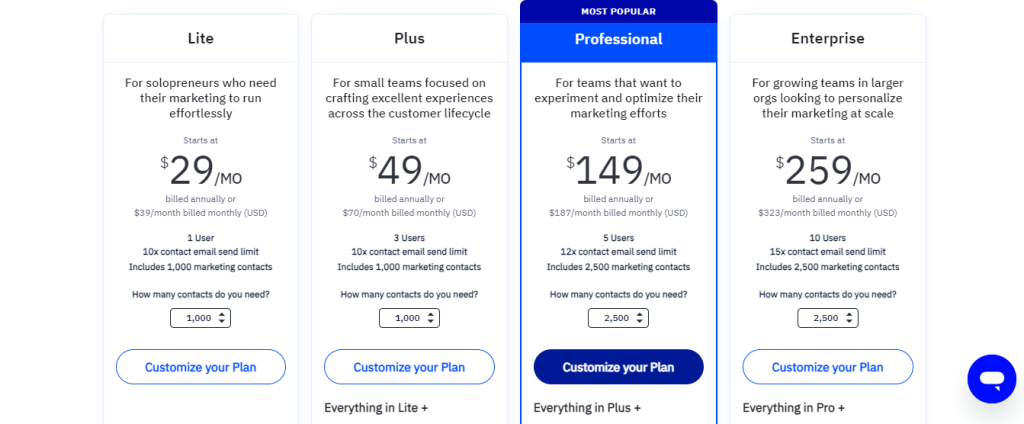
Lite ($29/month): Ideal for starting. Build basic landing pages, manage email contacts, and gain valuable insights with marketing automation.
Plus ($49/month): Perfect for growing businesses. Unlock advanced features like segmentation, CRM functionality, and lead scoring for more targeted marketing efforts.
Professional ($149/month): Designed for scaling businesses. Everything in Plus, along with increased automation capabilities and custom landing page templates for higher conversion rates.
Enterprise ($259/month): The ultimate solution for large organizations and agencies. This plan offers complete white labeling, custom pricing based on your needs, and dedicated support for a truly personalized experience.
Postmark, the leading service for transactional email, is now part of ActiveCampaign.
Get fast and reliable delivery for crucial transactional emails like password resets or order confirmations. Thanks to great API documentation, developers can start sending in minutes.
ActiveCampaign empowers you to choose the plan that aligns perfectly with your business goals. Start your free trial today and discover the power of marketing automation!
Streamline Your Agency Workflow with Landingi’s White-Label Landing Pages
Landingi isn’t just another landing page builder. It’s designed specifically to empower design and marketing agencies. Here’s why it stands out:
Effortless Agency Management: Manage multiple client projects seamlessly with sub-accounts, audit logs, and team roles. Ensure clear ownership, track activity, and collaborate effectively within your team.
White-Labeling for a Unified Brand Experience: Deliver a seamless experience for your clients. Landingi’s white-label functionality allows you to remove all references to their brand and replace them with your own.
Unmatched Ease of Use: Even non-technical users can create stunning landing pages with Landingi’s intuitive drag-and-drop editor. It’s one of the easiest and most user-friendly options available.
Flexibility for Different Needs: Publish your landing pages directly to WordPress or Shopify websites, giving your clients the freedom to choose the platform that best suits their needs.
Landingi empowers agencies to deliver exceptional results for their clients. With its powerful features, white-labeling capabilities, and user-friendly interface, it’s the perfect all-in-one solution for building high-converting landing pages.
Landingi: Craft High-Converting Landing Pages in Minutes
Landingi isn’t just a marketing tool, it’s a landing page powerhouse. Here’s what sets it apart:
All-in-One Marketing Toolkit: Go beyond landing pages. Landingi equips you with the tools to create high-converting forms, attention-grabbing pop-ups, and more, for a comprehensive marketing solution.
Effortless Drag-and-Drop Editing: No coding required! Landingi’s intuitive drag-and-drop editor empowers anyone to create stunning landing pages, regardless of technical expertise.
Pre-Built for Success: Jumpstart your landing page creation with Landingi’s extensive library of pre-built templates. Simply customize them with your branding and content for a quick and easy launch.
Powerful Design Elements: Unleash your creativity with a vast selection of widgets and content elements. Landingi provides everything you need to build engaging and effective landing pages.
Landingi streamlines the landing page creation process, making it easy to design, build, and publish high-converting pages in minutes.
Landingi Connects You to Your Marketing Ecosystem
Building a successful marketing strategy often requires a suite of tools working together seamlessly. Landingi understands this, and that’s why it offers a robust integration system:
Extensive Pre-Built Integrations: Connect Landingi with popular marketing tools you already use, such as Google Analytics for tracking results, CallPage for managing leads, and Facebook for running targeted ads. Integrations with email platforms like ActiveCampaign and GetResponse ensure smooth communication with your audience. Most CRMs and sales tools are also compatible with Landingi, allowing you to centralize your customer data.
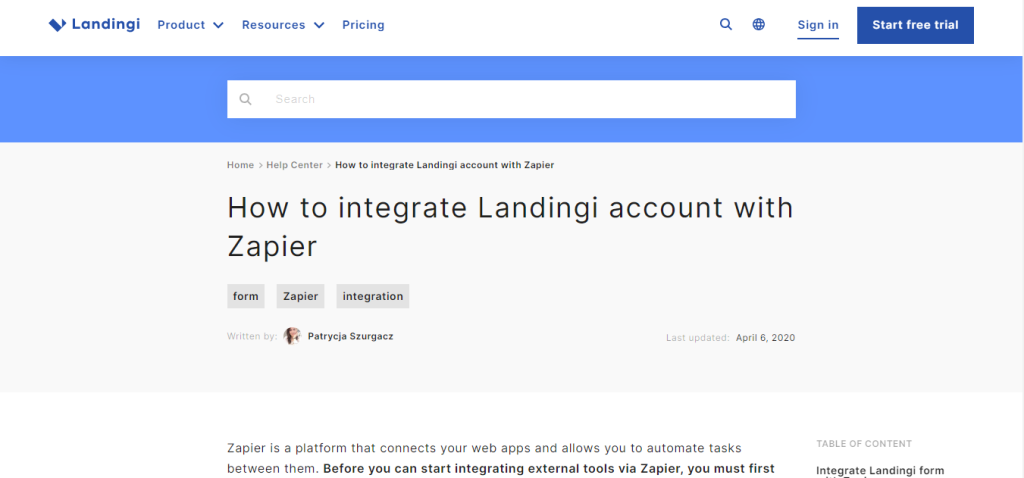
Unlimited Possibilities with Zapier: Need to connect a tool that isn’t directly integrated with Landingi? No problem! Zapier unlocks a universe of possibilities, allowing you to connect Landingi with virtually any other tool in your marketing arsenal.
Landingi empowers you to break down silos and create a unified marketing ecosystem. Focus on crafting compelling campaigns, and let Landingi handle the seamless connection between your favorite tools.
Landingi equips you with everything you need to create high-converting landing pages in minutes. Here’s what makes it stand out:
Effortless Drag-and-Drop Editing: Experience one of the easiest page editors available. Landingi’s intuitive drag-and-drop interface empowers anyone to build stunning landing pages, with autosaving ensuring your work is never lost.
Pre-Built for Efficiency: Jumpstart your creative process with a library of over 150 pre-designed templates for landing pages and pop-ups. Simply customize them with your branding and content for a quick launch.
Blazing-Fast Performance: Enjoy the benefits of a self-hosted platform with lightning-speed loading times for your landing pages, ensuring a smooth user experience on desktop devices.
Personalized Experiences: Deliver targeted content to your visitors. Landingi’s web personalization feature allows you to display different variations of your landing pages based on user data, maximizing engagement.
Complete Transparency: Maintain clear accountability with detailed audit logs that track all activity on your pages. Gain insights into user behavior and identify areas for improvement.
Seamless Integrations: Connect Landingi to virtually any tool in your marketing ecosystem. With a vast array of pre-built integrations and Zapier support, you can centralize your marketing efforts.
Actionable Insights: Gain valuable data-driven insights with built-in analytics for your landing pages. Track performance metrics, measure conversions, and continuously optimize your campaigns.
Sales Funnel Power: Take your marketing to the next level. Landingi allows you to connect landing pages and build powerful sales funnels to nurture leads and drive conversions seamlessly.
Multi-Channel Management: Landingi offers flexibility in publishing your creations. Export landing pages directly to your WordPress website or share them with other Landingi accounts for collaborative projects.
Enhanced Lead Capture: Capture leads effectively with Landingi’s call-tracking features, including calls, voice drops, and detailed call-tracking reports.
Landingi is your one-stop shop for creating high-performing landing pages. With its user-friendly interface, powerful features, and seamless integrations, it empowers you to design, launch, and optimize landing pages that convert.
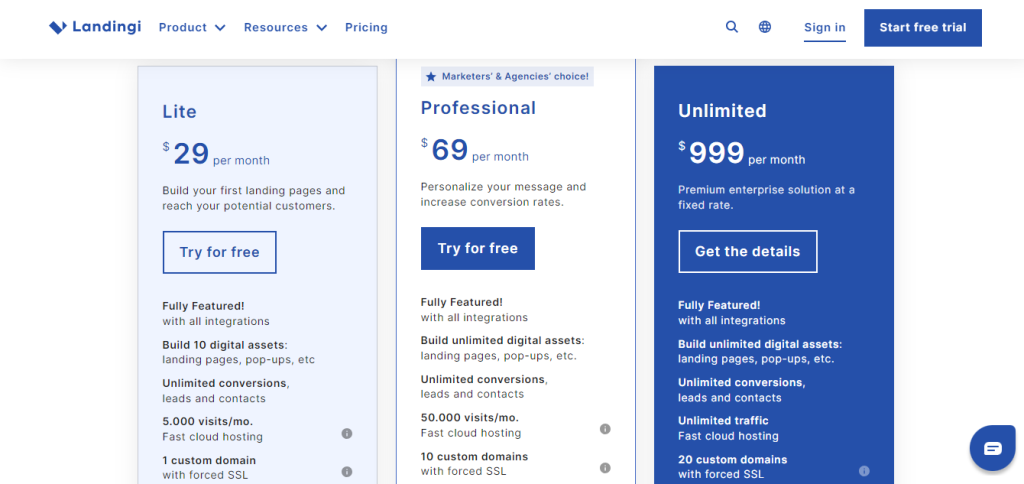
Landingi: Find the Perfect Plan to Match Your Needs (Gohighlevel Alternatives)
Landingi offers a tiered pricing structure to cater to businesses of all sizes. Start your journey with a free 14-day trial, allowing you to explore all features and create unlimited landing pages before committing. Here’s a breakdown of the paid plans:
Lite ($29/month): Ideal for getting started. Build basic landing pages, capture leads, and gain valuable insights with built-in analytics.
Professional ($69/month): Perfect for growing businesses. Unlock additional features like A/B testing for optimization, lead distribution through webhooks, and custom domains for a professional brand image.
Unlimited ($999/month): Designed for marketing automation enthusiasts. This plan offers everything in Create, plus advanced features like pop-up forms, exit-intent pop-ups, and email marketing integrations for streamlined lead nurturing. The ultimate solution for agencies and large teams. This plan includes all automated features with even higher limits, priority support, and the ability to manage multiple sub-accounts for efficient client collaboration.
Landingi empowers you to choose the plan that aligns perfectly with your business goals. Start your free trial today and discover the power of Landingi’s landing page creation platform!
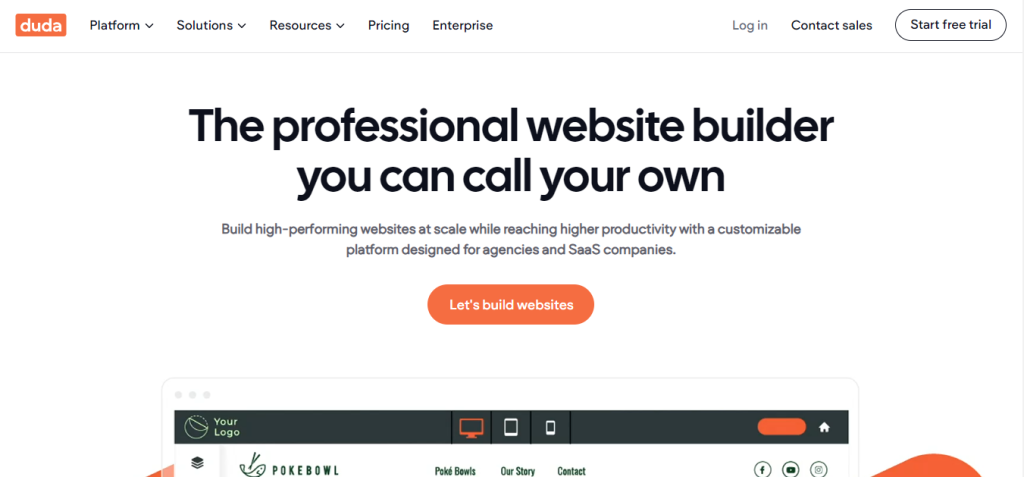
Duda: The White-Label Landing Page Builder Designed for Agencies and Designers
Duda isn’t just another landing page builder. It’s a powerful platform specifically designed for agencies and designers:
Unmatched White-Labeling: Deliver a seamless brand experience for your clients. Duda’s white-label editor empowers you to completely customize the platform’s interface, removing all references to Duda and replacing them with your branding.
Workflow Automation Made Easy: Streamline your processes with Duda’s built-in tools for building automated workflows. Create custom landing pages with conditional logic and dynamic content delivery for a truly personalized user experience.
Effortless Client Management: Duda simplifies working with multiple clients. The intuitive client management dashboard provides a centralized location to manage all your client projects, track progress, and collaborate effectively. User testing consistently ranks it among the best in the market.
Duda empowers agencies and designers to create high-converting landing pages, deliver exceptional white-labeled solutions, and manage client projects with unmatched ease.
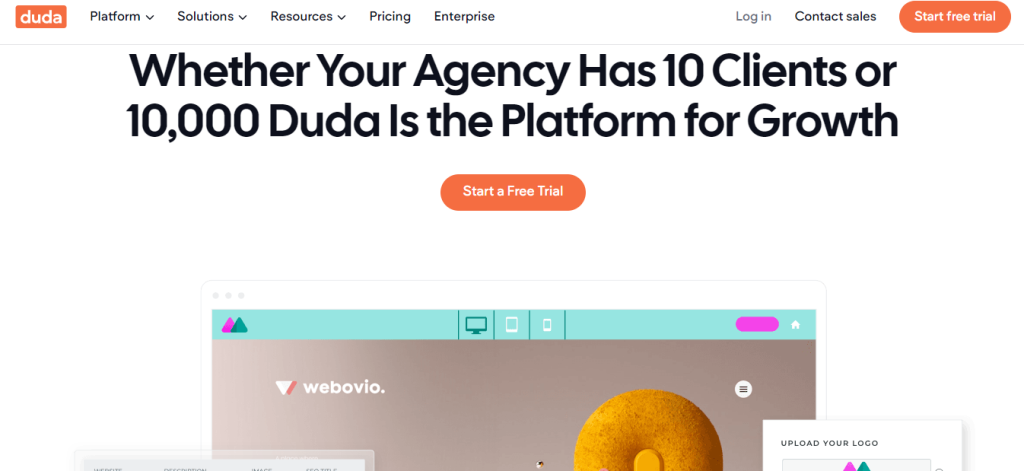
Duda: Building High-Performance Landing Pages with Seamless Client Collaboration
Duda goes beyond just creating beautiful landing pages. It sets you up for success with these key features:
Speed & Conversions: Duda prioritizes performance. Landing pages built with Duda consistently rank high on Core Web Vitals and page speed tests, which are critical for driving conversions and boosting your Google search rankings.
Granular Client Access: Empower your clients with the level of control they need. Duda’s role-based permissions allow you to grant access to specific design tools and features, ensuring a secure and tailored experience for each client. They can even manage their content through their dedicated client dashboards.
Effortless Design & Customization: Duda’s user-friendly drag-and-drop editor empowers anyone to create stunning landing pages with ease. Jumpstart your design process with a library of pre-built templates, and customize them to match your brand and vision.
Duda empowers agencies and designers to create high-performing landing pages, collaborate effectively with clients, and deliver exceptional white-labeled solutions.
Duda: The All-in-One Landing Page Powerhouse for Agencies and Designers
Duda empowers you to create high-converting landing pages, deliver exceptional white-labeled solutions, and manage client projects with unmatched ease. Here’s what sets Duda apart:
Unleash Your Brand: Deliver a seamless experience with Duda’s 100% white-label platform. Customize the entire interface to reflect your branding, ensuring a professional client experience.
Global Payment Solutions: Accept payments from anywhere in the world. Duda integrates with over 80 payment gateways, giving your clients ultimate flexibility and convenience.
Intuitive Design Environment: Duda’s user-friendly interface and drag-and-drop editor make creating landing pages a breeze, even for beginners. Explore a vast library of pre-built templates to jumpstart your design process.
Blazing-Fast Performance: Enjoy the reliability and security of AWS hosting. Duda prioritizes page speed optimization, ensuring your landing pages load lightning-fast, leading to better conversions and search rankings.
Duda University: Your Learning Partner: Never stop growing! Duda University provides a comprehensive learning hub with resources to help you master the platform, create high-performing landing pages, and stay ahead of the curve.
Data-Driven Decisions: Make informed decisions with Duda’s insightful analytics, statistics, and reporting. Track website visits, and conversion trends, and gain valuable insights to optimize your landing pages for success.
Effortless Client Management: Experience the most powerful client management tool in a white-label landing page builder. Duda simplifies collaboration with a user-friendly client dashboard, role-based access control, and simplified communication channels.
Rich Design Elements: Duda provides access to millions of free and premium stock images, allowing you to create visually appealing and engaging landing pages.
Global Payment Acceptance: Collect payments seamlessly from your clients, even in cryptocurrency, with Duda’s extensive payment gateway integrations.
Continuously Evolving Platform: Duda is committed to constant improvement. The platform benefits from ongoing development and an exceptional support team, available via priority emails, live chat, and phone calls.
Duda offers everything you need to create high-performing white-labeled landing pages, manage clients effectively, and achieve exceptional results.
Explore Your Perfect Fit with Duda Pricing (Gohighlevel Alternatives)
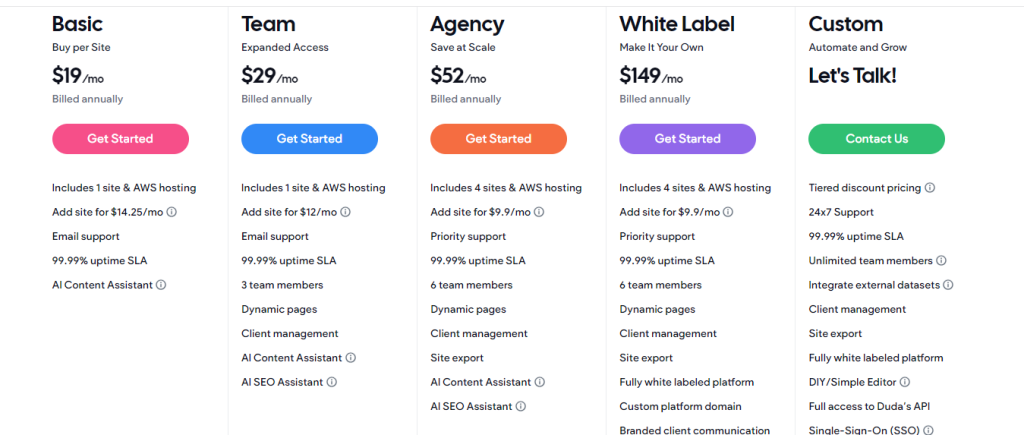
Duda offers a flexible pricing structure to accommodate the needs of agencies and designers of all sizes. Start your journey with a free 14-day trial to explore all features before committing. Here’s a breakdown of their paid plans:
Basic ($19/month): Ideal for freelancers and small teams. Build basic landing pages, manage one client, and leverage Duda’s core features to get started.
Team ($29/month): Perfect for growing agencies. This plan expands your capabilities with additional client management tools, team collaboration features, and increased design storage.
Agency ($52/month): The solution for established agencies. Enjoy all the features in Team, plus priority support, white-labeling options, and the ability to manage multiple clients for streamlined project management.
White label ($149/month): A more scale-driven plan for bigger business establishments, with a larger inflow of demands and consistent running of different projects at the same time.
Custom Plan (Custom Pricing): For agencies with high-volume needs or specific requirements, Duda offers custom plans with tailored features and pricing to match your unique business model.
Contact Duda’s sales team today to discuss your specific needs and unlock the full potential of white-labeled landing page creation.
ThriveCart: Beyond Shopping Carts, Building Conversion-Focused Sales Funnels
While widely recognized as a powerful shopping cart solution, ThriveCart offers much more. It empowers you to create high-converting sales funnels, streamlining the customer journey and maximizing revenue. This comprehensive functionality positions ThriveCart as a compelling alternative to HighLevel for businesses looking to boost sales.
Launched in 2016 by Josh Bartlett, ThriveCart has grown to serve over 150,000 business owners and entrepreneurs. It’s a trusted platform for businesses seeking to go beyond simple transactions and craft effective sales funnels that drive results.
ThriveCart: Where Sales Funnels Meet Smart Sales Tax Management
ThriveCart sets itself apart from other HighLevel competitors with its robust sales tax handling features. It automatically calculates taxes based on location, product type, and other relevant variables, eliminating the need for expensive integrations with third-party services.
However, it’s important to note that ThriveCart is primarily focused on building sales funnels and managing product sales. If your primary goal is lead generation and marketing automation campaigns, ThriveCart might not be the optimal solution for you.
ThriveCart: Craft Powerful Sales Funnels That Convert
ThriveCart equips you with everything you need to create high-performing sales funnels and drive sales. Here’s what sets it apart:
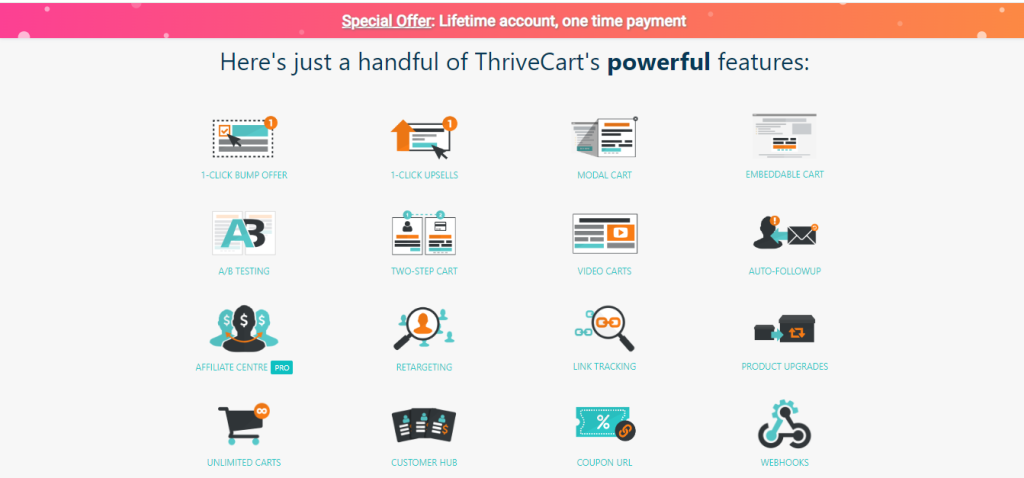
Effortless Funnel Building: Unleash your creativity with ThriveCart’s intuitive drag-and-drop funnel builder. Easily design engaging sales pages, standalone checkout pages, pop-up order forms, embedded order forms, and multi-step order forms to guide your customers seamlessly through the buying journey.
Jumpstart Your Success: Don’t waste time starting from scratch. ThriveCart provides a library of pre-built funnel templates that you can easily customize to match your brand and product offerings.
Data-Driven Optimization: Make informed decisions with ThriveCart’s built-in A/B testing feature. Test different variations of your sales pages to see which one converts best and continuously optimize your funnels for maximum results.
Actionable Insights: Gain valuable insights into your sales funnel performance with ThriveCart’s advanced analytics. Track key metrics, identify areas for improvement, and refine your funnels for ongoing success.
Empower Your Affiliates: Grow your reach and sales by creating a thriving affiliate program. ThriveCart’s built-in affiliate management tool allows you to recruit, manage, and track the performance of your affiliates, maximizing your sales potential.
ThriveCart is your one-stop shop for building high-converting sales funnels, managing affiliates, and gaining valuable insights to optimize your sales strategy.
ThriveCart: Affordable Ownership for Your Sales Funnels
ThriveCart breaks the mold with its unique pricing structure, making it an attractive option for businesses seeking a cost-effective solution for sales funnels. Here’s what sets it apart:
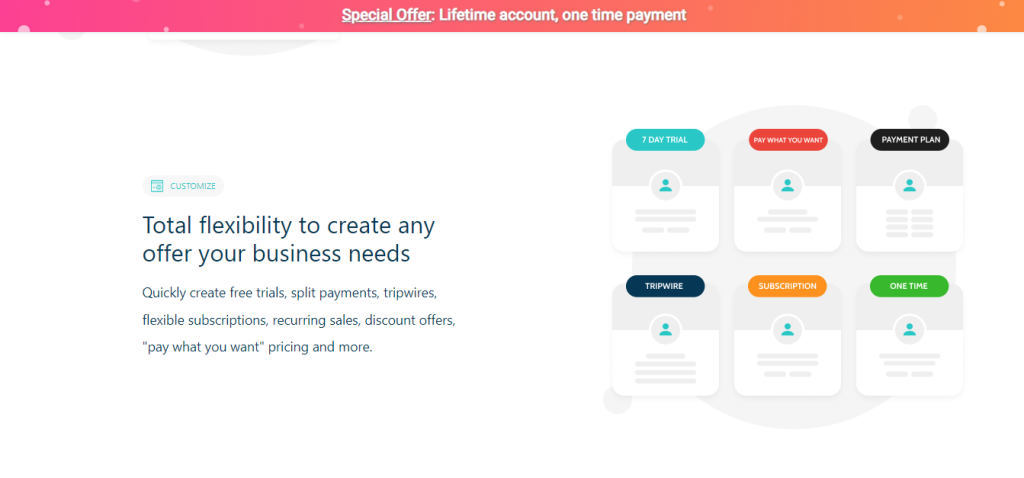
Lifetime Ownership: Unlike most competitors, ThriveCart offers a lifetime license for a one-time fee of $495. This eliminates ongoing monthly subscriptions and empowers you to own the software for life.
Unmatched Value: Compared to other HighLevel alternatives, ThriveCart’s lifetime pricing delivers exceptional value. You gain access to all its powerful sales funnel features for a single upfront investment.
ThriveCart is the only HighLevel alternative that allows you to pay once and own the software forever. This, combined with its robust feature set, makes it a compelling choice for businesses seeking a cost-effective and feature-rich sales funnel solution.
Expand Your Sales Funnel Potential with ThriveCart Pro
ThriveCart offers a standard plan with a lifetime license for $495. For those seeking even more advanced functionality, they also provide a ThriveCart Pro option. This Pro Account is available for a one-time payment of $690 and unlocks additional features to take your sales funnels to the next level.
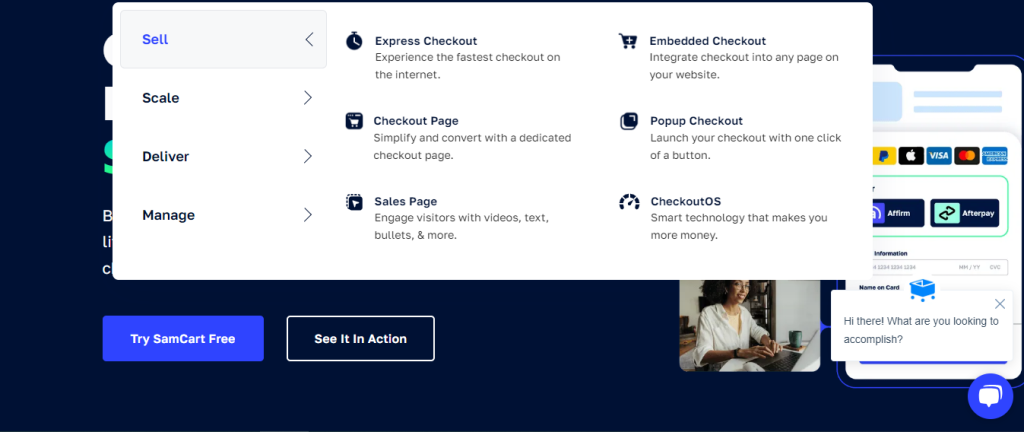
SamCart: Streamline Your Checkout Process and Boost Conversions
Looking for a powerful solution to optimize your online checkout experience? Look no further than SamCart. While it doesn’t offer the full suite of features for building complex sales funnels like ThriveCart, SamCart excels in:
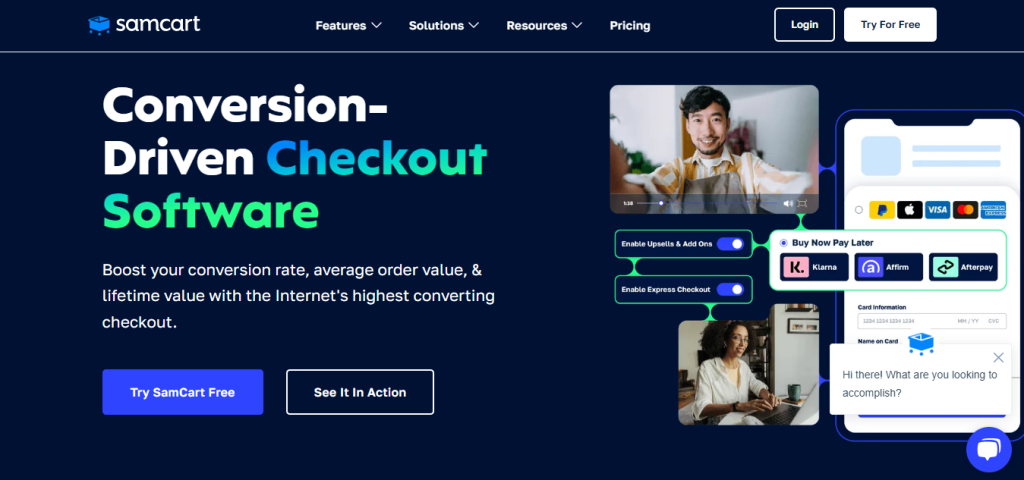
Frictionless Checkouts: SamCart empowers you to create beautiful, user-friendly checkout pages that minimize distractions and streamline the buying process for your customers. This translates to higher conversion rates and increased sales.
Simple Sales Funnel Creation: Although not as robust as dedicated sales funnel builders, SamCart allows you to create basic sales funnels to collect payments effectively. This is ideal for businesses with straightforward product offerings or those seeking a quick and easy solution.
If your primary focus is on optimizing your checkout process and collecting payments efficiently, SamCart is a perfect solution. For businesses requiring advanced sales funnel functionality, consider exploring alternatives like ThriveCart.
Launched in 2014 by Brian and Scott Moran, SamCart has become a trusted platform for over 22,000 small business owners and entrepreneurs. It has facilitated the processing of over $2.2 billion in sales for businesses selling both physical and digital products. SamCart’s track record and user base demonstrate its effectiveness in helping businesses streamline their checkout experiences and boost sales.
SamCart: Supercharge Your Checkouts and Simplify Sales
SamCart equips you with everything you need to streamline your checkout process and boost conversions. Here’s what sets it apart:
Effortless Checkout Design: No coding required! SamCart offers a library of pre-built, gorgeous, and high-converting checkout templates. Simply choose one that aligns with your brand and customize it for a seamless customer experience.
Sales Funnels Made Simple: While not as intricate as dedicated builders, SamCart’s intuitive sales funnel builder allows you to create effective sales funnels with ease. This includes the ability to strategically place order bumps and one-click upsells to maximize your revenue, all with zero transaction fees.
Flexible Payment Options: Cater to diverse customer preferences with SamCart’s robust checkout features. You can create subscriptions or recurring payments, one-time or installment plans, and even trial offers to incentivize purchases.
Empower Your Affiliate Network: Expand your reach and sales potential with SamCart’s impressive affiliate management software. Easily create affiliate links and recruit marketers to promote your products or services, leveraging their networks to drive sales.
Seamless Integrations: Connect SamCart seamlessly with over 700 essential business tools. This includes email marketing platforms, membership site software, and payment processors, ensuring streamlined workflows and centralized data management.
SamCart is your one-stop shop for creating high-converting checkout experiences, building basic sales funnels, and managing an affiliate program. Focus on growing your business, and let SamCart handle the checkout process.
SamCart: Find the Perfect Plan to Match Your Sales Needs (Gohighlevel Alternatives)
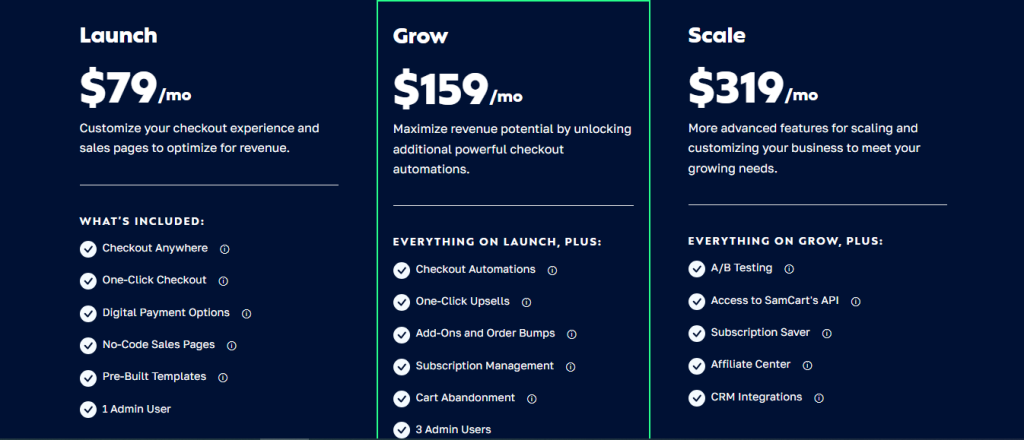
SamCart offers a tiered pricing structure to cater to businesses of all sizes. Start your journey with a free 14-day trial to explore all features before committing. Here’s a breakdown of the paid plans:
Launch ($79/month): Ideal for getting started. Create beautiful checkout pages, collect payments securely, and leverage basic sales funnel features to boost conversions.
Grow ($159/month): Perfect for growing businesses. Unlock additional features like order bumps, one-click upsells, and subscription management to maximize your revenue potential.
Scale ($319/month): The solution for established businesses. Enjoy all the features in Grow, plus advanced affiliate management tools, priority customer support, and the ability to remove SamCart branding for a professional touch.
SamCart empowers you to choose the plan that aligns perfectly with your business goals and sales volume. Start your free trial today and experience the power of streamlined checkouts and simplified sales!
Choosing Between SamCart and ThriveCart
Both SamCart and ThriveCart are excellent platforms for streamlining your checkout process and boosting sales. Here’s a recap to help you decide which might be the better fit for your needs:
SamCart: Shines in checkout experience optimization and ease of use. Its robust affiliate management software and pre-built, high-converting checkout templates make it ideal for businesses seeking a user-friendly solution with a strong affiliate program. However, its sales funnel functionalities are more basic.
ThriveCart: Offers a comprehensive sales funnel builder, allowing for the creation of more complex and conversion-focused sales sequences. This, combined with its lifetime ownership option, makes it a compelling choice for businesses seeking advanced sales funnel capabilities and a one-time investment. However, it doesn’t offer the same level of out-of-the-box affiliate management features as SamCart.
Ultimately, the best platform depends on your specific needs. Consider your priorities:
If checkout optimization, affiliate management, and ease of use are your top concerns, SamCart might be the ideal solution.
If you prioritize advanced sales funnel building and a one-time purchase option, ThriveCart could be a better fit.
I recommend trying out the free trials offered by both platforms to experience their features firsthand and make an informed decision.
DropFunnels: Stand Out with Cryptocurrency Payments and Conversion-Focused Funnels
Looking for a GoHighLevel alternative that breaks the mold? DropFunnels offers unique functionalities to set your business apart:
Embrace the Future of Payments:DropFunnels is the only platform on this list that currently allows you to collect cryptocurrency payments from your clients. This caters to a growing tech-savvy audience and expands your payment acceptance options.
Speed & Conversions by Design:DropFunnels prioritizes building fast-loading and responsive sales funnels and landing pages. This ensures a smooth user experience across devices, keeping your visitors engaged and maximizing your conversion rates.
https://youtu.be/T9CTbO0r-QE
DropFunnels empowers you to create high-performing sales funnels, accept cutting-edge cryptocurrency payments, and deliver a superior customer experience.
Launched in 2019 by Jordan Medirich, DropFunnels has established itself as a valuable platform for small business owners and entrepreneurs. Their core focus is on helping you create high-performing funnels that rank well on Google search results, eliminating the need to navigate the complexities of WordPress for building landing pages and sales sequences. This user-friendly approach empowers businesses to focus on their core offerings and achieve online success.
DropFunnels: Build Conversion-Focused Sales Funnels with Ease
DropFunnels equips you with everything you need to create high-performing sales funnels and landing pages that drive results. Here’s what sets it apart:
Blazing-Fast Performance:DropFunnels prioritizes speed. Your funnels and pages will load lightning-fast and render flawlessly across devices, keeping your visitors engaged and maximizing conversions.
Drag-and-Drop Design Freedom: Unleash your creativity with the intuitive visual builder. Effortlessly design landing pages, sales funnels, one-click upsells, downsells, multi-step order forms, and more, all without needing coding expertise.
Membership Made Easy: Create robust membership sites with DropFunnels. Define multiple access levels and control content delivery with drip features to keep your members engaged and coming back for more.
SEO Powerhouse: Effortlessly optimize your funnels for search engines. DropFunnels includes a built-in WordPress blog post creation tool with an SEO schema framework. This helps your funnels get indexed and rank higher on Google, driving organic traffic.
Seamless Integrations: Connect DropFunnels seamlessly with your favorite marketing tools. Integrations with email marketing platforms like AWeber, ActiveCampaign, ConvertKit, and Keap (formerly Infusionsoft) streamline your workflows and centralize data.
Flexible Payment Options: Provide your customers with a variety of payment options. DropFunnels integrates with leading payment gateways including Stripe, PayPal, NMI, Authorize.net, and even Coin Payments for accepting cryptocurrency.
Collaborative Funnel Sharing: The Share Funnel feature allows you to easily share your creations with other DropFunnels users, fostering collaboration within your team or with clients.
DropFunnels empowers you to create high-converting funnels, accept a wide range of payments, and leverage powerful integrations to streamline your marketing efforts.
DropFunnels: Find the Perfect Plan to Match Your Funnel Needs (Gohighlevel Alternatives)
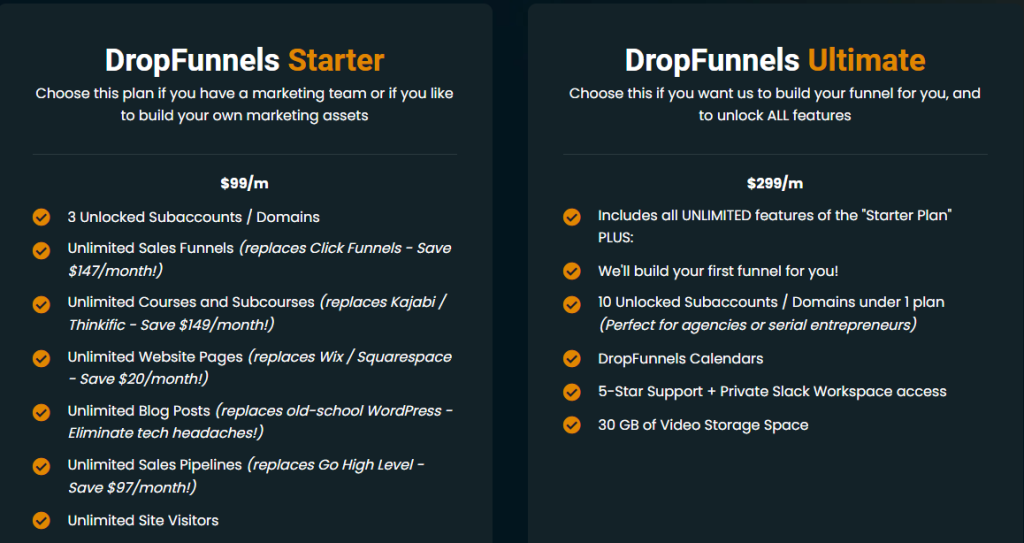
DropFunnels offers a tiered pricing structure to cater to businesses of all sizes. While the Lite and Starter plans offer a 14-day free trial, the Partner plan requires an upfront commitment. Here’s a breakdown of the options:
Starter ($99/month): Perfect for growing businesses. Unlock advanced features like unlimited funnels, unlimited members with multi-level access, and priority support to take your marketing efforts to the next level.
Ultimate ($299/month): The solution for established businesses and agencies. This plan offers everything in Starter, plus advanced integrations, priority phone support, the ability to remove DropFunnels branding, and the option to create client accounts for collaborative work.
Choose the DropFunnels plan that aligns with your business goals and funnel complexity. Start your free trial today and experience the power of building high-performing sales funnels with ease!
Convertri: Blazing-Fast Funnels Optimized for Conversions
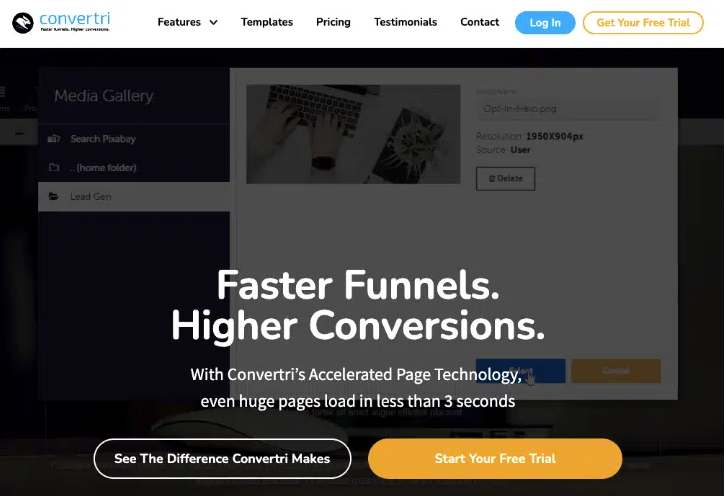
Convertri joins DropFunnels as another strong GoHighLevel contender, prioritizing lightning-fast loading speeds for your sales funnels and landing pages. This ensures a seamless user experience across devices, keeping visitors engaged and driving conversions.
It’s important to note that, similar to DropFunnels, Convertri focuses primarily on funnel building and doesn’t offer functionalities like built-in email autoresponders or affiliate management tools. If these features are essential for your business, platforms like Kartra or ClickFunnels might be a better fit.
Convertri empowers you to create high-performing funnels with exceptional speed, but keep in mind its feature set when making your choice.
Expanding Your Reach: Membership Site Functionality
While both Convertri and DropFunnels excel in building fast-loading funnels, DropFunnels offers an additional feature that might be crucial for some businesses: membership sites.
With DropFunnels, you can create robust membership sites, allowing you to host and sell online courses, drip content to members, and manage access levels. This functionality can be valuable for businesses seeking to create exclusive content communities or deliver educational programs.
Consider your specific needs when making your decision. If building and selling courses is a priority, DropFunnels’ membership site feature might be a deciding factor.
Convertri: Craft High-Converting Funnels with Speed and Personalization
Convertri empowers you to create high-performing sales funnels that drive results, all within an intuitive and user-friendly environment. Here’s what sets it apart:
Effortless Funnel Building: Convertri boasts one of the most user-friendly drag-and-drop funnel builders on the market. This makes creating engaging sales funnels, landing pages, and order forms an enjoyable experience, even for beginners.
Boost Conversions with Upsells & Order Bumps: Maximize your revenue potential with strategic upsells, one-click order bumps, and multi-step order forms. Convertri empowers you to seamlessly guide your customers toward higher-value purchases.
Ready-Made Success: Jumpstart your funnel creation with Convertri’s extensive library of pre-built, high-converting funnel templates. Simply customize them to match your brand and offerings for a quick start.
Flexible Checkout Options: Cater to diverse customer preferences with Convertri’s dynamic checkout system. Offer trial periods, coupons, one-time payments, or recurring subscriptions to provide maximum flexibility for your customers.
Lightning-Fast Performance: Don’t let slow loading times hinder your conversions. Convertri’s accelerated page technology ensures your funnels and pages load in under 3 seconds, keeping visitors engaged and driving action.
Connect Your Email Marketing: Seamlessly integrate Convertri with your preferred email marketing service. This allows for automated communication sequences and targeted marketing campaigns based on user behavior.
Personalized Touch: Create a unique buying experience for each customer with Convertri’s Dynamic Text Replacement feature. Personalize thank-you pages and other elements with dynamic content, fostering stronger customer relationships.
Multiple Payment Options: Accept payments securely and conveniently with Convertri’s integrations with leading payment gateways. Offer your customers the payment methods they trust to complete their purchases with ease.
Convertri’s user-friendly interface, powerful features, and focus on speed and personalization make it a compelling choice for businesses seeking to build high-converting sales funnels and deliver exceptional customer experiences.
Convertri: Straightforward Pricing for Streamlined Funnels
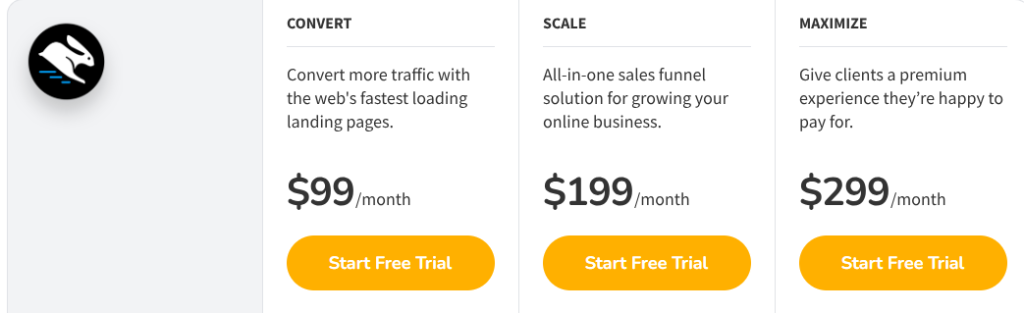
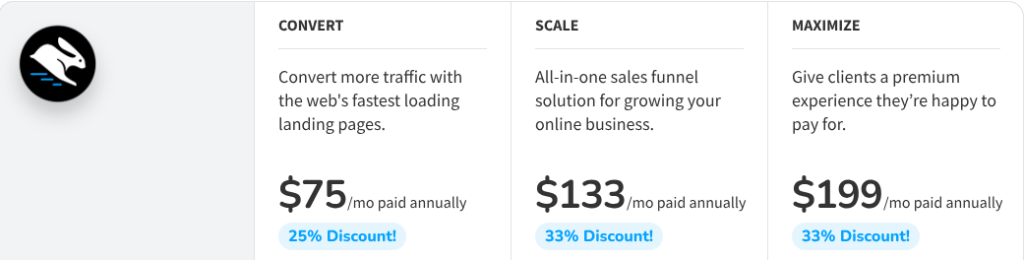
Convertri offers a transparent pricing structure with a single plan that caters to most business needs. Choose between two convenient billing options:
Monthly Billing: Enjoy the flexibility of a month-to-month plan at $99 per month.
Annual Billing: Opt for the cost-effective annual plan and pay only $75 per month (billed annually). This translates to a savings of 24% compared to the monthly plan.
Convertri simplifies your budgeting with a clear pricing structure, allowing you to focus on building high-performing funnels and achieving your business goals.
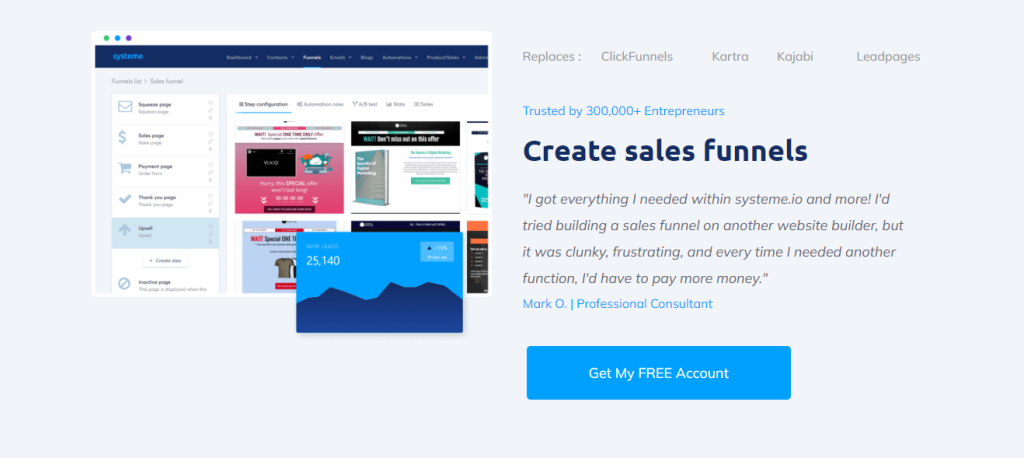
Systeme.io: A Feature-Rich Free Plan for Building Sales Funnels
In the crowded landscape of GoHighLevel alternatives, Systeme.io stands out for its generous free plan. Launched in 2018, the platform has gained traction by offering a robust feature set for creating sales funnels at no cost.
Here’s what makes Systeme.io‘s free plan attractive:
Build Sales Funnels for Free: Design and launch basic sales funnels to capture leads and convert them into paying customers, even on the free tier. This allows you to test the platform’s capabilities and see if it aligns with your needs before committing to a paid plan.
Cost-Effective Paid Options:Systeme.io offers several paid plans with progressively more features as your business grows. This tiered pricing structure ensures you only pay for the functionalities you need.
Consider Systeme.io if you’re a budget-conscious entrepreneur seeking a platform to build basic sales funnels for free. The platform’s affordability and free plan features make it a strong contender for businesses starting their online journey.
Systeme.io: Empowering Businesses with Affordable Sales Funnels and Marketing Tools
Systeme.io caters to a broad audience, including course creators, freelancers, consultants, and small business owners. Its focus lies in providing user-friendly tools at an accessible price point to help you manage your online presence effectively.
Here’s what makes Systeme.io an attractive option:
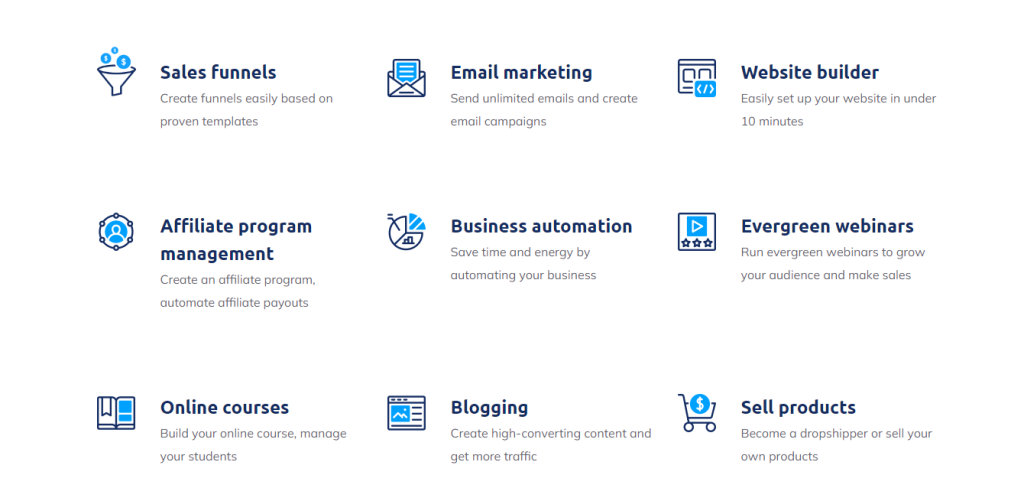
All-in-One Marketing Suite: Systeme.io offers a comprehensive toolkit that rivals established platforms like ClickFunnels and Kartra. Build high-converting sales funnels to nurture leads, grow your audience, and seamlessly sell your products or services.
Streamlined Course Creation & Sales: Launch and manage online courses with ease. Systeme.io provides the tools you need to create valuable content, host courses, and facilitate sales through effective marketing strategies.
Affiliate Program Management: Expand your reach and sales potential by building a thriving affiliate program. Systeme.io equips you to recruit, manage, and track the performance of your affiliates.
Scalable Solution: Systeme.io’s tiered pricing structure allows you to choose a plan that aligns with your business needs. Start small and scale up as you grow, ensuring you only pay for the features you require.
Systeme.io is a powerful and affordable solution for entrepreneurs and businesses seeking to manage their online presence, create sales funnels, launch courses, and achieve their marketing goals.
Systeme.io: Build, Automate, and Scale Your Business
Systeme.io equips you with everything you need to create high-performing sales funnels, launch online courses, manage your email marketing, and grow your business. Here’s what empowers you:
Intuitive Drag-and-Drop Builder: Effortlessly design landing pages, webinar registration forms, thank-you pages, pop-ups, and checkout experiences. Build high-converting sales funnels with upsells, downsells, and order bumps, all without coding knowledge.
Optimize with A/B Testing: Fine-tune your funnels for maximum conversions. Systeme.io’s A/B testing feature allows you to split-test different versions of your landing pages and see which ones resonate best with your audience.
Hit the Ground Running with Templates: Jumpstart your design process with a library of professionally designed templates. Systeme.io offers a wide range of options to match your brand and marketing goals.
Powerful Email Automation: Nurture leads and drive sales with robust email marketing capabilities. Systeme.io allows you to send unlimited emails per month, facilitating automated email sequences and targeted campaigns.
Membership Site Builder: Create and manage exclusive membership sites with ease. Host and sell online courses, deliver valuable content to your members, and control access levels with Systeme.io’s membership site features.
Effortless Affiliate Management: Expand your reach and sales potential by building a thriving affiliate program. Systeme.io provides tools to effortlessly recruit, manage, and track the performance of your affiliates, even automating commission payouts.
Systeme.io is an all-in-one marketing suite that simplifies building sales funnels, managing courses, and automating your email marketing. Focus on growing your business while Systeme.io handles the technical complexities.
Systeme.io: Choose the Perfect Plan to Match Your Needs (Gohighlevel Alternatives)
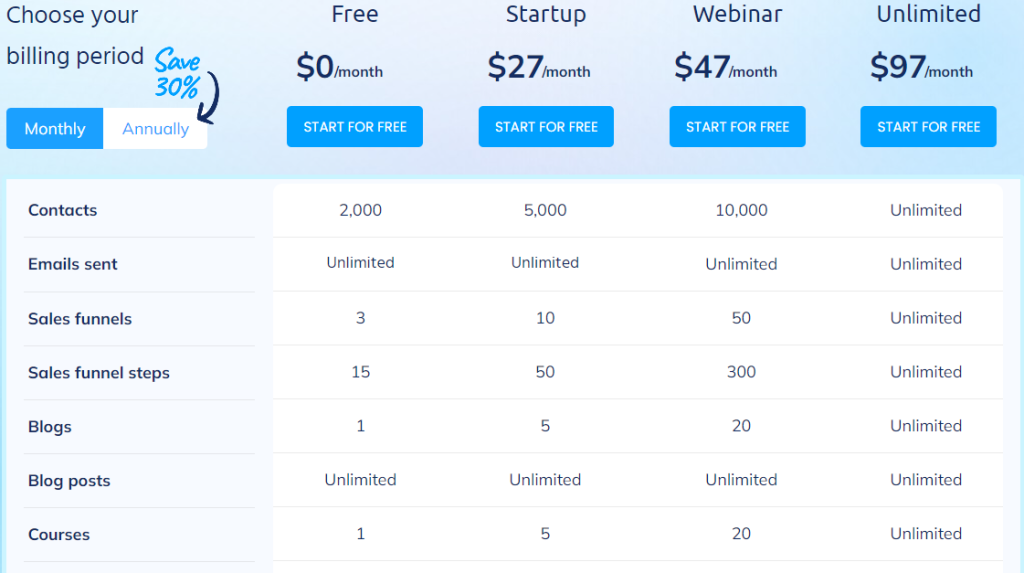
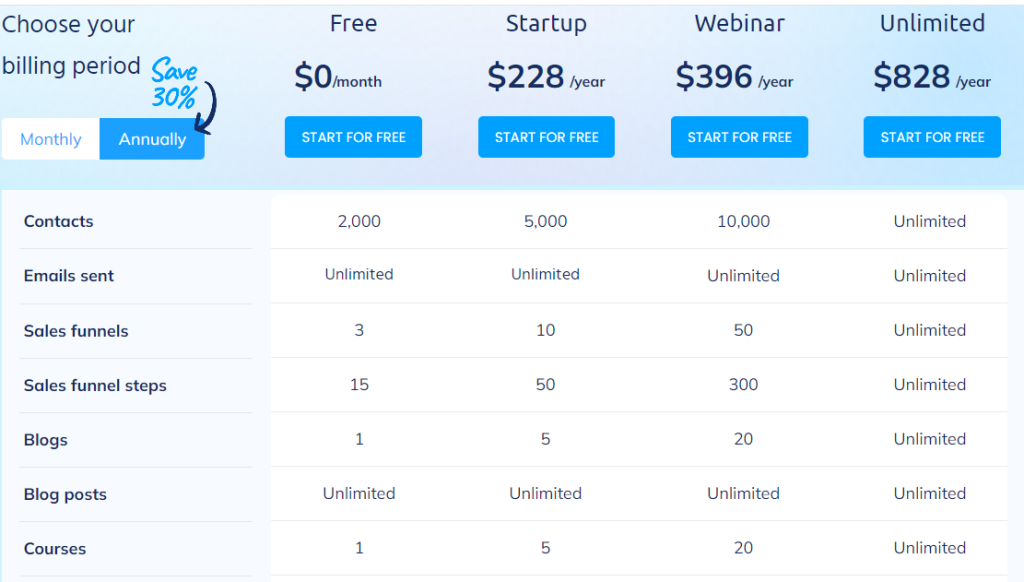
Systeme.io offers a tiered pricing structure to cater to businesses of all sizes. Here’s a breakdown of the plans to help you find the best fit:
Free Plan ($0/month): A perfect starting point. Experiment with creating landing pages, and sales funnels, and capture leads to test the platform’s capabilities before committing. This free tier allows you to explore the system and see if it aligns with your needs.
Startup Plan ($27/month): Ideal for getting started. This plan unlocks features to build effective sales funnels, manage up to 2,000 contacts, and launch basic email marketing campaigns. It’s a cost-effective option for solopreneurs or businesses starting their online journey.
Webinar Plan ($47/month): Perfect for businesses that leverage webinars. This plan builds upon the Startup features and adds functionalities specifically designed for webinars, including up to 5,000 contacts and advanced automation capabilities.
Enterprise Plan ($97/month): The solution for established businesses. Enjoy all the features in the lower tiers, plus unlimited contacts, advanced customization options, and priority support. This plan caters to businesses with high sales volume and complex marketing needs.
Systeme.io empowers you to choose the pricing plan that aligns with your budget and business stage. Start your free trial today and experience the power of building sales funnels, managing courses, and automating your marketing efforts!
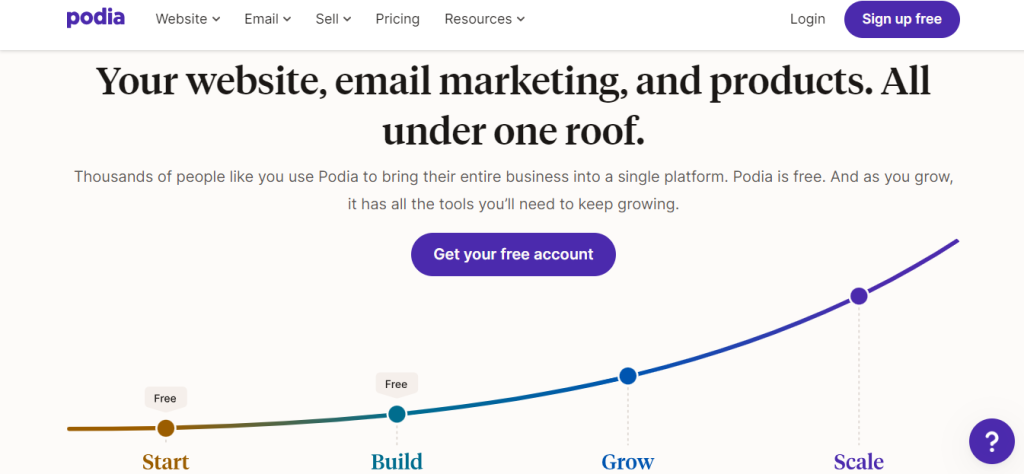
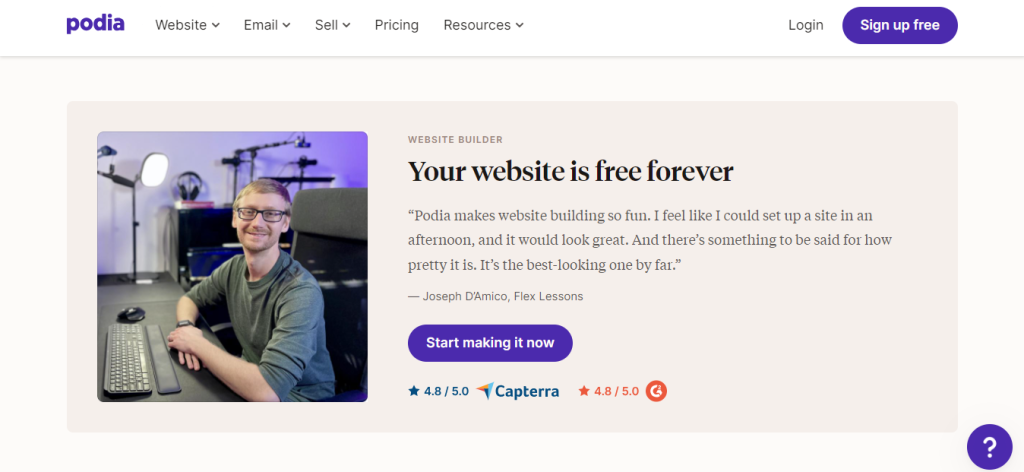
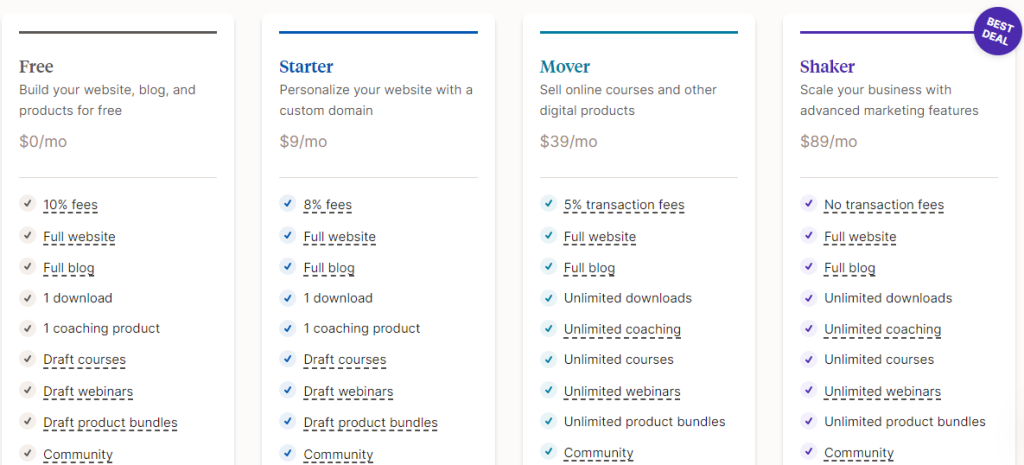
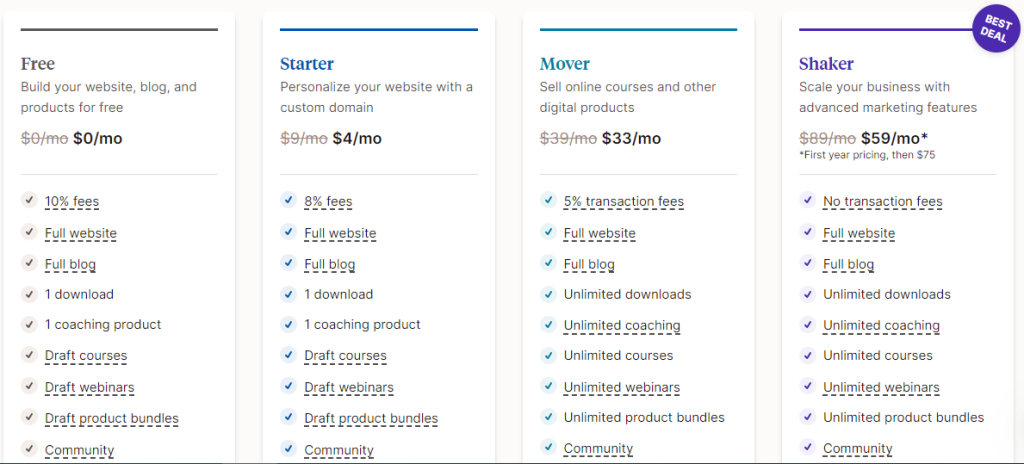
Podia: Streamline Your Sales Funnels and Boost Revenue
Looking for a user-friendly platform to create high-performing sales funnels and accelerate your revenue growth? Podia might be the perfect fit. Here’s what sets it apart:
All-in-One Sales Funnel Builder: Effortlessly design and launch sales funnels that convert visitors into customers. Podia empowers you to capture leads, nurture prospects, and seamlessly sell your products or services through a unified platform.
Focus on Revenue Growth:Podia prioritizes features that drive sales. Build effective sales funnels, integrate with your favorite payment processors, and leverage powerful tools to optimize your pricing strategies. This combination helps you maximize your revenue potential.
Cost-Effective Solution:Podia offers competitive pricing plans, making it an attractive option for businesses of all sizes. Focus your budget on growing your business, not expensive marketing software.
Consider Podia if you’re seeking a user-friendly platform with a focus on building effective sales funnels and accelerating revenue growth. Its affordability and feature set make it a compelling choice for businesses seeking to streamline their online sales process.
Podia: Sell Your Knowledge and Expertise with Ease
Podia goes beyond simply building sales funnels. It’s your all-in-one platform to turn your knowledge and expertise into a thriving online business. Here’s how:
Craft Captivating Sales Funnels: Design high-converting sales funnels that effortlessly capture leads, nurture prospects, and convert them into paying customers. Podia streamlines your entire sales process.
Membership Sites Made Easy: Create exclusive membership sites where your audience can access valuable content, courses, or communities. Podia empowers you to control access levels and set recurring fees, creating a sustainable revenue stream.
Automated Email Marketing: Stay connected with your audience and nurture leads with automated email sequences. Podia simplifies email marketing, allowing you to send targeted campaigns and engage with your subscribers effectively.
Effortless Affiliate Management: Expand your reach and sales potential by building a network of affiliates. Podia provides tools to recruit, manage, and track the performance of your affiliates, even automating commission payouts.
Podia empowers you to create, sell, and promote your online courses, memberships, and other digital products. Focus on creating valuable content, and let Podia handle the technical complexities of building sales funnels, managing memberships, and automating your marketing efforts.
Podia: Build, Sell, and Automate Your Online Business
Podia equips you with everything you need to create a thriving online presence and turn your expertise into sales. Here’s what empowers you:
Effortless Drag-and-Drop Builder: Design beautiful landing pages, product pages, and checkout experiences with Podia’s intuitive drag-and-drop builder. No coding knowledge is required, allowing you to create a professional online storefront for your digital products.
Sell Valuable Content: Podia isn’t just for courses. Sell ebooks, webinars, or any other digital product you create. This platform provides a secure and convenient way to monetize your knowledge and expertise.
Automate Your Marketing: Nurture leads and convert them into customers with powerful email marketing automation. Podia allows you to send targeted email sequences, schedule campaigns, and engage with your audience effortlessly.
Expand Your Reach with Affiliates: Build a network of affiliates to promote your products and services. Podia’s affiliate management system simplifies recruitment, and tracking, and even automates commission payouts, making it easy to leverage the power of affiliate marketing.
Podia simplifies building your online business. Create stunning landing pages, sell digital products, automate your marketing, and manage affiliates, all from a single platform.
Podia: Find the Perfect Fit for Your Online Business
Podia offers a variety of pricing plans to cater to businesses of all sizes. Here’s a breakdown to help you choose the ideal option:
Free Plan ($0/month): Experiment with Podia’s core functionalities at no cost. Build landing pages, create a basic product, and test email marketing features to see if the platform aligns with your needs. This is a great way to get started before committing to a paid plan.
Starter Plan ($9/month): The perfect starting point for solopreneurs or businesses launching their first online product.
Mover Plan ($39/month): Cost-Effective Way to Start Selling Digital Products (Combines affordability and product focus). This plan unlocks essential features for building sales funnels, selling unlimited products, and managing email marketing campaigns.
Shaker Plan ($89/month): Ideal for growing businesses. The Shaker plan offers everything in the Mover plan, plus advanced functionalities like memberships, coupons, and affiliate marketing tools. This plan empowers you to scale your online business and reach a wider audience.
Earthquaker Plan ($199/month): The solution for established businesses with high sales volume. This top-tier plan includes all Podia features, with unlimited everything and priority customer support.
Choose the Podia plan that aligns with your budget and business stage. Start your free trial today and experience the ease of building sales funnels, selling digital products, and automating your marketing efforts!
A veteran in the online marketing world, GetResponse has been around since 1998. Trusted by big brands like Stripe and Ikea, it empowers over 350,000 users in more than 180 countries to achieve their marketing goals.
Is frustration holding your email marketing hostage? High costs, clunky interfaces, and zero automation can make it a chore. GetResponse steps in as a hero, promising to save you money, streamline your efforts, and automate tedious tasks. With a feature-rich toolbox, this platform caters to both beginners and experienced marketers, allowing you to unleash the true potential of your email campaigns.
GetResponse started as a champion of email marketing automation, but its ambitions grew. Over time, it’s transformed into a comprehensive all-in-one marketing platform. Get ready to unlock a treasure trove of features! Let’s dive in…
Stop juggling marketing tools! GetResponse brings everything you need under one roof. From email marketing and automation to webinars and sales funnels, this platform empowers businesses of all sizes to connect with their audience, expand their reach, and boost sales.
**Go beyond basic email! GetResponse is a marketing powerhouse that lets you craft stunning emails, automate campaigns, run engaging webinars, and build sales funnels. But that’s not all. This platform packs a punch with features like
Create a product haven to showcase your offerings.
Integrate with popular payment gateways for secure transactions.
Set up sales funnels to strategically guide customers to purchase.
Sell with confidence! GetResponse seamlessly integrates with industry-leading payment processors like Stripe, BlueSnap, PayU, PayPal, and Square.
Plus, enjoy top-notch customer service to support you every step of the way.
GetResponse started in 1999 as a Polish startup with a simple mission: provide user-friendly email marketing for small businesses. Since then, it’s transformed into a leading platform for all your email marketing and marketing automation needs.
Fit GetResponse to your budget! They offer a range of plans, from a free option to feature-rich premium plans. Here’s a quick look:
Email Marketing Plan ($19/month): For a small monthly fee, unlock more marketing muscle.GetResponse combines the power of AI with unlimited sends and list-building tools, giving you everything you need to expand your reach and achieve your marketing goals.
Marketing Automation Plan ($59/month): Take your campaigns to the next level with advanced marketing automation. GetResponse automates your email marketing, keeping your audience engaged and propelling them toward conversions.
E-commerce Marketing Plan ($119/month): Access all the bells and whistles for the most demanding needs.GetResponse’s e-commerce features and integrations unlock a smoother sales journey, leading to more satisfied customers and a thriving business.
GetResponse Max ($1099/month): The enterprise plan offers sophisticated email and marketing automation tools designed to help large organizations reach new heights in revenue generation.
While there isn’t a separate free trial for paid plans, you can always start with the Free plan to get a feel for GetResponse.
GrooveFunnels is your all-in-one shop for selling digital products and services online. Build automated sales funnels, effortlessly manage affiliates and commissions, and integrate an order delivery system – all under one roof. GrooveForms even automates order delivery, making it easier than ever to get products to your customers.
GrooveFunnels: Your marketing and sales powerhouse in one place!
Imagine having access to over 10 powerful marketing apps, all seamlessly integrated under one roof. That’s the magic of GrooveFunnels. It caters to almost any business, from local shops to global enterprises.
Need a website, email marketing, a membership site, or an e-commerce store?GrooveFunnels has you covered. Plus, it offers features for webinars, sales management, affiliate programs, and more.
Local businesses: Boost your online presence and sales.
Bloggers and coaches: Share your expertise and connect with your audience.
Course creators: Sell your knowledge and build a thriving online academy.
Marketing agencies: Manage multiple client campaigns with ease.
E-commerce store owners: Streamline your sales process and grow your customer base.
Membership site owners: Create exclusive content communities and recurring revenue.
Digital product creators: Sell ebooks, software, and more with a complete sales funnel.
Plus, web developers, sales funnel builders, graphic designers, email marketing specialists, affiliate marketers, joint venture specialists, webinar organizers, and any online entrepreneur can leverage GrooveFunnels to take their business to the next level.
GrooveFunnels offers a free plan with valuable features and a PRO plan that unlocks everything without limits. Whether you’re just starting or looking to scale your online business, GrooveFunnels has the tools to help you succeed.
Free/Start-Up Plan (30 days free trial): GrooveFunnels Start-Up Plan (free trial available) offers email marketing, unlimited website pages and stores, various payment gateways, and more to launch your online business.
Creator+ Plan ($42/mo) Supercharge your marketing with 70% savings: GrooveFunnels Creator+ Plan (discounted) offers massive reach (10,000 contacts), unlimited design, sales features, templates, and content creation tools for a professional online presence. Upgrade for full branding control.
Premium+ Plan ($299/mo) Go all-in with unlimited everything: GrooveFunnels Premium+ Plan offers unlimited features for email marketing, websites, sales, memberships, content creation, and integrations to scale your business without limits.
Premium+ Lifetime ($2,597) Pay once, get unlimited marketing power forever: GrooveFunnels Premium+ Lifetime Plan provides all features for email marketing, websites, sales, memberships, content creation, and integrations with a one-time payment for unlimited use.
Vendasta: Leveling the tech playing field for small businesses.
Vendasta cuts through the tech clutter, making powerful tools easy to use, find, and afford for small businesses. It’s an all-in-one ecosystem that connects:
Businesses: You get a single login to a comprehensive suite of tools for marketing, sales, billing, fulfillment, and more.
Trusted Experts: These experts use Vendasta to create white-labeled solutions they can sell to you.
Technology Vendors: Vendasta provides a platform for managing orders and reaching new customers through a network of over 10,000 experts serving millions of businesses.
In short, Vendasta empowers small businesses to thrive with the right technology, while streamlining operations for experts and vendors.
Vendasta: Streamline Your Business Operations and Cut Costs.
It is a customizable platform that offers a range of digital solutions and services. Plus, our in-house fulfillment team and robust platform cater to businesses of all sizes, even multi-location brands. Vendasta helps you achieve cost savings without compromising on performance.
This rephrased version uses stronger verbs and emphasizes the dual benefits of cost savings and maintaining performance. It also clarifies that the platform is suitable for businesses of all sizes.
Become Your Clients’ Digital Hero with Vendasta! (This emphasizes the benefit to the user)
Vendasta is your all-in-one platform to supercharge your local marketing expertise. Market, sell, bill, and fulfill digital solutions for your SMB clients with ease.
Here’s what sets you apart:
White-label magic: Provide clients with a branded operating system to manage their digital tools.
Effortless client management: Empower clients with tools to manage products, analytics, and customer communication – all in one place.
Recurring revenue machine: Unlock the power of monthly recurring revenue with Vendasta’s seamless system.
Build trust and loyalty: Deliver exceptional service and become your clients’ go-to digital partner.
Join a Network of Experts: Vendasta is trusted by marketing agencies, media companies, and more. Sign up for your free 14-day trial and see how Vendasta can help you transform your local business! (This emphasizes the benefits and includes a call to action)
This rephrased version uses stronger verbs, highlights key benefits for local experts, and includes a clear call to action. It also shortens the text for better readability.
VENDASTA PRICING
Streamline and grow your local marketing business by selling with the Vendasta platform Find the pricing plan that’s right for you. Start 14-day trial
Ideal for agencies needing high-volume automation and advanced features to deliver exceptional client service.
Vendasta Enterprise: offers a custom solution for large agencies with high-volume needs. It provides;
Unlimited scalability: Scale your team and automation (get a quote for specific limits).
White-labeled software: Deliver a seamless client experience with your branding.
Advanced project management and payments: Handle complex projects and accept payments effortlessly.
In-depth reporting and insights: Gain a comprehensive view of your performance (contact Vendasta for details).
Multi-market management (bonus): Manage 3 additional markets for targeted offerings (more available upon request).
Ideal for large enterprises or agencies needing extensive customization and scalability. Contact Vendasta to discuss your specific needs and unlock the full potential of Vendasta Enterprise.
Get Started Seamlessly: Choose an onboarding plan to fit your needs. Onboarding is included with Professional, Premium, and Enterprise plans, and can be added to the Starter plan for a smooth transition.
Subscription add-ons
Subdivided Markets ($250/month): Unlock advanced client segmentation by creating separate markets with unique branding, salespeople, and account management – ideal for agencies managing diverse client bases.
Premium Reports ($249/month): Empower data-driven decision-making with in-depth financial, billing, automation, and sales analysis. Gain valuable insights to fuel strategic business growth.
This perfectly summarizes the key points used in the rephrased Vendasta Markets and Premium Reports sections. It highlights the use of strong verbs to emphasize benefits, clear explanations of features for easy understanding, and transparent pricing information.
Launch Your Dream Agency – Faster. Vendasta’s program equips you with the skills and sales strategies to land your first clients and build a thriving marketing agency. See if you Qualify
GoHighLevel Alternatives: Top Picks and Considerations
While GoHighLevel offers a powerful solution, it might not be the perfect fit for everyone. Here’s a breakdown of three strong alternatives to consider:
ClickFunnels (Feature Powerhouse):ClickFunnels stands out for its extensive features and integrations. It’s ideal for businesses seeking a comprehensive sales funnel builder with robust affiliate program management. While it’s the priciest option, its strong industry reputation and user base might justify the cost.
Simvoly (White-Labeling Champion): If complete white-labeling is your priority, Simvoly offers a compelling solution. It provides a broad range of features at an affordable price, allowing you to potentially increase revenue through white-labeling.
ThriveCart (Shopping Cart & Affiliate Management):ThriveCart shines for businesses seeking a combined shopping cart and affiliate management system. It boasts a powerful affiliate system and integrates seamlessly with various platforms. Consider taking advantage of their lifetime deal for added value.
Ultimately, the best choice depends on your specific needs. Look for features that best suit your business goals (e.g., white-labeling, affiliate management) and take advantage of free trials or money-back guarantees to ensure a perfect fit.
White Label Account: An upgrade to the Unlimited Account, priced at an additional $497 per month (Total is $794 per month).
Custom Whitelabel Zap: Available at an additional cost, starting at $50 per month.
Annual Discount Options: Unlock up to 2 months free with GoHighLevel by opting for an annual plan.
Whether you’re a startup or an established agency, this guide aims to demystify the nuances of GoHighLevel’s pricing structure, ensuring you make an informed decision for your business.
GoHighLevel Pricing Plans – How Much Does GoHighLevel Cost?
Unlocking the potential of GoHighLevel comes with a range of pricing options catering to diverse business needs. The cost of GoHighLevel varies depending on the chosen pricing plan, spanning from $97 to $794 per month.
GoHighLevel Pricing Overview:
Notably, the free trial period is a generous 14 days, during which you can explore all the features without incurring any charges. Post the trial period, the pricing details for each plan are as follows:
1. Agency Starter Account: $97 per month after the trial
2. Agency Unlimited Account: $297 per month after the trial
3. Agency Pro Account: $497 per month after the trial
Given that all three main accounts come with a 14-day free trial, opting for the Agency Unlimited Account allows you to experience the comprehensive software suite. Should you wish to make adjustments later, downgrading remains a flexible option. Dive into the trial period and explore the features before committing to the plan that aligns best with your business requirements.
Is HighLevel Worth The Cost? (Gohighlevel Pricing Plans)
The GoHighLevel CRM isn’t just a tool; it’s a comprehensive solution that consolidates your marketing arsenal. By incorporating website development, landing pages, and funnels all in one platform, GoHighLevel allows you to streamline your operations, ultimately saving you money. Say goodbye to the need for separate tools for email, CRM, calendars, and more.
Let’s talk about the numbers. The GoHighLevel pricing plans are designed to be cost-effective, offering a wallet-friendly alternative without compromising on quality. In comparison with competitors, particularly ClickFunnels in the funnel-building domain, GoHighLevel emerges as a standout performer. Its emphasis on marketing automation and a built-in CRM sets it apart.
What’s under the hood? GoHighLevel boasts a robust feature set encompassing CRM, marketing automation, email marketing, and a complete system for websites, funnels, and membership sites.
Here’s where it gets exciting. With GoHighLevel, you can craft automated and personalized follow-up campaigns that engage your leads through multiple channels—think Facebook Messenger, SMS, voice calls, voicemail drops, and more. This multi-channel approach is geared towards boosting response rates and elevating your marketing game.
In essence, GoHighLevel is more than just a cost-effective solution; it’s an investment in efficiency, consolidation, and a powerful suite of features that can take your marketing efforts to new heights.
Who Should Be Using GoHighLevel?(Gohighlevel Pricing Plans)
Who should consider integrating GoHighLevel into their operations? Well, it’s a versatile solution that caters to a variety of needs:
1. Local Businesses:
– Ideal for small and medium businesses with 1 to 1,000 locations.
– Empowers businesses to attract more sales leads, expand their customer base, and foster overall growth.
2. Agency Owners:
– Tailored for marketing agencies aiming to optimize their time, budget, and marketing resources.
– GoHighLevel streamlines marketing activities by providing an all-encompassing platform.
3. Sales Teams:
– Perfect for sales teams in search of an excellent all-in-one marketing and CRM follow-up system.
– Enhances efficiency in managing sales processes seamlessly.
Moreover, GoHighLevel isn’t exclusive to specific industries. It’s also highly beneficial for entrepreneurs, SaaS (Software as a Service) providers, marketers, service-based businesses, coaches, and more.
If you fall into any of these categories and are on the lookout for swift and efficient marketing solutions, giving GoHighLevel a try is a no-brainer. The platform is designed to be user-friendly, making it accessible even if you’re not a tech whiz. So, whether you’re a local business owner, agency professional, part of a sales team or an entrepreneur, GoHighLevel has something valuable to offer for your marketing endeavors.
GoHighLevel Free Trial(Gohighlevel Pricing Plans)
Unlocking the potential of GoHighLevel is as simple as taking advantage of their 14-day free trial. To determine if GoHighLevel aligns with your marketing needs, follow these easy steps:
1. Visit the Website: Head to the official GoHighLevel website.
2. Select Your Plan: Choose the pricing plan that piques your interest, whether it’s the Agency Starter Account or the Agency Unlimited Account.
3. Provide Basic Information: Input fundamental details such as your company name, email, and phone number to set up your GoHighLevel account.
During the 14-day trial period, you have the opportunity to explore all the features included in the selected account. It’s a chance to test the waters and evaluate how GoHighLevel can potentially elevate your business. While the service is complimentary during this period, opting for the Agency Unlimited Account allows you to experience the full spectrum of benefits.
A crucial note: If you decide not to cancel your membership within 14 days, it indicates your intention to continue with the chosen account. In such a case, you will be charged according to the plan you signed up for. So, take advantage of the trial wisely to make an informed decision about the plan that best suits your business needs.
Agency Starter Account, $97 Per Month (Gohighlevel Pricing Plans)
Explore the functionalities of GoHighLevel with the Agency Starter Account, available at a monthly subscription of just $97. Tailored for individual businesses, this plan provides access to a robust set of GoHighLevel features.
Highlights of the Agency Starter Account include full utilization of main tools and integration with Twilio. This integration unlocks the power of the GoHighLevel API, facilitating two-way SMS texting for effective communication.
Moreover, users can set up a Mailgun account seamlessly by entering their API, enabling unlimited sending capabilities. It’s important to note that the Agency Starter Account provides access to one login account, whether for personal use or a client.
For those venturing into marketing for the first time or managing a single business with GoHighLevel, the Agency Starter Account is an ideal choice. While it offers a comprehensive suite of features, businesses requiring unlimited sub-accounts should consider upgrading to the Agency Unlimited Account.
Agency Unlimited Account, $297 Per Month (Gohighlevel Pricing Plans)
Elevate your GoHighLevel experience with the Agency Unlimited Account, available at a monthly subscription of $297. This plan not only encompasses all the features of the Agency Starter Account but also introduces additional perks, making it a valuable investment.
One of the standout features is the inclusion of unlimited sub-accounts for your clients. This flexibility allows you to create numerous accounts tailored to the needs of your businesses and clients. Moreover, with the Agency Unlimited Account, you can craft a branded desktop app. By utilizing your domain, you can achieve a highly personalized look that aligns seamlessly with your brand or business.
Whether you’re running a small or large-scale operation, the Agency Unlimited Account proves to be a strategic investment. It empowers you to curate a more personalized customer experience, adding a unique touch to your brand. By opting for this plan, you not only unlock a comprehensive set of features but also gain the tools to make your brand stand out and leave a lasting impression on your audience.
Agency Pro SaaS Mode Plan, $497 Per Month (Gohighlevel Pricing Plans)
Introducing the latest addition to GoHighLevel’s offerings: the Agency Pro SaaS Mode Plan, priced at $497 per month. This innovative plan, also known as GoHighLevel Pro or Agency SaaS Pro (yes, the nomenclature can be a bit perplexing), currently stands as the highest-tier subscription in the GoHighLevel lineup.
What sets the SaaS Mode apart is its groundbreaking feature – the ability to white-label the software and essentially transform it into your own SaaS business. Priced at $497 per month, this plan provides you with the opportunity not only to brand the software but also to resell it under your own label. In essence, you become the proprietor of a SaaS product, allowing you to showcase and sell HighLevel as your own, fully aligned with your brand identity.
For those intrigued by this cutting-edge offering, a free trial of the SaaS Mode is available, enabling you to explore the features and possibilities firsthand. Take a step into the realm of SaaS entrepreneurship with GoHighLevel’s Agency Pro SaaS Mode Plan.
White Label Account, An Additional $497 Per Month (Gohighlevel Pricing Plans)
Enhance your GoHighLevel experience by considering the White Label Account, available as an add-on to the Agency Unlimited Account.
For an additional $497, bringing the total to $794 per month, the White Label Account opens up a realm of possibilities. With this add-on, you gain the ability to craft a personalized white-label mobile app, providing your customers with a distinctive and tailored mobile experience. This app not only offers access to your data on the go but also serves as a unique touchpoint for your brand.
The benefits extend further with a custom Zapier setup. GoHighLevel will create a bespoke Zapier integration tailored to the specific needs of your business, streamlining your workflows and operations.
A noteworthy advantage of the White Label option is the potential for a new revenue stream. You can sell the platform as your subscription service to clients, creating an additional income source for your brand. In essence, the White Label Account adds a layer of customization, convenience, and revenue potential to your GoHighLevel experience.
Which GoHighLevel Pricing Plan is Ideal for Your Business? (Gohighlevel Pricing Plans)
Choosing the right GoHighLevel pricing plan for your business requires a tailored approach based on your specific needs. After thorough research on various business scenarios, here are my recommendations:
1. Local Business:
Recommended Plan: Agency Starter Account ($97 per month).
Ideal for: Small to medium-sized businesses focusing on essential tools like email marketing, SMS marketing, website and funnel building, and CRM functionalities.
Why Choose: Cost-effective for businesses not requiring multiple user logins or sub-accounts.
Features: Provides access to main GoHighLevel features essential for managing a single business.
2. Agencies:
Recommended Plan: Agency Unlimited Account ($297 per month) or Agency Pro SaaS Mode Plan ($497 per month).
The Agency Unlimited Account is suitable for: Agencies managing multiple clients, offering unlimited sub-accounts, and the ability to create a branded desktop app.
For larger agencies or those looking to offer GoHighLevel as their product, the Agency Pro SaaS Mode Plan is ideal: It allows white labeling and selling the software under the agency’s brand.
These plans support A higher volume of clients and more complex needs like white-labeled apps and custom integrations.
3. Sales Teams:
Recommended Plan: Agency Starter Account ($97 per month) or Agency Unlimited Account ($297 per month), depending on the size of the team and client base.
For smaller sales teams with a limited client base: The Agency Starter Account may suffice, offering essential CRM and marketing tools.
Larger teams or those with a growing client list should consider the Agency Unlimited Account: It provides scalability and unlimited sub-accounts, supporting extensive campaign management and tracking necessary for robust sales operations.
GoHighLevel offers an annual discount, allowing you to enjoy up to 2 months free on any HighLevel plan when you opt for an annual subscription. The potential savings can be substantial based on your selected payment plan.
However, the process is not as straightforward as selecting the discount on the pricing page. To avail of the annual payment option, you need to contact them directly during the checkout process. A dedicated article covering all the HighLevel discount options is available for more detailed information. Don’t miss out on the opportunity to maximize your savings with GoHighLevel’s annual discount.
HighLevel Money Back Guarantee (Gohighlevel Pricing Plans)
GoHighLevel operates on a no-refund policy. This means that once a subscription is made, there are no refunds or prorated reimbursements for partially used accounts. If you find that GoHighLevel’s features do not meet your expectations, you have the option to cancel your subscription. It’s important to note that no refunds will be issued under this policy.
Final Thoughts – Is GoHighLevel Pricing Right For Your Business? (Gohighlevel Pricing Plans)
In conclusion, GoHighLevel CRM, marketing, and sales platform proves to be an ideal solution for marketing agencies, local businesses, sales teams, and entrepreneurs seeking an all-encompassing marketing software platform.
This platform not only streamlines processes but also saves valuable time and resources, facilitating client acquisition and lead generation.
The risk-free 14-day free trial provides an excellent opportunity to experience the benefits of both the Agency Starter Account and the Agency Unlimited Account.
A standout feature we appreciate is the White Label add-on, enabling the creation of a customized mobile app and utilizing Zapier zaps for added uniqueness in business operations.
In considering the value it brings to your business, this GoHighLevel pricing guide aims to highlight that the platform is indeed a worthy investment.
Navigating GoHighLevel’s pricing can be a bit perplexing, especially given the changes it has undergone over the years. To simplify things and assist you in finding the perfect plan for your business, we’ve compiled a comprehensive GoHighLevel pricing guide.
To explore its capabilities firsthand, visit the GoHighLevel website and kickstart your 14-day free trial.
Here are 100+ Top Film Industry Statistics You should know in 2025 and beyond:
The Evolving Landscape of Film(Film Industry Statistics)
The film industry, a multi-billion dollar global market, has undergone a significant transformation driven by:
Digital Technology: From production techniques to distribution channels, digital advancements have reshaped the industry.
Streaming Services: The rise of streaming platforms has disrupted traditional film distribution models and viewing habits.
Shifting Consumer Preferences: Evolving audience demands for content and accessibility influence film production and consumption.
Impact and Influence(Film Industry Statistics)
The film industry plays a major role in:
Economic Growth: It contributes significantly to the economies of various regions by generating revenue and creating jobs.
Global Entertainment: Film provides entertainment and cultural experiences for audiences worldwide.
Technological Innovation: The industry constantly adapts and embraces new technologies, fostering further advancements.
AI in Filmmaking(Film Industry Statistics)
Artificial intelligence (AI) is emerging as a tool within the film industry, with both potential benefits and concerns:
Enhanced Content Creation: AI can assist with tasks like special effects, animation, and content personalization, potentially leading to more engaging films.
Creativity and Diversity: Some argue that AI could stifle creative expression and limit film diversity.
This article delves deeper into key statistics and trends that are shaping the future of filmmaking, exploring the interplay of technology, audience preferences, and the evolving global film landscape.
Global Film Industry Growth(Film Industry Statistics)
The global film and entertainment industry is projected to reach a staggering $169.62 billion by 2030, with a steady growth rate (CAGR) of 7.21% between 2023 and 2030.
The global film and video market is estimated to reach $344.84 billion by 2027, highlighting continued industry expansion.
Audience Preferences(Film Industry Statistics)
A significant portion (50%) of Gen Z moviegoers prioritize audio-visual quality when deciding on a film to watch in theaters.
International Co-Productions(Film Industry Statistics)
Belgium leads the world in co-productions, with a remarkable 72% of their films being created in partnership with other countries.
Regional Film Markets(Film Industry Statistics)
China, the world’s second-largest film market, produced a staggering 1,082 movies in 2018 alone.
The Asian cinema market is expected to see impressive growth, with revenue reaching $32.52 billion by 2024 and user numbers climbing to 1.1 billion by 2029.
North America remains the largest region in the film and video market, though box office revenue in the United States and Canada reached roughly $8.91 billion overall.
In contrast, Mexico held the top spot for box office revenue in Latin America in 2022.
Interestingly, Ghana’s box office revenue is projected to remain stable at $1.1 million from 2018 to 2023.
A noteworthy statistic reveals that in 2021, over 100 titles released across Liberia, Ghana, and Nigeria were produced by Nollywood, a prominent African film industry.
Box Office Recovery and Regional Trends(Film Industry Statistics)
Cinema attendance in the EU and UK saw a significant rebound in 2022, with ticket sales increasing by 63% from 2021.
The box office revenue from Europe, the Middle East, and Africa collectively reached $10.9 billion in 2022, exceeding half of the global total of $21.3 billion.
France’s box office revenue experienced a substantial jump in 2022, rising to 1.1 billion euros, a 62.7% increase compared to the previous year.
AI in Filmmaking: Public Perception(Film Industry Statistics)
A survey revealed that 38% of respondents were open to the idea of using AI to generate voices for animated characters.
However, the use of AI in filmmaking seems to be met with some reservations, with only 22% of men and 14% of women believing it will have a positive impact on the industry.
Global Film Industry Growth(Film Industry Statistics)
The global movies and entertainment industry was valued at approximately $94.45 billion in 2022 and is projected to reach $169.62 billion by 2030, reflecting a steady growth rate (CAGR) of 7.21%. (source)
China, North America (including the United States and Canada), and Japan dominated the global box office revenue in 2021. (source)
The United States led the pack, generating around $24 billion. (source)
followed by China at $12 billion and Japan at $3.6 billion. (source)
Industry Employment and Revenue(Film Industry Statistics)
As of 2022, the global film industry employed an estimated 389,000 people across 57,000 businesses, with a projected revenue of $76.7 billion. (source)
Emerging Markets(Film Industry Statistics)
The film markets in Indonesia and India are expected to experience significant growth, with projections of 293% and 231% increase, respectively. (source)
Impact of COVID-19(Film Industry Statistics)
The theatrical market revenue across 60 economies dropped significantly in 2020 (down 71% from 2019) to U.S. $11.9 billion. This decline is likely attributed to cinema closures and reduced movie attendance due to the COVID-19 pandemic. (source)
Film and Video Market Growth(Film Industry Statistics)
The film and video market is projected for continuous growth, with an expected CAGR of 5.0% reaching $344.84 billion by 2027. (source)
Market size has steadily increased from $285.62 billion in 2024 to an estimated $390.76 billion in 2028, reflecting a CAGR of 6.5%. (source)
Production Budget Trends(Film Industry Statistics)
The average budget for producing live-action feature films has grown significantly, rising from around $38 million in 2000 to $87 million in 2021. (source)
Movie Profanity Statistics(Film Industry Statistics)
A study suggests that films from certain countries, including Ireland, the UK, Australia, Canada, and the USA, tend to have a higher frequency of swearing. (source)
Specific data from the study reveals that nearly 71% of 553 Thai movies analyzed contained at least one swear word, while the average Irish film included approximately 26.6 swear words. (source)
International Film Co-Productions(Film Industry Statistics)
Belgium leads the world in co-productions, with an impressive 72% of their films being created in collaboration with other countries. (source)
International Co-Production Levels(Film Industry Statistics)
While Belgium holds the top spot for co-productions, some countries maintain lower levels of collaborative filmmaking. India has 3%, the Philippines has 4%, and Indonesia has 6% of their films produced as co-productions. (source)
Top Foreign Films in Spain(Film Industry Statistics)
Analyzing audience preferences in Spain, “Titanic,” “Avatar,” and “E.T. the Extra-Terrestrial” emerge as the three most-viewed foreign films of all time. (source)
Gen Z Moviegoing Preferences(Film Industry Statistics)
A survey conducted in the United States revealed key factors influencing Gen Z’s decision to attend movie theaters:
Availability of desired films: 61% of Gen Z respondents considered this a very important factor. (source)
Audio-visual quality of the film: 50% of Gen Z moviegoers prioritized high audio-visual quality. (source)
Movie ticket quality: Nearly half (48%) of Gen Z respondents considered the quality of movie tickets to be an important factor. (source)
Global Box Office Trends(Film Industry Statistics)
Despite a rebound in 2021, global box office revenue remained significantly impacted by the COVID-19 pandemic. In 2021, it reached $21.3 billion, with Asia Pacific leading the way at $10.9 billion. (source)
followed by EMEA (Europe, the Middle East, and Africa) at $5 billion. (source)
Pre-pandemic figures illustrate a sharper contrast: global box office revenue reached $44.5 billion in 2019, dropping to $16.5 billion in 2020. (source)
Regional Box Office Performance(Film Industry Statistics)
India’s box office demonstrated remarkable resilience in 2022, selling over 981 million tickets, exceeding the combined sales of China, the United States, Mexico, and Japan. (source)
The Nigerian box office market also showed promise, with revenue projected to grow from $12 million in 2017 to $17 million in 2023. (source)
Genre and Film-Specific Performance (US & Canada)(Film Industry Statistics)
Romantic comedies consistently captured a niche in the US and Canadian market, contributing at least 4% of box office revenue. (source)
“Barbie” dominated the US and Canadian box office in 2023, generating a domestic revenue of approximately $636.23 million. (source)
3D Film Market Trends (US & Canada)(Film Industry Statistics)
3D film popularity declined in the US and Canada, with box office revenue dropping from $2.2 billion in 2010 to $1.3 billion by 2017. (source)
Asian Cinema Landscape(Film Industry Statistics)
Boasting film powerhouses like India, China, Japan, and South Korea, Asia is a world leader in film production. (source)
China stands out as the world’s second-largest film market, producing a staggering 1,082 movies in 2018, compared to 526 in 2010. (source)
Market Growth and User Base(Film Industry Statistics)
The Asian cinema market is projected for significant growth, with revenue expected to reach $32.52 billion by 2024 and climb further to $43.14 billion by 2029, reflecting a CAGR of 5.81%. (source)
This growth is likely fueled by a rising user base, anticipated to reach 1.1 billion by 2029. (source)
Box Office Recovery and China’s Dominance(Film Industry Statistics)
Asia-Pacific’s box office saw a remarkable 48.2% increase in 2021 compared to the previous year. (source)
China played a major role, contributing $6.76 billion of the total $8.76 billion in movie theater revenue. (source)
China’s box office dominance is further solidified by “The Battle at Lake Changjin,” the country’s highest-grossing film of all time, reaching 5.78 billion yuan. (source)
“Wolf Warriors 2” follows closely as the second-highest earner at 5.69 billion yuan. (source)
Despite the pandemic, China’s theatrical market shows resilience. In 2023, it sold approximately 1.3 billion tickets, which is nearly 76% of the pre-pandemic sales in 2019. (source)
India’s Box Office Performance(Film Industry Statistics)
India’s box office displayed impressive strength in 2022, selling nearly 981 million movie tickets, surpassing the combined sales of China, the United States, Mexico, and Japan. (source)
European Film Industry Recovery(Film Industry Statistics)
European cinema attendance shows signs of a rebound. In 2022, ticket sales reached an estimated 657 million in the EU and UK. (source)
A significant 63% increase from 2021 and representing 69% of pre-pandemic levels (2014-2019 average). (source)
This recovery is further reflected in a rise in film production. An estimated 1,960 feature films were produced in the EU and UK in 2022. (source)
The second-highest number on record and exceeding 2021 figures by 194 films. (source)
Notably, both feature documentaries and fiction films saw growth, with 771 and 1,189 films produced respectively in 2022. (source)
Box Office Performance(Film Industry Statistics)
European films are regaining audience interest. Their market share climbed from 26.8% in 2021 to 28.4% in 2022 within the EU and UK. (source)
Gross box office revenue in the EU and UK also experienced a significant increase, rising by 70% from €3.0 billion in 2021 to €5.1 billion in 2022. (source)
Regional Variations(Film Industry Statistics)
While Europe as a whole shows recovery trends, individual countries experienced varying degrees of success
Norway saw a remarkable 55% increase in cinema attendance in 2021, reaching 75% of pre-pandemic levels. (source)
Turkey’s theatrical market, though growing year-on-year, only reached 53% of its pre-pandemic admission levels in 2022. (source)
France’s box office revenue saw a substantial jump in 2022, reaching €1.1 billion, a 62.7% increase compared to the previous year. (source)
Germany and Spain also witnessed significant growth in box office revenue, with increases of 93.5% and 50.2% respectively in 2022. (source)
Global Context(Film Industry Statistics)
The box office revenue from Europe, the Middle East, and Africa (EMEA) collectively amounted to $10.9 billion in 2021, exceeding half of the global total of $21.3 billion. (source)
However, a more recent figure suggests the EMEA region’s box office revenue reached $7.1 billion in 2022. (source)
North American Film Industry: Market Leader with Signs of Recovery(Film Industry Statistics)
North America remains the dominant region in the film and video market, with theaters consistently ranking high due to the historical prevalence of US studios in producing major motion pictures. (source)
Box Office Performance(Film Industry Statistics)
Despite ranking second globally in terms of movie production influence, North America’s box office revenue in 2023 reached $8.91 billion, reflecting a positive trend compared to $7.37 billion in 2022. (source)
This growth is further supported by an increase in film releases, with 449 movies hitting theaters in the US and Canada in 2022 compared to 406 in the previous year. (source)
Notably, adventure films held the top spot as the highest-grossing genre at the North American box office from 1996 to early 2023. (source)
Movie Theater Attendance and Chain Dominance(Film Industry Statistics)
AMC is the largest theater chain in the US and Canada as of March 2023, with 7,710 screens. (source)
AMC witnessed a significant increase in attendance, rising from 75 million in 2020 to over 200 million in 2022. (source)
Global Context(Film Industry Statistics)
While North America holds a significant market share, its box office revenue in 2023 accounted for approximately 29% of the global total. (source)
Growth Potential in South America’s Film Industry(Film Industry Statistics)
Argentina’s filmed entertainment market shows significant promise, with a projected growth rate exceeding 390% from 2021 to 2026. (source)
Mexican Market Dominance(Film Industry Statistics)
Mexico leads the Latin American film industry in terms of box office revenue, surpassing the combined figures of Brazil and Argentina in 2022. (source)
Mexico boasts the highest number of active cinema screens in Latin America (over 7.4 thousand in 2022), exceeding neighboring countries. (source)
This screen count further increased to 7,637 by the end of 2023. (source)
Box Office Performance and Popular Genres(Film Industry Statistics)
The gross box office revenue in Latin American cinemas reached $166.4 million in 2022. (source)
Mexico led the region with $114.8 million earned. (source)
Followed by Brazil at $87.3 million and Argentina at $6.2 million. (source)
Action and adventure films emerged as the top-grossing genre in Latin America. (source)
“Fantastic Beasts: The Secrets of Dumbledore” and “The Batman” were among the most popular films in both Mexico and Brazil in 2022. (source)
Africa’s Thriving Film Industry(Film Industry Statistics)
Africa boasts a prolific film production scene, averaging around 5,500 movies produced between November 2020 and May 2021. (source)
East Africa and West Africa lead the way, contributing 1,500 and 3,400 films respectively. (source)
Box Office Dominance(Film Industry Statistics)
Nigeria stands out as the West African box office leader, generating a staggering 96.5% and 97% of the regional revenue in 2022 and 2021 respectively. (source)
Powerhouse Film Industries(Film Industry Statistics)
The continent enjoys a diverse film industry landscape with powerhouses like:
Nollywood (Nigeria): Averaging $15.32 million in revenue. (source)
Riverwood (Kenya): Averaging $4.7 million in revenue. (source)
Ghallywood (Ghana): Averaging $1.1 million in revenue. (source)
Swahiliwood (Swahili): Averaging $0.7 million in revenue. (source)
Market Share and Content(Film Industry Statistics)
Nollywood holds a significant market share in Ghana and Nigeria, contributing 30% of the total film industry revenue compared to Hollywood’s 69%. (source)
In 2021, Nollywood’s dominance is further reflected by the number of films released: 103 Nollywood titles. (source)
In 2021, several films were released;65 Hollywood and 6 Ghallywood films across Liberia, Ghana, and Nigeria, compared to Nollywood. (source)
Nollywood movies also capture the largest share of revenue within these countries, accounting for 45%. (source)
Advertising Revenue Growth (Nigeria)(Film Industry Statistics)
While data is limited to Nigeria, the advertising revenue generated by the cinema sector witnessed an increase between 2014 and 2018. (source)
In 2018, advertising revenue reached $700,000, reflecting a 17% rise from the previous year’s $600,000. (source)
Public Perception of AI in Film(Film Industry Statistics)
A July 2023 survey revealed mixed opinions on AI’s role in filmmaking. (source)
While a significant portion of respondents supported its use for special effects (42%) and voice acting for animated characters (38%) (source)
A sizeable number remained undecided (25% men, 37% women). (source)
Only a minority viewed AI’s impact as somewhat positive (22% of men, 14% of women). (source)
AI Adoption by Streaming Giants(Film Industry Statistics)
Major streaming platforms like Netflix and Amazon are actively leveraging AI and big data to personalize content recommendations for their subscribers. By analyzing viewing habits and preferences, these companies can curate content tailored to individual users, leading to more engaging and personalized viewing experiences. (source)
Early Examples of AI in Filmmaking(Film Industry Statistics)
In 2016, 20th Century Fox partnered with IBM Watson to utilize AI technology in creating a “perfect” movie trailer for the sci-fi horror film “Morgan.” This example showcases the potential of AI for film marketing. (source)
Cinema Market Poised for Growth(Film Industry Statistics)
The global cinema market is expected to reach $79.22 billion in revenue by 2024. (source)
However, The global cinema market is projected to continue growing at a CAGR of 5.68% until 2029, reaching a market size of $104.40 billion. (source)
The audience is also expected to expand, with an estimated 1.9 billion viewers by 2029. (source)
This translates to a user penetration rate of 21.6% in 2024, rising to 24.1% by 2029. (source)
On average, each viewer is expected to spend $47.34 at the cinema in 2024. (source)
The United States stands out as the leading revenue generator, contributing an estimated $20.98 billion in 2024. (source)
Hollywood Leads, But Others Spark Interest: While the United States remains the top contender in terms of audience engagement, other film industries like Bollywood generate significant interest as well, prompting discussion and conversation. (source)
Surprises in Engagement Levels: Established players like Italy (thriving with only a 1% gap compared to Bollywood) and Japan (alongside South Korea) show surprisingly strong engagement compared to France and Nigeria, despite the latter’s successful Nollywood scene. (source)
China’s Emerging Presence: China currently records a lower level of engagement (1.1%), suggesting a film industry not yet widely recognized as thriving on a global scale. (source)
North America Leads the Way: North America demonstrates the most significant difference, with actual engagement (nearly 2,500,000) almost doubling the expected level (just under 1,250,000). (source)
Europe and Latin America Underperform: Conversely, Europe and Latin America both show lower actual engagement figures compared to their expected levels. (source)
Oceania Shows Consistency: Oceania is the only region where actual engagement aligns closely with expectations, with slightly higher actual numbers. (source)
Polly’s Data: Age and Engagement(Film Industry Statistics)
Examining engagement by age group reveals intriguing patterns:
Senior Audience Leads: The over-65 age group demonstrates the highest engagement, exceeding expected levels (around 500,000) by a significant margin (actual engagement near 900,000). This might be due to factors like retirement, leading to more time for film consumption and online discussions. (source)
Engagement Dips in Midlife: The 55-64 age group shows higher engagement than expected, while the 45-54 group aligns closely with expectations. (source)
Younger Age Groups: A Disconnect: Interestingly, younger adults (35-44 and 25-34) have a lower actual engagement compared to their higher expected levels. This is particularly striking for the 25-34 age group. (source)
Social Media Paradox: The under-25 group falls slightly short of expected engagement. Notably, this demographic boasts the highest number of social media users, suggesting a disconnect between social media activity and online film industry discussions. (source)
Despite a positive year for UK and Irish cinema overall in 2023, British Film Institute (BFI) statistics reveal a decline in revenue and market share for UK-qualifying independent films compared to 2022. (source)
The global film industry thrives on constant evolution. Fueled by technological advancements, audience preferences, and the rise of streaming giants, this dynamic landscape offers a glimpse into the future of entertainment. By analyzing trends and consumer demands, as revealed by these film industry statistics, movie producers can navigate this ever-changing environment and secure their place within it.
FAQs(Film Industry Statistics)
Dominant Film Producers:
By volume: India boasts the title of the world’s largest film producer.
By market share: The United States (Hollywood) remains the industry leader.
Powerhouses in Europe: Italy, France, and Germany consistently rank among Europe’s top film-producing countries.
African Cinema Leader: Nigeria’s Nollywood film industry stands out as the largest in Africa.
Global Film Industry Size: The global film industry was valued at an estimated $90.93 billion in 2021 and is projected to continue growing.
Here are 100+ most Important Technology Addiction Statistics to help you in 2024 and beyond:
Is your technology usage becoming an addiction?
Technology has become like a trusty companion in today’s world. It connects, informs, and keeps us entertained like never before. But with all this constant connection comes a growing concern: technology addiction. Technology addiction is a pervasive and rapidly growing problem with alarming statistics that highlight its severe impacts on individuals, relationships, and society as a whole. This article dives deep into a collection of eye-opening statistics on alarming technology addiction, revealing the widespread nature of our digital dependence and its significant effects on individuals, our relationships, and even society as a whole.
Technology Addiction Statistics ( Editor’s Pick)
Screens Rule Our Lives: A study suggests the average American adult spends a whopping 44 years staring at screens.
Phones Over People? A survey found that over half of people (54%) prefer their phones to spending time with their partner.
Younger Generations Hit Hardest: A 2022 survey in Russia showed younger people are more susceptible to device and internet addiction.
We Can’t Look Away: Americans check their phones a staggering 144 times a day on average.
Phone Anxiety is Real: A survey revealed that a majority of teens (77%) experience anxiety when separated from their phones.
We’re Hooked: A US survey found nearly half (48%) of internet users consider themselves addicted or somewhat addicted to their devices.
How Widespread is Addiction? Studies suggest internet addiction affects between 1% and 10% of the population, based on prevalence studies conducted in 2022.
24 Hours Without a Phone? Unthinkable: Over half of Americans say they have yet to go a full day without their phone.
Family Feuds Over Screens: According to 31% of parents, screen time is a top cause of parent-teenager arguments.
Sleeping with Your Phone: A Qualtrics survey showed a whopping 79% of millennials sleep with their phones nearby, with over half (53%) waking up to check them at least once a night.
Digital Dependency Statistics (Technology Addiction Statistics)
Smartphones steal a huge chunk of our daily screen time, averaging over 4 hours a day for adults. (source).
Smartphone use is a major risk factor for teen drivers. More than one in five teen drivers in car accidents were using their phones when the crash occurred. (source).
Our online activity has become almost as time-consuming as sleep, with an average person spending 42% of their waking hours connected to the internet. (source).
The average UK citizen spends more time glued to screens than sleeping. (source).
A third of us struggle to put our tech down. (source).
Parents need help to limit their children’s technology use, with nearly half feeling their kids spend too much time on devices. (source).
Nearly seven in ten (68%) American parents find themselves sidetracked by their phones when they’re with their kids. (source).
Kids rack up an average of 44.5 hours of screen time each week. (source.)
Adults in the US spend a staggering amount of time with their gadgets – over 6,259 hours a year. (source).
Technology is causing friction in our relationships, with many couples arguing about screen time. (source).
Believe it or not, 4 out of 10 adults admit to checking their phones in the bathroom. (source).
The average American adult will spend 44 years of their life staring at screens. (source).
We can’t even resist checking our smartphones within minutes of waking up. (source).
Social media is a major culprit, with nearly 40% of adults admitting it consumes most of their screen time. (source).
Watching TV and working are other common screen time activities, followed by online shopping. (source).
Our eyes are suffering from all this screen time, with 70% of adults reporting eye strain. Yet, many of us don’t take breaks to rest our eyes. (source).
We reach for our phones first thing in the morning, with most checking them within 10 minutes of waking up, and 60% doing so within 5 minutes. (source).
On average, adults spend a significant amount of time watching TV, using laptops, and gaming each day. (source).
Video games are particularly captivating, with roughly a quarter of teens feeling addicted. (source). This addiction is more prevalent in males.
Teenagers are especially susceptible to smartphone addiction, with nearly half feeling hooked on their phones. (source).
Nearly half of Americans consider themselves hooked on their devices. (source).
It’s rude to check your phone while talking to someone, yet most of us do it. (source).
People with more money struggle to disconnect from technology compared to those with less. (source).
Most teenagers feel anxious without their phones, and many choose to sleep with them nearby. (source).
Nearly half of teens (around 44%) struggle to disconnect from their devices, even when they know it is a good idea to take a break. (source).
Muting your phone might backfire! Studies show that silencing notifications (no sound or vibrations) leads people to check their phones more often. (source).
A December 2022 report by NDDC found that a concerning number of fatal crashes in the US involved distracted drivers using smartphones – somewhere between a quarter and a third. This translates to a tragic toll of over 3,100 deaths and more than 324,000 injuries. (source).
Technology Addiction Statistics By Country
Most Americans can’t resist their phones. A whopping 75% check their devices within just five minutes of getting a notification. (source).
Over a tenth of Americans (around 13%) believe they’d be significantly more productive without their smartphones around. (source).
A 2019 survey in Poland found teenagers and young adults are especially prone to internet addiction. (source).
South Korea takes the crown for smartphone ownership globally, boasting a staggering penetration rate of 98%. (source).
A surprising study from Russia found that more than a third of people over 45 reported experiencing signs of addiction to their devices and the internet. (source).
The internet is practically everywhere for UK adults, with a whopping 92% going online at home or on the go. From news and learning to fun and staying connected, the online world offers it all, blurring the lines between our physical and digital lives. (source).
The internet is a constant presence for most Americans. A whopping 85% go online every day, with 31% practically living in cyberspace and another 48% checking their phones constantly. The remaining 6% join the digital world at least once daily. (source).
In the U.K. the average person spends 8 hours and 41 minutes more time glued to their devices rather than sleeping, according to Ofcom’s 2023 Adults’ Media Use and Attitudes Report. (source).
Nearly 99% of adults are online, the highest rate globally. (source).
Canadians rack up nearly 8 hours and 20 minutes on social media every week. (source).
A fifth of Brits (22%) admit to being hooked on TV, with a dedicated 7% saying they’re addicted. (source).
Almost two out of five (37%) young French adults (18-34) freely admit they can’t resist their devices, they’re hooked. (source).
Brits dedicate nearly 4 and a half hours (4 hours and 36 minutes) to online gaming each week. (source).
Americans reign supreme when it comes to streaming movies, averaging a whopping 5 hours and 23 minutes glued to Netflix and other platforms every week. (source).
More than half of Americans (57%) confessed their screen time ballooned by over an hour since the coronavirus lockdown. (source).
Germans spend a significant chunk of their week glued to screens, averaging 5 hours and 19 minutes streaming videos and another 4 hours and 12 minutes on social media. (source).
Among the countries analyzed Indonesia topped the list for daily smartphone usage, with users averaging 6.05 hours per day. This was significantly higher than Thailand (5.64 hours) and Argentina (5.33 hours). (source).
The average Australian spends up to 9 hours and 14 minutes every week, after work. (source).
There are currently 6.84 billion smartphone users globally, which is projected to climb to an estimated 7.1 billion by the end of 2024. In other words, smartphone use is rising, with nearly 7.1 billion users expected by year’s end. (source).
Nearly nine in ten (89%) Americans admit reaching for their phones within 10 minutes of waking up. (source).
12% of adults use their smartphones in the shower. (source).
The average internet user checks their phone 58 times daily. (source).
A third (33%) of adults who use smartphones find themselves on a date with their device rather than a real person. (source).
More than a third (35%) of moviegoers admit to using their phones during the film. (source).
Our phones are constantly calling, the average internet user picks theirs up a staggering 58 times a day. (source).
A significant portion (37%) of users reported a surge in texting since the COVID-19 pandemic began, exceeding their texting habits before. (source).
Average smartphone users touch their phone 2,617 times per day. This does not include the time spent locking the phone. (source).
87% of smartphone users check their phones less than an hour before going to bed. (source).
Phone addiction can significantly impact health habits. A study found that roughly 30% of those struggling with phone addiction exhibit unhealthy lifestyles, marked by increased consumption of fast food and decreased physical activity. (source).
In the United States, 15% of adults rely solely on smartphones for their internet access. This means they have a smartphone but lack a home broadband subscription. (source)
Twenty-seven percent of parents feel they are addicted to their mobile devices, while nearly the same number of teens, 28%, believe their parents are addicted, according to the poll. (source).
On average time spent on smartphones among users in 20 markets included in the analysis reached 4.37 hours per day in 2023. (source).
Smartphones account for 70% of digital media time in the United States. (source).
Social Media Addiction Statistics (Technology Addiction Statistics)
Social media saw explosive growth in 2020, attracting an average of over 1.3 million new users every day. That’s like nearly 16 new users joining every single second. (source).
Over 70% of adults from some countries use social media as a news source. These countries are the Philippines, Malaysia, South Africa, Kenya, and South Africa. (source).
Two-thirds (63%) of Americans over 12 are on Facebook. (source).
Social media use takes a toll on academic success for many young adults. A concerning 35.1% report suffering from poor academic performance due to their social media habits. (source).
On average, individuals aged 16-24 spend about 2 hours and 50 minutes daily on social media, with higher usage linked to negative impacts on social well-being. (source).
Nearly half (48%) of British teenagers who use social media platforms say they feel addicted to them. (source).
More than half (55%) of drivers in the US confess to browsing social media behind the wheel, putting themselves and others at risk. (source).
Overall, 34% of female internet users in the United States reported feeling addicted to social media. (source).
Social media can be a paradox. It acts as a bridge aiming to connect us, yet research suggests it can also create a chasm of loneliness and isolation for those who spend too much time on it. (source).
Facebook use emerges as a potential red flag in marital discord. Studies suggest it’s a factor in up to a third of disputes, potentially leading to divorce. This has spurred divorce lawyers to leverage social media data as evidence in court. (source).
YouTube is the online video giant in the US, claiming a whopping 81% user base. (source).
40.6% of young adults complain their sleep has been affected by social media. (source ).
Teenagers aren’t just seeking attention on social media – a study suggests “likes” trigger the same reward centers in their brains as getting money or enjoying chocolate. (source).
The fear of missing out (FOMO) is a significant concern for young adults, with over a third (34%) experiencing it when they’re not on social media. (source).
The cloak of anonymity offered by some platforms can create a breeding ground for harmful behavior, including cheating and sexual solicitation. (source).
Social media presents a paradox for teens. While 80% feel more connected to their friends’ lives, a significant portion (38%) also grapple with overwhelming drama on these platforms. (source).
Internet Addiction (Technology Addiction Statistics)
The COVID-19 pandemic saw a rise in problematic internet use, with about 33.37% of users developing unhealthy internet habits during this period. (source).
A study revealed that over 4% of the students met the criteria for internet addiction, with an additional nearly 29% at risk of developing it. (source).
30% of employers have dismissed employees due to inappropriate internet behavior, often related to excessive social media use and online gaming. (source).
Close to half (40%) of the population is estimated to deal with an internet-related compulsive disorder. (source).
Nearly half (43%) of users experienced a dip in self-esteem when their social media posts received no likes or comments. (source).
According to a study published in the International Journal of Neuropsychiatric Medicine, roughly 1 in 8 (12.5%) of Americans experience problematic internet use. This number can be even higher in some countries, reaching up to 30%. (source).
While we lack data on technology use by age, internet user demographics offer valuable insights. In 2019, the 25-34 age group dominated internet users at 32%, followed closely by 18-24 year olds at 18%. Adults aged 35-44 also formed a significant portion at 19%. (source).
A concerning number of people (35%) have been victims of cyberbullying. (source).
Research from the University of Michigan suggests that a significant number of people globally, roughly 210 million, struggle with addiction to social media and the internet. (source).
Image-based social media platforms like Instagram are significantly linked with body dysmorphia. (source).
9% of people have concealed their unnecessary internet activities from colleagues, friends, and relatives. (source).
A study in Malaysia found that internet addiction is a concern for Chinese ethnicity respondents, with 34% reporting symptoms. (source).
A significant portion of users experience physical problems due to their internet habits. These impairments include insomnia (26.8%), daytime sleepiness (20%), and eye strain (19%). (source).
The global video game community is thriving! With an estimated 3.09 billion active users, here’s a breakdown including projections for 2024 and yearly growth. (source).
Year
Number of Gamers
Increase Over Previous Year
Increase Over Previous Year (%)
2015
2.03 billion
–
–
2016
2.17 billion
140 million
↑ 6.9%
2017
2.33 billion
160 million
↑ 7.37%
2018
2.49 billion
160 million
↑ 6.87%
2019
2.64 billion
150 million
↑ 6.02%
2020
2.81 billion
170 million
↑ 6.44%
2021
2.96 billion
150 million
↑ 5.34%
2022
3.09 billion
130 million
↑ 4.39%
2023
3.22 billion
130 million
↑ 4.21%
2024
3.32 billion
100 million
↑ 3.11%
Alarming Technology Addiction Statistics
In the US, with an estimated 150 to 231 million gamers and a worldwide gaming disorder prevalence of 1.96% to 3%, there could be up to 6.9 million people struggling with gaming disorder. (source).
Studies indicate a higher prevalence of internet gaming disorder (IGD) among teenagers compared to teen females. (source).
A significant portion of respondents (around one-third) reported marathon gaming sessions of five hours straight. This intense gaming behavior has increased by 13% compared to the 2020 survey. (source).
Iran stands out with one of the world’s highest rates of video game addiction. A staggering 22.8% of the population is classified as addicted to various video games. (source).
The global gaming community is booming! With over two billion active players currently, the industry is projected to reach a staggering three billion by 2023. (source).
90-99% of all American children play video games. (source).
High smartphone ownership and internet use are hallmarks of Japanese society. However, this widespread digital access has led to a concerning trend: gaming addiction among youth. (source).
A 2017 study conducted by CAMH (The Centre for Addiction and Mental Health) in Canada raised concerns about video game addiction among university students in Ontario. The research found that nearly 12% of students exhibited signs of problematic gaming behavior. (source).
A concerning trend in South Korea is the high prevalence of video game addiction. Research suggests that roughly 10% of the population may be addicted to video games. (source).
90% of gamers do not engage in behavior that is dangerous or has long-term consequences. (source).
More than half of gamers (over 54%) sacrifice sleep due to their gaming habits. (source).
The ease of access plays a role in the overlap between smartphone and video game addiction. With a vast library of gaming apps readily available, smartphones become a gateway to problematic gaming behavior. This is supported by the fact that 76% of users prefer mobile gaming. (source).
The video game industry is a powerhouse, raking in nearly 347 billion U.S. dollars globally in 2022. Remarkably, mobile gaming reigns supreme, contributing a staggering 248 billion U.S. dollars to the total revenue. (source).
A whopping 78% agree that playing online helps them forge new friendships and relationships. (source).
Tech Use: Are You Crossing the Line? (Technology Addiction Statistics)
Is your tech use becoming a problem? Here are some red flags to watch out for:
Hiding Your Habit: Do you feel guilty or ashamed about how much time you spend on your devices? Are you secretive or dishonest about your tech use with family and friends?
Tech Before All Else: Is your mental health suffering because of your tech habits? Do you experience increased anxiety, stress, depression, or irritability when you can’t use your devices?
Tech as a Crutch: Do you rely on technology to feel good? Do you ever turn to electronic devices to feel better, feel more awake, or avoid dealing with things?
The Need for More: Do you feel like you’re spending increasingly more time on your devices lately?
Losing Interest in Life: Have your favorite hobbies or social activities fallen by the wayside because of your tech use?
Knowing the Harm, Ignoring the Alarm: Are you aware of the negative consequences of your tech habits, but continue using devices anyway?
The Urge to Use: Do you experience cravings or strong urges to use your devices, even when you know you shouldn’t?
Risky Tech Use: Do you put yourself or others at risk by using your devices in dangerous situations, like driving or walking in traffic?
Why We Can’t Resist These Technology Tools (Technology Addiction Statistics)
The Internet: The vast amount of information feeds a cycle of wanting to know more, keeping us hooked. We can now reach the internet from nearly anywhere, through computers, tablets, phones, and even watches. The fear of missing out (FOMO) is a common problem for young people who feel pressure to stay constantly connected. Social media platforms like Facebook can also become a crutch for those struggling with anxiety or depression. The internet is both easy and rewarding to use, making it hard to resist.
Video Games: We naturally crave feelings of competence, independence, and connection. Challenging video games provide players with a sense of accomplishment. They also offer a wide range of choices, giving teens a feeling of control they might lack in other areas of life. Just like success in the real world, video games allow players to accumulate virtual wealth and prestige, which can translate into a kind of real-world recognition. Gamers can also connect with others who share their interests through online forums and communities. Similar to the internet, games are readily available on smartphones, keeping them constantly within reach. While games can offer social connection, they can also serve as an escape into a fantasy world where players can adopt new identities.
Mobile Devices: These highly portable devices allow us to stay connected constantly. Smartphones, tablets, and other smart devices like smartwatches eliminate the need for a traditional computer, making it easier than ever to stay connected and complete tasks.
Social Media: Social media platforms present personalized information in a user-friendly way, like a customized newsfeed or curated list of followers. Whether it’s a video call with family or a comment on a celebrity’s post, social media fulfills our need for human connection by allowing us to interact with people who might be far away. As social creatures, we crave connection for our emotional and mental well-being. Social media’s appeal lies in its ability to meet these needs without the effort or limitations of face-to-face interaction.
The Growing Gamble: Online gambling is another red flag. With a wider range of betting apps and games readily available, and even gambling features integrated into online gaming, the ease of access is raising concerns. While gambling addiction isn’t new, having it just a tap or click away is a whole new ball game. (See more on Gambling Disorder)
Retail Therapy Gone Wrong: Online shopping addiction, or online shopping/auction addiction, is the urge to compulsively shop online, even when it causes harm and disrupts your life. People with this addiction can’t resist the impulse to buy, leading to negative consequences.
Clicking into Trouble: Problematic online pornography use describes the compulsive viewing of online sexual content that negatively affects your relationships and mental health.
How does technology addiction affect mental health? (Technology Addiction Statistics)
Technology addiction can have profound effects on mental health, often leading to a range of psychological issues that can significantly impair an individual’s quality of life. Some of the most common mental health impacts of technology addiction include:
Anxiety: Constant connectivity and the fear of missing out (FOMO) can lead to heightened anxiety levels, as individuals feel compelled to check their devices frequently for updates, messages, or notifications.
Depression: Excessive use of technology, particularly social media, can contribute to feelings of inadequacy, isolation, and depression. Comparing oneself to others and seeking validation through likes and shares can create a cycle of negative self-talk and low self-esteem.
Sleep disturbances: The blue light emitted by screens can interfere with the body’s natural sleep-wake cycle, leading to insomnia, irregular sleep patterns, and poor sleep quality. Lack of restorative sleep can exacerbate existing mental health issues and contribute to cognitive decline.
Impaired social skills: Overreliance on technology can result in diminished face-to-face social interactions, leading to difficulties in forming and maintaining healthy relationships. This can further contribute to feelings of loneliness and isolation.
Cognitive decline: Prolonged exposure to digital devices can negatively impact attention span, memory, and problem-solving abilities. The constant barrage of information and the need for instant gratification can hinder the development of critical thinking and decision-making skills.
Emotional dysregulation: Technology addiction can interfere with an individual’s ability to regulate their emotions, leading to impulsivity, irritability, and mood swings. This can further contribute to the development and exacerbation of mental health issues.
As technology continues to permeate our daily lives, it is crucial to recognize the potential mental health impacts of addiction and seek strategies to maintain a healthy balance between our digital and real-world experiences.
How to Prevent and Treat Tech Addiction (Technology Addiction Statistics)
Breaking the Cycle: Set clear limits on your screen time each day or week, and stick to them! This will help you reclaim control of your time.
Unplug and Recharge: Make time for activities that don’t involve screens. Spend time with loved ones, exercise, or rediscover old hobbies. Give your mind and body a break!
Knowledge is Power: Learn about the potential downsides of excessive tech use, especially for younger people. Raise awareness about the risks and consequences.
Be Tech Savvy: Develop healthy digital habits. Learn how to use technology safely and responsibly. Identify and avoid behaviors that might lead to addiction.
Talk it Out: Cognitive Behavioral Therapy (CBT) can help you identify and change negative thoughts and behaviors around technology use. A therapist can guide you through this process.
Find Your Tribe: Support groups offer a safe space to share your experiences and learn from others struggling with tech addiction. You’re not alone!
Help at Your Fingertips: Many online resources can help, including self-help websites and apps. Find tools and guidance to support your journey towards healthier tech habits.
Considering Medication: In some cases, medication might be prescribed to manage anxiety or depression that could be contributing to your tech addiction. A healthcare professional can advise you on this.
Conclusion (Technology Addiction statistics)
There’s no one-size-fits-all solution. The best treatment plan for you will depend on your individual needs. Consider seeking professional help from a therapist or counselor specializing in technology addiction treatment. They can create a personalized plan to help you regain control of your tech use.
Here are 61 Omnichannel marketing statistics to help you in 2025 and beyond
What is Omnichannel?(Omnichannel marketing statistics)
In today’s digital age, customers expect a seamless and personalized experience across all touchpoints of their buying journey. This is where omnichannel comes in.
Omnichannel refers to a multi-channel approach to marketing, selling, and serving customers in a way that creates a seamless and integrated customer experience. It involves providing a consistent and personalized experience across all channels, including websites, mobile apps, social media, email, chat, and brick-and-mortar stores.
The goal of omnichannel is to create a seamless and integrated customer journey that meets the needs and expectations of customers, regardless of the channel they choose. This approach recognizes that customers may use multiple channels during their buying journey and aims to provide a consistent and personalized experience across all of them.
By implementing an omnichannel strategy, businesses can improve customer satisfaction, increase loyalty, and drive revenue. In fact, according to a study by Harvard Business Review, companies with omnichannel customer engagement strategies retain on average 89% of their customers, compared to 33% for companies with weak omnichannel customer engagement.
Focus on Customer Experience: Omnichannel retail is all about creating a smooth and unified shopping journey for customers, no matter how they choose to interact with your brand – in-store, online, or mobile.
Breaking Down Silos: Omnichannel retailing breaks down barriers between different sales channels. It ensures a consistent experience for customers, whether they’re browsing online or visiting your physical store.
A Unified Shopping Journey: Think of omnichannel retail as creating a single, seamless shopping experience for your customers. They can seamlessly transition between online browsing, mobile app purchases, and in-store interactions.
Highlights of Omnichannel Marketing Statistics:
59% of shoppers research on Google before buying in-store. Businesses need a strong online presence and search visibility to reach them early. (Source)
Multichannel engagement boosts loyalty (89% retention). Weak channels lead to churn (33% retention). (Source)
Omnichannel vs. Siloed: 90% of customers crave a smooth experience. Embrace omnichannel or risk falling behind. (Source)
Heads up, retailers! 85% of online shoppers switch devices mid-purchase. Optimize your cross-device experience.(Source)
As of 2022, the total value of the global omni-channel market is estimated to be $5.57 billion, and it is projected to grow at a compound annual growth rate (CAGR) of 14.53% from 2022 to 2029. (Source)
Omnichannel vs. Single Channel: See a 287% jump in purchase rates by implementing a multi-channel marketing strategy. (Source)
Most marketers, or 92%, use multiple channels in their marketing efforts to achieve better results. This indicates that an integrated, cross-channel approach has become a standard best practice in the marketing industry. (Source)
During a survey of 1000 shoppers, it was found that more than half, or 57%, admitted to accessing a retailer’s website or mobile app while physically present in the store. This behavior, often referred to as “webrooming,” highlights the importance of a consistent and integrated online experience for retailers. (Source)
Implementing an omnichannel marketing strategy can significantly improve customer retention rates compared to a single-channel approach. Specifically, businesses using omnichannel marketing have been found to have a 90% higher customer retention rate than those using only one channel. (Source)
During a study of traditional brick-and-mortar stores, it was found that nearly 40% of customers had used a mobile device to assist with their shopping journey before making a purchase in-store. This behavior, known as “showrooming,” highlights the importance of a strong mobile presence and the integration of digital channels into the in-store experience for retailers. (Source)
Boost revenue and win customer loyalty with omnichannel: Businesses that embrace this approach are 3 times more likely to see a significant revenue jump and 4 times more likely to experience consistently high levels of customer satisfaction and loyalty compared to those that don’t. (Source)
A survey of customers revealed that only 7% identified as exclusive online shoppers, while a larger proportion, or 20%, identified as exclusive store shoppers. However, most customers, or 73%, preferred to shop through omnichannel options that integrate both online and offline channels. (Source)
According to a survey of e-commerce companies in Europe and North America, nearly half, or 47%, agreed that an omnichannel marketing campaign is a significant factor in their marketing strategy. This suggests that omnichannel marketing is a growing trend and a key consideration for businesses in these regions. (Source)
A significant majority of customers, or 69%, expect a uniform and uninterrupted brand experience across various digital and in-person channels. This highlights the importance of consistent and cohesive content and messaging in building a strong and recognizable brand identity. (Source)
A substantial proportion of customers, or 77%, are more inclined to increase their spending with brands that they feel comfortable and at ease with. This suggests that building a positive and trusting relationship with customers can have a significant impact on their purchasing behavior and loyalty. (Source)
Three significant challenges in implementing an effective omnichannel marketing strategy are restricted access to data, inaccurate marketing attribution, and violations of customer privacy. These challenges highlight the importance of investing in robust data management systems, implementing transparent and ethical marketing practices, and prioritizing customer trust and security to execute an omnichannel marketing strategy successfully. (Source)
Mobile Shopping Boom: Over half of internet users prefer to shop on their phones, and nearly 80% have made a mobile purchase in the past six months. The message is clear: mobile commerce is taking over! Businesses that optimize the mobile shopping experience are sure to win. (Source)
Omnichannel personalization is gaining ground: A 2021 survey shows that 35% of businesses have successfully implemented it. This is promising, but there’s significant room for future growth and innovation in creating seamless, personalized customer experiences. (Source)
Digital Sales Boom: B2B buyers are driving demand! A significant 20% are willing to invest heavily, creating a major opportunity for digital sales solutions. (Source)
Forget Siloed Marketing: A whopping 80% of B2B marketers believe omnichannel is the key to success.(Source)
Focus on mobile commerce growth: Mobile commerce is on the rise! Projections suggest it will account for a whopping 40.4% of all e-commerce sales by 2024. (source)
Focus on the rise of mobile payments: The way we pay is changing! By 2025, mobile transactions are expected to reach 10.4% of all retail purchases. (source)
Emphasize customer journey: Forget channel silos! Omnichannel marketing creates a unified customer journey. Customers can move between online and offline touchpoints with ease, ultimately leading to a purchase. (source)
Highlight channel fluidity: Forget channel barriers! Omnichannel marketing creates a frictionless experience. Customers can hop between different touchpoints (website, social media, app) with ease, ensuring a smooth path to purchase. (Source)
Smart omnichannel engagement pays off in a big way: Businesses that prioritize it achieve a remarkable 9.5% annual revenue increase, compared to just 3.4% for those struggling with omnichannel strategies. (Source)
Focusing on efficiency: Omnichannel marketing makes you more efficient! According to research, solid omnichannel strategies can lead to a 7.5% decrease in yearly cost per contact. (Source)
Highlighting the gap: The omnichannel opportunity gap is wide! Despite its benefits, research shows only 11% of organizations claim to have a well-developed omnichannel strategy in place. (Source)
Focus on the data gap:Data silos hinder omnichannel success! Only 48% of less effective omnichannel companies collect customer data across various channels, compared to a stellar 77% for high performers. (Source)
Highlight the dramatic increase:Multi-channel marketing is a game-changer! Companies that leverage three or more channels see their order rates skyrocket by a staggering 494%. (Source)
Omnichannel results that speak for themselves! Target’s 2020 performance is a testament to the effectiveness of omnichannel retail. Their sales grew by 24.3% overall, with digital sales experiencing a phenomenal 195% increase. (Source)
Target’s stores: the hidden heroes of online sales! Interestingly, during this period, Target’s physical stores fulfilled over 75% of their online orders, showcasing the crucial role stores play in their omnichannel strategy. (Source)
Omnichannel marketing is a sales powerhouse! Compared to single-channel campaigns, it can boost your purchase rate by a staggering 287%. (Source)
Focusing on pre-shopping research: Online inventory checks are a popular trend! A significant portion of shoppers (46%) do their research online before visiting a store in person. (Source)
Omnichannel experiences unlock bigger customer wallets! Customers who experience a seamless journey across all your channels spend a significant 13% more than those limited to a single channel. ( Source)
Focusing on the importance of personalization:Personalization is no longer an option, it’s a necessity! 71% of customers expect brands they engage with to deliver a personalized experience. (Source)
Highlighting the financial benefits:Personalization pays off! Businesses that prioritize creating a personalized customer experience see their revenue soar by 40% compared to those that don’t. (Source)
Startups are considerably more likely (55% vs. 38%) to have a digital business strategy in place compared to traditional companies. (Source)
When it comes to prioritizing digital-first approaches, services (95%), financial services (93%), and healthcare (92%) are at the forefront. ( Source)
Most companies (nearly 77%) report a positive relationship with technology. (Source)
Two-thirds (65%) of companies express confidence in their ability to handle technological disruptions in the next three years. (Source)
Over half of CEOs (56%) credit digital improvements for revenue growth. (Source)
53% of retail brands use tools to ease their selling experience. (Source)
In light of seamless interactions across multiple channels, 47% of consumers acknowledge that they would want to check out online and still return in-store. (Source)
US livestream viewers (44%) buy 3-4 clothing/shoe/accessory items per show, showing strong sales potential. (Source)
Customers expect seamless experiences across channels (90%). (Source)
Disappointing Results: Just 16% of employees believe their company’s digital transformations are effective and sustainable. (Source)
Top priorities for executives: Revenue (24%) and Net Promoter Score (23%) reign supreme as the most tracked customer experience metrics. (Source)
Cloud Opportunity: Only 36% of contact centers have adopted cloud solutions. There’s room for significant growth! (Source)
Humans and AI: A winning team! Nearly 70% of global business leaders believe the future of business is collaborative. (Source)
The AI Assistant Boom: 80% of businesses are embracing AI chatbots, already implemented or planned for by 2020. (Source)
Omnichannel shoppers are worth 30% more: Businesses that cater to customers across multiple channels can expect a significant boost in customer lifetime value compared to those relying on single channels. (Source)
Returns aren’t all bad news! Sure, they can be a hassle, but here’s the upside: 80% of in-store returners put their refund right back into your store! And in some cases, they spend up to 10 times more than online-only shoppers. (Source)
Shoppers want online info and in-store finds: Over half of shoppers research online before buying in-store. To avoid frustrating out-of-stock situations, make sure your online inventory reflects reality. Seamless data syncing is key – don’t send them on a wild goose chase. (Source)
Zara’s fashion win: Omnichannel scores big! By integrating digital and physical stores in Q2 2020, Zara saw their online sales soar nearly 75% in the first half of the year. Talk about a successful omnichannel strategy. (Source)
Adidas click and collect surprise: They underestimated demand BIG TIME. Aiming for low sales in 2015, they were shocked with a whopping 1,000 orders in the first week! The program was so popular they initially ran out of stock and had to relaunch a few years later. (Source)
Seamless Shopping at Oasis! This UK fashion retailer takes convenience to the next level. Forget the hassle of searching for a salesperson or waiting in line. Oasis equips their staff with iPads that show real-time inventory and product details and even act as a mobile checkout. So you can find what you love, get expert advice, and pay instantly – all on the spot. (Source)
Win-Win with Data Sharing: Consumers (90%) are happy to share data when it leads to lower prices and easier shopping. It’s all about value. (Source)
53%of retail brands use tools to ease their selling experience. (Source)
Get Personal, Get Sales! Shoppers crave personalization: More than ¾ say they’re more likely to buy from brands that tailor their experience. ( Source)
Personalization Drives Loyalty: A whopping 78% of customers who experience personalized interactions are more likely to buy again. (Source)
To create an effective omnichannel strategy, businesses need to consider the following (Omnichannel marketing statistics):
Customer Research: Understand your customers’ needs, preferences, and behaviors across all channels. This can be done through surveys, focus groups, and analytics.
Channel Integration: Ensure that all channels are integrated and provide a consistent and personalized experience. This involves integrating data, systems, and processes across all channels.
Personalization: Personalize the experience for each customer based on their preferences, behaviors, and history. This can be done through segmentation, targeting, and automation.
Measurement: Measure and track the effectiveness of the omnichannel strategy. This can be done through metrics such as customer satisfaction, loyalty, and revenue.
A Real-World Omnichannel Marketing Case Study (Omnichannel Marketing Statistics):
Warby Parker’s Success Story
Warby Parker, a prescription eyewear company, is a prime example of a successful omnichannel marketing strategy. The company started as an online-only retailer in 2010 and has since expanded its presence to include brick-and-mortar stores, mobile apps, and social media platforms. Here’s how Warby Parker has effectively implemented an omnichannel marketing approach:
Consistent Branding: Warby Parker maintains a consistent brand image and voice across all channels, ensuring that customers receive a seamless experience regardless of the platform they choose to engage with.
In-Store Technology: The company has integrated technology into its physical stores to enhance the customer experience. For instance, the “Home Try-On” program allows customers to select up to five frames to try on at home, and the “Virtual Try-On” feature on their mobile app uses augmented reality to let customers “see” how different frames would look on their faces.
Social Media Engagement: Warby Parker actively engages with its customers on social media platforms, sharing user-generated content, responding to customer inquiries, and promoting special offers and events.
Personalized Customer Experience: The company uses customer data and preferences to provide personalized recommendations and offers, both online and in-store.
Seamless Integration: Warby Parker’s online and offline channels are seamlessly integrated, allowing customers to easily access their purchase history, track orders, and manage returns and exchanges.
By implementing a well-executed omnichannel marketing strategy, Warby Parker has managed to create a cohesive and engaging customer experience that has contributed to its rapid growth and success.
Overall, omnichannel is a powerful approach to marketing, selling, and serving customers in today’s digital age. By implementing an effective omnichannel strategy, businesses can improve customer satisfaction, increase loyalty, and drive revenue.
Conclusion
Omnichannel marketing isn’t just a trend; it’s a game-changer. By creating a seamless customer experience across all channels, you can boost engagement, loyalty, and ultimately, sales.
Here’s your action plan:
Dive into the data: We’ve shown you key statistics on mobile shopping, personalization, and the success of omnichannel leaders like Starbucks. Use this information to inform your strategy.
Break down the silos: Ensure your marketing efforts are unified and consistent across all platforms (mobile, social, email, etc.). Invest in data management systems to get a complete customer view.
Personalize the journey: Tailored experiences resonate with customers. Implement personalization strategies to keep them engaged and coming back for more.
Measure and adapt: Use data analytics to track campaign performance and identify areas for improvement.
Remember, successful omnichannel marketing is about building trust and exceeding customer expectations. By following these steps, you can unlock the full potential of this powerful strategy and watch your business thrive.
Here are some really important internet safety statistics to guide you in 2025 and beyond;
The Double-Edged Sword of the Internet (Internet safety statistics): Balancing Convenience with Security
The internet has undeniably revolutionized our lives, offering unparalleled access to information, communication, and entertainment. However, this vast digital landscape also presents a growing set of security challenges. From cybercrime to online harassment, the potential threats are numerous and can impact individuals, families, and businesses alike.
This guide explores the evolving landscape of online safety. We’ll delve into:
The rising prevalence of cyber threats and their potential consequences.
Practical strategies to safeguard yourself, your family, and your business online.
Resources and tools available to stay informed and combat online dangers.
By taking a proactive approach to online safety, we can harness the full potential of the internet while minimizing the risks. Let’s navigate the digital world with confidence and create a safer online environment for everyone.
Understanding Online Risks From Internet Safety Statistics: Key Statistics
The internet has become an integral part of our lives, but it’s important to be aware of potential risks. These statistics offer insights into various aspects of online safety:
Youth and Online Content (internet safety statistics): A concerning statistic shows that a significant percentage of children aged 10-12 (33%) and teenagers (57%) have reportedly been exposed to online content that may have contributed to suicidal ideation. This highlights the need for age-appropriate content filters and open communication between parents and children about online safety.
Social Media Account Security (internet safety statistics): Data breaches are a growing concern. 25% of Americans have experienced unauthorized access to their social media accounts or devices in the past year. Implementing strong passwords and two-factor authentication can help protect accounts.
Parental Communication on Internet Safety (internet safety statistics): A positive trend: 91% of children aged 12-15 have discussed internet safety with their parents. Open communication is crucial for fostering safe online habits in children.
Data Privacy Concerns (internet safety statistics): Data privacy remains a top concern for Americans. 88% are worried about their data privacy, and a significant portion (86%) actively take steps to minimize their online footprint. Understanding privacy settings and data security practices is essential.
Cybercrime Costs (internet safety statistics): Cybercrime poses a substantial financial burden. Victims collectively spend an estimated 2.7 billion hours trying to resolve cybercrime-related issues. Strong cybersecurity measures can help businesses and individuals minimize risks.
Information Literacy Challenges (internet safety statistics): Evaluating online information can be challenging. 56% of Americans admit to having trouble verifying the legitimacy of online sources. Developing critical thinking skills and utilizing reliable sources of information are essential for safe and effective online navigation.
General Internet Safety Statistics
Over 6 in 10 US adults feel it’s unavoidable for companies to collect their data during daily activities. (source)
Limited Optimism: While 62% of US adults believe companies always collect data. (source)
A smaller but significant portion (38%) remains hopeful about avoiding data collection in daily life. (source)
Government Data Collection: Similar to concerns about companies, 63% of US adults feel the government inevitably collects their data. (source)
while 36% believe some avoidance is possible. (source)
Widespread Concern about Data Use: A large majority 81% in the US, expresses unease about how companies utilize collected data.(source)
And 71% overall expresses unease about how companies utilize collected data. (source)
Lack of Transparency: A significant knowledge gap exists, with 67% having little understanding of corporate data practices. (source)
And an even larger percentage (77%) lacking knowledge of government data use. (source)
Public Support for Regulation: The public overwhelmingly favors increased government regulation for online safety (72% in the US). (source)
With minimal support for less regulation (7% in the US). (source)
Internet dependence: The vast majority of teens (93%) rely on the internet for various purposes.(source)
Cybercrime Prevalence: Consumer fraud is a significant cyber threat, with nearly 31,000 cases reported in the US during Q2 2023. (source) This statistic highlights the importance of online vigilance.
Impact of Online Scams: Examples like counterfeit goods scams (affecting 42% of UK internet users lacking online safety awareness) demonstrate the real-world consequences of cybercrime. (source)
The Value of Connectivity: Despite security concerns, the internet offers undeniable benefits. A 2023 study revealed that 66% of UK internet users believe the advantages outweigh the drawbacks. (source)
The Rise of Social Media: The COVID-19 pandemic fueled a surge in social media and messaging service use, with a 40% increase since 2020. This trend underscores our growing reliance on online communication. (source)
A majority of children aged 10-12 (67%) and teenagers (76%) have encountered instances of bullying, whether as the aggressor, observer, or victim. (source)
A significant portion of children aged 10-12 (58%) and teenagers (75%) have come across online content containing sexual information. (source)
A substantial number of children aged 10-12 (58%) and teenagers (77%) have been exposed to internet content related to drugs and alcohol. (source)
A considerable percentage of children aged 10-12 (68%) and teenagers (82%) have encountered online content depicting violence. (source)
A minority of children aged 10-12 (8%) and teenagers (10%) have experienced predatory behavior from individuals online. (source)
A notable proportion of children aged 10-12 (26%) and teenagers (38%) have been exposed to internet content related to depression. (source)
A significant number of children aged 10-12 (33%) and teenagers (57%) have reported attempting suicide due to online information. (source)
Approximately one in six individuals have experienced online sexual abuse before reaching the age of 18. (source)
The vast majority of children aged 12-15 years (91%) have received guidance on internet safety from a parent. (source)
A significant percentage of children aged 8-11 years (73%) have received instruction on internet safety from a teacher. (source)
Two out of ten children aged 16-17 years (20%) have been educated about internet safety by law enforcement officials. (source)
Millennials and Gen Zers are more likely to report experiencing a cyber threat, with 44% of millennials and 51% of Gen Zers compared to 21% of baby boomers. (source)
Identity theft is more prevalent among millennials and Gen Zers, with 25% of millennials and 24% of Gen Zers having had their identities stolen, in contrast to only 14% of baby boomers. (source)
The majority of baby boomers (79%) state that they have never encountered internet safety issues or fallen victim to cybercrime. (source)
Security Habits: In the UK, only 7 out of 10 internet users secure their devices with strong passwords (source).
Fingerprint or facial recognition is used for device access by over half (51%) of internet users (source).
Privacy Habits: Among older UK citizens (aged 55+), 15% delete their browsing history and cookies daily (source).
This is compared to only 11% of younger citizens (16-24) who regularly delete their browsing history and digital traces (source).
Online Abuse: A majority (65%) of online abuse victims in the UK are dissatisfied with the response they receive from internet companies (source).
Only 16% of victims report being happy with how their case was handled (source).
VPN Usage: In the UK, a significant portion (27%) of citizens use virtual private networks (VPNs) for up to 20% of their browsing time (source).
Even more extreme, 11% of UK citizens now browse the internet exclusively through VPNs (source).
Privacy Concerns: When it comes to websites tracking their personal information, 30% of UK citizens feel skeptical, while 22% feel nervous about this practice (source).
Cybercrime: A concerning statistic is that nearly 330 million people across 10 countries have been victims of cybercrime within the last year (source). This translates to a substantial number of people being impacted by cybercriminals.
Impact of Cybercrime: The burden of cybercrime is significant. Victims spend an estimated 2.7 billion hours trying to resolve the issues caused by these attacks (source).
Remote Work Risks: The perception of increased risk is strong, with 76% of people believing remote work makes them more susceptible to cybercrime (source).
Post-Attack Actions: Most Americans (99%) who experience unauthorized access to an account or device take steps to improve their cybersecurity (source). This highlights a focus on improving online safety after a security breach.
Security Measures: Strong passwords are a common response to cybercrime, with 66% of affected Americans adopting this practice (source).
Seeking Help: When faced with cybercrime, victims often seek help from family (33%) or invest in additional security software (18%) (source).
Privacy Concerns: Data privacy is a major concern for Americans, with a significant majority (88%) expressing worry (source).
To combat this, 86% actively try to hide their online footprint (source).
Safety Measures: People are taking action to protect themselves online. Stronger passwords are used by 55%, and 40% limit the information they share on social media (source).
Knowledge Gap: A concerning knowledge gap exists, with 40% of Americans admitting they lack knowledge on how to protect themselves from cybercrime (source).
Additionally, nearly half (46%) would be unsure of what to do if their identity was stolen (source).
Parenting Challenges: The internet presents difficulties for parents. 70% of parents believe raising children is more complex today due to social media and unsafe online content (source).
Cybercrime Trends: There may be a slight decline in reported cybercrime. The number of reported cybercrimes in the US dipped to 800,944 in 2022, compared to 847,400 in 2021 (source). It’s important to note this might not reflect the true scale of the problem.
Financial Impact of Cybercrime: Cybercrime is taking a significant financial toll. In 2022, there was a nearly 50% increase in financial losses, reaching $10.3 billion from $6.9 billion in the previous year (source).
Phishing Dominates: Phishing attacks are the most common cybercrime, targeting a staggering 300,497 victims in 2022 and accounting for roughly 41% of all reported internet crimes (source).
Age Group Targeted: Adults between 30 and 39 years old were the age group hit hardest by cybercrime in 2022, with 94,506 individuals reporting incidents (source).
Investment Scams Costly: Fake investment scams were a major source of financial loss in 2022. These scams resulted in over $3.3 billion in lost assets, representing about one-third of total cybercrime losses (source).
Cybersecurity Fears: A significant portion of Americans (59%) are concerned about falling victim to cybercrime (source). This highlights a general population awareness of the threat.
Difficulties with Online Trust: Many Americans (56%) struggle to determine the credibility of information they encounter online (source). This highlights the challenge of navigating online information and avoiding misinformation.
Social Media and Stalking: Social media is a prime hunting ground for cyberstalkers, with a staggering 82% using these platforms to gather information about their victims (source).
Teens and Online Privacy: A significant portion of teens (32%) admit to hiding their browsing history, likely to shield their online activity from guardians (source). This statistic highlights potential privacy concerns among teenagers.
Social Media Prevalence: A large majority of kids (73%) have social media accounts, making them potential targets online (source).
Social Media and Stalking: Social media platforms are a major tool for cyberstalkers. A concerning 82% of cyberstalkers leverage these platforms to gather information about their victims (source). This information can be used to harass or endanger children.
Location Risks: Social media use by children can expose personal details. A substantial portion of cyberstalkers (65%) use social media to discover a child’s location, such as where they live or attend school (source).
Early Exposure: Even younger children are engaging with strangers online. A concerning 13% of kids in 2nd and 3rd grade have reported chatting with people they don’t know on the internet (source).
Privacy Settings: There’s a mixed bag regarding privacy settings used by teens on social media. While 62% of teens take some steps towards privacy by making their Facebook accounts private, a significant minority (17%) leave all their information publicly available (source). This highlights the need for education on online safety and managing social media profiles.
Privacy Efforts by Teens: Teens are taking steps to manage their online privacy from guardians. A significant portion (32%) admit to hiding their search history to conceal visited sites (source).
Additionally, 16% confess to using secret social media or email accounts their parents are unaware of (source).
Bypassing Parental Controls: A concerning statistic reveals that 11% of kids claim to know how to deactivate parental controls on their devices (source). This highlights the need for robust parental controls and open communication about online safety.
Parental Awareness Gap: Teens may be successfully concealing online activity. A substantial number of kids (40%) report stopping their online activities if they suspect parental monitoring (source).
Furthermore, 17% of kids believe their parents lack awareness of their online behavior (source). This suggests a gap in communication and the importance of open conversations about online safety.
Widespread Witnessing: Cyberbullying is a significant online concern for teens. A staggering 90% of children have witnessed cyberbullying behavior in the past year (source).
Increased Risk with Age: Teens become more likely to be involved in cyberbullying as they get older. Nationally, 33% of kids aged 12-17 report being victims, and the likelihood increases with age (source).
Repeated Victimization: Many teens experience cyberbullying repeatedly. Around 25% of kids report being bullied online more than once, and 40% have encountered hurtful comments online on multiple occasions (source).
Smartphones and Social Media: Smartphones are the primary platform for cyberbullying, unsurprising given that 80% of teens use them regularly (source). Anonymity and ease of access likely contribute to this trend.
Perceived Ease: Teens overwhelmingly believe that bullying is easier online, with 81% reporting this view (source). This perception may embolden bullies and make intervention more difficult.
Bystander Silence: A concerning statistic reveals that 90% of teens who witness cyberbullying on social media do not intervene (source). This highlights the need to encourage bystander action against online harassment.
Limited Parental Reporting: Teens are reluctant to report cyberbullying to parents. Only 10% of teens will inform a parent if they are being bullied online (source). This creates a communication gap and makes it harder to address the issue.
Disproportionate Impact: Girls are twice as likely to experience cyberbullying compared to boys (source). This highlights the need for targeted support and awareness campaigns.
Privacy Concerns on the Rise (internet safety statistics)
More than half of internet users are hitting the brakes on online sharing. Events like the Yahoo hack, the GDPR regulations, and even the COVID-19 pandemic have all put a spotlight on online privacy. This growing concern underscores the need for better education about cyber threats and the tools available to keep our digital lives secure.
Data Woes (internet safety statistics): Half Lost in the Mix
A whopping 50% of American adults feel uneasy about the amount of personal information floating around online. To make matters worse, nearly half (47%) aren’t sure what happens to their data once it’s collected. This information gap leaves many vulnerable to online dangers like scams, identity theft, and other malicious activities. It’s clear we need to bridge this knowledge gap and empower people to protect their digital lives.
Email (internet safety statistics): Hotbed for Hidden Threats
Did you know? A whopping 94% of malware lurks in emails! This stat is a wake-up call to treat every email with a healthy dose of suspicion. Even seemingly harmless messages could be packing a malicious punch. Remember, the internet isn’t always sunshine and rainbows. Stay sharp and play it safe when navigating your inbox.
The Takeaway (internet safety statistics): Safeguard Your Online World
The numbers paint a clear picture: the internet can be a minefield. But fear not! By understanding the risks and taking steps to protect yourselves, you and your family can navigate the digital world with confidence. Let’s turn these alarming statistics into a call to action for online safety.
Internet Safety: Your Digital Defense Guide
What’s Lurking Online?
The internet is a vast and wonderful place, but it also comes with hidden dangers. Here’s a quick rundown of the top threats:
Scammers on the Hunt: Watch out for online cons designed to steal your money or personal information.
Cyberbullies Run Amok: Unfortunately, online harassment can be a real problem.
Inappropriate Content Around the Corner: The internet can be a Wild West, so be mindful of what you or your family might encounter.
Identity Theft: A Nightmare Scenario: Criminals might try to steal your personal details for malicious purposes.
Phishing for Trouble: Don’t fall for fake emails or websites trying to trick you into giving away personal information.
Arm Yourself for the Digital Age
Knowledge is power! Here are some essential internet safety rules:
Password Power: Create strong and unique passwords for all your accounts.
Double the Security: Enable multi-factor authentication (MFA) whenever possible for an extra layer of protection.
Think Before You Click: Only visit websites that look trustworthy and avoid suspicious links.
Privacy Matters: Review your privacy settings on social media and other platforms. Don’t blindly accept privacy policies – take a moment to read them!
Backup Regularly: Save copies of your important data to avoid losing it.
Clean Up Your Digital Footprint: Close old accounts you no longer use.
What is Internet Safety?
Think of internet safety as your digital shield. It’s all about protecting your data and personal information from unauthorized access or misuse.
Phishing: Don’t Get Hooked
Phishing scamsare like online bait-and-switch tactics. Scammers use fake emails or websites to trick you into revealing your personal information, like passwords or credit card details.
Stay Phish-Free
Be cautious of websites without “HTTPS” in the address bar – this indicates a secure connection.
Strong passwords are your best defense.
Don’t open emails from unknown senders, and delete suspicious messages immediately.
Use anti-virus software to help identify and block potential threats.
How Hackers Get In
Hackers and malicious actors use various tricks to gain access to your data. These can be hidden in emails, fake downloads, or even seemingly harmless websites. By following these tips, you can significantly reduce the risk of falling victim to these tactics.
The Bottom Line (internet safety statistics)
The internet offers a treasure trove of information and connections, but it’s not without its pitfalls. These internet safety statistics would be a guide to navigate it safely. We need to be smart about what we share and how we connect. This includes being cautious with social media, online banking, and any personal information we reveal. Remember, the devices we use are gateways, and we need to secure them properly. Don’t wait for trouble to find you; take steps to stay protected from the start.
Here are 100+ Internet Danger Statistics to help you in 2024 and beyond;
The Double-Edged Sword of the Internet (Internet dangers statistics):
The Internet, a marvel of human ingenuity, has revolutionized communication and learning. However, like any powerful tool, it can be misused. This section explores the potential dangers lurking online, especially for children, to ensure safe and responsible internet use.
This revised text condenses the original passage while highlighting the internet’s positive and negative aspects. It focuses on online safety and avoids overly dramatic language.
Alarming Stats: Unveiling the Dangers of the Internet
Here are some of the key internet danger statistics:
Constant Threat: Cyberattacks are alarmingly frequent, with one occurring every 39 seconds.
Children at Risk: A staggering 1 in 7 children face online predators with malicious intentions.
Financial Devastation: Ransomware attacks are taking a significant financial toll, costing businesses an estimated $20 billion in 2021, with projections reaching $265 billion by 2031.
Cyberbullying on the Rise: Cyberbullying is a pervasive issue, impacting nearly 37% of youth aged 12-17.
Cybercrime’s High Cost: Cybercrime is a financial menace, with global losses exceeding $190,000 every second and an average cost of $13 million per incident for targeted organizations.
Small Businesses Most Vulnerable: Despite being the primary target for 43% of cyberattacks, only 14% of small businesses are adequately prepared to defend themselves.
Students Impacted: Cyberbullying leaves a long-lasting impact, with 37% of students reporting experiencing it at some point in their lives.
This highlights the most concerning statistics, drawing attention to the financial losses, the prevalence of cyberbullying, and the vulnerability of children and small businesses.
Navigating the Digital Landscape (Internet Dangers Statistics): A Look at Internet Dangers
Here’s a rephrased and summarized version of the internet danger statistics:
The Ever-Present Threat Landscape (Internet dangers statistics):
Malware on the Rise: The constant creation of new malware (230,000 samples daily) highlights the evolving threat landscape. (source)
Privacy Concerns: Over half of internet users (53%) are rightfully worried about protecting their online privacy. (source)
Cybercrime Trends: While cyber incidents in the financial sector decreased in 2022 (1,829 reported incidents), overall online attacks remain frequent (every 39 seconds). (source)
Children at Risk (Internet dangers statistics):
Cyberbullying Prevalence: Research confirms that cyberbullying is the most common internet danger for children worldwide. (source)
U.S. Statistics: In the U.S. alone, a staggering 12 million children face cyber risks, with millions impacted by cyberbullying and threats. (source)
Financial Risks (Internet dangers statistics):
Vulnerable Seniors: Older adults are a prime target for internet scams, losing a concerning $3.1 billion in 2022. (source)
Data Breach Costs: Data breaches expose millions of users (over 340 million new user registrations leaked this year) and inflict significant financial losses. (source)
Business Security Challenges (Internet dangers statistics):
DDoS Attacks: A significant portion of organizations (73%) have been affected by DDoS attacks, disrupting operations. (source)
Insider Threats: Surprisingly, human error is the leading cause of data breaches for organizations, as highlighted by a survey (84% of IT leaders). (source)
Insider data breaches are also remarkably common (94% of organizations). (source)
Phishing and Identity Theft (Internet dangers statistics):
Phishing Prevalence: The sheer volume of phishing emails sent daily (around 3 billion) underscores the importance of online vigilance. (source)
Identity Theft Concerns: Identity theft remains the most frequent type of data breach (59%), highlighting the need for robust security measures. (source)
Slow Detection Rates: The average time to identify a data breach in 2019 was a concerning 206 days, allowing attackers a significant window of opportunity. (source)
Explosive Growth: The number of new cybersecurity vulnerabilities discovered in the first week of 2024 (over 612) is alarming. (source)
exceeding the entire total for 2023 (29,000). This highlights the need for continuous security updates and vigilance. (source)
This condenses the information, and groups-related statistics for better readability and focuses on key takeaways for different user groups (children, businesses, general users). It emphasizes the constant threat of new malware, privacy concerns, the vulnerability of children and seniors, and the financial and operational risks associated with cybercrime.
Ransomware Rampage: The financial burden of ransomware attacks is significant, reaching $20 billion in 2021. (source)
Ransomware’s Devastating Rise: Ransomware attacks are not only the fastest-growing cybercrime but are also projected to inflict colossal damage – exceeding $265 billion globally by 2031. (source)
The frequency of attacks is alarming, predicted to target a business every 2 seconds by 2031. (source)
Surge in Victims: The number of ransomware victims reached an alarming new high in 2023, with over 4368 attacks reported. This surpasses the total number of victims in 2022, with the second and third quarters of 2023 alone exceeding the entire previous year. (source)
Prime Targets: The United States is the most targeted region for ransomware attacks, with businesses being the primary victims. (source)
Approximately half (49%) of teenagers report that their parents take no action to supervise their device usage. (source)
Seventy percent (70%) of children aged 7 to 18 have unintentionally encountered online pornography, often while conducting homework-related web searches. (source)
Predatory behaviors from online individuals were experienced by nearly 10% of tweens and over 20% of teenagers. (source)
Around 89% of instances of sexual solicitation targeting youth occurred in chat rooms or via instant messaging platforms. (source)
According to a survey, 86% of surveyed girls admitted to engaging in online chat without parental awareness, while 57% could access their parents’ emails, and 54% could initiate cyber relationships. (source)
Law enforcement officials estimate that up to 50,000 sexual predators are active online at any given time. (source)
Sixty-five percent (65%) of parents and 64% of teenagers acknowledge that teens engage in online activities they prefer their parents not to be aware of. (source)
An estimated 725,000 children have faced aggressive solicitation for sexual encounters, defined as proposals to meet in person. (source)
Twenty percent (20%) of the approximately 24 million children accessing the internet have been approached for sexual encounters in the past year. (source)
Forty-four percent (44%) of teenagers confessed to watching online content that their parents would disapprove of. (source)
Only 15% of parents are well-informed about their children’s social networking habits and the potential for these behaviors to lead to cyberbullying. (source)
A study found that 77% of online predators target victims aged 14 or older. (source)
Research indicates that girls are more frequently targeted by cyberbullies than boys. (source)
It has been reported that 28% of teenagers have experienced various forms of cyberbullying. (source)
Nearly two-fifths (37%) of youth aged 12-17 have been bullied online, and a disturbing 30% have faced it repeatedly. (source)
A recent study revealed that around one-quarter of middle and high school students have encountered cyberbullying in the past month. (source)
Over 41% of Americans have firsthand experience with being cyberbullied. (source)
Cyberbullying is a widespread concern, with nearly all Americans (92%) acknowledging it as a serious problem. (source)
Facebook appears to be a primary platform for cyberbullying, with three out of four targets being harassed there. (source)
There is a potential link between cyberbullying and the rise in youth suicides, highlighting its severity. (source)
A significant portion (42%) of US teens report encountering offensive name-calling online, indicating a prevalence of cyberbullying behavior. (source)
Almost a quarter (24%) of teenagers from low-income households (earning less than $30,000 annually) report facing physical threats online. (source)
In stark contrast, only 12% of teenagers from high-income households (earning $75,000 or more) say they experience similar threats online. (source)
A 2019 study found that over a third (37%) of students have encountered cyberbullying at some point in their lives. (source)
A significant portion (25%) of social media users unknowingly expose sensitive data online. (source)
Instagram has emerged as a significant platform for cyberbullying, with nearly half (42%) of young people experiencing it there. (source)
Facebook remains the leading platform for cyberbullying, affecting 27% of young people surveyed. Snapchat follows closely at 21%.(source)
Nearly a quarter (24%) of social media users have had private or embarrassing information exposed publicly without their consent. (source)
Almost a third (29%) of users have been stalked or contacted by strangers online. (source)
A concerning number of teens (12%) witness negative behavior “frequently” on social networking sites. (source)
Over 15% of teenagers on social media have been targeted by online meanness. (source)
A staggering 88% of teenagers have witnessed cyberbullying firsthand on social networking websites. (source)
Social networking sites appear to be a breeding ground for online predators, with 29% of internet sex crime relationships starting there. (source)
There has been a disturbing 300% increase in sexual assault cases linked to social media platforms. (source)
Excessive social media use, particularly among teenage girls, appears to be linked to an increased risk of depression. (source)
A study revealed that 40% of girls spending more than five hours daily on platforms like Instagram, Facebook, and WhatsApp exhibit symptoms of depression. (source)
An estimated one-third (33 million) of households invest in antivirus software for added protection. (source)
A strong majority (85%) of adult Americans believe antivirus software is a valuable tool for their computers. (source)
Over four-fifths (81%) of parents acknowledge the importance of online safety features to safeguard their children. (source)
Parents of younger children (ages 6-12) are significantly more likely to utilize platform-based safety tools compared to parents of teenagers. On average, they use 4.4 tools compared to parents of teens. (source)
Personal computers are the primary platform for antivirus software usage, accounting for 85%. Mobile phones and tablets follow with usage rates of 24% and 17%, respectively. (source)
A Norton Lifelock study revealed that more than two-thirds of adults are increasingly data-conscious, leading them to implement safety measures. (source)
The global cost of cybercrime is projected to skyrocket by a staggering $5.7 trillion between 2023 and 2028. (source)
Cybercrime costs are on a continuous upward trend, with forecasts predicting further increases in the coming years. (source)
Organizations are facing a significant financial burden from cybercrime, with the average cost reaching $13 million, a $1.4 million jump from previous years. (source)
Cyberattacks remain prevalent, with nearly 40% of UK businesses reporting incidents within the past year, showing no signs of decline. (source)
Investment fraud emerged as the most expensive cybercrime in 2022, inflicting an average loss of $70,811 per victim. (source)
The Asia-Pacific region witnessed a staggering 168% surge in cybercrime between May 2020 and May 2021. (source)
Ransomware attacks have become a lucrative source for cybercriminals, with over $4 billion in Bitcoin laundered through extortion schemes. (source)
The financial toll of cybercrime is immense, with an estimated loss of $190,000 every second. The situation worsened during the COVID-19 pandemic.(source)
Reported cybercrime cases have seen a dramatic 300% increase, and global costs are expected to reach a staggering $10.5 trillion by 2025. (source)
In a major cyberattack on April 29, 2021, the Russian cybercrime group DarkSide targeted oil giant Colonial Pipeline. They demanded a $4.4 million ransom for stolen data. (source)
The United Kingdom and the United States have a considerably higher rate of cybercrime victims per million internet users compared to other countries. (source)
A staggering 6.5 million lives were tragically lost due to cybercrime between 2001 and 2021, with economic costs estimated to be nearly $26 billion. (source)
The US government reported a sharp increase in healthcare data breaches in the first five months of 2022, nearly double the number compared to the same period in 2021. (source)
Phishing scams reign supreme as the most prevalent cybercrime, according to a U.S. Internet Crime Complaint Center report. Over 300,000 victims were targeted in 2022 alone. Additionally, a concerning 85% of organizations globally admitted to encountering bulk phishing attempts, and three-quarters reported being targeted by smishing scams (phishing via SMS). (source)
Small businesses are a prime target for cyberattacks, with 43% falling victim. However, only 14% are adequately prepared to defend themselves. (source)
Spear-phishing tactics are prevalent, with an estimated 62% of cyberattacks leveraging data obtained through this method. (source)
The COVID-19 pandemic caused a surge in cybercrime victims, with a jump from 2019 to 2020 reflected in a 69% increase. (source)
Identity theft poses a significant threat to young adults, with 20% of Millennials and 18% of Gen Z having fallen victim. (source)
More than half (50%) of people feel a lack of privacy online. (source)
Cybercrime appears to disproportionately target individuals between 20 and 39 years old. (source)
Social media accounts seem particularly vulnerable, with 46% of women and 37% of men reporting hacks. (source)
Online safety is a concern for many, with 31% of people feeling unsafe online. (source)
Parental involvement is evident, as 61% of parents monitor their teenagers’ web browsing history. (source)
Nearly 40% (39%) of parents utilize parental controls to restrict, filter, or monitor their teenagers’ online activities. (source)
In 2003, there were approximately 1.3 million pornographic websites, encompassing a total of 260 million pages. (source)
Estimates of the total profit generated by the porn industry range from $4 billion to $10 billion, with the total U.S. revenue in 2005 reaching $12.6 billion. (source)
Adult DVD/video rentals in the United States reached almost 1 billion in 2005. (source)
Fifty-five percent of hotel guests engage in viewership of adult films. (source)
Approximately 45 million unique users visit adult websites monthly. (source)
More than 70% of men aged 18 to 34 visit a pornographic website in a typical month. (source)
Ten percent of adults admit to being addicted to Internet sexual content, with 28% of them being women. (source)
Over 20,000 images of child pornography are posted online every week. (source)
About 20% of all Internet pornography involves children. (source)
It is estimated that 100,000 websites offer illegal child pornography. (source)
As of December 2005, the child pornography industry had an annual revenue of $3 billion. (source)
A survey conducted in 2003 by the American Academy of Matrimonial Lawyers revealed that two-thirds of the 350 divorce lawyers in attendance attributed the Internet to play a significant role in divorces over the past year, with excessive interest in online pornography contributing to more than half of such cases. This contrasts with the minimal role pornography played in divorces just seven or eight years prior. (source)
Roger Charman, representing Focus on the Family’s Pastoral Ministries, reports that approximately 20% of the calls received on their Pastoral Care Line pertain to issues such as pornography and compulsive sexual behavior. (source)
In a 2000 survey conducted by Christianity Today, 33% of clergy members admitted to visiting sexually explicit websites. Among those who had visited such sites, 53% did so “a few times” in the past year, and 18% visited sexually explicit websites a couple of times a month and more than once a week. (source)
According to research by The Barna Group, 29% of born-again adults in the United States believe it is morally acceptable to watch movies containing explicit sexual behavior. (source)
A survey conducted by Christians and Sex Leadership Journal in March 2005 found that 57% of pastors consider addiction to pornography to be the most sexually damaging issue affecting their congregation. (source)
A poll conducted by Today’s Christian Woman revealed that 34% of female readers admitted to intentionally accessing internet pornography. Furthermore, the poll found that 1 out of every 6 women, including Christians, struggles with pornography addiction. (source)
According to a poll by Focus on the Family, 47% of families acknowledge pornography as a problem in their household. (source)
The Internet played a significant role in two out of three divorces, as reported by the American Academy of Matrimonial Lawyers in 2003, according to Divorcewizards.com. (source)
While the internet offers a vast array of benefits, the recent statistics paint a sobering picture of the online threats lurking beneath the surface. From relentless cyberbullying to the ever-growing presence of cybercriminals, the data exposes the constant dangers individuals and organizations face.
The numbers are staggering (Internet dangers statistics): an online attack occurs every 39 seconds, and a disturbing 1 in 7 children encounter predators online. Businesses are projected to lose over $20 billion to ransomware alone, with reported losses reaching $10.3 billion in 2022.
These statistics serve as a stark reminder of the importance of online safety. By familiarizing ourselves with the risks and implementing robust cybersecurity measures, we can all take an active role in creating a safer and more secure digital environment.
FAQs On Internet Dangers Statistics
How frequently do hacker attacks occur?
Hacker attacks occur at a high frequency, with an average of one attack transpiring every 39 seconds worldwide.
What is the extent of social media usage by cyberstalkers to gather information about potential victims?
Up to 82% of cyberstalkers utilize social media platforms to collect information about their intended targets.
How many teens confess to concealing their search history from their parents or guardians?
Seventy percent (70%) of teenagers admit to hiding their online activities from their parents or guardians. They employ various methods to do so, including:
Deleting their browser history (53%)
Concealing or erasing instant messages or videos (34%)
Using internet-enabled mobile devices (21%)
Adjusting privacy settings to restrict content access to friends only.
What percentage of tweens report receiving uncomfortable messages online?
Approximately 17% of tweens have reported receiving unsettling messages via online platforms.
What proportion of children are likely to have stumbled upon pornographic material online by the age of 15?
Around 70% of teenagers aged 15 to 17 have reported inadvertently encountering pornography on the internet.
How many young individuals have encountered cyberbullying?
According to a report from the Pew Research Center, a significant number of young people have experienced cyberbullying. The report reveals that 59% of U.S. teens have personally encountered at least one of six types of abusive online behaviors. Additionally, another report from the same source in 2022 unveiled that a total of 28% of teens have faced multiple forms of cyberbullying.
How frequently is malware disseminated via email?
Malware is commonly distributed via email. Various sources indicate that 92-94% of all malware is delivered through emails, making it a prevalent and effective method for cyber attacks. Phishing emails, designed to deceive users into downloading malware, have become increasingly sophisticated over time, contributing to the substantial percentage of malware transmitted via email.
What are the best safety measures to mitigate internet dangers?
To safeguard yourself and your family from internet threats, consider implementing these safety measures:
Refrain from oversharing personal information online.
Verify the security of the websites you visit.
Regularly back up your data.
Utilize two-factor authentication (2FA).
Exercise caution when connecting to free WiFi hotspots.
Consider using a Virtual Private Network (VPN), especially while traveling.
Avoid opening random links.
Implement parental control settings for children.
Keep your software up to date with the latest updates and patches.
Here are 80+ Amazon Book sales Statistics And Facts To Help You;
Amazon revolutionized publishing, empowering anyone to become a published author and achieve financial success. (Amazon Book Sales Statistics)
However, navigating this new landscape requires understanding Amazon book sales’s current state and future outlook. These key Amazon book sales statistics will equip you to:
Identify winning strategies: Learn what works in the Amazon book market.
Target the right audience: Reach the readers most interested in your genre and content.
Project your earning potential: Gain insights into potential revenue streams.
Armed with this valuable data, you can craft a targeted strategy to maximize your success as a self-published author on Amazon.
Dominating the Market: (Amazon Book Sales Statistics)
Amazon reigns supreme in the e-book market, capturing a whopping 67% share of sales in the United States.
Their reach extends beyond digital, with an estimated 300 million printed books sold annually, generating $28 billion globally.
What’s Hot on Kindle? (Amazon Book Sales Statistics)
Competition is fierce in the world of Kindle books, with the Romance genre (particularly Contemporary Romance) being the battleground for the most attention.
Top Sellers & Trends:(Amazon Book Sales Statistics)
Books continue to be a bestseller on Amazon, with a staggering 57.2 million sales recorded.
In 2022, readers gravitated towards personal stories, with memoirs and biographies emerging as the top-selling genres.
Audiobooks on the Rise:(Amazon Book Sales Statistics)
Amazon holds a significant share (approximately 41%) of the audiobook market, highlighting the growing popularity of audio formats.
Amazon Book Sales Statistics
Dominant Market Share: Amazon holds a staggering 50% share of all printed books sold in the US, solidifying its position as the retail giant for physical books. (source)
Further strengthening its lead, Amazon boasts 78.5% of e-commerce sales in the Books, Video, and Music categories. (source)
Massive Sales Volume: They sell a mind-blowing 300 million printed books. (source)
Books themselves reign supreme as the most popular product category on Amazon with a record 57.2 million sales. (source)
Financial Powerhouse: These staggering sales translate to a significant revenue stream. Amazon rakes in a whopping $28 billion annually.(source)
From global book sales, contributing a notable 10% to their overall revenue. (source)
Reader Preferences: Interestingly, 71% of readers reported buying a book from Amazon last year. (source)
In terms of genre, memoirs and biographies emerged as the top sellers in 2022. (source) Looking for recommendations?
Amazon Editors have crowned ‘The Heaven and Earth Grocery Store’ by James McBride as the best book of 2023. (source)
Amazon dominates the UK book market, holding over half the share and selling more than 106 million books annually. (source)
Focusing on reader reach: Over 487 million ebooks find new homes through Kindle each year. (source)
Kindle Unlimited Thrives: With over 3 million subscribers, Kindle Unlimited boasts a robust membership base. (source)
Massive Reader Reach: A staggering 71% of UK readers and 67% of US readers have turned to Amazon for books in the past year. (source)
Genre Giants: The realm of Kindle ebook sales sees fierce competition, with contemporary romance reigning supreme. (source)
Market Leader: Amazon maintains a dominant market share of 60-70% in book sales, with a vast pool of 1.4 million self-published titles as of 2018. (source)
E-reader King: Kindle holds a commanding 72% share of the e-reader market, with a significant portion of users (33.7%) dedicating 60-90 minutes daily to Kindle reading. (source)
Distribution Powerhouse: Amazon exerts immense control over book distribution in the US, reaching up to 80% of the market. (source)
Author Insights: The average book sells around 200 copies in its first year on Amazon, reaching 1,000 total sales over its lifetime on the platform. (source)
These statistics paint a clear picture of Amazon’s undeniable influence in the world of ebooks and book sales in general.
Amazon’s Continued Growth: Publishing Power and E-reader Dominance (Amazon Book Sales Statistics)
Expanding Reach: Beyond its marketplace dominance, Amazon actively participates in book publishing, releasing roughly 1,000 new titles annually under its publishing arm. (source)
Solidified E-reader Presence: In the US market, Amazon Kindle further strengthens its position with a staggering 75% share of the e-reader market. (source)
These points add to the overall picture you’ve created, highlighting not just Amazon’s sales dominance but also its expanding reach in publishing and continued leadership in the e-reader market.
Unveiling the Amazon E-book Universe: A Sea of Content with Shifting Tides (Amazon Book Sales Statistics)
Content Library: Amazon boasts a vast e-book library, offering over 12 million titles for readers to explore. (source)
Engaged Reader Demographics: Interestingly, women over 45 emerge as the top purchasers of ebooks, accounting for a significant 37% of all e-book sales. (source)
Format Popularity: Ebooks hold a strong position within Amazon’s book sales, contributing 21% of their total revenue by revenue. (source)
Notably, ebooks account for an even larger share (36%) when considering the total number of books sold. (source)
Market Titan: Amazon reigns supreme in the e-book market, capturing a market share of at least 67%. (source)
which jumps to a staggering 83% when including Kindle Unlimited subscribers. (source)
Some estimates suggest Amazon controls up to 85% of all e-book sales. (source)
Price Variety: Catering to budget-conscious readers, Amazon offers ebooks at various price points, with some titles available for free or under $1. (source)
Market Fluctuations: E-book sales experienced an 11% rise in 2020, but faced a 3.7% decline in 2021, hinting at a possible shift in reading trends. (source)
The Association of American Publishers further confirms a decline in e-book sales during the first quarter of 2022. (source)
These Statistics highlight the dominance of Amazon in the e-book market, the diverse range of content available, and the recent fluctuation in e-book sales.
A Statistical Compendium (Amazon Book Sales Statistics)
UK E-book Sales: A Downturn: E-book sales in the UK dipped in 2021, reaching their lowest point since 2012 according to The Bookseller. (source)
UK Reader Preferences for Purchasing Books: Despite the decline in e-book sales, a 2022 survey revealed that a strong majority (71%) of Britons still purchased a book from Amazon in the past year. This figure is even higher than the percentages reported in Italy (66%) and Germany (62%) for the same survey. (source)
The above statistics highlight the decline in e-book sales but also emphasize the continued popularity of Amazon for book buying in the UK.
The UK E-book Market: Amazon’s Domain (Amazon Book Sales Statistics)
UK E-book Market: A Powerhouse: The UK boasts the second-largest e-book market globally, showcasing the strong digital reading trend in the region. (source)
E-books Thrive, But Face Challenges: Ebooks capture a significant 34% share of all book sales in the UK (source)
However, this market faces a potential barrier, as e-book purchases are subject to a 20% VAT (Value Added Tax) unlike physical books. (source)
Amazon Dominates, But Sales Dip: Amazon.co.uk reigns supreme, capturing a staggering 87.9% of the UK e-book market share. (sources)
However, e-book sales itself declined in 2021, dropping from 95 million sold in 2020 to 80 million. (sources)
This highlights the UK’s strong e-book market, the dominance of Amazon, and the recent decline in e-book sales. It also sheds light on the potential impact of VAT on e-book purchases.
E-books on Amazon in the US (Amazon Book Sales Statistics)
Amazon King of US E-books: Amazon reigns supreme in the US e-book market, capturing a commanding 83% share. The remaining slice of the pie is divided amongst competitors like Apple Books, Barnes & Noble, Kobo, and Google Play Books. (source)
The Million-Download Day: Back in January 2016, the sheer volume of e-book sales on Amazon US reached a staggering one million paid downloads in a single day. (source)
Independent Authors: A Strong Force: Indie ebooks authored by single writers contribute a significant 40% to the total retail value of US e-book sales. (source)
Beyond Kindle Unlimited: For independent authors, Kindle Unlimited generates around 12% of their income, similar to what they earn from non-Amazon US sales channels. However, this balance might shift when distributing ebooks outside the US and UK. (source)
Choose the rephrased title that best reflects the key insights you want to convey from the data you have collected.
The Rise of Audiobooks: Amazon’s Audible Leads the Charge (Amazon Book Sales Statistics)
Audible: The King of Audiobooks: With a massive library exceeding 800,000 titles, Audible, owned by Amazon, reigns supreme as the most popular audiobook platform. (source)
A Nation of Listeners: In the US alone, an impressive 20% of the population have tuned into audiobooks on Audible within the past year. (source)
Amazon’s Audiobook Market Share: While not as dominant as in e-books, Amazon still holds a significant share of the audiobook market, capturing approximately 41%. (source)
A Content Powerhouse: Adding to its vast library, Audible produces a staggering 10,000 new audiobook titles annually. (source)
Audiobook Sales Surge: Audiobook sales experienced a remarkable 22% jump in 2022, reaching a value of $3.04 billion. (sources)
This growth significantly outpaces the audiobook market in the US, which saw a more moderate increase of 3.43% in 2021, reaching $1.81 billion in revenue. (sources)
Year of the Audiobook: Further reflecting the rising popularity of audiobooks, over 74,000 new titles were published on Audible in 2021 alone. (source)
This highlights the dominance of Audible in the audiobook market, the increasing popularity of audiobooks, and the impressive growth in audiobook sales.
Unveiling Kindle Unlimited: A World of Ebooks and Reader Engagement (Amazon Book Sales Statistics)
A Thriving Community: Kindle Unlimited boasts an estimated 150 million subscribers, creating a vast audience for authors. (source)
Rewarding Reads: Authors on Kindle Unlimited earn royalties based on a unique system – the more pages Kindle Unlimited subscribers read, the more they earn. (source)
Publishing Updates: Recently, Amazon implemented a policy limiting self-published authors to releasing a maximum of three books per day. (source)
Reads Translate to Revenue: The core principle of Kindle Unlimited payouts lies in the number of pages read by subscribers. Authors with high reader engagement see a direct financial benefit. (source)
Beyond Sales Metrics: Amazon offers two distinct ranking systems: “best-selling” based on raw sales figures, and “most read” which reflects the actual reading habits of Kindle Unlimited subscribers. (source)
A Self-Publishing Powerhouse: A staggering 92% of books available on Kindle Unlimited are estimated to be self-published works, showcasing the platform’s role in empowering independent authors. (source)
Amazon holds a commanding market share in ebooks, capturing at least 67%, and a staggering 83% when including Kindle Unlimited subscriptions. (source)
In the UK, Amazon’s influence extends even further, controlling an estimated 87.9% of yearly ebook sales. (source)
Interestingly, despite ebooks’ initial surge, the trend seems to be shifting. Currently, Amazon sells three times more print books than ebooks. (source)
A Flood of Self-Published Titles: Amazon’s Kindle Direct Publishing (KDP) platform is a powerhouse for self-publishing, releasing over 1.4 million books annually. This figure likely underestimates the true volume, as it excludes books without an ISBN. Regardless, KDP reigns supreme as the world’s largest self-publishing platform. (source)
Author Earnings and Reach: KDP empowers authors by offering them the option to publish in 40 languages and provides significant financial opportunities. Amazon pays over $520 million in royalties each year to over 1 million self-published KDP authors. (source)
E-book Dominance: Self-published books are a driving force behind e-book sales, accounting for a substantial 31% of all ebooks sold on Amazon. (source)
Audiobook Niche: While ebooks thrive in the self-publishing realm, audiobooks remain a less common avenue for self-published work, with only 1% of titles on Audible being self-published. (source)
In 2007, Kindle Direct Publishing (KDP) was a fledgling platform, with a mere 5.7% share of the self-published book market. (source)
However, by 2018, the landscape had dramatically transformed. KDP had become a self-publishing powerhouse, accounting for a staggering 91.5% of all self-published books in the U.S. (source)
This incredible growth is further illustrated by the explosion in the number of self-published titles on KDP, surging from just 3,804 in 2007 to a whopping 1,416,384 in 2018. (source)
Brick-and-Mortar Bookstores Face a Downturn: The number of physical bookstores in the USA has plummeted dramatically. From 1998 to 2020, bookstores shrank by more than half, going from 12,000 stores to a mere 5,773. (source)
Independent Bookstores Hit Particularly Hard: Independent bookstores have been especially vulnerable in this decline. From 1995 to 2022, the number of independent stores dropped by a staggering 63.2%. (source)
and the number of their physical locations decreased by an even steeper 64.2%. (source)
The Rise of Online Retail: While brick-and-mortar bookstores struggled, online book sales soared. Notably, Amazon itself captured at least 50% of all book sales in the USA, highlighting the shift towards online book purchasing. (source)
Adult Reads Reign Supreme: A whopping 82.35% of Amazon’s publishing imprints cater to the adult audience, reflecting a focus on mature content. (source)
A Niche for Young Readers: While the majority caters to adults, Amazon imprints do allocate 17.65% of their titles towards the children and young adult (YA) segment, offering content for younger audiences as well. (source)
Author Success and Reader Reach: Boasting over 80 authors with a global readership exceeding 1 million each, Amazon imprints have become a launchpad for successful writers. (source)
Publishing Powerhouse: Amazon Publishing leads the pack within the company, publishing over 55.3% of all Amazon books. (source)
Thomas & Mercer and Montlake follow closely, each contributing around 11.3% of published titles. (source)
From Page to Screen: Success Stories in Genre Fiction (Amazon Book Sales Statistics)
“The Martian” Takes Flight: Andy Weir’s science fiction masterpiece, “The Martian,” has become a global phenomenon. It has sold a staggering 5 million copies within the U.S. alone, captivating readers with its thrilling story. (source)
Weir’s success transcended the page in 2015, with the book’s film adaptation grossing $630 million worldwide. (source)
Further solidifying his talent, Weir secured a lucrative $3 million deal just five years later, selling the film rights to his next book, “Project Hail Mary,” to MGM. (source)
Self-Publishing Powerhouse: Romance author Marie Force is another shining example of success in the genre fiction world. She has become a multiple New York Times bestseller, selling a remarkable 12 million copies of her books globally. (source)
Notably, Force highlighted the power of self-publishing in 2016, revealing that a significant portion (80%) of her revenue stemmed from her 30 self-published titles. (source)
This text condenses the information and focuses on the commercial success of both authors. It highlights the impressive sales figures of “The Martian” and the film adaptation’s revenue, while also mentioning Weir’s subsequent deal. For Marie Force, it emphasizes her global sales and the significant contribution of self-publishing to her financial success.
Paperbacks: Authors earn a 40% royalty on the listed price of their paperback book after Amazon deducts all costs associated with printing and fulfillment. (source)
Ebooks: Royalty rates for ebooks depend on whether you enroll in Kindle Direct Publishing (KDP) Select, a program offering exclusive distribution through Amazon. For KDP Select ebooks, authors receive a 70% royalty on the list price, minus expenses. For non-exclusive ebooks, the royalty rate is 35%, minus expenses. (source)
Audible: Similar to ebooks, Audible offers tiered royalty structures. Authors can earn a 40% royalty for audiobooks sold exclusively through Audible, or a 25% royalty for non-exclusive audiobooks. (source)
Amazon Reigns Supreme in the Book Industry (Amazon Book Sales Statistics)
A Book Behemoth: Amazon sits firmly on the throne of the book industry, boasting a commanding 67% market share of US e-book sales and selling a staggering 300 million printed books annually. This dominance translates to a global revenue of $28 billion. (source)
Beyond E-books: Interestingly, despite the surge in e-books, physical books remain a major player. Books are Amazon’s most popular product category, generating sales of 57.2 million. (source)
The Power of Independent Sellers: A noteworthy aspect of Amazon’s success is the crucial role played by independent sellers. Over 60% of sales on the Amazon platform come from these independent vendors, highlighting the platform’s role in fostering a diverse marketplace. (source)
A Leader in All Formats: From its vast e-book selection to its success in audiobooks, Amazon has solidified its position as a leader across all book formats.
This revised text condenses the information while maintaining the core message. It emphasizes Amazon’s dominance in the market, highlights the ongoing popularity of physical books, and acknowledges the contribution of independent sellers.
Demystifying Amazon Book Sales: Your Frequently Asked Questions Answered (Amazon Book Sales Statistics)
Earning Through Book Sales on Amazon (Amazon Book Sales Statistics)
Royalties and Profits:
Amazon offers royalty rates between 35% and 70% of the book’s selling price, minus printing costs for hardcovers.
Earnings can vary greatly depending on book type, pricing, and sales volume. Successful self-published authors can earn over $10,000 per month, but income is highly influenced by factors like genre, marketing, and sales strategies.
Costs Associated with Selling on Amazon (Amazon Book Sales Statistics)
Breakdown of Fees:
There are various fees involved:
15% referral fee per book sold.
$1.80 closing fee per book sold.
$5.00 rental book service fee (for textbook rentals).
$0.005 per inactive listing monthly fee (if you have over 100,000 listings).
For a high-volume bookselling business, consider the Professional selling plan with a flat monthly fee, plus additional service-specific charges.
Publishing and Selling Your Ebook on Amazon (Amazon Book Sales Statistics)
The KDP Process:
Utilize Kindle Direct Publishing (KDP) to create and sell your ebook:
Create a KDP account (if you don’t have one already).
Prepare your manuscript (write, edit, and format).
Publish your ebook: upload your manuscript, and cover, and set the price through your KDP account.
Promote your ebook to reach a wider audience and boost sales.
New to self-publishing? Carefully review KDP guidelines to ensure your ebook meets Amazon’s publishing standards.
Listing Your Book for Sale on Amazon (Amazon Book Sales Statistics)
Steps to Sell:
Choose a selling plan and create a seller account on Amazon.
List your books for sale on the platform.
Set competitive book prices based on type, condition, and competitor pricing.
Self-Publishing Option: Utilize KDP to publish your book in both print and digital formats, making it available on Amazon stores worldwide within 72 hours.
Understanding Amazon’s Book Sales Rank (Amazon Book Sales Statistics)
Sales Rank Explained:
Amazon’s sales rank reflects a book’s relative customer activity compared to other books.
It updates frequently (every 60-90 minutes) and is relative, meaning a book’s rank can fluctuate even with consistent sales activity.
A good sales rank is generally under 100,000, indicating decent sales performance. However, it’s not an absolute measure of sales volume and should only be used as a general indicator.
Here are the top Workplace collaboration and teamwork statistics to help you in 2024 and beyond;
Building a Dream Team: The Power of CollaborationAnd Teamwork
It’s no secret that organizations thrive on teamwork. A strong, ambitious team fueled by open communication, shared goals, and clear roles is a recipe for success. But here’s the surprising catch: many managers aren’t confident their employees grasp the company’s direction.
The solution? Fostering a collaborative environment where everyone works together seamlessly towards shared objectives. This article dives deep into the power of teamwork, equipping you with insightful statistics and the latest trends in team building and collaboration. By the end, you’ll have the tools to create a truly efficient workforce and propel your business forward.
Teamwork vs. Collaboration: Unveiling the Nuances
At first glance, teamwork and collaboration might seem like synonyms. After all, both involve people working together towards a common goal. However, employers often differentiate between these terms, and for good reason. Here’s how they differ:
Teamwork: A Building Block: Teamwork is the foundation. It involves individuals contributing their assigned tasks to achieve a shared objective. Think of it like constructing a building – each team member lays a specific brick.
Collaboration: A Symphony of Ideas: Collaboration takes teamwork a step further. It’s a more fluid process where people work as equals, often without a designated leader. They share ideas, brainstorm solutions, and make collective decisions. Imagine an orchestra – each musician plays a part, but they listen and adapt to each other to create a harmonious piece.
The Power of Collaborative Teamwork (workplace collaboration and teamwork statistics)
While both teamwork and collaboration are valuable, the magic truly happens when they’re combined. This sweet spot, known as collaborative teamwork, leverages the best of both worlds:
The Power of Collaboration And Teamwork: Statistics That Speak Volumes
Building a successful organization hinges on a strong foundation – teamwork and collaboration. Here are some compelling statistics that highlight their undeniable impact:
The Cornerstone of Success: A resounding 75% of employers agree that teamwork and collaboration are essential ingredients for a thriving workplace (source).
The Cost of Disunity: Collaboration breakdowns are a major pain point, with 86% of business leaders citing them as a root cause of workplace failures (source).
The Ripple Effect: Effective communication and collaboration have a far-reaching impact on businesses. Strong teamwork fosters trust, employee retention, engagement, and, ultimately, productivity (source).
The Power of “We” Over “Me”: Companies that embrace teamwork and collaboration outperform their less collaborative counterparts by a staggering 5 times (source). This is a clear testament to the power of a unified team.
A Growing Market: The demand for collaboration is evident in the software market. Revenue for collaboration software is predicted to rise continuously by 10.4% between 2023 and 2028 (source).
The Human Touch Endures: Even in an increasingly remote work landscape, a surprising statistic emerges: most U.S. workers emphasize the importance of in-person collaboration for their jobs (source). This highlights the value of fostering opportunities for face-to-face interaction alongside remote collaboration tools.
Shared Ownership: With solid leadership, collaborative teamwork ensures everyone feels invested in the goal. Tasks are distributed fairly, often based on individual strengths. (source)
Efficiency Through Synergy: Collaborative teamwork allows for efficient work. By sharing ideas and expertise, the team can find the best solutions faster. (source)
Motivation Boost: Working together can be energizing! Collaborative teamwork fosters a sense of community and shared purpose, leading to a more motivated workforce. (source)
The In-Office Advantage: While remote work has become a prominent trend, there’s a clear preference for in-office collaboration. Nearly half (49%) of surveyed U.S. workers find collaborating in the office easier compared to just 15% who prefer doing so at home (source). This suggests the value of physical proximity for some aspects of teamwork.
The Power of Shared Knowledge: Collaboration isn’t just about brainstorming – it fuels performance! A significant 30% of employee performance improvements are attributed simply to information sharing among colleagues (source). This highlights the importance of fostering open communication within teams.
The Collaboration Boost: Teamwork isn’t just about feeling good – it’s good for business! Studies suggest that teamwork and collaboration in the workplace can lead to a substantial sales increase of 27% (source). This is a compelling argument for investing in collaborative practices within your organization.
Collaboration And Teamwork: The Cornerstone of Success in Today’s Workplace
The statistics paint a clear picture: collaboration is no longer a nice to have. It’s a game-changer. Here’s how collaboration is impacting businesses today:
Marketing Magic: Marketers are witnessing the power of collaboration firsthand. Over a quarter (28%) report that working together on marketing initiatives is a key driver of visibility (source).
A Must-Have Skill: Collaboration isn’t just for marketing teams. According to Forbes, it’s one of the top 5 skills every worker needs to succeed (source).
A Booming Market: The demand for collaboration tools is surging! The global market for enterprise collaboration is expected to balloon to $90.60 billion by 2028, driven by the rise of online and mobile collaboration solutions (source).
Tech to the Rescue: A whopping 83% of employers leverage technology to foster collaboration (source). This includes tools like video conferencing, project management apps, and instant messaging platforms.
The Future is AI-Powered: Collaboration is evolving! Over 1,500 companies are already integrating human intelligence with AI for collaborative projects (source).
In fact, 94% of companies are actively exploring solutions that combine human intelligence and AI to enhance collaboration (source).
The Employee Desire: Employees crave a collaborative environment. A staggering 91.1% express a desire to work in organizations that prioritize open communication and collaboration (source).
The Cost of Disunity: Both employees (97%) and employers (97%) agree a lack of teamwork hinders overall results (source).
The message is clear: fostering collaboration through communication, technology, and open-mindedness is the key to building a successful and thriving organization.
Teamwork: Supercharging Employee Wellbeing and Business Success (workplace collaboration and teamwork statistics)
Effective teamwork isn’t just about achieving goals – it fosters a thriving work environment. Here’s how collaboration benefits both employees and businesses:
Employee Wellbeing: Teamwork is a well-being booster! It provides essential emotional support, helping to reduce burnout for a significant 60% of workers. (source)
Self-Awareness & Engagement: Collaboration enhances self-discovery. 41% of employees report that teamwork helps them identify their strengths and weaknesses, leading to increased engagement and reduced absenteeism. (source)
Productivity Boost: Collaboration platforms aren’t just a fad – they’re productivity powerhouses! Forrester’s research suggests that effective team collaboration platforms can improve productivity by a remarkable 10%. This translates to employees saving 5-10% of their work time, leading to reduced stress. (source)
Retention Rocket Fuel: Happy employees stay longer! Effective communication and collaboration can generate a staggering 4.5 times higher talent retention rate. (source)
Happiness & Productivity Hand in Hand: Happiness is contagious, and it’s good for business! A report reveals that a positive work environment fosters a 13% increase in employee productivity. Teamwork helps create a friendlier and less stressful atmosphere, leading to happier and more productive employees. (source)
The Collaboration Advantage: The numbers speak for themselves! Employees who experience effective communication and collaboration report a 72% increase in productivity, a 63% improvement in customer service, and a well-deserved 60% boost in confidence. (source)
The Open Collaboration Effect: Openness breeds productivity! When teamwork and collaboration create an open environment, it leads to a significant 17% increase in worker productivity. (source)
The Happiness Advantage: Happy employees are high performers! Studies show that happy employees outperform their unhappy counterparts by a remarkable 20%. This reinforces the importance of fostering a positive and collaborative work environment. (source)
The Stress Factor: Workload isn’t the only culprit behind employee stress. While heavy workloads contribute to over 36% of stress, team dynamics play a surprisingly large role, impacting a whopping 92% of stress factors related to employees. This highlights the importance of fostering healthy team dynamics to create a more positive work environment. (source)
The Remote Collaboration Challenge: Collaboration isn’t always seamless, especially for remote teams. A significant 16% of remote workers identify difficulties in collaboration and communication as a major hurdle. This underlines the need for effective communication strategies and collaboration tools to bridge the gap for geographically dispersed teams. (source)
Challenges on the Path to Collaboration (workplace collaboration and teamwork statistics)
While collaboration offers numerous benefits, it’s not without its hurdles. Here are some common roadblocks to address:
Communication Breakdowns: Miscommunication is a deadline killer! Nearly a third (28%) of employees report that miscommunication is a primary culprit behind missed deadlines. (source)
Alignment Blues: A team on the same page is a productive team. A staggering 97% of business leaders and employees agree that a lack of alignment within a team significantly impacts project outcomes. (source)
The Shadow of Skill Overlap: Collaboration isn’t always sunshine and rainbows. Skill overlap within teams can sometimes lead to issues, along with reduced engagement and unhealthy internal competition. Careful team composition and management are crucial to mitigate these challenges. (source)
Silo Mentality: Breaking down departmental barriers is key to success. A significant 41% of respondents find collaborating across departments more challenging than working within their own departments. (source)
This is further emphasized by the statistic that 75% of business executives admit their departments compete rather than collaborate on digital projects. These findings highlight the need to foster a culture of cross-functional collaboration throughout the organization. (source)
Feeling Isolated, Not Inspired: Employees who feel isolated are less productive! Studies show that feelings of employee isolation can lead to a significant 21% decrease in productivity. (source)
Goal Setting Gaps: Unclear goals can lead to confusion and hinder teamwork. Nearly 36% of surveyed U.S. employees admit they don’t personally track their team’s goals. (source)
Over half (53%) reported having limited to no visibility into other teams’ goals. This underscores the importance of setting clear, transparent goals that everyone understands. (source)
Bridging the Distance: The Rise of Online Collaboration Tools (workplace collaboration and teamwork statistics)
Technology is transforming the way we work together, especially for remote teams. Here’s how online collaboration tools are making a difference:
Video Conferencing Takes Center Stage: A whopping 76% of the global workforce leverages video conferencing as a vital remote work tool. (source)
Younger Generations Embrace Tech: There’s a clear generational preference for online collaboration tools. A significant 86% of younger employees (25-34) prefer video conferencing for online teamwork compared to just 46% of older employees (55+). This highlights the need for a variety of communication methods to cater to different preferences. (source)
Tech-Savvy Collaboration: Young employees are leading the way in embracing technology for collaboration. Around 60% of younger employees effectively utilize at least three online tools to collaborate with colleagues. (source)
The Collaboration Boom: The use of collaboration tools is skyrocketing! There’s been a remarkable 44% increase in these tools for work purposes between 2019 and 2021. This surge reflects the growing acceptance and importance of online collaboration in today’s work environment. (source)
The Evolution of Collaboration And Teamwork: Pre-Pandemic, Pandemic, and Beyond
The way we collaborate has undergone a transformation:
Pre-Pandemic Collaboration Landscape: Before COVID-19, in-person and online collaboration played a significant role in the workday. U.S. workers dedicated about 43% of their time to collaborative efforts. (source)
The Pandemic Shift: The pandemic impacted collaboration patterns. With a shift to remote work, the percentage of time spent collaborating dropped to 27%. This highlights the need for effective strategies to foster collaboration in remote environments. (source)
A Booming Collaboration Software Market: The demand for collaboration tools is surging! The global collaboration software market is projected to reach a staggering $17.9 billion by 2025. (source)
with the team collaboration software market expected to reach $24.2 billion by 2027. (source)
The Rise of Remote Collaboration Tools: Specific tools gained popularity during the shift to remote work. In 2020, Zoom emerged as a top choice in the U.S., with over 36% of workers using it for video conferencing. (source)
The Collaboration App Surge: The need for remote collaboration solutions accelerated rapidly. In May 2020, there was a massive 176% increase in the installation of enterprise collaboration apps, reflecting the growing number of remote jobs. (source)
Communication Champions: Communication is a cornerstone of collaboration. Two popular platforms, Slack and Microsoft Teams, exemplify this trend. A Slack report revealed that over 600,000 companies used Slack for team messaging in 2019. (source)
while a VentureBeat report indicated that over 500,000 companies utilized Microsoft Teams as a collaboration tool in the same year. (source)
Building Strong Teams Virtually: A Growing Trend (workplace collaboration and teamwork statistics)
Team building isn’t just for in-person offices anymore! Here’s how virtual team building is taking center stage:
The Rise of Virtual Teams: A significant portion of the global workforce (over 25%) now relies on virtual team building to foster collaboration. (source)
The Future of Work: Virtual & Permanent: Virtual team setups are here to stay! A strong 64% of surveyed companies believe virtual teams will become a permanent fixture in business operations. (source)
Leaders Invest in Team Culture: Business leaders recognize the value of team building. Over half (55%) believe investing in team-building activities will lead to a more positive and productive team culture. (source)
Virtual Success Stories: The numbers speak for themselves! 75% of surveyed workers report experiencing improved performance remotely due to virtual team-building initiatives. (source)
Global Leaders in Virtual Team Building: Singapore takes the top spot when it comes to investment in virtual team building, with the U.S. following closely behind. This reflects the growing importance of building strong virtual teams in today’s globalized workplace. (source)
An Employee Desire: More Team Building: Employees crave a focus on team building! A resounding 73% of workers express a desire for their organizations to invest more in effective team-building activities. (source)
Emphasizing the Widespread Need:Teamwork makes the dream work! A significant portion of the U.S. workforce – more than 50% – indicates that collaboration is essential to their daily tasks. (source)
Highlighting the Value:Strong teamwork is a top priority! A whopping 75% of employees rate collaboration and teamwork as essential for success in their roles. (source)
Modernizing Communication Channels:Reaching employees where they are! A significant 56% of employers are embracing online collaboration tools and social media as communication channels to engage with their employees. (source)
Leaders See the Collaboration Gap: Breakdown in Teamwork = Breakdown in Success! Leaders on the front lines know it best – 86% of them identify a lack of collaboration as the primary reason for projects and initiatives falling short. (source)
The Collaboration Retention Connection:Keeping your best talent? Companies that prioritize collaboration and communication have been linked to a significant drop (50%) in employee turnover. (source)
The Collaboration-Happiness Connection:Feeling good at work? Teamwork might be why! Studies show that employees who collaborate with colleagues experience a jump of 17% in job satisfaction on average. (source)
The Collaboration Revolution:Working together is the new normal! Over the past 20 years, there’s been a dramatic shift towards collaboration in the workplace, with a minimum increase of 50%. (source)
The Collaboration Advantage:Tech-powered teamwork unlocks a happier workplace! When employees have the opportunity to collaborate effectively with the help of digital tools, their satisfaction with their jobs and the overall work environment jumps by up to 17%. (source)
A Recipe for Peak Performance: Top performers excel by strategically dividing their time. 45% goes to focused individual work, 45% to collaborative teamwork, and the remaining 10% is invested in learning and social interaction – all crucial components of workplace success. (source)
The Power of “We” Over “Me”: Collaboration unlocks success! Studies show that individuals working collaboratively achieve tasks more than 50% faster than their independent counterparts. (source)
Employees Value Collaboration:Teamwork tops the charts! Most (52%) of U.S. employees rank teamwork as highly important in their work environment. (source)
A Collaboration Disconnect: Many employees (39%) feel their colleagues don’t collaborate enough, highlighting a potential gap between perceived and desired collaboration levels. (source)
Communication Room for Improvement: Only 27% of respondents felt confident in their communication skills, suggesting a need for communication training or initiatives to bridge this gap and foster more effective collaboration. (source)
Emphasizing the Strong Preference:People Crave Collaboration! An impressive three-quarters (75%) of people view collaboration in the workplace as highly important. (source)
The Hidden Dollars in Teamwork (workplace collaboration and teamwork statistics):
Studies reveal the financial benefits of fostering a collaborative work environment:
Idea Sharing & Task Collaboration Boost: Simply by collaborating on tasks and sharing ideas, organizations unlock an estimated $1,660 in value per employee annually. (source)
Quality Improvement Through Teamwork: Collaboration doesn’t just boost efficiency; it elevates quality! Effective teamwork is associated with an impressive $2,517 improvement in quality per employee each year.
These numbers highlight the significant return on investment that collaboration brings to businesses. (source)
Unlocking Success Through Collaboration:
A Frost & Sullivan study revealed a powerful connection between collaboration and business success. Here’s how teamwork pays off:
Sales Surge: Companies with strong collaboration see a remarkable 27% increase in sales, highlighting the power of teamwork in driving revenue growth. (source)
Happier Customers, Higher Ratings: Collaboration fosters a customer-centric approach, leading to a 41% improvement in customer satisfaction ratings. (source)
Enhanced Product Quality: When teams work together effectively, the quality of products improves by a significant 34%, ensuring customer satisfaction and brand reputation. (source)
Faster Product Development: Collaboration streamlines processes, resulting in a 30% improvement in product development speed, allowing companies to stay ahead of the curve. (source)
These statistics paint a clear picture: collaboration isn’t just a feel-good notion; it’s a strategic driver of business success.
Collaboration Signals Employer Investment:Working together shows you matter! Companies that prioritize collaboration are 22% more likely to have employees who feel their well-being is valued. Collaboration suggests an investment in fostering a positive work environment. (source)
The Collaboration Multiplier Effect:Teamwork multiplies success! Organizations that prioritize collaboration experience a staggering fivefold increase in the likelihood of achieving high-performance status. (source)
The Stress Factor: How Collaboration Can Be the Cure (workplace collaboration and teamwork statistics)
Feeling overwhelmed at work? You’re not alone. A whopping 80% of employees experience stress on the job. (source)
Studies reveal a surprising culprit behind much of this stress: team dynamics. A staggering 92% of work-related stress is linked to how well teams function. (source)
The solution? Meaningful communication and collaboration! Experts recommend fostering open communication and teamwork as a powerful way to improve team dynamics. This, in turn, can significantly lower stress levels and help employees avoid burnout. (source)
By prioritizing collaboration, companies can create a more positive and productive work environment for everyone.
Innovation Ignites, Productivity Soars: The Power of CollaborationAnd Teamwork
Frost & Sullivan’s research highlights the undeniable benefits of collaboration for businesses:
Innovation Powerhouse: Companies that embrace collaboration unlock a 30% boost in innovation. Teamwork fosters a dynamic environment where ideas can flourish, and creativity thrives. (source)
Productivity on Autopilot: Collaboration isn’t just about good ideas; it’s about getting things done! Organizations with strong collaboration see a remarkable, at least 36% increase in productivity. Effective teamwork streamlines processes avoid bottlenecks and keeps projects moving forward efficiently. (source)
The Impact of Remote Work on Collaboration And Teamwork:
The shift to remote work has impacted how teams collaborate. Here’s what a recent poll revealed:
Reduced Collaboration Time: Employees working full-time from home dedicate nearly half (48%) less time to collaboration compared to working in an office setting. ( source)
Shifting Work Environment: The poll attributes this drop in collaboration to the significant changes in the work environment brought about by the COVID-19 pandemic. (source)
Time Management for Remote Workers: A Breakdown (workplace collaboration and teamwork statistics)
Research sheds light on how online employees typically distribute their workday:
Focus Time Reigns Supreme:A significant portion of the workday (62%) is dedicated to focused individual work, such as completing tasks or tackling specific projects. (source)
Collaboration Takes Second Place: While essential, collaboration occupies a smaller portion of the online workday, clocking in at 27%. (source)
Investing in Learning and Socialization: Online employees dedicate 6% of their time to learning new skills or expanding their knowledge, while 5% is spent on social interaction with colleagues. (source)
This breakdown highlights the importance of creating a structured workday for remote employees, ensuring they balance focused work with opportunities for collaboration, learning, and social connection.
Boosting Productivity Through Social Collaboration And Teamwork: A Generational Look
The rise of social networks has impacted how we work together. Here’s how employees view its influence on productivity:
Overall Preference for Social Collaboration: Nearly half (45%) of the workforce believes that collaborating via social networks can enhance workplace productivity. (source)
Generational Breakdown: A closer look reveals interesting generational preferences:
Tech-Savvy Millennials: The youngest generation surveyed, Millennials (born between 1981 and 1996), shows the strongest preference for social collaboration, with 50% reporting a belief in its productivity benefits. (source)
Gen X Embraces Tech: Gen X (born between 1965 and 1980) follows closely behind, with 46% viewing social networks as a potential productivity booster. (source)
Boomers Wary, But Open: Baby Boomers (born between 1946 and 1964) are the most cautious, with 40% acknowledging the potential benefits of social collaboration for productivity. (source)
These statistics suggest a growing acceptance of social networks as a valuable tool for workplace collaboration, with younger generations leading the way. As technology continues to evolve, social collaboration is likely to play an increasingly important role in boosting productivity across all generations.
Collaboration: A Blessing and a Curse in the Digital Age (workplace collaboration and teamwork statistics)
While collaboration is a proven productivity booster, online tools can introduce new challenges. Here’s what research reveals about distractions in the online workplace:
Double-Edged Sword: Despite collaboration’s benefits, online tools can be a source of distraction. A significant portion of these distractions (41%) stem from personal conversations happening online during work hours. (source)
Focus Disrupted: Incoming requests are another major distraction (39%), pulling employees away from their current tasks and projects. (source)
These findings highlight the need for a balanced approach. Organizations can leverage online collaboration tools for their many advantages while implementing strategies to minimize distractions and ensure employees can focus on their work. This might involve setting communication guidelines, establishing dedicated focus times, or utilizing features within the collaboration tools themselves to manage notifications and distractions.
The Collaboration And Teamwork Tech Landscape: A Multi-Platform World
With nearly 90% of businesses utilizing online collaboration tools for internal communication, a diverse range of platforms have emerged to meet their needs. Here’s a breakdown of some popular choices:
Microsoft Takes the Lead:Microsoft Teams emerges as the frontrunner, with 31% of businesses preferring it for communication and collaboration. (source)
Strong Showing for Skype:Microsoft Skype for Business remains a popular choice for 27% of businesses, showcasing its continued relevance. (source)
Google Chat Gains Traction:Google Chat claims a significant share of the market, with 21% of businesses favoring its integration with other Google Workspace tools. (source)
Cisco WebEx Teams and Zoom Round Out the Options:Cisco WebEx Teams (15%) and Zoom (13%) round out the top choices, offering businesses additional options to suit their specific needs. (source)
This variety reflects the evolving nature of workplace communication. Businesses can choose the platform that best aligns with their existing workflows, team size, and desired functionalities.
The Rise of Video Conferencing in 2019 (workplace collaboration and teamwork statistics):
A 2019 report by Life-size, the “2019 Impact Of Video Conferencing Report,” revealed a surge in video conferencing adoption at work:
Video Calls on the Rise: Significantly more employees (48%) reported using video conferencing more frequently in 2019 compared to just two years prior. This highlights a growing preference for face-to-face interaction, even in a virtual setting. (source)
Young Professionals Embrace Video: The study found that young professionals (aged 18-29) were leading the video conferencing charge, with a significant portion (25%) using it daily. This suggests a comfort level with technology and a desire for real-time collaboration. (source)
Innovation Through Video: Interestingly, over half (51%) of survey respondents associated companies using video conferencing with being more innovative. This suggests a perception that video calls foster better communication and idea exchange, ultimately leading to a more innovative work environment. (source)
These statistics paint a clear picture: by 2019, video conferencing was rapidly becoming a preferred method of communication in the workplace, especially among younger generations. It was not only seen as a convenient tool but also linked to fostering a more innovative work culture.
Building Stronger Teams in 2024: Trends and Strategies for the Modern Workplace (workplace collaboration and teamwork statistics)
In today’s dynamic business landscape, effective teamwork is no longer a luxury – it’s a necessity. As we navigate a world shaped by remote work, hybrid teams, and an emphasis on innovation, the way we collaborate continues to evolve.
This guide explores the latest trends in teamwork, providing valuable insights and actionable strategies you can leverage to:
Boost team morale and engagement in an era of dispersed workforces.
Optimize communication and collaboration, fostering a culture of innovation and problem-solving.
Develop strong team relationships that transcend physical distance.
By understanding these trends and implementing the right strategies, you can empower your teams to achieve peak performance and propel your business model forward in 2024 and beyond.
The Future of Teamwork (workplace collaboration and teamwork statistics): Embracing Collaboration in a Virtual World
The COVID-19 pandemic has fundamentally reshaped the way we work. Gone are the days of centralized offices and traditional team dynamics. Now, businesses are embracing a virtually connected work environment.
This shift has sparked a wave of innovation in team collaboration, with companies adapting their management styles and utilizing a robust suite of communication and collaboration tools. In this dynamic landscape, staying ahead of the curve is crucial.
This resource will delve into the latest team collaboration trends for the virtual workplace. We’ll explore how companies are:
Leading virtual teams effectively in this new normal.
Leveraging technology to bridge geographic distances and foster seamless collaboration.
Building strong team connections despite physical separation.
By understanding these trends, you can equip your teams with the tools and strategies they need to thrive in the virtual workspace and unlock their full potential.
Collaboration And Teamwork Trends
1. Feedback (workplace collaboration and teamwork statistics): The Fuel for High-Performing Teams
Effective teamwork hinges on clear and consistent feedback. A recent survey of 1,000 U.S. employees underscores this notion: a staggering 74% of respondents identified frequent constructive feedback as a hallmark of high-performing teams.
This feedback loop empowers teams to continuously improve their strategies and execution. Recognizing this, organizations are placing a greater emphasis on providing constructive feedback that motivates and inspires employees, particularly those working remotely.
To facilitate this, companies are increasingly investing in sophisticated collaboration and communication tools that enable seamless feedback exchange, regardless of location. This investment not only strengthens team dynamics but also paves the way for sustained high performance.
2. Communication Tools (workplace collaboration and teamwork statistics): Building Bridges in the Virtual Workplace
The rise of virtual teams, geographically dispersed and operating across time zones, has placed a premium on clear and efficient communication. As the demand for workplace flexibility continues to grow, companies are strategically shifting from on-premise collaboration tools to cloud-based solutions.
These cloud-based tools offer a multitude of benefits:
Seamless Communication: They enable real-time communication across locations, ensuring everyone stays on the same page.
Enhanced Collaboration: Team members can work together on projects, share files, and provide instant updates regardless of their physical location.
Accessibility Across Devices: Accessibility on various devices (desktops, laptops, mobile phones) empowers everyone to stay connected and contribute, fostering a truly inclusive work environment.
The market offers a diverse range of tools to cater to specific needs, including:
Video conferencing: Enables face-to-face interaction for building rapport and fostering teamwork.
Conference chat services: Facilitate real-time conversations and quick updates.
Commenting systems: Enable collaborative feedback and document editing.
Additionally, all-in-one solutions, such as email-based project management tools, streamline workflow by allowing teams to manage projects and communicate within a familiar platform, such as their email.
By investing in the right communication tools, companies can bridge geographical distances, create a more connected workforce, and unlock the full potential of their virtual teams.
3. The Metaverse (workplace collaboration and teamwork statistics): A Collaborative Frontier (Emerging Technology)
The emergence of the metaverse, a virtual world where users can interact and collaborate, presents exciting possibilities for the future of teamwork.
Enhanced Collaboration: Companies are exploring the potential of creating virtual workspaces within the metaverse, allowing geographically dispersed teams to feel more connected and collaborate as if they were in the same physical location.
Bridging the Distance Gap: By utilizing Augmented Reality (AR) and Virtual Reality (VR) technologies, teams can hold meetings and work together in virtual environments that mimic physical offices, fostering a sense of presence and shared experience.
Idea Sharing & Innovation: These virtual spaces allow for dynamic idea-sharing and collaborative problem-solving, potentially sparking innovation and creativity within teams.
It’s important to acknowledge that the metaverse is still a developing technology, and its potential impact on teamwork is an ongoing discussion. While not all companies are currently implementing it, those pioneering this approach are exploring its capabilities to unlock new avenues for collaboration and build a more immersive and engaging work experience.
4. Asynchronous Collaboration (workplace collaboration and teamwork statistics): Embracing Flexible Work Schedules
The rise of remote and hybrid work models has fueled the popularity of asynchronous collaboration. This approach allows team members to contribute to projects on their own schedules without requiring real-time interaction.
Flexibility for Remote Teams: Asynchronous collaboration empowers remote teams by granting them the flexibility to work when they are most productive, regardless of location or time zone.
Employee Preference: A Buffer study revealed that a significant 52% of employees desire asynchronous work policies. This approach caters to individual work styles and preferences, potentially leading to increased employee satisfaction and engagement.
Accessibility and Convenience: Asynchronous collaboration tools and platforms allow employees to access project materials and contribute their work at their convenience, fostering a more inclusive work environment.
By embracing asynchronous collaboration, companies can unlock the benefits of a flexible workforce. This will empower employees to contribute their best work while maintaining a healthy work-life balance.
Building Strong Teams in a Virtual World: Trends and Strategies for 2024 and Beyond
Team building has always been a cornerstone of effective collaboration. However, the rise of remote and hybrid work models necessitates a shift in our approach. This guide explores the latest trends in virtual team building, providing valuable insights and actionable strategies you can leverage to:
Foster strong team connections despite physical separation.
Boost team morale and engagement in a geographically dispersed workforce.
Cultivate a sense of belonging and shared purpose within your virtual teams.
By embracing these trends and implementing the right strategies, you can ensure your virtual teams thrive in the new world of work.
The Remote Revolution: Why Virtual Team Building Matters More Than Ever
The surge in remote work arrangements is undeniable. As more companies adopt flexible work models, the ability to build and maintain strong teams across distances becomes paramount.
Statistics show that remote work is here to stay, making virtual team building a critical investment. This section will delve deeper into the reasons why virtual team building is essential for success in today’s workplace.
1. The Rise of Hybrid Teams (workplace collaboration and teamwork statistics): A New Era of Work
The concept of hybrid work, where employees split their time between working in an office and remotely, has gained significant traction in recent years. According to Murray Seward, CEO of Outback Team Building and Training, hybrid work models are poised to become increasingly dominant in the professional landscape.
This shift presents both opportunities and challenges for organizations:
Adapting to Hybrid Work: Businesses must decide on the most suitable hybrid model for their needs, whether it’s a specific number of in-office days or a more flexible approach.
Unlocking Potential: Hybrid models leverage the benefits of both in-person and remote work, potentially boosting productivity and employee satisfaction.
Addressing Remote Work Challenges: Effective management of remote teams remains crucial. This includes fostering a strong company culture, building positive relationships despite physical distance, and finding creative ways to facilitate collaboration and teamwork in a virtual environment.
By taking a proactive approach to these considerations, organizations can design successful hybrid work models that create a thriving and engaged workforce.
2. Prioritizing In-Person Events for Stronger Connections (workplace collaboration and teamwork statistics)
The rise of remote work highlights the importance of fostering strong team relationships. To bridge the physical gap and build stronger bonds, consider the following:
Increased Frequency of In-Person Events: Move beyond annual team-building activities and schedule more frequent in-person gatherings. This allows team members to connect on a more personal level, fostering a sense of camaraderie and belonging.
Structured Activities for Engagement: Plan well-structured activities that encourage interaction and participation from all team members. This could involve team-building exercises, social events, or workshops that are both enjoyable and promote a sense of connection.
Focus on Organic Relationship Building: While structured activities provide a framework, the ultimate goal is to create opportunities for organic relationship building. These events should allow for informal interactions and conversations, fostering a more cohesive and collaborative team spirit.
By prioritizing in-person events, companies can bridge the physical divide inherent in remote work and nurture strong team connections – a critical ingredient for a successful and engaged workforce.
Note: I’ve replaced “inorganic relationship” with “organic relationship building,” as the former suggests a forced or artificial connection, while the latter emphasizes fostering genuine connections.
3. Tech-Powered Team Building (workplace collaboration and teamwork statistics): Fostering Collaboration in the Virtual Sphere
The rise of virtual teams has fueled the innovative use of technology to facilitate team building. This shift offers exciting possibilities:
Enhanced Engagement: Technology takes team building to a new level by offering interactive and engaging virtual activities. These activities promote participation and create a more fun and dynamic environment for remote teams.
Focus on Real Production Value: Companies are seeking solutions that go beyond basic virtual interaction. Tech-powered team-building platforms offer high-quality experiences with real production value, ensuring a professional and engaging atmosphere.
Promoting Teamwork Skills: Virtual games and activities can be specifically designed to hone critical teamwork skills like creative problem-solving and critical thinking. Examples include virtual escape rooms ( Jewel Heist ) or collaborative online challenges.
By strategically leveraging technology, organizations can create engaging virtual team-building experiences that foster connections and enhance essential teamwork skills. This empowers remote teams to collaborate effectively and achieve outstanding results.
4. Breaking Down Silos (workplace collaboration and teamwork statistics): The Rise of Cross-Departmental Collaboration
2023 witnessed a surge in cross-departmental team building, and this trend is expected to continue its upward trajectory in 2024. A growing number of companies recognize the value of fostering interactions and collaboration beyond individual teams. This shift offers significant advantages:
Breaking Down Departmental Silos: By encouraging cross-departmental interaction, companies can break down silos that may exist between departments. This fosters a more collaborative and integrated work environment, leading to better information sharing and problem-solving.
Maximizing Company Performance: Cross-departmental collaboration allows teams to leverage diverse perspectives and skill sets. This synergy can lead to more innovative solutions and, ultimately, maximize overall company performance.
Preserving Company Culture: In a remote work environment, maintaining a cohesive company culture can be challenging. Cross-departmental activities create opportunities for employees across different departments to connect and build relationships, fostering a stronger sense of shared purpose and belonging.
By embracing cross-departmental team building, organizations can unlock the full potential of their workforce and cultivate a collaborative culture that drives success, regardless of physical location.
5. Adapting Recruitment Strategies for the Remote Landscape (workplace collaboration and teamwork statistics)
The rise of remote work presents new challenges for talent acquisition and assessment. Previously, direct observation during the hiring process allowed for easier evaluation of a candidate’s cultural fit. However, remote interactions necessitate a shift in strategy:
Prioritizing Cultural Alignment: In a virtual environment, ensuring a strong cultural fit remains crucial for maintaining company culture. Employers are implementing more structured methods to assess a candidate’s alignment with company values, such as behavioral interviewing techniques and in-depth discussions about company culture during the interview process.
Evaluating Skills Virtually: Remote hiring necessitates evaluating essential skills through reliable virtual assessments. This could involve online simulations, project-based tasks, or pre-recorded presentations that showcase a candidate’s capabilities beyond a traditional interview setting.
Building Trust During Remote Interviews: Creating a positive and engaging interview experience is essential in a virtual setting. Employers are focusing on clear communication, providing opportunities for candidates to ask questions, and utilizing technology effectively to create a professional and trustworthy first impression.
By adapting their recruitment strategies for the remote landscape, companies can continue to attract and hire top talent who are not only skilled but also a strong cultural fit for their organization.
6. The Power of Purposeful Communication (workplace collaboration and teamwork statistics): Building Bridges in the Virtual Workplace
Effective communication is the cornerstone of successful teamwork, and this is especially true in virtual environments. Purposeful communication, where every team member expresses ideas and information clearly and with a specific goal in mind, offers significant benefits:
Enhanced Productivity: Research shows that purposeful communication can boost employee productivity by a remarkable 60%. This is because clear and concise communication minimizes misunderstandings, delays, and wasted time.
Stronger Understanding and Alignment: When team members communicate purposefully, they actively listen to each other, fostering a deeper understanding of individual perspectives and project goals. This leads to better collaboration and a higher likelihood of achieving desired outcomes.
Here are some key strategies to promote purposeful communication in your virtual teams:
Clarity and Concision: Team members should strive to articulate their thoughts and ideas clearly and concisely, ensuring their message is understood accurately. This might involve using bullet points, visuals, or screen-sharing tools to enhance clarity.
Active Listening: Effective communication is a two-way street. Active listening, where team members pay close attention to each other’s contributions and ask clarifying questions, is essential.
Adaptability: Communication styles can vary. Being adaptable and tailoring communication methods to the audience (written vs. verbal, individual vs. group) ensures everyone feels heard and understood.
Non-Verbal Communication: Even in a virtual setting, non-verbal cues like body language and tone of voice matter. Encourage team members to use video conferencing whenever possible to enhance communication and build rapport.
Reflection and Feedback: Regular reflection on communication effectiveness is crucial. Encourage team members to provide constructive feedback to each other in a safe and supportive environment. This will help everyone continuously improve their communication skills.
By prioritizing purposeful communication, companies can empower their virtual teams to collaborate effectively, achieve goals, and build a strong sense of connection despite physical distance.
7. Embracing Diversity and Inclusion (workplace collaboration and teamwork statistics): Building a Stronger Team
Diversity and inclusion (D&I) are not just buzzwords; they are essential ingredients for successful team building in today’s workplace. Here’s why:
Fueling Innovation: Teams composed of individuals from diverse backgrounds bring a wealth of unique ideas, perspectives, and skills to the table. This fosters a culture of innovation and creativity, leading to better problem-solving and groundbreaking solutions.
Tackling Complex Challenges: Diverse teams are better equipped to tackle complex problems. Each member brings a different lens to the situation, allowing for a more comprehensive analysis and a higher chance of finding effective solutions.
Boosting Employee Engagement: A culture that embraces D&I fosters a sense of belonging and psychological safety for team members. This leads to increased employee engagement, motivation, and a willingness to contribute their best work.
Building Stronger Relationships: D&I initiatives encourage collaboration and understanding across differences. This builds stronger relationships within teams, ultimately fostering a more cohesive and supportive work environment.
By prioritizing D&I, companies can create high-performing teams that leverage the collective power of diverse perspectives and experiences. This fosters a more innovative, engaged, and successful workforce.
The Future of Teamwork: Embracing Collaboration in a Virtual World
The statistics presented in this report underscore the undeniable power of collaborative teamwork. Effective teamwork fuels organizational success fosters a positive work environment and empowers employees to achieve remarkable results.
However, the workplace landscape is evolving. The rise of virtual and hybrid work models necessitates a shift in our approach to team building and collaboration.
The good news is there’s a wealth of innovative strategies and technologies at our disposal. By embracing purposeful communication, fostering a culture of diversity and inclusion, and leveraging the latest virtual team-building trends, organizations can cultivate high-performing teams that thrive in a remote or hybrid environment. Remember, successful teams are built on a foundation of mutual respect, clear communication, and a shared sense of purpose. By prioritizing these elements and continuously adapting your approach, you can unlock the full potential of your workforce and ensure your organization remains competitive in the ever-changing world of work.