


Leadership isn’t optional — it’s measurable, strategic, and one of the strongest predictors of business performance. Companies with strong leadership outperform competitors, retain talent, and cultivate resilient cultures. Those without it face disengagement, burnout, turnover, and declining productivity.
Here are 70+ data-backed leadership statistics that reveal what works and what doesn’t in modern leadership. Each number links to credible research.
Why Leadership Numbers Matter (Leadership Statistics)
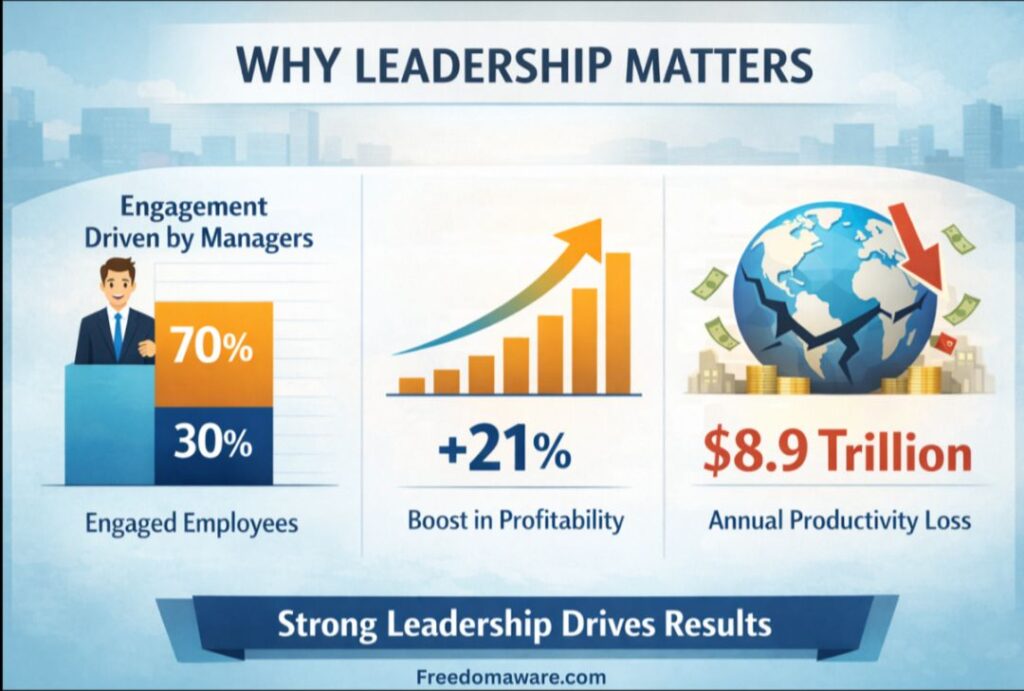
Leadership increasingly drives employee engagement and business results — more than perks, office design, or isolated programs.
- 70% of employee engagement is directly influenced by leadership quality, not benefits or perks. (source)
- Only 30% of global employees are actively engaged at work, highlighting an engagement crisis. (Source)
- A disengaged workforce can cost the global economy more than $8.9 trillion annually due to lower productivity. (Source)
- Managers alone explain around 70% of variation in engagement scores between teams. Source
- Organizations with engaged teams are 21% more profitable and 17% more productive. Source
These data highlight the urgency of leadership focus — especially as many companies chase “culture fixes” without addressing leadership quality.
Leadership Perception vs. Reality (Leadership Statistics)
Employees and leaders often see leadership effectiveness very differently.
6. Only 31–40% of leaders are perceived as effective by their teams. Source
7. Many employees rate their leaders as ineffective at communication and development. Source
8. Leaders working in hybrid roles report lower engagement than fully onsite or remote counterparts. Source
9. Less than half of leaders communicate success expectations clearly to their teams. Source
10. Only about 30–50% of employees feel appreciated by their leaders. Source
This perception gap eats trust, slows performance, and increases turnover.
Leadership Development — The Gap & ROI (Leadership Statistics)
Companies know leadership matters; many just don’t invest enough.
11. Only 44% of managers globally have received formal leadership training, despite its impact on engagement and performance. Source
12. Managers under age 35 saw engagement drop by 5 percentage points, and female managers saw a 7-point decline, showing demographic variations in leadership engagement. Source
13. Approximately 60% of organizations view employee disengagement as resulting from poor management, while 75% of managers believe leadership drives engagement — revealing a perception gap. Source
14. Teams led by managers who provide regular feedback achieve up to 23% higher performance than teams with infrequent feedback. Source
15. Leadership programs on average increase employee retention by 59% and profitability by around 21% among organizations that invest in training. Source
16. 71% of Millennial employees say they would likely leave within three years if leadership development programs are lacking. Source
17. External hires into leadership roles are 61% more likely to fail within 18 months compared to internally promoted leaders. Source
18. Only about 10% of people are natural leaders, yet roughly 20% can become effective leaders with proper development. Source
19. 77% of organizations report leadership gaps at all levels. Source
20. Only a minority provide robust leadership development programs. Source
21. 93% of organizations consider leadership training a priority. Source
22. Investing in leadership development correlates with 29–34% higher employee retention. Source
23. Leadership programs improve team performance by 20–25% on average. Source
24. Companies with strong leadership development see managers outperform peers by 28–37% in key competencies. Source
Effective leadership learning isn’t an expense — it’s measurable ROI.
Skills Modern Leaders Actually Need (Leadership Statistics)
Leadership today blends technical savvy with emotional and relational skills.
25. 70% of leadership skills required today are new or evolving compared to traditional models. Source
26. Soft skills now outweigh technical skills for leadership success. Source
27. Emotional intelligence (EQ) is consistently ranked as a top leadership attribute. Source
28. Leadership communication ability predicts engagement and productivity. Source
29. Leaders must also be digitally fluent due to remote/hybrid work structures. Source
This shift means leadership development must focus on people skills, not just processes.
Emotional Intelligence: The Invisible Multiplier (Leadership Statistics)
Emotional intelligence now sits at the heart of leadership success.
30. Leaders with high EQ outperform peers by up to 25–40% in key outcomes. Source
31. Emotional intelligence strongly predicts trust, collaboration, and psychological safety. Source
32. Organizations that prioritize EQ create more engaged and resilient teams. Source
Emotional intelligence isn’t soft — it’s strategic.
Recognition & Motivation Leadership Statistics
Recognition and motivational behaviors have measurable outcomes.
33. 94% of employees would stay longer if their organization invested in learning and development. Source
34. Managers who provide frequent feedback see stronger performance outcomes. Source
35. Effective recognition programs directly correlate with higher engagement scores. Source
Leading with appreciation is one of the lowest-cost, highest-impact leadership behaviors.
Diversity, Inclusion & Leadership (Leadership Statistics)
True leadership today embraces diversity and inclusive practices.
36. Diverse leadership teams generate up to 19–35% higher revenue compared to less diverse peers. Source
37. Inclusive leaders drive higher innovation and retention rates. Source
38. Organizations with focused diversity programs improve inclusion metrics by ~29%. Source
Inclusive leadership isn’t a trend — it’s measurable business value.
Remote & Hybrid Leadership Realities (Leadership Statistics)
Remote work dramatically changes leadership expectations.
39. Remote leadership increased by ~80% since the pandemic. Source
40. Hybrid leadership requires new communication and trust-building skills. Source
41. Leaders unprepared for digital leadership risk engagement drop-offs. Source
42.Only 27% of leaders feel very effective at leading hybrid or virtual teams, despite hybrid work being widespread. Source
43. Around 36% of companies operate entirely remotely, with another 28% using hybrid models, reflecting diverse organizational leadership landscapes. Source
44. 63% of leadership professionals believe remote and hybrid work has had a high or very high impact on leadership effectiveness. Source
45. Remote workers who regularly hear from leadership report 58% higher trust and alignment than those with infrequent communication. Source
46. Only 19% of remote workers feel comfortable giving leadership feedback, highlighting a major trust and communication gap. Source
As workplaces evolve, leadership must evolve faster.
Burnout & Leadership Well-Being (Leadership Statistics)
Leadership effectiveness depends on leader resilience.
47. Many leaders report high levels of burnout and exhaustion. Source
48. Burnout correlates with lower engagement and higher turnover risk. Source
49. Leaders overloaded with work are significantly more likely to make poor decisions. Source
Leading while depleted undermines performance and culture.
Advanced Leadership Performance Metrics (Leadership Statistics)
Organizations that measure leadership like a business KPI achieve stronger outcomes.
50. Organizations with leadership feedback loops are 2× more agile. Source
51. Leadership alignment improves strategic execution by ~44%. Source
52. Transparent leaders build ~38% more trust with stakeholders. Source
Metrics make leadership measurable and improvable.
Leadership Development & Training Insights (Leadership Statistics)
53. Only 44% of managers globally have received formal leadership training, despite its impact on engagement and performance. Source
54. Managers under age 35 saw engagement drop by 5 percentage points, and female managers saw a 7-point decline, showing demographic variations in leadership engagement. Source
55. Approximately 60% of organizations view employee disengagement as resulting from poor management, while 75% of managers believe leadership drives engagement — revealing a perception gap. Source
56. Teams led by managers who provide regular feedback achieve up to 23% higher performance than teams with infrequent feedback. Source
57. Leadership programs on average increase employee retention by 59% and profitability by around 21% among organizations that invest in training. Source
58. 71% of Millennial employees say they would likely leave within three years if leadership development programs are lacking. Source
59. External hires into leadership roles are 61% more likely to fail within 18 months compared to internally promoted leaders. Source
60. Only about 10% of people are natural leaders, yet roughly 20% can become effective leaders with proper development. Source
Additional Impact (Leadership Statistics)
Here’s even more data reshaping the leadership landscape:
61. Leadership training reduces team turnover by up to 25%.Source
62. Leaders with better conflict-resolution skills see 15% fewer team departures. Source
63. Highly engaged managers see teams with 59% lower turnover. Source
64. Leadership programs can reduce time-to-promotion by 6–12 months. Source
65. 80% of executives say leadership improvement is a top business priority. Source
66.Organizations with comprehensive leadership development programs enjoy 218% higher income per employee than those without formal training. Source
67. Companies that invest in manager training report 23% higher profitability compared to peers who don’t. Source
68. Leadership development can reduce voluntary turnover by 27% in organizations that invest in training. Source
69. Effective leadership development participants report 28% higher job satisfaction compared with non-participants. Source
70. Strong leadership development is linked to a 32% improvement in innovation metrics in organizations that emphasize leadership capability. Source
What These 70+ Leadership Statistics Really Tell Us (Leadership Statistics)
After analyzing the data, several themes emerge:
- Leadership drives engagement, not perks.
- Soft skills and EQ matter more than ever.
- Investment in development delivers measurable ROI.
- Diversity, inclusion, and psychological safety aren’t optional.
- Leaders must adapt to digital, hybrid, and human realities.
Leadership isn’t abstract — it’s measurable and strategic.
Practical Actions You Can Take Today (Leadership Statistics)
If you want to improve leadership outcomes in your organization:
- Incorporate regular coaching and development plans
- Prioritize emotional intelligence training
- Build feedback and recognition systems
- Invest in inclusive leadership practices
- Measure leadership outcomes like KPIs
- Support leader well-being and resilience
Small improvements compound — even a 5–10% engagement boost dramatically improves productivity and bottom-line results.
Final Thoughts (Leadership Statistics)
Leadership determines organizational success. When leaders inspire trust, cultivate psychological safety, and invest in development, performance soars. When they don’t, performance stagnates.
Use these statistics not as numbers, but as guidance.
Build leadership that creates engaged, motivated, high-performing teams — because in 2026, leadership isn’t just a role — it’s measurable performance.
Leave a Reply