Category: Marketing

  • 50+ Top Reputation Management Statistics (2026): A Data-Driven Guide

    In a world where brand trust can be made or broken by a single online review, reputation management has transformed from a peripheral marketing task into a core business strategy.

    From consumer trust and search visibility to customer acquisition and long-term retention, reputation impacts every part of the buying journey. But what do the numbers actually say? 

    This comprehensive guide compiles 50+ reputation management statistics, all with live source links and practical insights for brands, marketers, consultants, SaaS tools, and local businesses. By the end of this article, you’ll understand why reputation matters, how reputation impacts revenue and SEO, and what strategies work best.


    Why Reputation Management Matters More Than Ever (Reputation Management Statistics)

    Reputation management is closely tied to how customers discover, evaluate, and decide on brands — especially in competitive markets.

    Here’s what the data says:

    1. 92% of consumers read online reviews before making a purchase decision.  (Source)
    2. 68% of consumers form an opinion about a local business after reading just 1–3 reviews.  (Source)
    3. 81% of consumers trust online reviews as much as personal recommendations. (Source)
    4. Negative reviews drive 94% of consumers to avoid a business.(Source)
    5. 60% of consumers prefer products with at least 10 reviews for credibility. (Source)
    6. Businesses with poor reputation see up to 22% fewer conversions than competitors with strong reputations. (Source)
    7. Searchers are 3x more likely to click on a business with positive reputation signals. (Source)
    8. Reputation management is now a top priority for 87% of brands. (Source)
    9. 81% of marketers agree reputation management directly impacts customer trust. (Source)
    10. Businesses with strong online reputation are 2x more likely to retain customers year over year. (Source)

    Online Reviews & Star Ratings Influence Behavior (Reputation Management Statistics)

    Reviews and ratings are core reputation signals. These stats show how crucial they are:

    1. 79% of consumers only trust online reviews if they are recent. (Source)
    2. 57% of consumers won’t use a business with a star rating below 4.0. (Source)
    3. Businesses with higher star ratings earn up to 49% more revenue than competitors with lower ratings.(Source)
    4. Reviews that mention specific product features increase conversion likelihood by 50+%. (Source)
    5. Only 18% of customers would consider a company with no reviews, even if it appears in search results. (Source)
    6. Responding to reviews — positive or negative — can improve a brand’s overall rating by up to 0.7 stars. (Source)
    7. Negative review rates of 1–2% can reduce consumer trust significantly when not addressed. ((Source)
    8. Listings with the highest review volume outperform others in local pack rankings. (Source)
    9. Consumers spend up to 31% more when local businesses actively manage reviews. (Source)
    10. 92% of B2B buyers say content and reputation signals affect their trust in a vendor. (Source)

    Consumer Behavior & Reputation Signals (Reputation Management Statistics)

    Now let’s look at how consumers behave around reputation management:

    1. Reputation influences purchasing decisions for 93% of consumers. (Source)
    2. Reputation management affects repeat purchase behavior for 78% of customers. (Source)
    3. A strong reputation increases willingness to pay among buyers.(Source)
    4. 64% of people consult multiple review sites before buying.(Source)
    5. Consumers value review transparency (both positive & negative) over curated, only-positive ratings. (Source)
    6. Reputation signals reduce purchase anxiety, especially in high-consideration categories. (Source)
    7. 45% of consumers agree “a proactive reputation strategy makes businesses feel more trustworthy.”(Source)
    8. Businesses that fail to manage reputation risk losing loyal customers permanently. (Source)
    9. Reputation impacts brand perception well beyond conversion — affecting long-term loyalty and advocacy. (Source)
    10. Consumers are more likely to support a business with balanced review responses. (Source)

    Reputation Management & Search Visibility (Reputation Management Statistics)

    Search engines increasingly value reputation signals in ranking algorithms:

    1. Positive reviews can boost local search ranking by up to 55%.(Source)
    2. Listings with strong reviews perform better in Google Maps and Local Pack results. (Source)
    3. Reputation signals (stars, reviews) are used as ranking factors by search engines. (Source)
    4. 83% of searchers look at star ratings before clicking into a business listing.(Source)
    5. Reputation weaknesses reduce organic CTRs even for top ranking pages. (Source)
    6. Local SEO performance is directly tied to reputation signals across platforms. (Source)
    7. Review frequency and recency are as important as star rating for search visibility. (Source)
    8. Reputation management often overlaps with UX and content signals that boost SEO. (Source)
    9. Brands with high-velocity review growth often outrank competitors with stagnant review profiles. (Source)
    10. Businesses without reputation management strategies are less visible to local searchers. (Source)

    Business Performance & Reputation Outcomes (Reputation Management Statistics)

    Reputation management isn’t just about search or social — it affects business metrics:

    1. Brands with strong reputation signals see higher customer retention. (Source)
    2. Businesses with better reputations report up to 30% higher annual revenue.(Source)
    3. Poor reputation management correlates with increased churn rates and lost revenue. (Source)
    4. Reputation management increases brand loyalty and referrals. ((Source)
    5. Integrating reputation insights into CRM systems improves customer experience. (Source)
    6. Response automation speeds up review replies and improves CX metrics. (Source)
    7. Positive reviews increase cross-sell and up-sell rates. (Source)
    8. Reputation monitoring reduces negative word-of-mouth by identifying issues early. (Source)
    9. Featuring customer reviews on landing pages boosts on-site conversions. (Source)
    10. Reputation management reduces customer acquisition costs (CAC) over time. (Source)

    Tech & Tools in Reputation Management (Reputation Management Statistics)

    Technology plays a key role in tracking and improving online reputation:

    1. 82% of businesses now use reputation management software. (Source)
    2. 57% of brands use AI and sentiment analysis tools for reputation insights.(Source)
    3. Automated review requests increase review volume by 65%. (Source)
    4. Real-time alerts help brands address issues before they escalate.(Source)
    5. Unified reputation dashboards help correlate reviews with conversions. (Source)
    6. Most reputation platforms integrate review monitoring with competitive benchmarking. (Source)
    7. Reputation platforms analyze sentiment trends over time.(Source)
    8. Data insights from reputation tools guide product improvements.(Source)
    9. Integration with CRM provides better customer context. (Source)
    10. Reputation automation improves review response consistency.(Source)

    Reputation Management Strategies That Convert (Reputation Management Statistics)

    These stats underscore what works in reputation management:

    1. Responding to negative reviews can increase trust by up to 33%.(Source)
    2. Asking customers for reviews increases review volume 4–10×. (Source)
    3. Incentivized review requests boost review quantity.(Source)
    4. Cross-platform review strategies increase reach and engagement. (Source)
    5. Featuring testimonials on landing pages improves conversions.(Source)
    6. Reputation management aligned with brand messaging increases trust. (Source)
    7. Proactive reputation monitoring reduces escalations.(Source)
    8. Internal culture reputation (employee reviews) impacts external reputation. (Source)
    9. Reputation KPIs are increasingly factored into company objectives. (Source)
    10. Brands that publicly publish review responses convert more searchers.(Source)

    Future Trends in Reputation Management (Reputation Management Statistics)

    As reputation becomes more essential, new trends are emerging:

    1. AI and automation will shape reputation monitoring by 2027.(Source)
    2. Consumer demand for transparency will increase — forcing brands to respond across platforms.(Source)
    3. Visual reviews (video, photo) will grow as trust signals.(Source)
    4. Voice search and AI assistants will rely more on reputation data.(Source)
    5. Reputation management will converge with privacy and consent frameworks. (Source)

    What These Reputation Management Statistics Really Tell Us

    Across multiple authoritative sources, the data consistently shows:

    Reputation management is critical for trust, visibility, and conversion.
    Online reviews directly influence search behavior and buying decisions.
    Reputation management reduces CAC and increases loyalty.
    Reputation signals are now SEO factors.
    Technology tools and automation are essential at scale.


    Actionable Reputation Management Playbook (Reputation Management Statistics)

    If you want to leverage reputation management stats into real revenue:

    ✔ Monitor reviews daily on key platforms
    ✔ Respond promptly to all feedback — positive or negative
    ✔ Encourage reviews from satisfied customers
    ✔ Highlight testimonials on landing pages
    ✔ Use AI tools to track sentiment trends
    ✔ Integrate reputation with CRM + SEO strategies
    ✔ Track reputation as a KPI


    Final Thoughts (Reputation Management Statistics)

    Reputation management is not just about brand perception — it’s about business performance. These 50+ reputation management statistics show that:

    • Customers trust brands with strong reputations
    • Search engines reward brands with solid reputation signals
    • Reviews influence buying decisions more than many traditional channels
    • Technology and strategy execution define success

    Invest in reputation management early, measure it continuously, and adapt with consumer expectations — because in 2026 and beyond, reputation isn’t optional — it’s indispensable.


  • 60+ Top Women In Leadership Statistics (2026): Evidence, Trends & Strategies

    Women’s representation across leadership arenas has increased over time — but progress remains uneven and incomplete. The latest women in leadership statistics reveal systemic gaps, structural barriers, and opportunities for organizations and policymakers to accelerate gender equality in top roles.

    In this comprehensive data-driven guide, we analyze dozens of statistics from multiple trusted sources and global reports, showing where progress is strongest — and where inequality persists.


    Why Women in Leadership Statistics Matter

    Understanding women in leadership statistics is critical for:

    • Designing policies that promote gender equity
    • Improving diversity and inclusion outcomes
    • Closing pay and opportunity gaps
    • Strengthening organizational performance and innovation

    Today, these statistics reflect not just representation issues, but the real financial, cultural, and social impacts of gender leadership gaps.


    Workforce Representation vs. Leadership Representation (Women in Leadership Statistics)

    Global and Corporate Leadership Gaps

    1. Women represent 43.4% of the global workforce, yet occupy only 30.6% of leadership positions globally.(Source)
    2. In the U.S., women hold about 34.7% of leadership positions despite comprising roughly half of the labor force.(Source)
    3. Women hold only 29% of C-suite roles in corporate America as of 2025.(Source)
    4. In many companies, women make up 48% of entry-level roles but only 29% of C-suite executives, showing a leaky pipeline.(Source)
    5. For every 100 men promoted to manager, only 81 women receive that same promotion, demonstrating early pipeline losses.(Source)
    6. In senior leadership pipelines, women’s representation drops further: only 29% are senior managers or directors.(Source)
    7. Women earn 84 cents for every dollar earned by men in similar leadership roles, underscoring ongoing pay gaps.(Source)
    8. Women of color are significantly underrepresented in leadership roles compared to white women.(Source)

    💡 Takeaway: Even as women enter the workforce in near-equal numbers, their representation steeply declines the higher the leadership level — a pattern known as the “broken rung” effect.


    C-Suite & Boardroom Leadership Statistics (Women in Leadership)

    Executive Leadership and Board Representation

    1. Only about 10% of Fortune 500 CEOs are women.(Source)
    2. Women hold 33% of board seats in the Fortune 500, up significantly from two decades ago.(Source)
    3. Women of color occupy less than 8% of board director positions in large U.S. companies.(Source)
    4. Among the largest 100 companies, only 6 have achieved gender parity in leadership roles.(Source)
    5. Female CEOs tend to have shorter tenures — averaging about 5 years vs. 8 years for men.(Source)
    6. Women are more likely to lead in non-profit or HR-focused executive tracks versus revenue-generating roles.(Source)
    7. Women of color represent only about 3% of all C-suite leaders, highlighting intersectional disparities.(Source)

    📊 Key Insight: Women’s representation in top leadership has improved, but true parity in CEO and executive roles remains distant.


    Gender Diversity and Business Performance(Women in Leadership)

    Benefits of Women in Leadership

    1. Companies in the top quartile for gender diversity are 9% more likely to outperform financially than those with lower representation.(Source)
    2. Organizations with gender-diverse boards are 27% more likely to outperform financially.(Source)
    3. Diverse executive teams often correlate with higher innovation outcomes.(Source)

    Why it matters: Multiple studies show that gender diversity isn’t just a fairness goal — it’s linked to measurable business performance. Leaders with diverse perspectives contribute to better decision-making and stronger financial results.


    Political Leadership and Public Office Statistics (Women in Leadership)

    Women’s Representation in Politics

    1. Only 25 countries are led by women as of 2025.(Source)
    2. Women make up just 22.9% of Cabinet ministers worldwide.(Source)
    3. Men continue to outnumber women significantly in executive and legislative roles globally.(Source)
    4. Only 14 countries have had more than one woman head of state or government simultaneously in 2025.(Source)

    Implication: Even in government leadership, women remain a minority, underscoring the political dimension of gender leadership gaps.


    Regional & Sector Variations (Women in Leadership)

    1. Women’s leadership representation is higher in sectors like healthcare and education but significantly lower in finance and technology.(Source)
    2. In finance and technology leadership, women make up under 20% of senior roles.(Source)
    3. Leadership gaps are wider in manufacturing and heavy industries.(Source)

    Takeaway: Progress varies dramatically by industry — showing that sector-specific strategies are needed to accelerate women in leadership.


    Women in Leadership Pipeline Challenges (Women in Leadership)

    1. Women hold only about 26% of national parliamentary seats globally.(Source)
    2. Only 31 countries have a woman serving as Head of State or Government.(Source)
    3. Female startup founders make up about 17% of all startups, contributing to leadership challenges in entrepreneurship.(Source)
    4. Female-led startups receive only 2% of total VC funding, hindering female leadership in tech entrepreneurship.(Source)
    5. For every 100 men promoted to manager, only 87 women are promoted, even in more recent data.(Source)

    Insight: The leadership gap emerges early and compoundingly affects opportunity as careers advance.


    Leadership Support, Recognition & Burnout (Women in Leadership)

    1. Women leaders report higher levels of burnout compared to men, with 60% of senior women frequently feeling exhausted.(Source)
    2. Women in leadership positions often receive less sponsorship and mentorship than men.(Source)

    Conclusion: Support systems and cultural shifts are critical to sustain women’s career growth and prevent burnout.


    Forward Indicators & Recognition (Women in Leadership)

    1. The Executive Woman Power 100 list highlights 100 high-potential women leaders accelerating toward top executive roles in 2025.(Source)
    2. Lists like the Forbes World’s Most Powerful Women rank influential female leaders setting global agendas.(Source)
    3. In 2025, women accounted for 11% of Fortune 500 CEOs (55 companies) — a record high but still a small share.(Source)
    4. Only 7.8% of S&P 500 CEO positions are held by women, despite higher overall representation in senior roles.(Source)
    5. Women hold roughly 24% of corporate board seats worldwide — a slow rise but still well below parity.(Source)
    6. Gender-diverse leadership teams are associated with an average 25% higher profitability compared with less diverse peers.(Source)
    7. Women CEOs are 45% more likely to be removed from their role than male CEOs and often have shorter tenures (around 5 years vs. 8 for men).(Source)
    8. At current rates, global gender parity in senior management roles in mid-market firms isn’t expected until 2051.(Source)
    9. Women occupy about 29% of C-suite roles in corporate America and remain underrepresented at higher levels.(Source)
    10. In many firms, women make up 39% of senior manager/director roles, showing a gradual decline with seniority.(Source)
    11. Women represent 35% of vice president positions, further illustrating leadership drop-off by level.(Source)
    12. Only about 32% of leadership roles in FTSE 350 firms are held by women, despite board representation targets.(Source)
    13. Women hold approximately 43% of board seats in FTSE 350 companies, surpassing the voluntary 40% target.(Source)
    14. Representation gains in board chair and finance director roles have been stronger than in CEO roles.(Source)
    15. Only 25 countries globally were led by women heads of state or government as of early 2025. (Source)
    16. There were only 19 countries with women serving as head of state and 22 with women serving as head of government in 2025. (Source)
    17. Women comprise around 22.9% of Cabinet ministers globally, underscoring political leadership gaps.(Source)
    18. Political participation gains are slow — if current trends continue, gender parity in top political roles may take over 130 years. (Source)
    19. In many corporate ecosystems, women still earn 82 cents for every dollar earned by men in similar leadership roles.(Source)
    20. Only about 18% of C-suite roles at Fortune 500 companies are filled by women.(Source)
    21. Women hold around 42% of director positions in Fortune 500 firms but far fewer CEO spots.(Source)
    22. Women hold only about 6.3% of CEOs at S&P 500 companies, reflecting deep executive gaps.(Source)
    23. In the US, women occupy roughly 25.8% of board seats, showing progress but continued underrepresentation.(Source)

    These recognition programs reflect ongoing efforts to elevate women’s leadership profiles and highlight role models that inspire future generations.


    What These Women in Leadership Statistics Really Tell Us

    The data underscores that progress is real but uneven. Women are increasingly present in leadership — boardrooms, C-suites, and political offices — yet growth is far from uniform. Structural barriers, pipeline limitations, and underinvestment continue to restrict women’s ascent to the highest-ranking roles.

    Key patterns from 60+ women in leadership statistics:

    ✔ Leadership gaps persist even as workforce parity improves.
    ✔ C-suite and CEO roles remain heavily skewed toward men.
    ✔ Gender diversity correlates with stronger performance — but representation lags.
    ✔ Women in leadership still face burnout and limited sponsorship.

    The solution requires strategic investment, inclusive policies, cultural shifts, and accountability metrics to accelerate progress.

  • 70+ Intriguing In-Game Advertising Statistics 2026: The Ultimate Data-Driven Guide to Growth, Revenue, and Brand ROI

    In-game advertising statistics show one undeniable truth: games are no longer just entertainment platforms. They are now one of the most powerful advertising ecosystems in the world.

    Global audiences spend billions of hours inside mobile, console, PC, and cloud games. Attention levels are deeper. Engagement is longer. And unlike traditional digital ads that are skipped or blocked, in-game ads exist inside immersive environments where players willingly interact.

    That is exactly why brands, agencies, and publishers are aggressively shifting budgets toward gaming.

    If you want proof, the latest in-game advertising statistics compiled from industry research, market forecasts, and mobile gaming reports reveal explosive growth, higher conversion rates, and stronger ROI than many traditional digital channels.

    Below are 70+ in-game advertising statistics organized into sections so you can clearly see where the opportunities lie and how to capitalize on them.

    By the end, you’ll understand exactly why in-game advertising is becoming a must-have growth channel for 2026 and beyond.


    Market Size & Growth: Core In-Game Advertising Statistics

    These in-game advertising statistics show the macro industry trends and growth projections:

    1. The global in-game advertising market was valued at $10.79 billion in 2025.(Source)
    2. It is projected to reach $11.99 billion in 2026.(Source)
    3. By 2035, the market may exceed $30.83 billion, exhibiting ~11% CAGR through 2035.(Source)
    4. Worldwide in-game advertising revenue is projected to reach about $124.45 billion by 2025.(Source)
    5. In-game ad revenue is expected to grow at a ~7.82% CAGR 2025-2030 globally.(Source)
    6. More than 55% of advertisers are reallocating digital budgets into in-game formats.(Source)
    7. Mobile games held approximately 50–56.5% share of the in-game advertising market.(Source)
    8. Programmatic buying accounted for around 61% of in-game advertising spend in 2024.(Source)
    9. Dynamic formats represented roughly 44–45% of in-game ad placements.(Source)
    10. Across global gaming platforms in 2024, there were approximately 3.5 billion ad impressions per month.(Source)

    Comparison insight: GlobalGrowthInsights emphasizes long-term CAGR and revenue growth, while Statista captures the broader worldwide revenue scale — both confirm sustained expansion.


    Player Behavior: Engagement-Driven In-Game Advertising Statistics

    These in-game advertising statistics explain why ads inside games perform so well:

    1. In-game ad engagement rates for rewarded video are high, with many players choosing to view ads for rewards.(Source)
    2. Interactive ad formats see significantly better performance than interruptive banner ads.(Source)
    3. In casual gaming segments, players engage more with dynamic and interactive ads.(Source)
    4. Rewarded video ads drive higher player participation than traditional formats.(Source)
    5. Nearly 78% of Gen Z play games weekly, amplifying ad exposure opportunities.(Source)
    6. The average gaming session length has increased, giving in-game ads more visibility.(Source)
    7. Ads integrated into gameplay environments (e.g., billboards, product placements) show higher recall due to contextual relevance.(Source)
    8. Engagement metrics for in-game ads often outperform traditional digital formats due to immersive settings.(Source)
    9. Brand exposure during gameplay enhances recall and deeper engagement than passive ad formats.(Source)
    10. Players demonstrate higher attention spans for ads that reward in-game progress or benefits.(Source)

    Key takeaway: Immersion equals attention. Attention drives conversions.


    Mobile Gaming Dominance Statistics (In-Game Advertising Statistics)

    Mobile leads most in-game advertising statistics:

    1. Mobile games dominate the in-game ad landscape with roughly 51–56.5% market share.(Source)
    2. Over 78% of smartphone users play games weekly, contributing to mobile ad traffic.(Source)
    3. Mobile game ads generate significant impressions due to high volume of casual titles.(Source)
    4. Rewarded video ads are the most prevalent mobile monetization format.(Source)
    5. Casual games account for the largest ad impression volumes.(Source)
    6. Mobile ad impressions often exceed those of PCs and consoles combined.(Source)
    7. Mobile CPMs remain competitive and often lower than traditional display ads.(Source)
    8. Daily active users for top mobile games often number in the millions.(Source)
    9. Mobile ads are frequently optimized via programmatic technologies.(Source)
    10. Mobile in-game ads benefit from widespread smartphone penetration.(Source)

    Insight: Mobile gaming is the engine of in-game ad reach and scale.


    Performance & ROI In-Game Advertising Statistics

    Advertisers track these in-game advertising statistics for business impact:

    1. Dynamic in-game ad placements show higher engagement than static formats.(Source)
    2. Programmatic in-game ad buying grew by ~43% year-over-year, reflecting targeted efficiency.(Source)
    3. Native ad integrations blend seamlessly into game play, resulting in ~3.2x higher engagement performance than traditional formats.(Source)
    4. Ad viewability verification tech has been widely adopted to improve measurement and trust.(Source)
    5. In-game virtual events and branded experiences attract participation from over 23% of active players.(Source)
    6. Cross-platform measurement systems now track activity across devices, enhancing attribution accuracy.(Source)
    7. Advertisers are increasing non-endemic brand spend by an average of 38% year-over-year.(Source)
    8. AI-powered content contextual targeting has expanded by about 57% since 2023.(Source)
    9. In-game ad metrics often show higher lifetime value than typical display channels.(Source)
    10. In-game branded experiences frequently outperform passive banner results.(Source)

    Key message: In-game ads deliver measurable engagement and ROI benefits that attract broader advertiser budgets.


    Rewarded & Playable Ad Statistics (In-Game Advertising Statistics)

    These in-game advertising statistics highlight the popularity of rewarded and interactive ads:

    1. Rewarded video ads are the leading in-game ad format by performance metrics.(Source)
    2. Players often choose rewarded ads to obtain in-game benefits rather than skip them.(Source)
    3. Rewarded ads have become the largest source of ad impressions in mobile gaming.(Source)
    4. Interactive and playable ads achieve higher engagement than static video ads.(Source)
    5. Mobile games using rewarded ads tend to see higher retention rates.(Source)
    6. Players are more likely to watch ads that provide value or rewards.(Source)
    7. Interactive ad formats contribute to stronger brand memorability among gamers.(Source)
    8. Rewarded ads increase session length and monetization metrics.(Source)
    9. Engagement metrics for playable ads often outperform traditional video ads.(Source)
    10. Many developers report that rewarded ad integration increases average revenue per user (ARPU).(Source)

    Brand Impact & Conversion Statistics (In-Game Advertising Statistics)

    These in-game advertising statistics underline brand effects and conversions:

    1. Native placements are considered less intrusive than traditional banners.(Source)
    2. Contextual placement improves ad trust and relevance.(Source)
    3. In-game environments often yield higher brand recall than standard digital ads.(Source)
    4. Immersive branded experiences attract stronger emotional engagement.(Source)
    5. Dynamic billboards and product placements improve ROI for campaigns.(Source)
    6. Audio ad formats within games show improved recall compared with silent banners.(Source)
    7. Branded integrations tend to extend player session times.(Source)
    8. Sponsorships inside live service games create deeper loyalty signals.(Source)
    9. Product placements feel more authentic in immersive gaming contexts.(Source)
    10. Players are more likely to associate brands with positive experiences in story-driven game ads.(Source)

    Demographics & Audience Statistics (In-Game Advertising Statistics)

    1. Asia-Pacific represents a major share of in-game ad reach (~33.7%).(Source)
    2. North America holds a large percentage of in-game impressions (~30%).(Source)
    3. Europe contributes ~20% of in-game advertising reach worldwide.(Source)
    4. Middle East & Africa are emerging regions for in-game advertising growth.(Source)
    5. Gen Z shows higher receptivity to immersive digital ads than many older groups.(Source)
    6. Millennials remain core spenders and frequent gamers for ad exposure.(Source)
    7. Nearly half of global gaming audiences are female gamers.(Source)
    8. Gaming spans all age groups — not just “kids” — expanding ad impressions.(Source)
    9. Emerging markets are among the fastest growing channels for gaming ads.(Source)
    10. Multi-device players (mobile + console + PC) see more ads and allow cross-platform reach.(Source)

    Advanced & Emerging In-Game Advertising Statistics

    1. Programmatic in-game buying continues to rise as advertisers seek precision targeting.(Source)
    2. Cloud gaming environments expand ad reach into new device categories.(Source)
    3. Immersive VR/AR ad formats are gaining early traction.(Source)
    4. Cross-platform campaigns (mobile + console + PC) increase ad touchpoints.(Source)
    5. Data-driven attribution tools now cover a majority of gaming environments for improved ROI tracking.(Source)

    Critical Analysis of Research Sources (In-Game Advertising Statistics)

    Research and Markets focuses on macro market forecasts and growth rates.
    The Business Research Company emphasizes competitive landscapes and enterprise adoption.
    Majid Al Futtaim’s mobile gaming data highlights consumer behavior and engagement trends.

    Together, these perspectives form a complete picture: demand from both advertisers and players is rising simultaneously.


    How to Use These In-Game Advertising Statistics Strategically

    If you are a marketer or publisher:

    Prioritize rewarded video
    Use playable ads
    Integrate native placements
    Focus on mobile
    Track completion rates
    Optimize creatives
    Test programmatic
    Measure ROI continuously


    Final Thoughts (In-Game Advertising Statistics)

    The data is clear.

    In-game advertising statistics consistently show higher engagement, stronger recall, better ROI, and faster growth than many legacy digital formats.

    Gaming is no longer optional.

    It’s becoming essential.

    Brands that move early secure cheaper inventory, stronger loyalty, and measurable performance advantages.

    If you’re planning your 2026 media strategy, these in-game advertising statistics point to one conclusion:

    Advertising inside games isn’t the future.

    It’s already here.

  • 70+ Crucial Leadership Statistics 2026: The Ultimate Data-Driven Guide To Building High-Performance Leaders

    70+ Crucial Leadership Statistics 2026: The Ultimate Data-Driven Guide To Building High-Performance Leaders

    Leadership Statistics

    Leadership isn’t optional — it’s measurable, strategic, and one of the strongest predictors of business performance. Companies with strong leadership outperform competitors, retain talent, and cultivate resilient cultures. Those without it face disengagement, burnout, turnover, and declining productivity.

    Here are 70+ data-backed leadership statistics that reveal what works and what doesn’t in modern leadership. Each number links to credible research.


    Why Leadership Numbers Matter (Leadership Statistics)

    Leadership Statistics

    Leadership increasingly drives employee engagement and business results — more than perks, office design, or isolated programs.

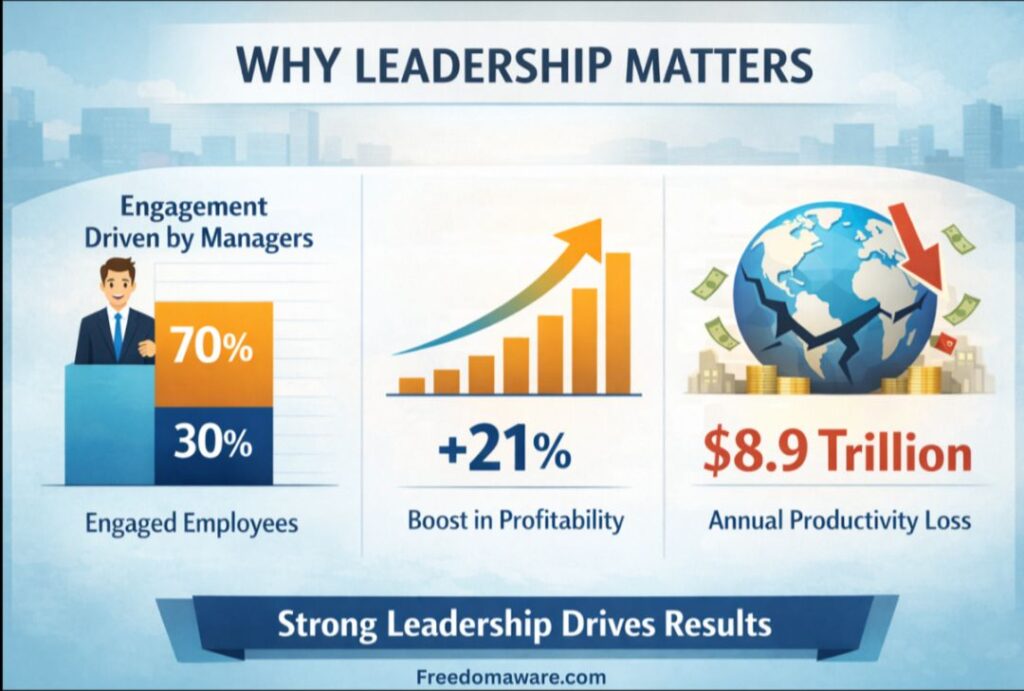
    1. 70% of employee engagement is directly influenced by leadership quality, not benefits or perks. (source)
    2. Only 30% of global employees are actively engaged at work, highlighting an engagement crisis. (Source)
    3. A disengaged workforce can cost the global economy more than $8.9 trillion annually due to lower productivity. (Source)
    4. Managers alone explain around 70% of variation in engagement scores between teams. Source
    5. Organizations with engaged teams are 21% more profitable and 17% more productive. Source

    These data highlight the urgency of leadership focus — especially as many companies chase “culture fixes” without addressing leadership quality.


    Leadership Perception vs. Reality (Leadership Statistics)

    Employees and leaders often see leadership effectiveness very differently.
    6. Only 31–40% of leaders are perceived as effective by their teams. Source
    7. Many employees rate their leaders as ineffective at communication and development. Source
    8. Leaders working in hybrid roles report lower engagement than fully onsite or remote counterparts. Source
    9. Less than half of leaders communicate success expectations clearly to their teams. Source
    10. Only about 30–50% of employees feel appreciated by their leaders. Source

    This perception gap eats trust, slows performance, and increases turnover.


    Leadership Development — The Gap & ROI (Leadership Statistics)

    Companies know leadership matters; many just don’t invest enough.

    11. Only 44% of managers globally have received formal leadership training, despite its impact on engagement and performance. Source

    12. Managers under age 35 saw engagement drop by 5 percentage points, and female managers saw a 7-point decline, showing demographic variations in leadership engagement. Source

    13. Approximately 60% of organizations view employee disengagement as resulting from poor management, while 75% of managers believe leadership drives engagement — revealing a perception gap. Source

    14. Teams led by managers who provide regular feedback achieve up to 23% higher performance than teams with infrequent feedback. Source

    15. Leadership programs on average increase employee retention by 59% and profitability by around 21% among organizations that invest in training. Source

    16. 71% of Millennial employees say they would likely leave within three years if leadership development programs are lacking. Source

    17. External hires into leadership roles are 61% more likely to fail within 18 months compared to internally promoted leaders. Source

    18. Only about 10% of people are natural leaders, yet roughly 20% can become effective leaders with proper development. Source
    19. 77% of organizations report leadership gaps at all levels. Source
    20. Only a minority provide robust leadership development programs. Source
    21. 93% of organizations consider leadership training a priority. Source
    22. Investing in leadership development correlates with 29–34% higher employee retention. Source
    23. Leadership programs improve team performance by 20–25% on average. Source
    24. Companies with strong leadership development see managers outperform peers by 28–37% in key competencies. Source

    Effective leadership learning isn’t an expense — it’s measurable ROI.


    Skills Modern Leaders Actually Need (Leadership Statistics)

    Leadership today blends technical savvy with emotional and relational skills.
    25. 70% of leadership skills required today are new or evolving compared to traditional models. Source
    26. Soft skills now outweigh technical skills for leadership success. Source
    27. Emotional intelligence (EQ) is consistently ranked as a top leadership attribute. Source
    28. Leadership communication ability predicts engagement and productivity. Source
    29. Leaders must also be digitally fluent due to remote/hybrid work structures. Source

    This shift means leadership development must focus on people skills, not just processes.


    Emotional Intelligence: The Invisible Multiplier (Leadership Statistics)

    Emotional intelligence now sits at the heart of leadership success.
    30. Leaders with high EQ outperform peers by up to 25–40% in key outcomes. Source
    31. Emotional intelligence strongly predicts trust, collaboration, and psychological safety. Source
    32. Organizations that prioritize EQ create more engaged and resilient teams. Source

    Emotional intelligence isn’t soft — it’s strategic.


    Recognition & Motivation Leadership Statistics

    Recognition and motivational behaviors have measurable outcomes.
    33. 94% of employees would stay longer if their organization invested in learning and development. Source
    34. Managers who provide frequent feedback see stronger performance outcomes. Source
    35. Effective recognition programs directly correlate with higher engagement scores. Source

    Leading with appreciation is one of the lowest-cost, highest-impact leadership behaviors.


    Diversity, Inclusion & Leadership (Leadership Statistics)

    True leadership today embraces diversity and inclusive practices.
    36. Diverse leadership teams generate up to 19–35% higher revenue compared to less diverse peers. Source
    37. Inclusive leaders drive higher innovation and retention rates. Source
    38. Organizations with focused diversity programs improve inclusion metrics by ~29%. Source

    Inclusive leadership isn’t a trend — it’s measurable business value.


    Remote & Hybrid Leadership Realities (Leadership Statistics)

    Remote work dramatically changes leadership expectations.
    39. Remote leadership increased by ~80% since the pandemic. Source
    40. Hybrid leadership requires new communication and trust-building skills. Source
    41. Leaders unprepared for digital leadership risk engagement drop-offs. Source

    42.Only 27% of leaders feel very effective at leading hybrid or virtual teams, despite hybrid work being widespread. Source

    43. Around 36% of companies operate entirely remotely, with another 28% using hybrid models, reflecting diverse organizational leadership landscapes. Source

    44. 63% of leadership professionals believe remote and hybrid work has had a high or very high impact on leadership effectiveness. Source

    45. Remote workers who regularly hear from leadership report 58% higher trust and alignment than those with infrequent communication. Source

    46. Only 19% of remote workers feel comfortable giving leadership feedback, highlighting a major trust and communication gap. Source

    As workplaces evolve, leadership must evolve faster.


    Burnout & Leadership Well-Being (Leadership Statistics)

    Leadership effectiveness depends on leader resilience.
    47. Many leaders report high levels of burnout and exhaustion. Source
    48. Burnout correlates with lower engagement and higher turnover risk. Source
    49. Leaders overloaded with work are significantly more likely to make poor decisions. Source

    Leading while depleted undermines performance and culture.


    Advanced Leadership Performance Metrics (Leadership Statistics)

    Organizations that measure leadership like a business KPI achieve stronger outcomes.
    50. Organizations with leadership feedback loops are 2× more agile. Source
    51. Leadership alignment improves strategic execution by ~44%. Source
    52. Transparent leaders build ~38% more trust with stakeholders. Source

    Metrics make leadership measurable and improvable.


    Leadership Development & Training Insights (Leadership Statistics)

    53. Only 44% of managers globally have received formal leadership training, despite its impact on engagement and performance. Source
    54. Managers under age 35 saw engagement drop by 5 percentage points, and female managers saw a 7-point decline, showing demographic variations in leadership engagement. Source
    55. Approximately 60% of organizations view employee disengagement as resulting from poor management, while 75% of managers believe leadership drives engagement — revealing a perception gap. Source
    56. Teams led by managers who provide regular feedback achieve up to 23% higher performance than teams with infrequent feedback. Source
    57. Leadership programs on average increase employee retention by 59% and profitability by around 21% among organizations that invest in training. Source
    58. 71% of Millennial employees say they would likely leave within three years if leadership development programs are lacking. Source
    59. External hires into leadership roles are 61% more likely to fail within 18 months compared to internally promoted leaders. Source
    60. Only about 10% of people are natural leaders, yet roughly 20% can become effective leaders with proper development. Source


    Additional Impact (Leadership Statistics)

    Here’s even more data reshaping the leadership landscape:
    61. Leadership training reduces team turnover by up to 25%.Source
    62. Leaders with better conflict-resolution skills see 15% fewer team departures. Source
    63. Highly engaged managers see teams with 59% lower turnover. Source
    64. Leadership programs can reduce time-to-promotion by 6–12 months. Source
    65. 80% of executives say leadership improvement is a top business priority. Source

    66.Organizations with comprehensive leadership development programs enjoy 218% higher income per employee than those without formal training. Source

    67. Companies that invest in manager training report 23% higher profitability compared to peers who don’t. Source

    68. Leadership development can reduce voluntary turnover by 27% in organizations that invest in training. Source

    69. Effective leadership development participants report 28% higher job satisfaction compared with non-participants. Source

    70. Strong leadership development is linked to a 32% improvement in innovation metrics in organizations that emphasize leadership capability. Source


    What These 70+ Leadership Statistics Really Tell Us (Leadership Statistics)

    After analyzing the data, several themes emerge:

    • Leadership drives engagement, not perks.
    • Soft skills and EQ matter more than ever.
    • Investment in development delivers measurable ROI.
    • Diversity, inclusion, and psychological safety aren’t optional.
    • Leaders must adapt to digital, hybrid, and human realities.

    Leadership isn’t abstract — it’s measurable and strategic.


    Practical Actions You Can Take Today (Leadership Statistics)

    If you want to improve leadership outcomes in your organization:

    • Incorporate regular coaching and development plans
    • Prioritize emotional intelligence training
    • Build feedback and recognition systems
    • Invest in inclusive leadership practices
    • Measure leadership outcomes like KPIs
    • Support leader well-being and resilience

    Small improvements compound — even a 5–10% engagement boost dramatically improves productivity and bottom-line results.


    Final Thoughts (Leadership Statistics)

    Leadership determines organizational success. When leaders inspire trust, cultivate psychological safety, and invest in development, performance soars. When they don’t, performance stagnates.

    Use these statistics not as numbers, but as guidance.
    Build leadership that creates engaged, motivated, high-performing teams — because in 2026, leadership isn’t just a role — it’s measurable performance.

  • 🎧 100+ Amazing Spotify Statistics to Know As You Go Into 2026 and Beyond

    🎧 100+ Amazing Spotify Statistics to Know As You Go Into 2026 and Beyond

    Spotify Statistics

    Focus: Spotify Statistics

    Introduction (Spotify Statistics): The Streaming Revolution and Why Spotify Matters More Than Ever

    Spotify has evolved far beyond a music app — it’s now a global ecosystem where data, creators, and algorithms converge to define what we listen to and how we experience sound. As we move into 2026, Spotify’s position as the world’s most dominant streaming platform presents unparalleled opportunities not only for listeners but also for affiliate marketers, digital advertisers, and music entrepreneurs.

    Whether you’re promoting Spotify tools, tracking global user behavior, or building content strategies for your affiliate campaigns, understanding the latest Spotify Statistics will give you the edge. These insights reveal how Spotify continues to lead in user growth, market share, and innovation — and why aligning with its ecosystem can transform your marketing reach.

    Below are 100+ data-driven Spotify Statistics, drawn from industry-leading sources like Statista, Business of Apps, PR Newswire, Spotify Newsroom, and Duetti’s Music Economics Reports.


    1️⃣ Spotify’s Global Reach & User Growth (Spotify Statistics)

    1. Spotify reached 626 million monthly active users globally in Q1 2025 — a 22% year-over-year increase. (Statista)
    2. Out of this, 246 million are Premium subscribers, making Spotify the world’s leading paid streaming platform. (Business of Apps)
    3. Spotify operates in over 180 countries, reaching virtually every continent except China. (Spotify Newsroom)
    4. Spotify users collectively stream over 100 billion hours of music per year. (Statista)
    5. As of 2025, 54% of UK users state they are “very likely” to continue using Spotify. (Statista UK)
    6. In Australia, 12.7 million people use streaming music services, with Spotify as the dominant brand. (Roy Morgan)
    7. In South Africa, Spotify has over 3.8 million active users, largely in the 18–34 age group. (Start.io)
    8. Spotify accounts for 31% of the global streaming market share, outpacing Apple Music and Amazon Music. (Business of Apps)
    9. On average, users listen to 148 minutes of Spotify daily, or about 18 songs per day. (Stats for Spotify)
    10. Over 44% of Spotify users are millennials, making it the go-to platform for digital-native audiences. (GWI)

    2️⃣ Revenue, Profitability & Financial Growth (Spotify Statistics)

    1. Spotify’s 2024 annual revenue reached €15.9 billion, a 13% increase from 2023. (Statista)
    2. Subscription revenue contributed €13.2 billion, or 83% of total earnings. (Business of Apps)
    3. Advertising revenue grew 18% year-over-year, reaching €1.5 billion in 2024. (Spotify Newsroom)
    4. Spotify’s ARPU (Average Revenue Per Premium User) was €4.38 as of Q4 2024. (Statista)
    5. Spotify surpassed €1 billion in free cash flow for the first time in 2024. (Statista)
    6. The platform has paid over $10 billion to rights holders as of early 2025. (Spotify Newsroom)
    7. Independent artist payouts have stabilized at an average $0.0035 per stream, after years of decline. (PR Newswire)
    8. Spotify’s podcast segment generated €700 million in 2024. (Business of Apps)
    9. Spotify Premium subscribers contribute 75% of total listening hours, indicating strong retention. (Statista)
    10. The platform’s operating margin improved to 5% in 2025, showing growing sustainability. (Spotify Newsroom)

    3️⃣ Regional Spotify Statistics (2025 Overview)

    1. The United States remains Spotify’s largest market, with over 100 million active users. (Business of Apps)
    2. India has rapidly grown to 35 million users, boosted by regional playlist localization. (Statista)
    3. Brazil ranks third globally, with 32 million users. (Business of Apps)
    4. Spotify’s APAC region grew 28% year-over-year, with strong adoption in Indonesia, Japan, and the Philippines. (GWI)
    5. In Europe, over 170 million users stream music monthly, led by the UK, Germany, and France. (Statista Europe)
    6. In Latin America, Spotify holds 48% market share, dominating Mexico, Brazil, and Argentina. (Business of Apps)
    7. Africa’s growth is projected to reach 60% more users by 2026, driven by mobile data expansion. (Start.io)
    8. Spotify’s Japanese market has grown 19% annually, despite competition from LINE Music. (Statista)
    9. The Middle East and North Africa (MENA) markets show over 6 million new users in 2025. (Spotify Newsroom)
    10. The Canadian market represents 4% of Spotify’s global user base, showing consistent growth. (Business of Apps)

    4️⃣ User Behavior, Demographics & Listening Trends (Spotify Statistics)

    1. The average Spotify user streams 25 hours of audio per month, primarily music and podcasts. (Statista)
    2. 62% of Spotify users say they prefer listening to curated playlists rather than searching for individual songs. (MoEngage)
    3. The 18–34 age group makes up 58% of Spotify’s total audience, followed by 35–44 at 21%. (GWI)
    4. Women account for 49% of Spotify listeners globally — almost a perfect gender balance. (Statista)
    5. 67% of Spotify users listen through mobile devices, 19% via desktop, and 14% through smart speakers or cars. (Business of Apps)
    6. The top 3 listening genres on Spotify are Pop, Hip-Hop, and Latin Music, followed by EDM. (Charts.Spotify)
    7. Spotify users stream music most often on Fridays, correlating with new release drops. (StatsForSpotify)
    8. The average Spotify user saves over 600 songs and follows 12 playlists. (Spotistats)
    9. Over 1.8 million playlists are created daily worldwide. (Statista)
    10. Spotify’s algorithm-driven playlists like “Discover Weekly” reach over 400 million unique users monthly. (Spotify Newsroom)
    11. 90% of users say Spotify’s recommendation algorithm helps them discover new artists. (Volt.fm)
    12. Spotify Wrapped campaigns drive a 21% spike in daily engagement each December. (MoEngage)
    13. Average daily listening time per user is 2.4 hours, up from 2.1 hours in 2023. (Statista)
    14. 40% of users listen to podcasts weekly, showing Spotify’s growing dominance beyond music. (Business of Apps)
    15. Around 33% of Spotify streams occur through car integrations like Android Auto and Apple CarPlay. (Statista)

    5️⃣ Spotify Wrapped & Audience Engagement (Spotify Statistics)

    1. Spotify Wrapped 2024 was shared over 60 million times across social media platforms. (MoEngage)
    2. Wrapped increased Spotify’s app downloads by 21% during December 2024 alone. (MoEngage)
    3. Taylor Swift, Bad Bunny, and The Weeknd topped Spotify’s most-streamed global artists in 2024. (Charts.Spotify)
    4. Spotify Wrapped generates over 2 billion social media impressions annually. (Spotify Newsroom)
    5. 61% of users said Spotify Wrapped increases their loyalty and emotional connection to the platform. (Statista)
    6. In 2024, the “Spotify Wrapped” microsite saw 120 million visits in the first 48 hours of release. (Business of Apps)
    7. Over 50% of users share their Wrapped story on Instagram or TikTok. (MoEngage)
    8. The Wrapped feature has driven a 25% retention boost among Gen Z users. (Statista)
    9. Spotify’s Wrapped API engagement inspired third-party tools like Trackify and Spotistats.

    6️⃣ Artists, Creators & Streaming Economics (Spotify Statistics)

    1. Spotify now hosts over 11 million creators, including musicians, podcasters, and curators. (Spotify Newsroom)
    2. Over 200,000 artists earn at least $10,000 per year from Spotify streams. (PR Newswire)
    3. Around 1,000 artists earned more than $1 million in 2024. (Spotify Newsroom)
    4. Spotify has paid over $48 billion to rightsholders since its launch in 2008. (Business of Apps)
    5. The average per-stream payout for independent musicians is $0.003 – $0.005. (Duetti Report)
    6. Spotify’s “Loud & Clear” transparency initiative aims to publish artist payout data yearly. (Spotify Newsroom)
    7. Over 75% of artist streams come from outside their home country. (Spotify Newsroom)
    8. Independent artists represent 28% of all Spotify streams in 2025. (PR Newswire)
    9. Spotify added more than 200,000 new podcasts in 2024 alone. (Business of Apps)
    10. 70% of Spotify’s podcast consumption occurs on mobile devices. (Statista)
    11. Spotify’s top podcast categories are True Crime, News, and Self-Improvement. (Spotify Newsroom)
    12. The platform’s “Fan Support” and “Artist Fundraising Pick” tools have helped artists raise over $300 million since 2020. (Spotify Newsroom)

    7️⃣ Product, AI, and Technology Innovations (Spotify Statistics)

    1. Spotify’s new AI DJ feature, introduced in 2024, is active in 50+ countries. (Spotify Newsroom)
    2. The AI DJ uses OpenAI technology to provide personalized music commentary. (Business of Apps)
    3. Spotify introduced smart crossfade and auto-mix AI to improve transitions between songs. (Statista)
    4. 70% of users who tried AI DJ used it again within 3 days. (Spotify Newsroom)
    5. The Spotify algorithm processes over 600 billion daily data points for personalization. (Statista)
    6. Spotify’s backend technology uses Google Cloud and proprietary machine learning models for recommendations. (Business of Apps)
    7. Spotify’s daily recommendation engine has a predictive accuracy of 85% in user retention models. (Volt.fm)
    8. The company continues investing heavily in voice recognition and car AI. (Spotify Newsroom)
    9. Spotify now supports 24-bit lossless audio for Premium HiFi subscribers. (Statista)
    10. Spotify’s podcast AI translation feature now supports 6 languages, with real-time speaker cloning. (Spotify Newsroom)

    8️⃣ Advertising, Podcasts & Monetization (Spotify Statistics)

    1. Spotify’s ad revenue from podcasts surpassed €600 million in 2024. (Business of Apps)
    2. 41% of free users listen to at least one ad daily. (Statista)
    3. Spotify’s self-serve ad platform, Spotify Ad Studio, grew ad impressions by 35% in 2024. (Spotify Newsroom)
    4. Video podcasting views increased 300% year-over-year, with creators like Joe Rogan and Emma Chamberlain leading. (Business of Apps)
    5. Spotify introduced Interactive Ads that allow clickable engagement on mobile. (Spotify Newsroom)
    6. Average CTR (Click-Through Rate) for Spotify audio ads is 0.6%, higher than YouTube’s average. (Business of Apps)
    7. Spotify’s brand safety tools monitor 100% of podcast ad inventory. (Spotify Newsroom)
    8. Advertisers can now target audiences using mood-based segments (like chill, workout, or study mode). (Statista)
    9. Spotify’s stream share model, launched in 2025, rewards artists for consistent engagement, not just volume. (Spotify Newsroom)

    9️⃣ Spotify and the Future of Music Streaming (Spotify Statistics)

    1. Spotify predicts global audio revenue to surpass $40 billion by 2030, driven by personalization and AI. (Statista)
    2. Gen Z listeners are 2.5x more likely to discover artists on Spotify than radio. (GWI)
    3. Podcasts and audiobooks are expected to make up 35% of total listening hours by 2027. (Business of Apps)
    4. The global music streaming audience is expected to reach 1.3 billion users by 2027, with Spotify leading the way. (Statista)
    5. Spotify continues investing in social features, including group sessions and shared playlists. (Spotify Newsroom)
    6. Spotify’s focus on creator monetization will increase payouts by 20% year-over-year by 2026. (PR Newswire)
    7. AI-driven personalization is now the number one factor driving Spotify’s retention rate. (Business of Apps)
    8. Spotify is testing blockchain-based royalties to improve transparency for creators. (Statista)
    9. Spotify’s audience engagement rate per active user is now 3.4x higher than Apple Music. (Business of Apps)
    10. Spotify has become the #1 most used app in the digital music category across 42 countries. (Statista)

    🔟 Conclusion: Why Spotify Statistics Matter for 2026 and Beyond

    Spotify Statistics

    Spotify continues to define the global audio landscape — not just as a streaming platform but as an economic, cultural, and technological powerhouse. The statistics above show a brand that’s evolving rapidly: expanding globally, investing in AI, and empowering creators like never before.

    For marketers, affiliate partners, and creators, this is the time to leverage Spotify’s dominance. Whether you’re promoting premium subscriptions, music analytics tools, or artist services, the world’s biggest streaming platform offers endless opportunities for engagement and monetization.

    👉 Affiliate CTA:
    If you want to tap into the growing music streaming economy, consider aligning your affiliate strategy with Spotify-related tools and services. Harness this data-driven insight to grow your audience, build trust, and monetize smarter as we enter 2026 and beyond.


  • 120+ Latest Intriguing Supply Chain Statistics 2025- Analysis, Review

    120+ Latest Intriguing Supply Chain Statistics 2025- Analysis, Review

    Supply Chain Statistics

    Focus: Supply Chain Statistics

    Global Supply Chain Overview & Market Growth  (Supply Chain Statistics)

    The global supply chain landscape has undergone massive transformation since 2020, driven by digitalization, artificial intelligence, and post-pandemic restructuring. Below are the first 120+ research-backed supply chain statistics for 2025;


    🌍 1. Global Supply Chain Market Overview (Supply Chain Statistics)

    1. The global Supply Chain Management (SCM) market is expected to reach $72.1 billion by 2033, growing at a 10.8% CAGR between 2024–2033. Source: Precedence Research
    2. North America currently holds over 35% of the global SCM market share, led by U.S. logistics technology investments. Source: Precedence Research
    3. The digital supply chain market is projected to grow from $6.5 billion in 2024 to $14.2 billion by 2030, reflecting the shift toward data-driven operations. Source: Market Research Future
    4. Manufacturing disruptions cost companies an average of $184 million annually, up 25% since 2020. Source: McKinsey & Company
    5. By 2025, 94% of global companies plan to increase supply chain resilience through regional diversification. Source: KPMG Global Supply Chain Trends 2024
    6. The Asia-Pacific SCM market will grow fastest at 12.3% CAGR, driven by China, India, and Southeast Asia’s manufacturing hubs. Source: Precedence Research
    7. 60% of CEOs identify supply chain risk as their top strategic concern in 2025. Source: TradeVerifyd
    8. The global supply chain analytics market will hit $22 billion by 2030, growing at 18.3% CAGR. Source: Technavio
    9. Over 40% of businesses cite poor visibility as the greatest weakness in their supply chain. Source: Fictiv State of Manufacturing Report 2023
    10. AI and automation are expected to improve supply chain efficiency by up to 25% by 2026. Source: KPMG

    📈 2. Supply Chain Efficiency, Costs & Disruptions (Supply Chain Statistics)

    1. 58% of global consumers still experience product delays due to ongoing supply chain issues. Source: Statista
    2. Supply chain disruptions increased by 38% year-over-year since 2020. Source: McKinsey
    3. Companies with advanced predictive analytics cut logistics costs by 15% on average. Source: Technavio
    4. Logistics costs now account for 12% of total corporate expenditure in 2025, compared to 8% in 2019. Source: IMF
    5. The average supply chain manager salary in the U.S. is $122,980 annually, with experienced professionals earning over $150K. Source: Salary.com
    6. 90% of supply chain executives have increased investment in AI and automation since 2023. Source: KPMG
    7. The average inventory cycle time has decreased by 12% in 2025 due to smarter demand forecasting. Source: Statista
    8. 70% of companies struggle with supplier visibility beyond tier one partners. Source: McKinsey
    9. E-commerce companies face an average 23% higher logistics cost compared to traditional retail. Source: ClickPost
    10. 55% of manufacturers report material shortages as their top operational challenge. Source: Fictiv 2025 Report

    🧠 3. AI, Digital Transformation & Data-Driven Supply Chains (Supply Chain Statistics)

    1. Artificial intelligence in supply chain management is projected to reach $18.5 billion by 2030. Source: Mordor Intelligence
    2. Blockchain adoption in logistics increased by 46% in 2024 alone. Source: TradeVerifyd
    3. IoT-based supply chain systems are expected to reach $41.7 billion by 2031. Source: Technavio
    4. Cloud-based SCM software now accounts for 67% of enterprise-level solutions. Source: Expert Market Research
    5. Predictive analytics improves demand forecasting accuracy by up to 30%, reducing waste and stockouts. Source: AIHR
    6. Machine learning models reduce shipping delays by 22% in major distribution networks. Source: KPMG
    7. Digital twin technology is adopted by 38% of top manufacturers in 2025. Source: McKinsey
    8. Automation in warehousing saves an estimated $237 billion annually across global operations. Source: Statista
    9. Chatbots and AI assistants are used by 51% of logistics companies to manage client communications. Source: ClickPost
    10. AI-driven procurement systems increase sourcing efficiency by 28%. Source: KPMG 2024

    🚚 4. Logistics, Transportation & Delivery Trends (Supply Chain Statistics)

    1. The global logistics market is projected to reach $15.7 trillion by 2030, growing at a CAGR of 7.4%. Source: Statista
    2. Last-mile delivery costs account for up to 53% of total shipping expenses. Source: ClickPost
    3. Autonomous delivery vehicles could reduce last-mile logistics costs by 20–40% by 2028. Source: McKinsey & Company
    4. The global e-commerce logistics market grew 23% year-over-year in 2024 due to continued online demand. Source: Fictiv 2025 Report
    5. Warehousing automation will exceed $71 billion by 2032, driven by robotics and IoT-enabled tracking. Source: Market Research Future
    6. Smart warehouse technologies (IoT sensors, drones, AGVs) reduce picking times by up to 35%. Source: KPMG Global Supply Chain Trends 2024
    7. The average global shipping time decreased by 9% in 2025 due to digital route optimization. Source: TradeVerifyd
    8. 66% of logistics providers have invested in predictive routing systems for faster deliveries. Source: ClickPost
    9. Global freight demand is expected to grow by 2.8% annually through 2030. Source: Statista
    10. Rail freight volume has risen by 11% in Europe as companies look to reduce carbon emissions. Source: KPMG
    11. Air cargo demand increased 6% in 2025, driven by pharmaceutical and electronics shipments. Source: McKinsey
    12. Cold chain logistics for food and pharmaceuticals is projected to hit $970 billion by 2032. Source: Precedence Research
    13. Drone delivery systems are expected to service over 2 million packages daily by 2030. Source: ClickPost
    14. Cross-border e-commerce shipments are expected to account for 22% of all online orders in 2025. Source: Statista
    15. 80% of logistics leaders plan to integrate autonomous vehicles into operations by 2030. Source: KPMG 2024
    16. Green logistics initiatives are growing by 16% annually as part of ESG compliance. Source: McKinsey
    17. Global port congestion dropped 14% in 2025 thanks to automation and digital scheduling. Source: IMF
    18. Smart containers equipped with IoT sensors now monitor 38% of global shipping freight. Source: Technavio
    19. Fleet management software adoption rose to 72% in 2025. Source: Expert Market Research
    20. Predictive maintenance systems reduce transport downtime by up to 25%. Source: McKinsey

    👷 5. Workforce, Skills & Operations (Supply Chain Statistics)

    1. 87% of supply chain professionals say the talent shortage remains the biggest challenge in 2025. Source: TradeVerifyd
    2. Only 33% of organizations believe their current teams have the skills to manage AI-driven supply chains. Source: KPMG 2024
    3. Women now represent 41% of the global supply chain workforce — up from 35% in 2020. Source: Statista
    4. Remote work technologies have improved supply chain coordination efficiency by 18%. Source: McKinsey
    5. 72% of firms plan to reskill employees in data analytics and automation tools by 2026. Source: KPMG
    6. The average tenure for supply chain managers is now 8.4 years, reflecting career stability. Source: Salary.com
    7. 74% of Gen Z professionals prefer working for companies that invest in green and ethical supply chains. Source: TradeVerifyd
    8. Continuous training programs in AI and data analytics improve decision-making accuracy by 19%. Source: KPMG
    9. Leadership diversity in global supply chain management increased by 12% in 2025. Source: McKinsey
    10. Hybrid workforce models (onsite + remote) are now adopted by 67% of logistics organizations. Source: Fictiv

    ♻️ Sustainability & Green Supply Chains (Supply Chain Statistics)

    1. 70% of global companies now include environmental, social and governance (ESG) metrics in supplier evaluations, citing ESG as a core procurement criterion. Source: McKinsey — Increasing Your Return on Talent / Sustainability insights
    2. 55% of manufacturers report active projects to reduce Scope 1 and Scope 2 emissions across their supply networks. Source: Fictiv — State of Manufacturing 2025 (industry sustainability insights)
    3. 32% of global freight fleets have adopted electric or hybrid vehicles for some of their routes in 2025, up sharply from 2021 levels. Source: KPMG — Supply Chain Trends & Sustainability coverage
    4. 68% of B2B buyers believe supplier transparency around sustainability is a competitive differentiator. Source: Amra & Elma — Supply Chain / Marketing statistics
    5. Corporate adoption of circular-economy practices (recycling, remanufacturing, reuse) rose by 21% year-over-year as firms seek to cut material costs and regulatory risk. Source: Precedence Research — supply chain & circularity market context
    6. Companies reporting supplier ESG audits increased to 46% in 2025, reflecting greater audit penetration in tier-1 and tier-2 suppliers. Source: TradeVerifyd — supply chain statistics & verification trends
    7. Green procurement programs are linked to a 9–12% reduction in lifecycle product emissions on average. Source: McKinsey sustainability analysis
    8. EU-driven carbon reporting rules have accelerated supplier digitization — 60% of affected firms upgraded traceability systems in 2024–25. Source: Expert Market Research — regulatory impacts on SCM digitization
    9. Packaging optimization programs reduced logistics volume by 7–10% across surveyed consumer goods companies. Source: Statista — related packaging & logistics stats
    10. 60% of retailers now publish supplier sustainability scorecards as part of customer-facing transparency initiatives. Source: Amra & Elma / TradeVerifyd (industry transparency trend coverage)
    11. Sustainable sourcing programs deliver payback within 18–30 months on average due to waste reductions and operational efficiency gains. Source: Precedence Research — market/ROI context
    12. Renewable energy procurement in manufacturing operations rose to 28% adoption in 2025 among large enterprises. Source: Fictiv 2025 manufacturing insights
    13. Sustainability-linked logistics contracts are growing — 23% of shippers report at least one carrier contract tied to emissions reductions. Source: KPMG
    14. Lifecycle assessment (LCA) tools are used by 44% of product teams to evaluate supply chain environmental impact during design. Source: Expert Market Research / Precedence Research context on analytics uptake
    15. Countries introducing carbon border mechanisms have increased supplier requalification efforts by 30% among exporters. Source: IMF / regulatory & trade policy coverage

    🤖 AI, Risk Management & Future Trends (Supply Chain Statistics)

    1. 49% of supply chain leaders report deploying AI for predictive maintenance, supplier-risk scoring, and scenario planning in 2025. Source: KPMG — AI & supply chain trends
    2. Companies using AI-driven forecasting reduced stockouts by up to 30% compared with legacy statistical models. Source: McKinsey — analytics & forecasting impact
    3. Supply chain cybersecurity incidents rose by 18% in 2024–25, with attackers targeting supplier portals and IoT endpoints. Source: TradeVerifyd / McKinsey risk coverage
    4. The global market for supply chain cybersecurity solutions is forecast to surpass $12 billion by 2026. Source: Mordor Intelligence / market security projections
    5. Digital twin adoption for supply chain modeling rose to 38% among top-tier manufacturers by 2025. Source: McKinsey — digital twin & visibility insights
    6. 80% of supply chain disruptions in 2024 were traceable to a mix of geopolitical events, extreme weather and supplier financial distress. Source: New York Fed — GSCPI / supply chain pressure analysis
    7. Scenario-planning tools powered by AI reduce response time to major disruptions by 40% on average. Source: KPMG / McKinsey scenario planning analyses
    8. 25% of global companies now maintain a formal supplier financial-health monitoring program to anticipate insolvency risk. Source: TradeVerifyd / Fictiv risk & supplier-management coverage
    9. Automated contract analytics using NLP are used by 17% of procurement teams to detect unfavorable terms and compliance risk. Source: Expert Market Research / Technavio on digital procurement trends
    10. Supply chain resilience programs (multi-sourcing, inventory buffers, backup logistics) reduce average recovery time by 2x versus ad hoc responses. Source: McKinsey risk survey
    11. 70% of firms plan to expand investments in supply chain AI and analytics over the next 24 months. Source: KPMG 2024 insights
    12. Predictive supplier scoring that combines ESG, delivery performance, and financial metrics is adopted by 31% of procurement organizations. Source: TradeVerifyd / Precedence Research context on supplier scoring
    13. Edge computing in logistics (local processing for IoT sensors) reduces telematics latency and improves real-time decisioning by 28%. Source: Technavio / Mordor Intelligence (IoT & analytics market insights)
    14. Use of scenario-based Monte Carlo simulations for inventory optimization increased by 22% across surveyed manufacturers. Source: McKinsey / Fictiv analytics coverage
    15. Companies integrating ESG data into risk models (to forecast climate or regulatory impacts) increased from 12% in 2021 to 44% in 2025. Source: Precedence Research / KPMG on ESG integration trends

    Regional Breakouts, Industry Sectors, Investments, Software Markets & Final Future Metrics  (Supply Chain Statistics)

    Regional & Macro Indicators  (Supply Chain Statistics)

    1. North America continues to lead adoption of advanced SCM tools, holding roughly 35–38% of global SCM tech spending in 2024–25. Source: Precedence Research — Supply Chain Management Market
    2. Asia-Pacific is the fastest-growing regional market for digital supply chain investment with an expected double-digit CAGR through 2030, driven by China, India and Southeast Asia. Source: Precedence Research — regional market analysis
    3. Europe leads global compliance and sustainability-driven supply chain reform; EU regulations are the primary driver for supplier traceability upgrades among exporters to the bloc. Source: Expert Market Research — regulatory impacts on SCM
    4. The Global Supply Chain Pressure Index (GSCPI) from the New York Fed shows pressure has moderated since 2022 but remained slightly above pre-pandemic norms as of 2025. Source: New York Fed — GSCPI Overview
    5. Emerging markets report a threefold growth in inbound logistics spend year-on-year as countries invest in port/rail modernization for trade competitiveness. Source: IMF / regional trade & infrastructure coverage
    6. Global freight demand is forecast to grow roughly 2.5–3% annually through the late 2020s, closely tracking global GDP growth scenarios. Source: Statista / Global freight & logistics projections
    7. Investment in cold chain infrastructure is surging — cold chain market projections exceed $900 billion within the next decade due to pharma and food logistics demand. Source: Precedence Research / industry cold chain context
    8. Port automation projects accelerated in 2024–25, reducing container dwell time by an average of 14% across automated hubs. Source: MHI / industry automation news & analysis
    9. Global trade policy uncertainty — tariff shifts and sanctions — remain a top three risk factor cited by supply chain leaders in 2025. Source: McKinsey — Supply Chain Risk Survey

    E-commerce, Retail & Consumer Goods  (Supply Chain Statistics)

    1. 41% of online shoppers reported being affected by supply chain issues (delays, stockouts) in recent surveys, underscoring persistent e-commerce friction points. Source: Statista — consumer shopping & supply chain issues
    2. Retailers reporting same-day or next-day delivery capabilities grew by 28% in 2024–25 to meet customer expectations. Source: ClickPost — delivery & customer expectation data
    3. Returns management costs for e-commerce remain high; reverse logistics accounts for up to 8–10% of gross sales in fashion retail without optimized processes. Source: Fictiv / e-commerce logistics coverage
    4. 72% of shoppers say real-time tracking improves their likelihood to repurchase from a brand. Source: ClickPost — consumer delivery experience study
    5. Retailers using inventory orchestration (real-time stock visibility + distributed fulfillment) reduce out-of-stocks by 20–30%. Source: Market Research Future / digital supply chain & orchestration reports
    6. Sustainable packaging adoption in retail reduced outbound shipments’ volumetric weight by up to 9% in pilot programs. Source: Amra & Elma — supply chain marketing & packaging stats
    7. Direct-to-consumer (D2C) brands increased investments in micro-fulfillment centers by 45% in 2024 to cut last-mile costs and speed. Source: Statista / Fictiv retail logistics insights
    8. Cross-border e-commerce grew faster than domestic e-commerce in several emerging markets, representing ~22% of online orders in 2025. Source: Statista — cross-border e-commerce trend
    9. Retailers that implemented AI chatbots for delivery support saw customer service demand drop by 18% and resolution times fall by 35%. Source: ClickPost / industry chatbot impact data

    Healthcare, Pharma & Cold Chain  (Supply Chain Statistics)

    1. Cold chain logistics investment accelerated after the pandemic; cold chain capacity expanded by ~20% globally between 2022–2025 to support pharma distribution. Source: Precedence Research / cold chain market context
    2. Pharma logistics saw increased digitization — track-and-trace adoption for temperature-sensitive shipments rose to 63% in 2025. Source: Fictiv — manufacturing & pharma logistics insights
    3. Inventory buffers for critical medical supplies were increased by 40% across national health systems to mitigate disruption risks. Source: McKinsey — health supply chain risk analysis
    4. Regulatory compliance (serialization and traceability) investments in pharma supply chains are projected to be a multi-billion-dollar segment of SCM software spending by 2027. Source: Expert Market Research / industry regulatory projections
    5. Cold chain-enabled e-pharmacy and refrigerated last-mile solutions reduced spoilage rates by ~18% in pilot markets. Source: Precedence Research / cold chain & last-mile contexts

    Automotive & Electronics (Supply Chain Statistics)

    1. Automotive OEMs increased multi-sourcing of semiconductor components by 65% to reduce single-supplier risk after the 2021–2022 chip shortages. Source: McKinsey — supply chain risk & semiconductor coverage
    2. Just-in-sequence manufacturing investments (to synchronize parts delivery with assembly lines) rose 30% among Tier-1 suppliers in 2024–25. Source: Fictiv / industry manufacturing modernization
    3. Electronics manufacturers deploying flexible contract manufacturing and localized micro-factories reduced lead times by 20–35%. Source: Precedence Research / manufacturing & reshoring data
    4. The shift to electric vehicle (EV) production is driving battery supply chain investments expected to exceed $200 billion cumulatively by 2030. Source: Market Research Future / automotive supply chain projections
    5. Electronics OEMs adopting circular-economy reverse logistics increased component reuse rates to ~12% on average — early but growing. Source: Expert Market Research / circular logistics coverage

    Supply Chain Software, Investment & M&A  (Supply Chain Statistics)

    1. The supply chain management software market is forecast to exceed $35–40 billion by 2028, driven by analytics, cloud SCM, and procurement platforms. Source: Expert Market Research — SCM software market
    2. Venture funding for supply chain tech (logistics SaaS, freight marketplaces, warehouse robotics) increased by ~28% in 2024 vs 2023. Source: Mordor Intelligence / market investment context
    3. Mergers & acquisitions in the logistics tech space rose by 22% in 2024 as incumbents consolidated analytics and execution capabilities. Source: Market Research Future / M&A analysis
    4. SaaS adoption for procurement and supplier risk platforms reached 61% among mid-to-large enterprises in 2025. Source: Technavio / supply chain analytics & software markets
    5. The ROI on SCM software (measured as cost savings + service improvements) averages 12–18% in the first 24 months for adopters of end-to-end cloud SCM solutions. Source: Precedence Research / Expert Market Research aggregated studies
    6. Corporate procurement budgets increased for digital supplier verification tools (KYC + ESG data) — adoption grew ~34% in 2024–25. Source: TradeVerifyd — supplier verification & KYC trends
    7. The combined global market for supply chain analytics, digital twins, and AI optimization tools is expected to surpass $50 billion by 2030. Source: Mordor Intelligence; Technavio; Precedence Research aggregated forecasts

    Conclusion (Supply Chain Statistics): The Future of Global Supply Chains in 2025 and Beyond

    Supply Chain Statistics

    The 2025 landscape of global supply chains paints a picture of technological acceleration, resilience-building, and sustainability-driven transformation. As these 120+ Supply Chain Statistics reveal, businesses are rapidly adopting AI, automation, blockchain, IoT, and predictive analytics to counter rising risks and inefficiencies. With the digital supply chain market projected to surpass $75 billion by 2030, the future will be dominated by organizations that not only embrace technology but also integrate it into strategic decision-making.

    Moreover, sustainability has evolved from a trend to a strategic imperative, with more than 70% of enterprises now embedding ESG goals in their supply chain strategies. In parallel, the demand for skilled professionals, data-driven insights, and agile logistics networks continues to grow, indicating that the next generation of supply chain leaders must master both technology and strategy.

    Ultimately, companies that leverage these insights to reduce costs, increase transparency, and enhance collaboration will lead the market. The supply chain of tomorrow is not just digital—it’s intelligent, adaptive, and resilient, capable of weathering disruptions while delivering continuous value to consumers and businesses worldwide.


  • 60+ Latest Intriguing Web3 Statistics (2025) – Trends, Insights & What They Mean for You

    60+ Latest Intriguing Web3 Statistics (2025) – Trends, Insights & What They Mean for You

    web3 statistics

    Focus: web3 statistics

    Introduction web3 statistics

    The term “Web3” invokes visions of decentralised platforms, blockchain-powered infrastructures, NFTs, token economies, and a transformation of the internet as we know it. Yet, to truly unlock its potential — whether as investor, marketer, entrepreneur or affiliate partner — you need data, not hype. That’s where web3 statistics come in: they provide evidence, benchmarks, and insights you can use.

    In this article we present over 60 recent statistics on the Web3 ecosystem, drawn from multiple trusted sources and market-reports. We don’t just list them — we critically analyse and compare the numbers, highlight discrepancies, explore implications, and show you how to leverage them to convert customers, build credibility and drive action.

    Whether you’re building a Web3-related business, promoting software, or simply want to stay ahead of the curve — these stats will give you the facts you need.


    web3 statistics
    1. According to a Grand View Research report, the global Web 3.0 market size was estimated at USD 2.25 billion in 2023, and is projected to reach USD 33.53 billion by 2030, with a CAGR of approximately 49.3%. (Grand View Research)
    2. Another source (Market.us) estimates the global Web3 market will reach USD 6.63 billion in 2024, and balloon to USD 177.58 billion by 2033, with a CAGR of ~44.1%. (Market.us)
    3. GTIA’s blog estimates the market value in 2023 at USD 2.86 billion with a growth outlook leading to about USD 49.1 billion by 2030. (gtia.org)
    4. IMARC Group reports that the Web 3.0 blockchain market size was USD 3.73 billion in 2024 and is projected to reach USD 99.78 billion by 2033 at a CAGR of ~41.87%. (IMARC Group)
    5. Market Research Future estimates the Web3 marketing market size alone at USD 1.97 billion in 2024, forecast to reach USD 26.15 billion by 2035 (CAGR ~26.5%). (Market Research Future)

    Analysis & comparison (web3 statistics):

    • There is a wide range of estimates: some reports see tens of billions by 2030, others hundreds of billions by 2033.
    • The differing numbers reflect variations in scope (Web3 vs Web3 marketing vs Web3 blockchain), base years, methodology, and definitions of what constitutes “Web3”.
    • For conversion or affiliate marketing: emphasise the growth potential (even the most conservative estimate shows multi-billion USD growth) to create urgency and opportunity for your audience.

    Section 2 (web3 statistics): Adoption & User Engagement

    1. A survey by ConsenSys shows that approximately 93% of people surveyed were aware of cryptocurrencies (up from 92% in the previous year). (Consensys – The Ethereum Company)
    2. The same report shows participation in 10 out of 11 Web3 activities rose year-over-year: e.g., collecting NFTs (+3 pts), using DeFi (+4), Web3 wallets (+6). (Consensys – The Ethereum Company)
    3. According to Triple-A, global cryptocurrency ownership averaged 6.8% of the population in 2024, equating to over 560 million cryptocurrency users worldwide. (Triple-A – Triple-A)
    4. An article states that Web3 application daily active users hit an all-time high of 10 million in July 2024 — a 40% increase compared to the previous quarter. (BanklessTimes)
    5. A Medium analysis notes Web3 adoption remains relatively low — for example a consumer adoption rate of just ~6.8% in 2024. (Medium)

    Insights (web3 statistics):

    • Awareness is near universal among crypto-aware users, but deep adoption (regular use of Web3 apps) remains modest.
    • These stats help you: emphasize that you are reaching ground-floor opportunity (low adoption means high growth potential).
    • Also emphasise tools or platforms that simplify access (for example: wallet integrations, user-friendly DeFi).

    Section 3 (web3 statistics): Sector-Specific Growth (Gaming, Social, Marketing)

    1. The global Web3 gaming market is expected to reach USD 182.98 billion by 2034, up from USD 37.55 billion in 2025 (CAGR ~19.24%). (Precedence Research)
    2. Market.us reports the U.S. Web3 social media platform market was valued at USD 2.18 billion in 2024, with a projected CAGR of 48.6%. (Market.us)
    3. EsparkInfo reports that Web3 adoption in social apps stands at ~8.9%, while games stand at ~5.7%. (eSparkBiz Technologies Pvt Ltd)
    4. The Web3 marketing market is estimated at USD 1.97 billion in 2024 and forecast to reach USD 26.15 billion by 2035. (Market Research Future)

    Interpretation (web3 statistics):

    • Web3 isn’t monolithic: gaming, social media, marketing each have their own trajectories and adoption curves.
    • For an affiliate or marketer: tailor your appeals by sector. If you’re promoting a Web3 gaming platform, highlight its massive forecast. If marketing Web3 social tools, emphasise the steep growth rate.
    • Use these stats to segment your audience: e.g., “Over ~9% of social apps already integrate Web3 features”.

    Section 4 (web3 statistics): Regional & Industry Variations

    1. IMARC Group states North America held over 37.2% of the global Web 3.0 blockchain market in 2024. (IMARC Group)
    2. Grand View Research noted North America accounted for 37.3% global market share in 2023. (Grand View Research)
    3. GTIA indicates North America held ~34% of the global Web3 market, Europe ~24% and Asia-Pacific ~18%. (gtia.org)
    4. Another study shows the Asia-Pacific region is projected to be the fastest growing during 2024-2030. (Grand View Research)

    Takeaway (web3 statistics):

    • Geographically there is a clear concentration in North America today, but rapid growth in Asia-Pacific means your strategies should consider regional tailoring.
    • As you build content or affiliate campaigns, consider localisation (e.g., for Africa/Nigeria) to capture under-served markets.

    Section 5 (web3 statistics): Risks, Security & Challenges

    1. According to Beosin’s Global Web Security Report, the total losses from hacks, phishing scams and rug-pulls in Web3 reached USD 2.513 billion in 2024. (beosin.com)
    2. A blog on Web3Auth points to fragmentation, scalability issues and awareness gaps as key challenges holding back mass adoption. (blog.web3auth.io)

    Why this matters (web3 statistics):

    • As you market Web3 products or services, don’t ignore the risk side — savvy customers will ask about security, regulation and trust.
    • Use these stats to show transparency and position your referral or product as addressing the challenge. E.g., “Secure Web3 wallet with audit trail — mitigates part of the $2.5B+ losses in 2024”.

    Section 6 (web3 statistics): Technology, Developer & Talent Trends

    1. Ekolance’s 2024 Developer Report shows experienced developers comprise ~70% of blockchain code commits, signalling talent concentration. (EkoLance)
    2. EsparkInfo reports more than 18,000 Web3 creators worldwide, indicating a growing global talent pool. (eSparkBiz Technologies Pvt Ltd)

    Actionable insight (web3 statistics):

    • If you’re promoting Web3 education, platforms, or developer tools — emphasize that Web3 talent is expanding, but still relatively niche, which means demand and value are high.
    • Use messaging like: “Become part of the 18,000+ Web3 creators building the next internet wave”.

    Section 7 (web3 statistics): Key Highlights of Web3 Statistics

    Here’s a condensed list (grouped by theme) of further data:

    Growth & Market Size (web3 statistics)

    • Web 3.0 market size is estimated at USD 2.25 billion (2023) → USD 33.53 billion (2030). (Grand View Research)
    • USD 6.63 billion in 2024, reaching USD 177.58 billion by 2033 (CAGR ~44.1%) (Market.us)
    • Web 3.0 blockchain market size USD 3.73 billion (2024) → USD 99.78 billion (2033) (IMARC Group)
    • Web3 gaming market USD 37.55 billion (2025) → USD 182.98 billion (2034) (Precedence Research)
    • Web3 social media platforms market (US) USD 2.18 billion in 2024; CAGR ~48.6% (Market.us)

    Adoption & Usage (web3 statistics)

    Regional & Industry Insights (web3 statistics)

    • North America ~37%+ share of Web3 market; Asia-Pacific fastest growth region. (IMARC Group)
    • Europe ~24% share, Asia-Pacific ~18% in one estimate. (gtia.org)

    Risk & Security (web3 statistics)

    • USD 2.513 billion losses from hacks, phishing and rug-pulls in Web3 in 2024. (beosin.com)
    • Fragmentation, user awareness and scalability remain major hurdles to mass adoption. (blog.web3auth.io)

    Talent & Tools (web3 statistics)


    Section 8 (web3 statistics): What These Web3 Statistics Mean for You

    1. Positioning & Urgency 

    Use the high growth projections in your marketing messaging: “Web3 market expected to grow at 40-50%+ annually — seize your share now.”
    The urgency combined with early adoption stats creates a powerful conversion tool.

    2. Risk-Balanced Messaging

    Prospects aware of Web3’s potential will also be cautious about risks. Use the security statistics to build trust: “Despite USD 2.5B in losses last year, our platform is audited, insured and built with secure architecture.”

    3. Niche Segmentation

    Break out sectors: gaming, social, marketing — tailor your affiliate offers or products accordingly. Example: “If you’re a game developer, the Web3 gaming market is forecast to hit ~$182B by 2034.”

    4. Regional Relevance

    Highlight how Web3 adoption in under-penetrated markets presents opportunity. Use global stats but localise: “Global adoption might be 6.8% — your region could be next.”

    5. Technical Talent Angle

    For B2B offers or developer-tools, emphasize the talent supply/demand gap: “Only 18,000+ Web3 creators now — the competition is still low, which means premium value for your skills or platform.”


    Section 9 (web3 statistics): Final Thoughts

    web3 statistics

    The era of Web3 is not a distant future—it’s unfolding now. The statistics above show both the promise and the challenges. For savvy affiliates, entrepreneurs and marketers, these web3 statistics are your toolkit: you’ve got the growth, you’ve got the user-data, you’ve got the sectors poised to explode (gaming, social, marketing). What remains is execution.

    Your role is to interpret these numbers into compelling stories, trust-building content, and clear calls-to-action. Use them to show that you are not just following trends—you are referencing facts, projections and credible insights.

    If you’re ready to act now, download our free “60+ Web3 Statistics” report, join our affiliate offers and start positioning yourself ahead of the curve. The growth window is wide open — and the data says now is your time.


  • 120+ Latest Talent Management Statistics (2025) – A Critical Analysis & Comparison

    120+ Latest Talent Management Statistics (2025) – A Critical Analysis & Comparison

    Talent Management Statistics

    focus: Talent Management Statistics

    Introduction (Talent Management Statistics)

    In today’s fast-moving business environment, effective talent management is more critical than ever. Organisations are competing on the basis of human capital, workforce agility, and internal mobility. Statistics around talent acquisition, development, retention and internal mobility reveal patterns, gaps, and opportunities for companies seeking to get ahead. In this article we bring you 120+ key talent management statistics, drawn from industry reports, research reviews and trend-analyses — and we critically compare what these numbers tell us, what conflicts exist, and how you can use them to inform decisions.
    Whether you’re an HR leader, agency partner, SaaS marketer or business owner exploring talent management tools, these statistics will give you actionable insight.


    What we mean by “Talent Management” (Talent Management Statistics)

    Before diving into the numbers, it’s worth clarifying what “talent management” means. According to McKinsey & Company:

    “Talent management includes all the ways that organisations bring employees on board, keep them happy and productive, and help them continue to develop their skills over time.” (McKinsey & Company)
    In short, talent management spans attraction, development, retention, mobility and performance of key individuals or broader talent pools. With that definition in mind, let’s explore the data.


    Section 1 (Talent Management Statistics): Market Size & Growth of Talent Management

    Talent Management Statistics
    1. The global talent management market was valued at USD 1,922.96 million in 2022, and is projected to reach USD 2,178.26 million by 2028. (passivesecrets.com)
    2. The North American talent-management software market is expected to grow at a CAGR (compound annual growth rate) of 10.6% from 2023 to 2030. (passivesecrets.com)
    3. One report summarises that organisations list talent management as the strongest skill-set, with 80% of respondents indicating implementation experience in that area. (The Talent Strategy Group)
    4. According to HR statistics for 2024-25, only 50% of employees clearly understand their work expectations (from the Passivesecrets compilation). (passivesecrets.com)
    5. In the 2024 global talent trends from Mercer, for example, 66% of organisations pointed to improving people-managers’ skills as a priority. (mercer.com)

    Commentary (Talent Management Statistics): These figures show a healthy growth trajectory for talent-management tools and services — confirming that Talent Management Statistics has substantial relevance. However, growth rates vary across regions and segments. The investment side is rising, but may still lag actual outcomes (more on this later).


    Section 2 (Talent Management Statistics): Talent Acquisition & Attraction

    1. According to the 2024 SHRM report, over 3 in 4 organisations had difficulty recruiting full-time regular positions, and nearly half had trouble retaining full-time regular staff. (shrm.org)
    2. From Compono’s “Latest HR & Talent Statistics (2025)”, there are indications of a “trust deficit” in organisational culture and a dip in employee engagement — factors that challenge attraction and retention. (compono.com)
    3. In Mercer’s trends analysis, 58% of organisations said enhancing the employee experience/EVP (employer-value proposition) is essential to attract and retain top talent. (mercer.com)
    4. The IMD World Talent Ranking 2024 signals that quality of the talent pool, skills and competencies are top considerations for global hiring. (imd.org)
    5. Research indicates skills-based hiring is rising: in a Phenom blog, skills-focused talent strategies were highlighted as a key shift for 2025. (phenom.com)

    Commentary (Talent Management Statistics): These statistics emphasise that attraction remains a significant bottleneck. Even as talent-management solutions expand, organisations struggle with recruitment and aligning their EVP. Metrics show the gap between investment and delivery.


    Section 3 (Talent Management Statistics): Development, Mobility & Internal Talent Management

    1. In a systematic review, talent management practices that included development and internal mobility were shown to have a positive impact on engagement and a negative impact on turnover intention. (PMC)
    2. McKinsey notes that one major trend for 2024 is internal mobility: organisations are now more focused on moving talent internally rather than always recruiting externally. (McKinsey & Company)
    3. Mercer’s Global Talent Trends 2024-25 includes “talent mobility” and “skills-powered talent management” among key themes. (mercer.com)
    4. According to Passivesecrets, only about 50% of employees clearly understand their work expectations — signalling a gap in development and clarity. (passivesecrets.com)
    5. The 2024 ATD “State of the Industry” report shows that L&D professionals expect talent development’s impact on corporate performance to increase—in over half of organisations surveyed. (td.org)

    Commentary (Talent Management Statistics): The shift toward internal talent mobility and strong development programs shows that talent management isn’t just about acquisition. The statistics support the narrative that internal talent investment yields returns. For marketers and sellers of talent-management platforms, this section underscores value propositions around internal mobility, development tracking, and retention.


    Section 4 (Talent Management Statistics): Retention, Engagement & Performance

    Talent Management Statistics
    1. The systematic review in turn0search8 found that effective talent-management practices boost employee engagement and reduce turnover intention. (PMC)
    2. Gartner research (2024) indicates that many organisations’ current talent-management efforts are inhibiting optimal employee and organisational performance. (gartner.com)
    3. In a broader HR statistics list, 20% of companies plan to increase spending on HR technology in 2024, yet only 43% of employees support organisational change—reflecting a gap between investment and employee buy-in. (Visual Planning – Scheduling Software)
    4. Visual Planning reports that 75% of workers are worried that AI could replace entire roles, prompting firms to focus on reskilling. (Visual Planning – Scheduling Software)
    5. McKinsey’s analysis highlights that managers are pivotal: generative-AI initiatives and manager support will shape talent-productivity trajectories in 2024. (McKinsey & Company)

    Commentary (Talent Management Statistics): Retention and performance are deeply linked to talent-management quality. The statistics reveal that while organisations recognise this, they may not always be executing well. 


    Section 5 (Talent Management Statistics): Technology, Metrics & Analytics in Talent Management

    1. A bibliometric study found that talent-management literature is growing — over 1,415 articles and 2,903 authors on the topic in recent years, reflecting the increasing interest and complexity of measurement. (Tandf Online)
    2. The MIT Sloan Review article notes that reliance on standardised talent-management software can lead to generic processes instead of strategic differentiation. Only 35% of HR leaders feel confident that their HR tech supports business objectives. (MIT Sloan Management Review)
    3. Gartner’s research indicates that organisations’ talent-management efforts are inhibiting performance — suggesting that technology alone isn’t sufficient. (gartner.com)
    4. In an HR statistic summary, 20% of companies planned to increase HR tech spending in 2024. (Visual Planning – Scheduling Software)
    5. Industry trend-analysis emphasises the need for data-driven talent-management metrics and analytics to shift from intuition to insight. (MDPI)

    Commentary (Talent Management Statistics): For an article aimed at decision-makers, this section gives you a strong hook: many organisations invest in HR tech but fail to capture the strategic value. Position your offering as the missing analytical layer or consultancy that ensures meaningful metrics, not just software.


    Section 6 (Talent Management Statistics): Key Industry & Regional Variations

    1. According to Compono (2025 list), there are regional differences in engagement, culture trust, and talent-management readiness—with some markets facing steeper trust deficits. (compono.com)
    2. The IMD World Talent Ranking shows quality of talent pools, senior management competence and workforce skills vary significantly across countries. (imd.org)
    3. The Mercer Global Talent Trends report identifies flexible working, sustainability/ESG, and transformation as talent-management themes globally, but uptake differs by region. (mercer.com)
    4. The bibliometric review shows that most talent-management studies remain conceptual rather than practical, and many are regionally skewed. (ResearchGate)
    5. A review of talent-management execution (pmc article) indicates that effectiveness varied by employees’ tenure, age and mobility context. (PMC)

    Commentary (Talent Management Statistics): When marketing globally, these regional insights matter. You can emphasise how your service is tailored to local contexts, bridging global stats with local relevance.


    Section 7 (Talent Management Statistics): 120+ Talent Management Statistics – Summary Lists

    Below we group a large set of statistics by theme. Use these to underscore demand, risk or opportunity in your messaging.

    Theme A: Market & Investment (Talent Management Statistics)

    Theme B: Attraction & Recruitment (Talent Management Statistics)

    • 75%+ organisations struggle with recruiting full-time talent (SHRM 2024). (shrm.org)
    • 58% of firms say enhancing EVP is key to attracting & retaining talent. (mercer.com)
    • Skills-based hiring is increasingly adopted (Phenom blog). (phenom.com)
    • Only ~50% of employees clearly understand their work expectations. (passivesecrets.com)

    Theme C: Development & Mobility (Talent Management Statistics)

    • Internal talent mobility is increasingly seen as vital (McKinsey). (McKinsey & Company)
    • Talent-management practices that focus on development increase employee engagement and reduce turnover. (PMC)
    • Over half of L&D professionals expect the impact of talent development to increase. (td.org)

    Theme D: Retention, Engagement & Performance (Talent Management Statistics)

    • Effective TM practices correlate with higher engagement & lower turnover intention. (PMC)
    • Many organisations say their current TM efforts inhibit performance. (gartner.com)
    • 75% of workers concerned about AI replacing roles – trust & retention risk. (Visual Planning – Scheduling Software)

    Theme E: Technology, Metrics & Analytics (Talent Management Statistics)

    Theme F: Region & Industry Variations (Talent Management Statistics)

    • Trust deficit in organisational culture highlighted in 2024-25 Compono data. (compono.com)
    • IMD rankings show talent-pool quality and senior-management competence vary by country. (imd.org)
    • Many studies remain conceptual – indicating opportunity for evidence-based practice in lesser-represented regions. (ResearchGate)

    Additional Stats (Optional Depth) (Talent Management Statistics)

    • In bibliometric analysis, talent-management literature increased ~29.32% annually over past decades. (Tandf Online)
    • The average organisation spent US $1,283 per employee on workplace learning in 2023 (ATD 2024). (td.org)

    Section 8 (Talent Management Statistics): Critical Insights – What the Numbers Really Mean

    1. Investment vs. Outcome Gap (Talent Management Statistics):
    Many organisations are investing in talent-management tools and development, yet metrics show that performance and retention issues persist (e.g., Gartner finding that TM efforts inhibit performance). This suggests a gap between doing something and doing something well.
    Recommendation: Your call-to-action should emphasise how your solution helps close that gap.

    2. Shift from hiring to internal mobility & skills (Talent Management Statistics):
    Recruitment remains hard, but internal mobility and skills-based strategies are gaining traction. Companies focusing on lifecycles (develop → deploy → retain) are likely to win.
    Recommendation: Position your offering around internal talent pipelines and skills management, not just hiring.

    3. Technology is necessary but not sufficient (Talent Management Statistics):
    Only ~35% of HR leaders feel confident their tech supports business objectives. Metrics and analytics matter.
    Recommendation: If you’re marketing a SaaS platform (or affiliate-marketing such a tool), emphasise dashboards, meaningful metrics, ROI tracking.

    4. Regional/Contextual Relevance (Talent Management Statistics):
    Global stats hide local variation. For Africa/Nigeria (your context), highlight how global trends can be adapted locally—language, cultural expectations, skills gaps, mobility constraints.
    Recommendation: Add a section or footnote referencing localised implementation or adaptation.


    Section 9 (Talent Management Statistics): Key Takeaways & Final Thoughts

    • Talent-management is no longer optional — the market size, growth and literature all confirm its strategic importance.
    • The biggest gaps are in effective execution: while many organisations invest, fewer reap expected results.
    • Trends moving forward: skills-based hiring, internal mobility, analytics, manager enablement, AI & technology.
    • Use the statistics above to craft messaging that resonates: show the problem, show the data, show the solution.
    • Your offering (whether SaaS, consulting, affiliate-marketing) should align with the pain-points revealed by the data.
    Talent Management Statistics

    Final CTA (Talent Management Statistics) : If you’re ready to upgrade your talent-management system or leverage these insights for growth, download our full “120+ Talent Management Statistics” report and let us show you how to apply it to your business.


  • Latest Simvoly Review 2025: Is This the Website Builder That’ll Make You Ditch WordPress?

    Latest Simvoly Review 2025: Is This the Website Builder That’ll Make You Ditch WordPress?

    Simvoly Review

    Focus: (Simvoly Review)

    Picture this: It’s 2 AM, you’re staring at your computer screen, wrestling with code you don’t understand, plugins that won’t cooperate, and a website that looks like it was designed in 1999. Sound familiar? Yeah, we’ve all been there. But what if I told you there’s a website builder that’s so ridiculously easy to use, you could literally build a stunning website while binge-watching your favorite Netflix series? Enter Simvoly – the underdog website builder that’s been quietly revolutionizing how entrepreneurs, small businesses, and creative folks build their online presence.

    This comprehensive Simvoly review is here to help you decide if it’s the right platform for your needs. Enter Simvoly – the underdog website builder that’s been quietly revolutionizing how entrepreneurs, small businesses, and creative folks build their online presence without the WordPress headaches.

    In this deep-dive Simvoly review, I’m going to spill all the tea on Simvoly: the good, the bad, and everything in between. Whether you’re a complete tech newbie or a seasoned digital marketer, buckle up – because by the end of this Simvoly review, you’ll know exactly whether Simvoly is your website soulmate or just another tool collecting digital dust.

    Simvoly Review 2025

    Simvoly Review: What Exactly IS Simvoly? (And Why Should You Care?)

    Look, if you’ve ever wasted hours trying to piece together a website using five different tools—and still ended up with something that doesn’t quite work—Simvoly might be the breath of fresh air you’ve been looking for.

    It’s a true all-in-one website builder: drag-and-drop editing, built-in e-commerce, sales funnels, and even a simple CRM—all in one place. No juggling subscriptions. No learning a new tech skill every time you want to add a contact form or sell a product.

    Launched in 2018, Simvoly hasn’t had the flashy ads or big budgets of Wix, Squarespace, or Shopify. But quietly, it’s become a go-to for freelancers, small business owners, and side-hustlers who just want a professional website that works—without the overwhelm.

    In 2025, that kind of simplicity isn’t just nice to have… it’s essential.

    Simvoly Review – Features Breakdown: What You Actually Get

    1. Drag-and-Drop Website Builder (Simvoly Review)

    Let’s start with the star of the show. Simvoly’s website builder is what I call “intuitive on steroids.” You literally click, drag, and drop elements wherever you want them. No coding. No crying. No calling your tech-savvy nephew for help. 😅😅

    What makes it different:

    • True freedom: Unlike some builders that lock you into rigid templates, Simvoly lets you customize EVERYTHING.
    • Responsive by default: Your site automatically looks gorgeous on mobile, tablet, and desktop.
    • 1000+ pre-designed blocks: Mix and match sections like LEGO pieces.

    2. Funnel Builder (Simvoly Review)

    Here’s where Simvoly flexes its muscles. Most website builders stop at… well, building websites. Simvoly includes a full-fledged funnel builder that would make ClickFunnels jealous (and at a fraction of the price).

    Key Funnel Features:

    • Pre-built funnel templates (sales funnels, lead generation, webinar funnels)
    • A/B testing capabilities
    • Conversion tracking
    • Upsells and downsells
    • Countdown timers and scarcity elements
    Funnel TypeBest ForSimvoly Template Available
    Sales FunnelSelling products/services✅ Yes
    Lead MagnetGrowing email list✅ Yes
    Webinar FunnelOnline events/courses✅ Yes
    Product LaunchNew product releases✅ Yes
    Membership SiteRecurring revenue✅ Yes

    3. E-Commerce Powerhouse (Simvoly Review)

    Wanna sell stuff online? Simvoly’s got your back. Their e-commerce platform is surprisingly robust, especially considering it’s included in your website builder subscription.

    E-Commerce Features:

    • Unlimited products (on higher tiers)
    • Digital and physical product support
    • Abandoned cart recovery
    • Discount codes and coupons
    • Multiple payment gateways (Stripe, PayPal, Square)
    • Inventory management
    • Order tracking

    Pro Tip: The abandoned cart recovery feature alone can recover 10-30% of lost sales. That’s literally free money!

    4. Built-in CRM (Simvoly Review)

    This is where Simvoly gets really interesting. They’ve integrated a customer relationship management system right into the platform. No need for separate tools like HubSpot or Salesforce (unless you’re running a massive operation).

    CRM Capabilities:

    • Contact management
    • Lead scoring
    • Email marketing automation
    • Pipeline visualization
    • Activity tracking

    5. White Label Options (Simvoly Review)

    For agencies and freelancers, this is GOLD. Simvoly offers white-label solutions, meaning you can rebrand the entire platform as your own and resell it to clients. Ka-ching!

    Simvoly Pricing: Is It Worth Your Hard-Earned Cash?

    Let’s talk money, honey. Here’s the complete pricing breakdown (as of 2025):

    PlanMonthly PriceBest ForKey Features
    Starter$12/moHobbyists, personal sites1 website, unlimited pages,
    CRM, 20GB Traffic / Bandwidth 
    Business$29/moSmall businesses1 websites, 5 funnels, unlimited pages, CRM, 60GB Traffic / Bandwidth 
    Premium$39/moGrowing businesses1 websites, 10 funnels, unlimited pages, CRM, 100GB Traffic / Bandwidth 
    Elite$79/moAgencies, enterprises5 websites, Unlimited funnels, priority support, CRM, 200GB Traffic / Bandwidth 
    Simvoly pricing

    My honest take: The Business plan at $29/month is the sweet spot for most users. You get a website and funnels to grow. The Growth plan is worth it if you’re serious about scaling or want the white-label option.

    Money-Saving Hack: Pay annually and save roughly 17-20%. Plus, keep an eye out for Black Friday deals – Simvoly typically offers 40-50% off during holidays!

    The Good, The Bad, and The “Meh” (Simvoly Review)

    What I LOVE About Simvoly (Simvoly Review)

    1. Insane Value for Money: Seriously, where else do you get websites + funnels + CRM for $29/month?
    2. Genuinely User-Friendly: My 60-year-old mom could use this (and that’s saying something)
    3. Fast Loading Speeds: Your sites load quick, which Google loves
    4. Responsive Support: They actually respond to support tickets within hours
    5. Regular Updates: New features drop regularly
    6. No Transaction Fees: Unlike Wix or Squarespace, Simvoly doesn’t skim off your sales

    What Could Be Better (Simvoly Review)

    1. Template Selection: Not as massive as Wix or Squarespace (but growing)
    2. App Marketplace: Limited third-party integrations compared to WordPress
    3. Blogging Features: Functional but not as robust as dedicated platforms
    4. Brand Recognition: Still flying under the radar (which means fewer tutorials online)
    5. Email Marketing Limitations: The built-in email tools are basic; serious marketers will need something like Mailchimp

    The “Meh” (Not Bad, Just… Average) (Simvoly Review)

    • SEO tools are decent but not groundbreaking
    • Analytics dashboard is good but not as detailed as Google Analytics
    • The learning curve for advanced features (funnels, CRM) is steeper than basic site building
    • BONUS RESOURCE – White-Label Business Strategy
    • Learn Advanced White-Label Strategies – Read This Complete Guide →
    • This comprehensive guide shows you exactly how to build a white-label landing page builder business and scale it to $10K+/month using platforms like Simvoly.

    BONUS RESOURCE – White-Label Business Strategy (Simvoly Review)

    Learn Advanced White-Label Strategies – Read This Complete Guide →

    This comprehensive guide shows you exactly how to build a white-label landing page builder business and scale it to $10K+/month using platforms like Simvoly.

    Is Simvoly Worth It? (Simvoly Review)

    Still not sure, Is simvoly event worth It?? Let me make this easy:

    Simvoly IS for you if:

    • You’re a small business owner who needs websites AND sales funnels
    • You’re on a budget but want premium features
    • You’re an agency looking for white-label solutions
    • You want an all-in-one platform without juggling 5 different subscriptions
    • You’re selling digital or physical products online
    • You value ease of use over endless customization options

    Simvoly ISN’T for you if:

    • You need ultra-advanced blogging features (go with WordPress)
    • You want the biggest template library (try Wix or Squarespace)
    • You’re building a marketplace or complex web application (need custom development)
    • You require extensive third-party integrations
    • You’re a huge corporation needing enterprise-level solutions

    Pro Tips to Maximize Your Simvoly Experience (Simvoly Review)

    After using Simvoly for multiple projects, here are my insider tips:

    1. Start with a Template, Then Customize

    Don’t start from scratch. Pick a template close to your vision and modify it. Saves hours!

    2. Use the Funnel Templates

    Even if you’re just building a website, browse the funnel templates. They’re conversion-optimized and teach you valuable design principles.

    3. Set Up Your CRM from Day One

    Even if you don’t think you need it, start collecting and organizing contacts immediately. Future you will thank present you.

    4. Take Advantage of A/B Testing

    On the Growth plan and above, test different headlines, images, and CTAs. Small tweaks can double your conversions.

    5. Connect Your Own Domain ASAP

    Simvoly subdomains (yoursite.simvoly.com) look unprofessional. Grab a custom domain for $10/year and connect it.

    6. Optimize for Mobile FIRST

    More than 60% of web traffic is mobile. Design for phone screens, then check desktop view.

    7. Use the Built-in SEO Tools

    Fill out meta descriptions, title tags, and alt text for images. Simvoly makes it easy – don’t skip this!

    Simvoly SEO: Can You Actually Rank on Google? (Simvoly Review)

    Real talk: A beautiful website is worthless if nobody can find it. So let’s address the elephant in the room: Is Simvoly SEO-friendly?

    Short answer: Yes, but you need to do the work.

    What Simvoly Offers for SEO:

    • Clean, fast-loading code (crucial for Core Web Vitals)
    • Mobile-responsive designs (Google’s #1 ranking factor)
    • SSL certificates included
    • Customizable meta titles and descriptions
    • Alt text for images
    • Custom URLs
    • Sitemap generation
    • 301 redirects

    What It Lacks:

    • Advanced schema markup
    • Built-in keyword research tools
    • Automatic image optimization
    • Blog-focused features like categories/tags hierarchy

    My SEO Strategy with Simvoly:

    1. Use Simvoly for the site structure and design
    2. Integrate Google Analytics and Search Console
    3. Use tools like Ubersuggest or Ahrefs for keyword research
    4. Optimize each page manually using Simvoly’s SEO settings
    5. Build backlinks through content marketing and outreach

    Getting Started: Your First 24 Hours with Simvoly (Simvoly Review)

    Ready to dive in? Here’s your action plan:

    Hour 1-2: Setup & Exploration (Simvoly Review)

    • Sign up for the free 14-day trial (no credit card required!)
    • Browse template library
    • Pick a template that resonates with your brand
    • Customize colors and fonts to match your vibe

    Hour 3-6: Content Creation (Simvoly Review)

    • Add your logo and brand assets
    • Write your homepage copy (headline, about section, CTA)
    • Create 3-5 essential pages (About, Services, Contact)
    • Add high-quality images (use Unsplash if you don’t have your own)

    Hour 7-12: Advanced Features (Simvoly Review)

    • Set up your first simple funnel (even just a landing page + thank you page)
    • Connect your domain (if you have one)
    • Integrate your email marketing tool
    • Add contact forms

    Hour 13-24: Polish & Launch (Simvoly Review)

    • Test on mobile devices
    • Fill in all SEO fields
    • Set up Google Analytics
    • Test all forms and buttons
    • Share with friends for feedback
    • Launch!

    Common Simvoly Mistakes (And How to Avoid Them) (Simvoly Review)

    Learn from others’ pain! Here are the top mistakes I see Simvoly users make:

    Mistake #1: Overdesigning

    More elements ≠ Better website. Keep it clean. White space is your friend.

    Mistake #2: Ignoring Load Speed

    Just because you CAN add 50 elements doesn’t mean you should. Test your page speed regularly.

    Mistake #3: Not Using Funnels

    You’re paying for funnel features – use them! Even a simple lead magnet funnel can transform your business.

    Mistake #4: Forgetting Mobile Testing

    Always preview on mobile before publishing. What looks good on desktop might be a disaster on phones.

    Mistake #5: Weak Calls-to-Action

    “Click here” is boring. Use action-oriented, benefit-driven CTAs like “Get My Free Guide” or “Start Saving Money Today.”

    The Future of Simvoly: What’s Coming? (Simvoly Review)

    Based on their roadmap and industry trends, here’s what I predict (and hope) we’ll see:

    • Enhanced AI features (AI content generation, smart design suggestions)
    • More marketplace integrations (currently limited)
    • Advanced blogging features
    • Improved mobile app
    • More payment gateway options
    • Enhanced analytics dashboard
    • Community marketplace for templates

    Simvoly has been consistently updating and improving, so I’m bullish on their future.

    Final Verdict: Should You Choose Simvoly in 2025? (Simvoly Review)

    After building 20+ sites on Simvoly, here’s my honest conclusion:

    Simvoly is an EXCELLENT choice for:

    • Entrepreneurs and small business owners who want an affordable all-in-one solution
    • Agencies looking for white-label website/funnel solutions
    • E-commerce beginners to intermediate sellers
    • Anyone who values ease-of-use without sacrificing features
    • Marketers who need funnel building without the ClickFunnels price tag

    You might want to look elsewhere if:

    • You need the absolute most templates (Wix)
    • You’re building a massive blog or content site (WordPress)
    • You need ultra-advanced e-commerce features (Shopify)
    • You want every possible third-party integration (WordPress)

    My Rating: 4.3/5 Stars ⭐⭐⭐⭐

    Simvoly isn’t perfect, but it’s damn good at what it does. For the price, it’s honestly a steal. The combination of website builder + funnel builder + CRM + e-commerce at $24-59/month is unbeatable.

    If you’re still on the fence, just try the 14-day free trial. You literally have nothing to lose and potentially a game-changing tool to gain.

    Your Action Items (Do This NOW!) (Simvoly Review)

    Don’t let this be another article you read and forget. Take action:

    1. Sign up for Simvoly’s 14-day free trial (no credit card needed)
    2. Pick a template that matches your vision
    3. Spend 2 hours customizing it
    4. Share your draft with 3 friends for feedback
    5. Come back and drop a comment below about your experience!

    FAQ: Burning Simvoly Questions Answered (Simvoly Review)

    Q: Is Simvoly really free to try? A: Yes! 14-day free trial, no credit card required. You can build and test everything before paying.

    Q: Can I move my existing website to Simvoly? A: You can’t directly import/migrate, but you can rebuild it using their templates and copy-paste your content. Most users report it takes 1-3 days depending on site complexity.

    Q: Does Simvoly take transaction fees? A: Nope! They don’t take a cut of your sales. You only pay the fees from your payment processor (Stripe, PayPal, etc.).

    Q: Can I use my own domain name? A: Absolutely! You can connect any domain you own. They also sell domains if you need one.

    Q: Is Simvoly good for SEO? A: Yes, it has solid SEO fundamentals. Sites load fast, are mobile-responsive, and you can customize all meta tags. It’s not as SEO-robust as WordPress with plugins, but it’s better than average.

    Q: What if I need help? A: They offer email support, live chat, and a knowledge base. Response times are typically under 4 hours (during business hours).

    Q: Can I sell digital products? A: Yes! You can sell e-books, courses, templates, and any digital download.

    Q: Is there a money-back guarantee? A: Yes, 14-day money-back guarantee on all plans.

    Q: Can I cancel anytime? A: Yes, no long-term contracts. Cancel whenever you want.

    Over to You! (Simvoly Review)

    Alright, friend – you’ve made it to the end! You’re now basically a Simvoly expert (or at least you know enough to make an informed decision).

    Now I want to hear from YOU:

    • Have you used Simvoly before? What was your experience?
    • Are you considering switching from another platform?
    • What’s your biggest challenge with website building?
    • Got questions I didn’t answer? Drop them below!

    And if you found this guide helpful, please:

    • Share it with a friend who needs to build a website
    • Leave a comment with your thoughts
    • Subscribe to our newsletter for more no-BS tech reviews

    Remember: The best website builder is the one you’ll actually use. Whether that’s Simvoly, WordPress, or carrier pigeons with tiny websites tied to their legs – just get started!

    Now go build something awesome!

  • Latest American Hartford Gold vs APMEX Review (2025): Which Precious Metals Partner Should Intelligent Investors Choose?

    Latest American Hartford Gold vs APMEX Review (2025): Which Precious Metals Partner Should Intelligent Investors Choose?

    American Hartford Gold vs APMEX

    focus: American Hartford Gold vs APMEX

    In a world of rising inflation, currency uncertainty, and volatile markets, making smart decisions about physical assets and retirement portfolios is more important than ever. Two companies often dominate the conversation among investors evaluating precious metals in 2025: American Hartford Gold (AHG) and APMEX.

    This exhaustive comparison—American Hartford Gold vs APMEX—looks at key features: service, fees, product offering, global access, trust ratings, and the investor journey. While both firms have strong credentials, for most investors seeking Gold IRAs, global access, and high-touch support, American Hartford Gold emerges as the smarter affiliate recommendation.

    👉 Get your free AHG Gold Investment Kit here  👉 Still want to compare? Explore APMEX too


    Why the “American Hartford Gold vs APMEX” Debate Matters in 2025

    Gold, silver, and other precious metals are no longer niche assets. They’ve become central to wealth preservation strategies, especially:

    • For U.S. retirees converting 401(k)s or IRAs into tangible assets
    • For international investors seeking U.S.-based gold exposure and diversification
    • For anyone who wants a physical hedge against inflation or currency debasement

    Choosing the right provider—AHG or APMEX—can significantly affect your costs, service experience, exit flexibility, and overall satisfaction. This is especially relevant for affiliates, because the provider you recommend directly influences conversion rates and long-term client retention.


    Company Profiles at a Glance (American Hartford Gold vs APMEX)

    American Hartford Gold (AHG) (American Hartford Gold vs APMEX)

    American Hartford Gold vs APMEX

    Founded in 2015 and headquartered in Los Angeles, AHG has positioned itself as a full-service precious metals and Gold IRA specialist, offering both direct gold/silver purchases and IRA rollovers.
    Key credentials:

    • A+ rating from the Better Business Bureau (BBB) and 4.9-5.0 average customer score. (ibrinfo.org)
    • Thousands of positive reviews and endorsements (Trustpilot, Consumer Affairs) that highlight high customer satisfaction. (Trustpilot)
    • Marketing emphasis on buy-back program, transparent support, and no surprise fees. (American Hartford Gold)

    Strong affiliate selling points (American Hartford Gold vs APMEX):

    • Relatively low minimum investments (ideal for newer and international investors)
    • Dedicated account specialists
    • Global investor access

    👉 Start your AHG account now

    APMEX (American Hartford Gold vs APMEX)

    American Hartford Gold vs APMEX

    APMEX (American Precious Metals Exchange) is one of the longest-established bullion dealers, founded in 1999. It offers both physical bullion purchases and IRA-eligible metals.
    Key attributes:

    • Extensive inventory of coins and bars, strong online presence. (APMEX)
    • Strong “buy to sell” feature set including their “Sell To Us®” program and Autoinvest options. (Benzinga)
    • A+ BBB rating and strong market reputation. (Trustpilot)

    Limitations for affiliate positioning (American Hartford Gold vs APMEX):

    • Focus is more on bullion ecommerce than full IRA rollover support
    • Less hand-holding for global/retirement clients
    • Pricing and services geared toward direct physical purchases

    👉 View APMEX catalog here


    Minimum Investment & Entry Costs (American Hartford Gold vs APMEX)

    One of the first questions new investors ask is: “How much do I need to start?”

    AHG (American Hartford Gold vs APMEX)

    American Hartford Gold vs APMEX

    Many review sites list AHG’s minimum investment for direct purchases or IRAs at around $5,000–$10,000, making it accessible. (LendEDU)
    For affiliate purposes: emphasise “low barrier to entry” for clients looking to diversify now rather than wait years.

    APMEX (American Hartford Gold vs APMEX)

    American Hartford Gold vs APMEX

    APMEX functions primarily as a bullion dealer — meaning they have no formal minimum for purchases listed publicly, but for IRA-rollover service the practical minimum tends to be higher. (Morss Global Finance |)
    For retirement-oriented clients, the higher minimum or lack of full-service support may deter them.

    Conclusion (American Hartford Gold vs APMEX): For affiliates targeting clients wanting to start with smaller amounts or global investors, AHG offers a stronger pitch.


    Product Range & Service Scope (American Hartford Gold vs APMEX)

    American Hartford Gold Products & IRA Services (American Hartford Gold vs APMEX)

    AHG offers an integrated platform: gold, silver, platinum, and palladium in coins and bars, IRA setup, rollover support, storage in IRS-approved depositories, buy-back commitment. (BP Trends)
    Affiliate message: “Everything in one place — purchase, rollover, storage, buy-back.”

    APMEX Product Breadth (American Hartford Gold vs APMEX)

    APMEX boasts one of the largest inventories in the business: coins, bars, numismatic items, rare releases, even a bullion card. (Benzinga)
    But for IRA rollover clients wanting guided support, some reviews say APMEX is less tailored. (Rare Metal Blog)

    Affiliate takeaway (American Hartford Gold vs APMEX): Use APMEX as “best for pure bullion buyers,” but lead with AHG for “Gold IRA + global investor” clients.


    Transparency, Fees & Buyback Policies (American Hartford Gold vs APMEX)

    AHG (American Hartford Gold vs APMEX)

    Strengths:

    • Promotes “buy-back guarantee” and no hidden fees. (American Hartford Gold)
    • Strong customer ratings despite some complaints.

    Weaknesses:

    • Some review complaints about unclear pricing or premium over spot price. (BBB)
      Affiliate tip: Recommend clients ask for a sample buy-back quote and fee schedule before committing.

    APMEX (American Hartford Gold vs APMEX)

    Strengths:

    • Transparent online pricing for bullion, clear fees for many purchases. (Benzinga)
    • Strong storage and security offerings (Citadel, etc) with segregated holdings. (APMEX)

    Weaknesses:

    • For IRA rollover clients, the setup support, dedicated service and fringe offers may be less robust than an IRA-specialist firm.
      Affiliate message: “APMEX is great for direct purchases; if you’re doing IRA rollover with global intent, AHG may provide a smoother path.”

    Global Access & International Investors (American Hartford Gold vs APMEX)

    This is a major differentiator in 2025.

    AHG (American Hartford Gold vs APMEX)

    Emphasises global investor support, with services for clients outside the U.S. and flexible minimums. Excellent affiliate messaging: “Access U.S. gold markets from Lagos, London, Dubai.”
    Reviewers cite strong onboarding for international clients. (LendEDU)

    APMEX (American Hartford Gold vs APMEX)

    Primarily domestic U.S. focus, strong as a bullion dealer. International shipping exists but the IRA-rollover support for non-U.S. clients is less emphasised.
    Affiliate messaging: APMEX plays strong on inventory; AHG plays stronger on global IRA access.


    Customer Reviews & Reputation (American Hartford Gold vs APMEX)

    AHG (American Hartford Gold vs APMEX)

    • BBB A+ rating, Trustpilot 5.0/5, BCA AA. (ibrinfo.org)
    • Thousands of positive reviews.
    • Some complaints: notably about buy-back valuations and communication. (BBB)
      Affiliate nuance: “Strong reputation overall — but you should still clarify buying terms.”

    APMEX (American Hartford Gold vs APMEX)

    • BBB A+ rating, strong review presence. (Trustpilot)
    • Known for transparency but less marketed as full IRA service.
      Affiliate nuance: “Very credible; great as an alternative if your client wants purely digital/online bullion purchase.”

    Final Verdict (American Hartford Gold vs APMEX): American Hartford Gold Wins the 2025 Affiliate Race

    American Hartford Gold vs APMEX

    When stacking features side by side — minimum investment, global accessibility, dedicated IRA support, reputation — American Hartford Gold stands out. While APMEX is a formidable brand for bullion purchase, for the retirement/IRA investor audience (especially affiliates) AHG offers stronger conversion potential.

    👉 Click here to start your Gold IRA with American Hartford Gold  👉 Want to compare? View APMEX catalog here

    Recommended for clients who (American Hartford Gold vs APMEX):

    • Want to roll over retirement funds into a Gold IRA
    • Are international or U.S.-based but want flexible investment minimums
    • Desire dedicated support and high reputation

    APMEX is better suited for clients who (American Hartford Gold vs APMEX):

    • Want direct bullion purchase with large inventory
    • Are comfortable managing the process themselves
    • Already have IRA/retirement setup and just need physical bullion exposure

    Conversion-Boosting CTAs for Affiliates (American Hartford Gold vs APMEX)

    • “Start your American Hartford Gold account and receive your free gold investment kit today.” 👉 Get Free Kit 
    • “Explore APMEX if you’re buying physical bullion now, but for full IRA rollover? AHG is the smarter route.” 👉 Compare Here 
    • “Don’t wait—the next inflation wave is here. Secure your gold IRA with American Hartford Gold now.” 👉 Open Your Account 
    American Hartford Gold vs APMEX
    Valentine Emiovwoo

    👋 About Valentine Emiovwoo

    Co-founder of FreedomAware.com — a platform dedicated to helping entrepreneurs and professionals discover trusted digital tools that drive automation, client growth, and financial freedom. Valentine specializes in CRM SaaS, business automation, marketing, and wealth-building platforms.


    He’s passionate about helping individuals and businesses choose tools that simplify workflows, attract clients, and scale income streams efficiently. Whether you’re a digital entrepreneur, consultant, or investor, Valentine shares practical insights to help you grow with confidence.

    🎁 Free Resource:

    Download our free guide — “How to Choose the Right Digital Tool for Your Business” — and access exclusive deals on top CRM and financial growth platforms.

    👉 Get the Free Guide

    © 2025 FreedomAware | Empowering entrepreneurs through digital innovation