Tag: management statistics

  • 50+ Top Reputation Management Statistics (2026): A Data-Driven Guide

    In a world where brand trust can be made or broken by a single online review, reputation management has transformed from a peripheral marketing task into a core business strategy.

    From consumer trust and search visibility to customer acquisition and long-term retention, reputation impacts every part of the buying journey. But what do the numbers actually say? 

    This comprehensive guide compiles 50+ reputation management statistics, all with live source links and practical insights for brands, marketers, consultants, SaaS tools, and local businesses. By the end of this article, you’ll understand why reputation matters, how reputation impacts revenue and SEO, and what strategies work best.


    Why Reputation Management Matters More Than Ever (Reputation Management Statistics)

    Reputation management is closely tied to how customers discover, evaluate, and decide on brands — especially in competitive markets.

    Here’s what the data says:

    1. 92% of consumers read online reviews before making a purchase decision.  (Source)
    2. 68% of consumers form an opinion about a local business after reading just 1–3 reviews.  (Source)
    3. 81% of consumers trust online reviews as much as personal recommendations. (Source)
    4. Negative reviews drive 94% of consumers to avoid a business.(Source)
    5. 60% of consumers prefer products with at least 10 reviews for credibility. (Source)
    6. Businesses with poor reputation see up to 22% fewer conversions than competitors with strong reputations. (Source)
    7. Searchers are 3x more likely to click on a business with positive reputation signals. (Source)
    8. Reputation management is now a top priority for 87% of brands. (Source)
    9. 81% of marketers agree reputation management directly impacts customer trust. (Source)
    10. Businesses with strong online reputation are 2x more likely to retain customers year over year. (Source)

    Online Reviews & Star Ratings Influence Behavior (Reputation Management Statistics)

    Reviews and ratings are core reputation signals. These stats show how crucial they are:

    1. 79% of consumers only trust online reviews if they are recent. (Source)
    2. 57% of consumers won’t use a business with a star rating below 4.0. (Source)
    3. Businesses with higher star ratings earn up to 49% more revenue than competitors with lower ratings.(Source)
    4. Reviews that mention specific product features increase conversion likelihood by 50+%. (Source)
    5. Only 18% of customers would consider a company with no reviews, even if it appears in search results. (Source)
    6. Responding to reviews — positive or negative — can improve a brand’s overall rating by up to 0.7 stars. (Source)
    7. Negative review rates of 1–2% can reduce consumer trust significantly when not addressed. ((Source)
    8. Listings with the highest review volume outperform others in local pack rankings. (Source)
    9. Consumers spend up to 31% more when local businesses actively manage reviews. (Source)
    10. 92% of B2B buyers say content and reputation signals affect their trust in a vendor. (Source)

    Consumer Behavior & Reputation Signals (Reputation Management Statistics)

    Now let’s look at how consumers behave around reputation management:

    1. Reputation influences purchasing decisions for 93% of consumers. (Source)
    2. Reputation management affects repeat purchase behavior for 78% of customers. (Source)
    3. A strong reputation increases willingness to pay among buyers.(Source)
    4. 64% of people consult multiple review sites before buying.(Source)
    5. Consumers value review transparency (both positive & negative) over curated, only-positive ratings. (Source)
    6. Reputation signals reduce purchase anxiety, especially in high-consideration categories. (Source)
    7. 45% of consumers agree “a proactive reputation strategy makes businesses feel more trustworthy.”(Source)
    8. Businesses that fail to manage reputation risk losing loyal customers permanently. (Source)
    9. Reputation impacts brand perception well beyond conversion — affecting long-term loyalty and advocacy. (Source)
    10. Consumers are more likely to support a business with balanced review responses. (Source)

    Reputation Management & Search Visibility (Reputation Management Statistics)

    Search engines increasingly value reputation signals in ranking algorithms:

    1. Positive reviews can boost local search ranking by up to 55%.(Source)
    2. Listings with strong reviews perform better in Google Maps and Local Pack results. (Source)
    3. Reputation signals (stars, reviews) are used as ranking factors by search engines. (Source)
    4. 83% of searchers look at star ratings before clicking into a business listing.(Source)
    5. Reputation weaknesses reduce organic CTRs even for top ranking pages. (Source)
    6. Local SEO performance is directly tied to reputation signals across platforms. (Source)
    7. Review frequency and recency are as important as star rating for search visibility. (Source)
    8. Reputation management often overlaps with UX and content signals that boost SEO. (Source)
    9. Brands with high-velocity review growth often outrank competitors with stagnant review profiles. (Source)
    10. Businesses without reputation management strategies are less visible to local searchers. (Source)

    Business Performance & Reputation Outcomes (Reputation Management Statistics)

    Reputation management isn’t just about search or social — it affects business metrics:

    1. Brands with strong reputation signals see higher customer retention. (Source)
    2. Businesses with better reputations report up to 30% higher annual revenue.(Source)
    3. Poor reputation management correlates with increased churn rates and lost revenue. (Source)
    4. Reputation management increases brand loyalty and referrals. ((Source)
    5. Integrating reputation insights into CRM systems improves customer experience. (Source)
    6. Response automation speeds up review replies and improves CX metrics. (Source)
    7. Positive reviews increase cross-sell and up-sell rates. (Source)
    8. Reputation monitoring reduces negative word-of-mouth by identifying issues early. (Source)
    9. Featuring customer reviews on landing pages boosts on-site conversions. (Source)
    10. Reputation management reduces customer acquisition costs (CAC) over time. (Source)

    Tech & Tools in Reputation Management (Reputation Management Statistics)

    Technology plays a key role in tracking and improving online reputation:

    1. 82% of businesses now use reputation management software. (Source)
    2. 57% of brands use AI and sentiment analysis tools for reputation insights.(Source)
    3. Automated review requests increase review volume by 65%. (Source)
    4. Real-time alerts help brands address issues before they escalate.(Source)
    5. Unified reputation dashboards help correlate reviews with conversions. (Source)
    6. Most reputation platforms integrate review monitoring with competitive benchmarking. (Source)
    7. Reputation platforms analyze sentiment trends over time.(Source)
    8. Data insights from reputation tools guide product improvements.(Source)
    9. Integration with CRM provides better customer context. (Source)
    10. Reputation automation improves review response consistency.(Source)

    Reputation Management Strategies That Convert (Reputation Management Statistics)

    These stats underscore what works in reputation management:

    1. Responding to negative reviews can increase trust by up to 33%.(Source)
    2. Asking customers for reviews increases review volume 4–10×. (Source)
    3. Incentivized review requests boost review quantity.(Source)
    4. Cross-platform review strategies increase reach and engagement. (Source)
    5. Featuring testimonials on landing pages improves conversions.(Source)
    6. Reputation management aligned with brand messaging increases trust. (Source)
    7. Proactive reputation monitoring reduces escalations.(Source)
    8. Internal culture reputation (employee reviews) impacts external reputation. (Source)
    9. Reputation KPIs are increasingly factored into company objectives. (Source)
    10. Brands that publicly publish review responses convert more searchers.(Source)

    Future Trends in Reputation Management (Reputation Management Statistics)

    As reputation becomes more essential, new trends are emerging:

    1. AI and automation will shape reputation monitoring by 2027.(Source)
    2. Consumer demand for transparency will increase — forcing brands to respond across platforms.(Source)
    3. Visual reviews (video, photo) will grow as trust signals.(Source)
    4. Voice search and AI assistants will rely more on reputation data.(Source)
    5. Reputation management will converge with privacy and consent frameworks. (Source)

    What These Reputation Management Statistics Really Tell Us

    Across multiple authoritative sources, the data consistently shows:

    Reputation management is critical for trust, visibility, and conversion.
    Online reviews directly influence search behavior and buying decisions.
    Reputation management reduces CAC and increases loyalty.
    Reputation signals are now SEO factors.
    Technology tools and automation are essential at scale.


    Actionable Reputation Management Playbook (Reputation Management Statistics)

    If you want to leverage reputation management stats into real revenue:

    ✔ Monitor reviews daily on key platforms
    ✔ Respond promptly to all feedback — positive or negative
    ✔ Encourage reviews from satisfied customers
    ✔ Highlight testimonials on landing pages
    ✔ Use AI tools to track sentiment trends
    ✔ Integrate reputation with CRM + SEO strategies
    ✔ Track reputation as a KPI


    Final Thoughts (Reputation Management Statistics)

    Reputation management is not just about brand perception — it’s about business performance. These 50+ reputation management statistics show that:

    • Customers trust brands with strong reputations
    • Search engines reward brands with solid reputation signals
    • Reviews influence buying decisions more than many traditional channels
    • Technology and strategy execution define success

    Invest in reputation management early, measure it continuously, and adapt with consumer expectations — because in 2026 and beyond, reputation isn’t optional — it’s indispensable.
  • 120+ Latest Talent Management Statistics (2025) – A Critical Analysis & Comparison

    120+ Latest Talent Management Statistics (2025) – A Critical Analysis & Comparison

    Talent Management Statistics

    focus: Talent Management Statistics

    Introduction (Talent Management Statistics)

    In today’s fast-moving business environment, effective talent management is more critical than ever. Organisations are competing on the basis of human capital, workforce agility, and internal mobility. Statistics around talent acquisition, development, retention and internal mobility reveal patterns, gaps, and opportunities for companies seeking to get ahead. In this article we bring you 120+ key talent management statistics, drawn from industry reports, research reviews and trend-analyses — and we critically compare what these numbers tell us, what conflicts exist, and how you can use them to inform decisions.
    Whether you’re an HR leader, agency partner, SaaS marketer or business owner exploring talent management tools, these statistics will give you actionable insight.


    What we mean by “Talent Management” (Talent Management Statistics)

    Before diving into the numbers, it’s worth clarifying what “talent management” means. According to McKinsey & Company:

    “Talent management includes all the ways that organisations bring employees on board, keep them happy and productive, and help them continue to develop their skills over time.” (McKinsey & Company)
    In short, talent management spans attraction, development, retention, mobility and performance of key individuals or broader talent pools. With that definition in mind, let’s explore the data.


    Section 1 (Talent Management Statistics): Market Size & Growth of Talent Management

    Talent Management Statistics
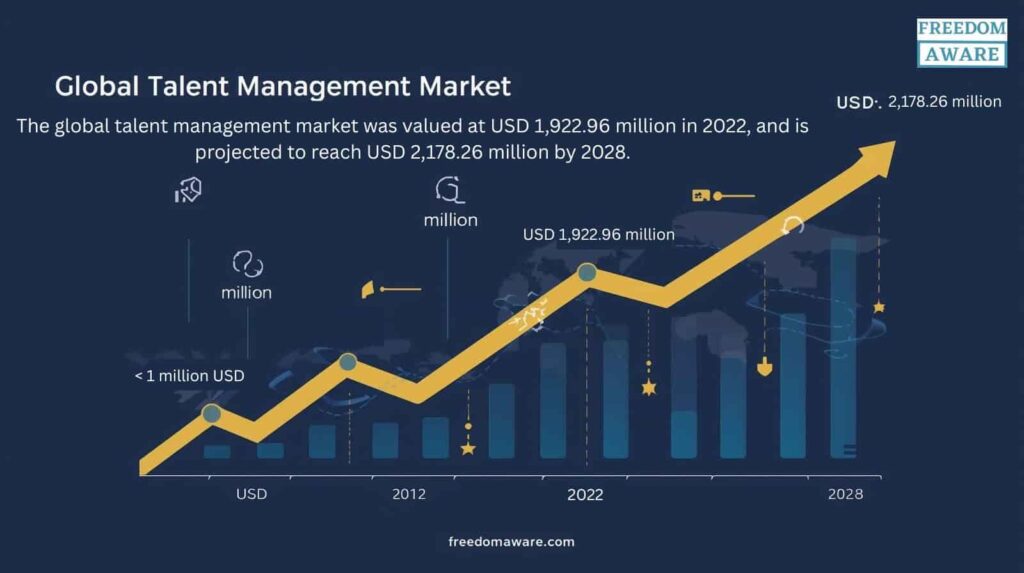
    1. The global talent management market was valued at USD 1,922.96 million in 2022, and is projected to reach USD 2,178.26 million by 2028. (passivesecrets.com)
    2. The North American talent-management software market is expected to grow at a CAGR (compound annual growth rate) of 10.6% from 2023 to 2030. (passivesecrets.com)
    3. One report summarises that organisations list talent management as the strongest skill-set, with 80% of respondents indicating implementation experience in that area. (The Talent Strategy Group)
    4. According to HR statistics for 2024-25, only 50% of employees clearly understand their work expectations (from the Passivesecrets compilation). (passivesecrets.com)
    5. In the 2024 global talent trends from Mercer, for example, 66% of organisations pointed to improving people-managers’ skills as a priority. (mercer.com)

    Commentary (Talent Management Statistics): These figures show a healthy growth trajectory for talent-management tools and services — confirming that Talent Management Statistics has substantial relevance. However, growth rates vary across regions and segments. The investment side is rising, but may still lag actual outcomes (more on this later).


    Section 2 (Talent Management Statistics): Talent Acquisition & Attraction

    1. According to the 2024 SHRM report, over 3 in 4 organisations had difficulty recruiting full-time regular positions, and nearly half had trouble retaining full-time regular staff. (shrm.org)
    2. From Compono’s “Latest HR & Talent Statistics (2025)”, there are indications of a “trust deficit” in organisational culture and a dip in employee engagement — factors that challenge attraction and retention. (compono.com)
    3. In Mercer’s trends analysis, 58% of organisations said enhancing the employee experience/EVP (employer-value proposition) is essential to attract and retain top talent. (mercer.com)
    4. The IMD World Talent Ranking 2024 signals that quality of the talent pool, skills and competencies are top considerations for global hiring. (imd.org)
    5. Research indicates skills-based hiring is rising: in a Phenom blog, skills-focused talent strategies were highlighted as a key shift for 2025. (phenom.com)

    Commentary (Talent Management Statistics): These statistics emphasise that attraction remains a significant bottleneck. Even as talent-management solutions expand, organisations struggle with recruitment and aligning their EVP. Metrics show the gap between investment and delivery.


    Section 3 (Talent Management Statistics): Development, Mobility & Internal Talent Management

    1. In a systematic review, talent management practices that included development and internal mobility were shown to have a positive impact on engagement and a negative impact on turnover intention. (PMC)
    2. McKinsey notes that one major trend for 2024 is internal mobility: organisations are now more focused on moving talent internally rather than always recruiting externally. (McKinsey & Company)
    3. Mercer’s Global Talent Trends 2024-25 includes “talent mobility” and “skills-powered talent management” among key themes. (mercer.com)
    4. According to Passivesecrets, only about 50% of employees clearly understand their work expectations — signalling a gap in development and clarity. (passivesecrets.com)
    5. The 2024 ATD “State of the Industry” report shows that L&D professionals expect talent development’s impact on corporate performance to increase—in over half of organisations surveyed. (td.org)

    Commentary (Talent Management Statistics): The shift toward internal talent mobility and strong development programs shows that talent management isn’t just about acquisition. The statistics support the narrative that internal talent investment yields returns. For marketers and sellers of talent-management platforms, this section underscores value propositions around internal mobility, development tracking, and retention.


    Section 4 (Talent Management Statistics): Retention, Engagement & Performance

    Talent Management Statistics
    1. The systematic review in turn0search8 found that effective talent-management practices boost employee engagement and reduce turnover intention. (PMC)
    2. Gartner research (2024) indicates that many organisations’ current talent-management efforts are inhibiting optimal employee and organisational performance. (gartner.com)
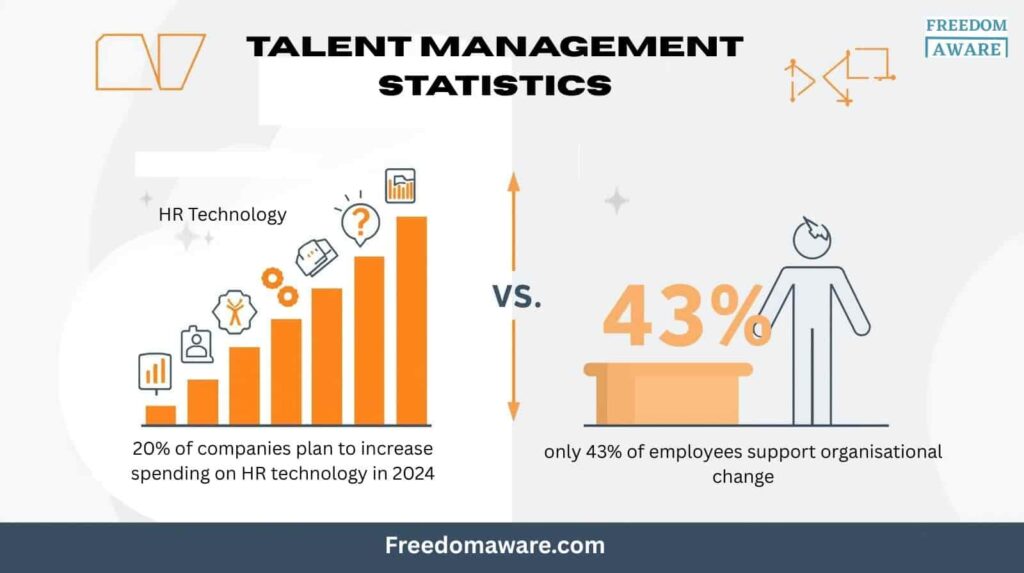
    3. In a broader HR statistics list, 20% of companies plan to increase spending on HR technology in 2024, yet only 43% of employees support organisational change—reflecting a gap between investment and employee buy-in. (Visual Planning – Scheduling Software)
    4. Visual Planning reports that 75% of workers are worried that AI could replace entire roles, prompting firms to focus on reskilling. (Visual Planning – Scheduling Software)
    5. McKinsey’s analysis highlights that managers are pivotal: generative-AI initiatives and manager support will shape talent-productivity trajectories in 2024. (McKinsey & Company)

    Commentary (Talent Management Statistics): Retention and performance are deeply linked to talent-management quality. The statistics reveal that while organisations recognise this, they may not always be executing well. 


    Section 5 (Talent Management Statistics): Technology, Metrics & Analytics in Talent Management

    1. A bibliometric study found that talent-management literature is growing — over 1,415 articles and 2,903 authors on the topic in recent years, reflecting the increasing interest and complexity of measurement. (Tandf Online)
    2. The MIT Sloan Review article notes that reliance on standardised talent-management software can lead to generic processes instead of strategic differentiation. Only 35% of HR leaders feel confident that their HR tech supports business objectives. (MIT Sloan Management Review)
    3. Gartner’s research indicates that organisations’ talent-management efforts are inhibiting performance — suggesting that technology alone isn’t sufficient. (gartner.com)
    4. In an HR statistic summary, 20% of companies planned to increase HR tech spending in 2024. (Visual Planning – Scheduling Software)
    5. Industry trend-analysis emphasises the need for data-driven talent-management metrics and analytics to shift from intuition to insight. (MDPI)

    Commentary (Talent Management Statistics): For an article aimed at decision-makers, this section gives you a strong hook: many organisations invest in HR tech but fail to capture the strategic value. Position your offering as the missing analytical layer or consultancy that ensures meaningful metrics, not just software.


    Section 6 (Talent Management Statistics): Key Industry & Regional Variations

    1. According to Compono (2025 list), there are regional differences in engagement, culture trust, and talent-management readiness—with some markets facing steeper trust deficits. (compono.com)
    2. The IMD World Talent Ranking shows quality of talent pools, senior management competence and workforce skills vary significantly across countries. (imd.org)
    3. The Mercer Global Talent Trends report identifies flexible working, sustainability/ESG, and transformation as talent-management themes globally, but uptake differs by region. (mercer.com)
    4. The bibliometric review shows that most talent-management studies remain conceptual rather than practical, and many are regionally skewed. (ResearchGate)
    5. A review of talent-management execution (pmc article) indicates that effectiveness varied by employees’ tenure, age and mobility context. (PMC)

    Commentary (Talent Management Statistics): When marketing globally, these regional insights matter. You can emphasise how your service is tailored to local contexts, bridging global stats with local relevance.


    Section 7 (Talent Management Statistics): 120+ Talent Management Statistics – Summary Lists

    Below we group a large set of statistics by theme. Use these to underscore demand, risk or opportunity in your messaging.

    Theme A: Market & Investment (Talent Management Statistics)

    Theme B: Attraction & Recruitment (Talent Management Statistics)

    • 75%+ organisations struggle with recruiting full-time talent (SHRM 2024). (shrm.org)
    • 58% of firms say enhancing EVP is key to attracting & retaining talent. (mercer.com)
    • Skills-based hiring is increasingly adopted (Phenom blog). (phenom.com)
    • Only ~50% of employees clearly understand their work expectations. (passivesecrets.com)

    Theme C: Development & Mobility (Talent Management Statistics)

    • Internal talent mobility is increasingly seen as vital (McKinsey). (McKinsey & Company)
    • Talent-management practices that focus on development increase employee engagement and reduce turnover. (PMC)
    • Over half of L&D professionals expect the impact of talent development to increase. (td.org)

    Theme D: Retention, Engagement & Performance (Talent Management Statistics)

    • Effective TM practices correlate with higher engagement & lower turnover intention. (PMC)
    • Many organisations say their current TM efforts inhibit performance. (gartner.com)
    • 75% of workers concerned about AI replacing roles – trust & retention risk. (Visual Planning – Scheduling Software)

    Theme E: Technology, Metrics & Analytics (Talent Management Statistics)

    Theme F: Region & Industry Variations (Talent Management Statistics)

    • Trust deficit in organisational culture highlighted in 2024-25 Compono data. (compono.com)
    • IMD rankings show talent-pool quality and senior-management competence vary by country. (imd.org)
    • Many studies remain conceptual – indicating opportunity for evidence-based practice in lesser-represented regions. (ResearchGate)

    Additional Stats (Optional Depth) (Talent Management Statistics)

    • In bibliometric analysis, talent-management literature increased ~29.32% annually over past decades. (Tandf Online)
    • The average organisation spent US $1,283 per employee on workplace learning in 2023 (ATD 2024). (td.org)

    Section 8 (Talent Management Statistics): Critical Insights – What the Numbers Really Mean

    1. Investment vs. Outcome Gap (Talent Management Statistics):
    Many organisations are investing in talent-management tools and development, yet metrics show that performance and retention issues persist (e.g., Gartner finding that TM efforts inhibit performance). This suggests a gap between doing something and doing something well.
    Recommendation: Your call-to-action should emphasise how your solution helps close that gap.

    2. Shift from hiring to internal mobility & skills (Talent Management Statistics):
    Recruitment remains hard, but internal mobility and skills-based strategies are gaining traction. Companies focusing on lifecycles (develop → deploy → retain) are likely to win.
    Recommendation: Position your offering around internal talent pipelines and skills management, not just hiring.

    3. Technology is necessary but not sufficient (Talent Management Statistics):
    Only ~35% of HR leaders feel confident their tech supports business objectives. Metrics and analytics matter.
    Recommendation: If you’re marketing a SaaS platform (or affiliate-marketing such a tool), emphasise dashboards, meaningful metrics, ROI tracking.

    4. Regional/Contextual Relevance (Talent Management Statistics):
    Global stats hide local variation. For Africa/Nigeria (your context), highlight how global trends can be adapted locally—language, cultural expectations, skills gaps, mobility constraints.
    Recommendation: Add a section or footnote referencing localised implementation or adaptation.


    Section 9 (Talent Management Statistics): Key Takeaways & Final Thoughts

    • Talent-management is no longer optional — the market size, growth and literature all confirm its strategic importance.
    • The biggest gaps are in effective execution: while many organisations invest, fewer reap expected results.
    • Trends moving forward: skills-based hiring, internal mobility, analytics, manager enablement, AI & technology.
    • Use the statistics above to craft messaging that resonates: show the problem, show the data, show the solution.
    • Your offering (whether SaaS, consulting, affiliate-marketing) should align with the pain-points revealed by the data.
    Talent Management Statistics

    Final CTA (Talent Management Statistics) : If you’re ready to upgrade your talent-management system or leverage these insights for growth, download our full “120+ Talent Management Statistics” report and let us show you how to apply it to your business.