Launch Your SaaS Business in a Flash with GoHighLevel SaaS Snapshot
Do you want to build your SaaS business from scratch? GoHighLevel’s SaaS Snapshot is your shortcut to success. This pre-built package includes everything you need to launch your white-labeled SaaS quickly.
GoHighLevel is a cloud-based CRM that simplifies complex business operations. It offers a unified platform for marketing tools, making it easy for businesses of all sizes to manage and grow their customer base. With its user-friendly interface and flexible SaaS pricing, GoHighLevel is a powerful tool for boosting efficiency and achieving business goals.
GoHighLevel’s SaaS Mode (or Pro) lets you rebrand their powerful platform and sell it as your own. But is it worth it? We break down the confusion and tell you exactly who this game-changing option is for. If you loved our HighLevel review, you’ll want to know more.
GoHighLevel SaaS Mode lets you transform the platform into your own branded software and charge clients for access. This means extra income and stronger client relationships. Imagine offering your clients a powerful all-in-one marketing tool while boosting your bottom line. It’s a win-win!
Ready to Start Your SaaS Journey? (Gohighlevel saas Snapshot)
New to HighLevel? Begin with a free Agency Unlimited trial ($297/mo) and then start a SaaS Mode trial. For annual savings, call 1-888-732-4197 and mention Sam.
GoHighLevel’s SaaS Snapshot is your shortcut to success? This pre-built package includes everything you need to launch your white-labeled SaaS quickly.
What’s inside? (Gohighlevel saas Snapshot)
Ready-made website and sales funnels: Attract and convert leads effortlessly.
Automated workflows: Handle tasks like scheduling and payments on autopilot.
Engaging email and SMS campaigns: Build strong relationships with your customers.
Efficient calendars and booking: Manage appointments and bookings with ease.
Powerful forms and surveys: Gather valuable insights from your audience.
Organized pipelines and CRM: Track leads and nurture relationships effectively.
Essential marketing materials: Get started with pre-written templates and scripts.
Don’t waste time building from the ground up. Launch your SaaS business in just one day with GoHighLevel’s SaaS Snapshot.
Important Considerations (Gohighlevel saas Snapshot)
Before diving in, consider these factors:
Cost: Understand the investment required for your chosen snapshot.
Customization: Assess how flexible the snapshot is to match your unique brand.
Technical Expertise: Evaluate your team’s capabilities for handling potential adjustments.
Ready to Launch? (Gohighlevel saas Snapshot)
We hope this guide has helped you understand the potential of GoHighLevel’s SaaS Snapshot. If you’re excited to get started, click below to explore your options.
Here are the best and most surprising Data-Driven Decision Making Statistics You Should Know in 2025 and beyond;
In today’s fast-paced business landscape, making informed decisions is crucial for success. Gone are the days of relying on gut instincts and anecdotal evidence. Instead, companies are turning to data-driven decision-making to drive growth, improve efficiency, and stay ahead of the competition.
What Is Data-Driven Decision Making?(Data-Driven Decision Making Statistics)
Data-driven decision-making is the process of using data analysis and insights to inform strategic choices. It’s about moving beyond assumptions and personal biases to make decisions based on evidence, patterns, and trends.
But just how widespread is the adoption of data-driven decision-making? And what are the benefits of using data to inform business strategy? Let’s dive into the numbers and explore data-driven decision-making statistics that will revolutionize your business strategy.
Key Data Points on Data Driven Decision Making(Data Driven Decision Making Statistics)
Data is becoming essential: Over 90% of enterprises recognize data’s growing importance, with nearly half making most decisions based on data.
Data drives financial gains: Organizations leveraging big data analytics report an average 8% revenue boost and 10% cost reduction.
A data-driven culture is prevalent: Three-quarters of leaders in data-forward companies rely exclusively on data for decision-making.
Challenges persist: While data is crucial, only about half of data professionals have high confidence in its quality. Improving data integrity is a top priority.
The future is data-centric: The overwhelming majority of organizations anticipate an even greater reliance on data for decision-making in the coming year.
Data’s impact on sales: Data-driven strategies will surpass gut instinct in over two-thirds of B2B sales organizations within the next few years.
Statistics on Data-Driven Decision Making Adoption(Data Driven Decision Making Statistics)
Companies typically rely on an average of five internal data sources for decision-making. (Source)
Data-driven strategies will outperform gut feelings in 65% of B2B sales organizations by 2026. (Source)
Over 40% of companies are using big data analytics, but there’s still significant room for growth. (Source)
A vast majority about 90% of enterprises recognize data as a critical business driver. (Source)
A quarter of organizations primarily base strategic decisions on data, while nearly half rely on it heavily. (Source)
The vast majority of companies recognize the strategic importance of data and analytics. (Source)
Many companies are starting to view information as a valuable asset, with even more planning to do so in the future. (Source)
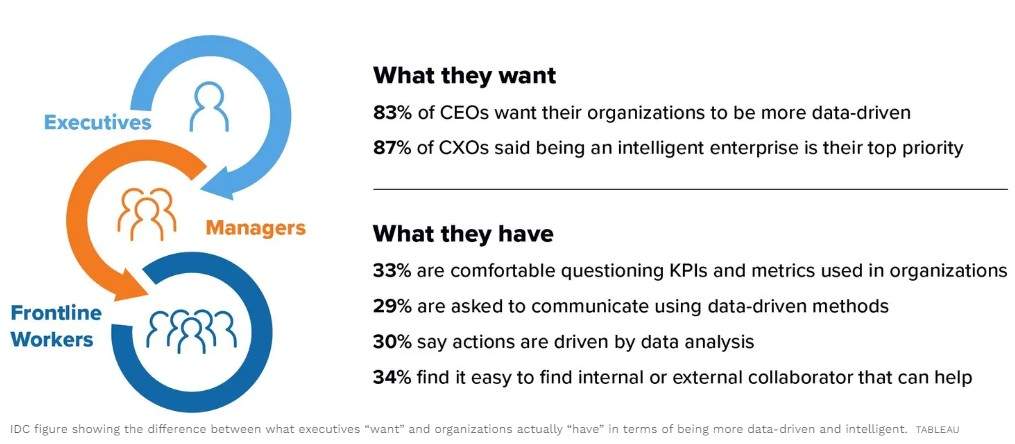
83% of CEOs want their organizations to be more data-driven. (Source)
87% of CXOs said being an intelligent enterprise is their top priority. (Source)
33% are comfortable questioning KPIs and metrics used in organizations. (Source)
29% are asked to communicate using data-driven methods. (Source)
30% say actions are driven by data analysis. (Source)
34% find it easy to find internal or external collaborators that can help. (Source)
While global adoption of data-driven decision-making surged by 12% between 2018 and 2020, only half of organizations reported making decisions primarily based on data. (Source)
Fewer than one-third of enterprises currently use data to identify new opportunities, but most intend to leverage it for this purpose. (Source)
A top-down approach is the most common decision-making style, with collaborative methods lagging. (Source)
According to a survey, executives in leading data-driven companies rely exclusively on data to guide their decision-making. ( Source)
In 2021, roughly two-thirds of European and U.S. data and analytics leaders reported having a corporate initiative to become more data-driven. Only 3% lacked such an initiative and planned to remain so. (Source)
A majority of C-suite executives acknowledge that their companies rely minimally on data to guide decision-making. (Source)
A large majority of leading marketers indicate that data informs decision-making at every level of their organizations. (Source)
Almost 40% of business leaders say their company makes decisions heavily relying on data, highlighting a strong trend toward data-driven practices. (Source)
Data privacy has emerged as a paramount concern in light of regulations like GDPR and CCPA. (Source)
Global marketing leaders primarily leverage data-driven strategies for email marketing (47%) and customer journey mapping (46%). (Source)
In 2020, the respondents surveyed demonstrated a 12 percent increase in implementing data-driven decision-making within their global organizations when compared to 2018. (Source)
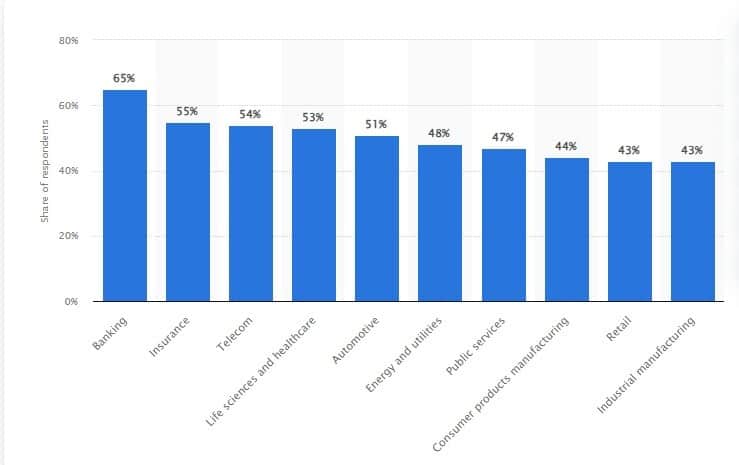
In 2020, a leading 65% of organizations in the banking sector utilized data-driven decision-making. (Source)
Data Driven Decision Making Statistics: Impact and Profitability
A recent study revealed that 85% of Singaporean business leaders experience decision distress, but they hold a strong belief that data can enhance decision-making, reduce risk, and increase preparedness for unforeseen circumstances. (Source)
Data-driven decision-making, prioritized by 77% of data and analytics professionals, delivers tangible benefits: operational efficiency (73%), cost reduction (62%), revenue generation (59%), and regulatory compliance (57%). (Source)
A significant gap exists between the potential of data and analytics and its actual integration into corporate strategy. Less than 50% of documented strategies highlight it as essential for delivering value. (Source)
Organizations leveraging big data analysis see significant gains: 8% revenue growth and 10% cost reduction. Top benefits include improved strategic decision-making (69%), optimized operational processes (54%), deeper customer insights (52%), and cost reduction (47%). (Source)
Best-in-class companies rely less on gut feelings (40%) than laggards (70%) for decision-making. (Source)
68% of companies that grew revenue within a year used market research to drive their success. (Source)
pen data access is strongly linked to higher performance, as leading marketers are 1.6 times more likely to believe in this connection. (Source)
Data-driven organizations significantly outperform others, boasting 23 times higher customer acquisition, six times greater customer retention, and 19 times higher profitability. (Source)
Businesses using big data saw an 8-10% profit increase and a 10% cost reduction. (Source)
Implementing data programs not only yields positive results (44%) but also fuels further demand for data (46%), suggesting that high-quality data drives business success. (Source)
Common Hurdles in Data DrivenDecision Making (Data Driven Decision Making Statistics)
Data quality (36%), integration (60%), and integrity (50%) remain major challenges, hindering trust in data for decision-making. Only 46% of data professionals have high confidence in its use, highlighting the need for improvement. (Source)
It’s not all sunshine and rainbows in the data-driven world. For every 10 organizations successfully using data, 23 are still trying to figure it out. (Source)
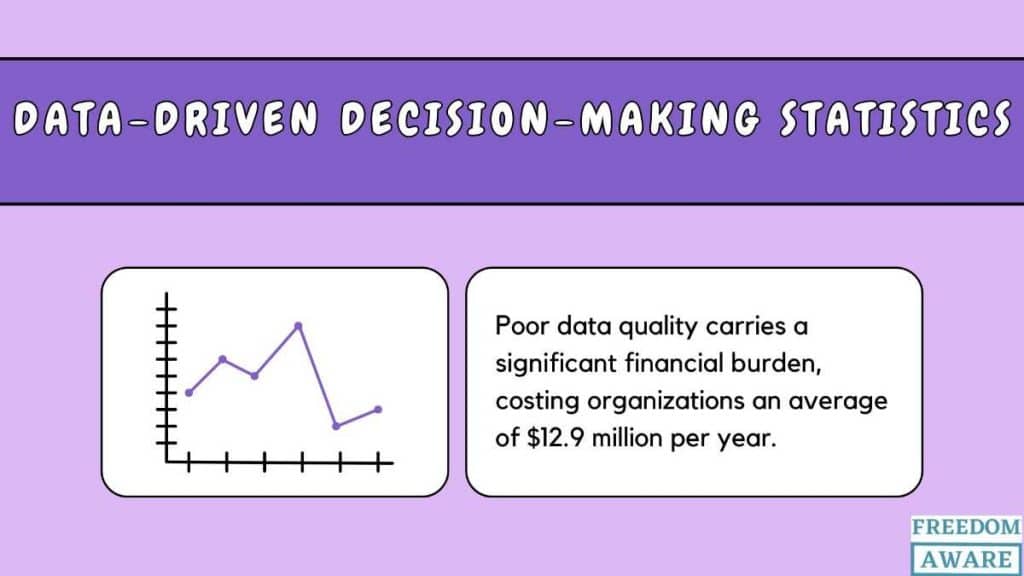
Poor data quality carries a significant financial burden, costing organizations an average of $12.9 million per year. (Source)
Half of all businesses lack clarity on their data and AI needs, hindered by data complexity. (Source)
Despite the abundance of data, organizations are only utilizing 50%, missing out on a significant opportunity to make more informed decisions. (Source)
Senior executives overwhelmingly agree that eliminating organizational silos is critical for leveraging data and analytics to make better decisions. (Source)
According to Qlik research, 45% of C-suite executives make decisions based on gut feeling, and 42% doubt data accuracy. (Source)
92% of business leaders asserted that the increasing number of data sources has limited their organizations’ progress. Also, 73% of business leaders agree that their distrust of data has prevented them from making decisions. (Source)
Gut instinct drives most decisions in 58% of companies, according to a survey. (Source)
While data-driven organizations experience a threefold improvement in decision-making, a significant portion (62%) of executives still prioritize experience and advice over data. (Source)
Targeting segmented audiences (50%) and ensuring real-time decision-making and data quality (33%) are major hurdles for marketers seeking to embrace data-driven practices. (Source)
Technology and Tools Usage Statistics (Data Driven Decision Making Statistics)
Organizations excelling in performance are significantly more likely to leverage advanced technology for risk analysis, stakeholder identification, and change management compared to their underperforming counterparts. (Source)
Businesses using predictive data analytics reported an average revenue increase of 15%. (Source)
Effective use of predictive analytics can boost operating margins by as much as 60%. (Source)
The predictive analytics market is set to skyrocket from $11.5 billion in 2023 to $61.9 billion by 2032, with a robust annual growth rate of 21.2% from 2024 to 2033. (Source)
The global decision intelligence market is booming, surging from $10.64 billion in 2022 to a projected $36.06 billion by 2030, driven by a 16.5% annual growth rate. (Source)
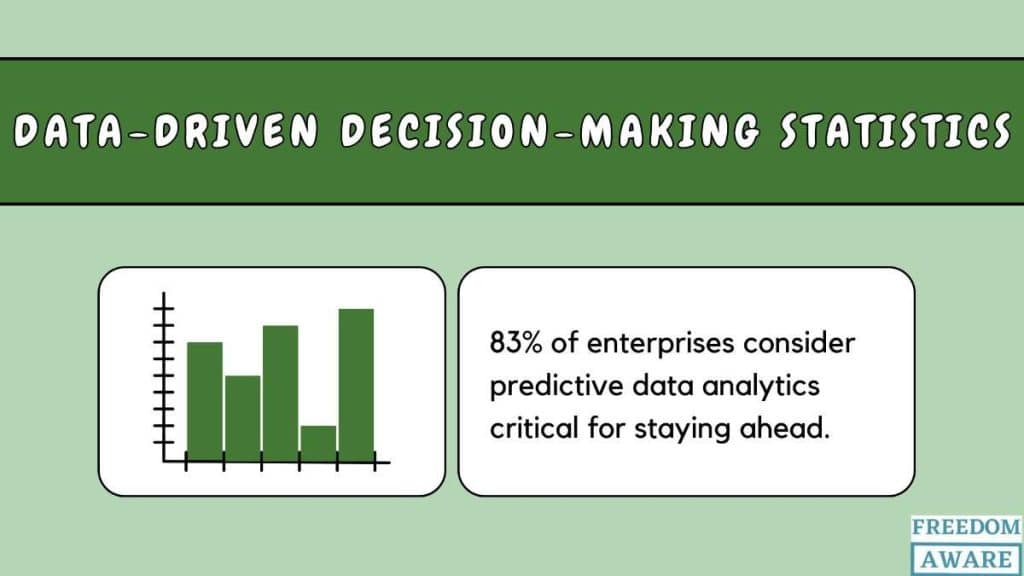
83% of enterprises consider predictive data analytics critical for staying ahead. (Source)
Data Driven Decision Making Statistics
Asia Pacific was expected to spend US$42.2 billion ($57 billion) on big data and analytics. (Source)
The decision dilemma is creating havoc in the business world, with 87% of business leaders suffering decision distress. (Source)
Italian managers highlight speedier decisions, better operations, and product innovation as key benefits of data-driven approaches, with data monetization less emphasized (14%). (Source)
In 2020, a leading 77% of U.S. organizations utilized data-driven decision-making. (Source)
Data overload is crippling Singaporean business leaders, causing decision paralysis (63%), mistrust (87%), and a desire for automated decisions (76%). (Source)
Less than 50% of companies agree that information is highly valued for decision-making or treated as an asset in their organization today, but two-thirds believe it will be in the future. (Source)
Finance leads data management and governance (60%), with IT playing a supporting role (41%), but sole IT responsibility is rare (10%). (Source)
Leading marketers are significantly more likely (72%) to invest in enhancing first-party data quality and quantity compared to their peers. (Source)
Data quality is a major issue for 70% of data professionals struggling with data trust, with 53% seeing it as crucial for data integrity. (Source)
Data-leading organizations boast a 70% higher rate of easy data access compared to data-aware ones. (Source)
More healthcare data is being collected in Africa than anywhere else in the world. (Source)
A vast majority of CEOs (83%) aim to transform their organizations into data-driven powerhouses. (Source)
Data Driven Decision Making Trends (Data Driven Decision Making Statistics)
Trend 1: The Rise of Artificial Intelligence(Data-Driven Decision Making Statistics)
Traditionally reliant on human intuition, decision-making often leads to subjective biases and inaccurate outcomes. AI is revolutionizing this process by providing objective analysis, real-time insights, and predictive capabilities. By identifying hidden patterns and continuously learning, AI empowers organizations to make data-driven choices that outperform traditional methods and drive operational efficiency.
Trend 2: Harnessing Advanced Analytics(Data Driven Decision Making Statistics)
Advanced analytics techniques are transforming how businesses operate by uncovering hidden risks, predicting market shifts, and optimizing processes. These insights enable organizations to deliver exceptional customer experiences and gain a competitive edge through proactive decision-making.
Trend 3: The Era of Hyper-Personalization(Data Driven Decision Making Statistics)
The one-size-fits-all approach is obsolete. By leveraging customer data, businesses can create highly personalized experiences, recommendations, and services. This level of customization fosters stronger customer relationships and drives business growth.
Trend 4: Cloud-Powered Transformation(Data Driven Decision Making Statistics)
The shift to cloud-based data management is accelerating. Cloud platforms offer unparalleled scalability, flexibility, and cost-efficiency. Coupled with advanced analytics and machine learning tools, the cloud empowers organizations to extract maximum value from their data. This leads to faster insights, improved collaboration, and the ability to handle massive datasets.
Conclusion: (Data Driven Decision Making Statistics)
In today’s competitive environment, data-driven decision-making is no longer a luxury, it’s a necessity for business survival and growth. By embracing a data-driven approach, companies can:
Minimize risk and make informed choices.
Increase efficiency and optimize operations.
Enhance customer satisfaction and loyalty.
Gain a competitive edge and drive sustainable growth.
FAQ (Data Driven Decision Making Statistics)
Why does decision-making require data?(Data Driven Decision Making Statistics)
Data-driven decision-making unlocks valuable insights into customer behavior, preferences, and needs. By analyzing customer data, businesses can precisely segment their customer base, tailor offerings to individual preferences, elevate customer experiences, and create highly targeted marketing campaigns.
What are some examples of data driven decision making?(Data Driven Decision Making Statistics)
Uber leverages data, algorithms, and predictive models to optimize driver allocation by accurately estimating travel times. Conversely, Starbucks utilizes data analytics to understand customer preferences and purchasing behavior.
How effective is data driven decision making?(Data Driven Decision Making Statistics)
Data-driven decision-making is a catalyst for operational efficiency. By uncovering bottlenecks, redundant processes, and areas for improvement, organizations can optimize resource utilization and streamline workflows, leading to substantial performance gains.
What is data driven decision making theory?(Data Driven Decision Making Statistics)
Data-driven decision-making is a strategic approach that leverages facts, metrics, and data analysis to inform business choices that directly contribute to the achievement of organizational goals and initiatives.
Here are the latest and best Gohighlevel saas Pricing information to help you in 2025 and beyond;
GoHighLevel: Your All-in-One Business Growth Platform(Gohighlevel Saas Pricing)
GoHighLevel is a cloud-based CRM that simplifies complex business operations. It offers a unified platform for marketing tools, making it easy for businesses of all sizes to manage and grow their customer base. With its user-friendly interface and flexible SaaS pricing, GoHighLevel is a powerful tool for boosting efficiency and achieving business goals.
GoHighLevel’s SaaS Mode (or Pro) lets you rebrand their powerful platform and sell it as your own. But is it worth it? We break down the confusion and tell you exactly who this game-changing option is for. If you loved our HighLevel review, you’ll want to know more.
GoHighLevel SaaS Mode lets you transform the platform into your own branded software and charge clients for access. This means extra income and stronger client relationships. Imagine offering your clients a powerful all-in-one marketing tool while boosting your bottom line. It’s a win-win!
GoHighLevel offers a range of pricing options to suit different business needs. Their flagship SaaS plan, packed with powerful features, is available for $497 per month. For those seeking more tailored solutions, GoHighLevel provides specific plans designed to cater to various business sizes and requirements.
Designed for growing businesses, the Agency Unlimited plan expands on the Starter plan with:
Unlimited user accounts
Advanced CRM capabilities
SMS messaging, custom domains, and advanced integrations
Facebook and Google Ads integration
Phone and chat support
Advanced reporting, customizable funnels, and workflow builder
Ideal for teams and agencies needing more flexibility and scalability. Upgrade to White Label capabilities for added power.
Start your 14-day free trial and discover the Agency Unlimited difference.
Plus, don’t miss our top-tier SaaS plan for advanced users and resellers.
At the heart of GoHighLevel is a robust platform packed with features to streamline your operations. From contact management and automation to sales pipelines and marketing tools, it’s designed to boost your efficiency.
SaaS Mode: Resell and Reap (Gohighlevel saas Pricing)
For agencies and entrepreneurs looking to create a recurring revenue stream, GoHighLevel’s SaaS mode is a game-changer. At $497 per month, you can white-label the entire platform and sell it under your brand, keeping 100% of the profits.
GoHighLevel offers a flexible pricing structure designed to meet the needs of businesses and agencies of all sizes. With plans ranging from the budget-friendly Starter to the powerful Unlimited and customizable SaaS options, you can find the perfect fit for your growth strategy.
Ready to supercharge your business? Start your 14-day free trial today and experience the GoHighLevel difference.
GoHighLevel SaaS Mode: Your Agency’s Secret Weapon?
GoHighLevel’s SaaS Mode (or Pro) lets you rebrand their powerful platform and sell it as your own. But is it worth it? We break down the confusion and tell you exactly who this game-changing option is for. If you loved our HighLevel review, you’ll want to know more.
GoHighLevel SaaS Mode lets you transform the platform into your own branded software and charge clients for access. This means extra income and stronger client relationships. Imagine offering your clients a powerful all-in-one marketing tool while boosting your bottom line. It’s a win-win!
Ready to Start Your SaaS Journey?(Gohighlevel Saas Mode)
New to HighLevel? Begin with a free Agency Unlimited trial ($297/mo) and then start a SaaS Mode trial. For annual savings, call 1-888-732-4197 and mention Sam.
SaaS Mode offers a dual advantage. Your clients get a robust platform with features like messaging, chat, reputation management, and more. As the agency, you enjoy tools for managing your SaaS business, including automated billing, user management, and account snapshots. It’s a win-win!
SaaS Mode: Worth the Investment?(Gohighlevel Saas Mode)
GoHighLevel‘s SaaS Mode is a game-changer for established agencies. It opens new revenue streams and deepens client relationships. However, it’s a significant investment.
SaaS Mode can be a profitable venture if you’re an agency with a solid client base. But for those starting from scratch, building a brand around a white-labeled platform is challenging. Differentiation is key.
Ultimately, the decision depends on your business model and goals.
White labeling means using someone else’s product as your own. You pay a fee to use their software and rebrand it under your business name.
GoHighLevel SaaS Mode: A Game-Changer
GoHighLevel’s SaaS Mode is a groundbreaking tool for agencies. It’s a fantastic opportunity to expand your offerings, boost revenue, and create a loyal customer base. No other platform offers this level of white-labeling capability.
However, it’s a significant investment. Carefully consider your client base and potential market before diving in. Survey your clients to gauge interest in additional marketing tools. This will help determine if SaaS Mode is the right move for your business.
Ultimately, GoHighLevel SaaS Mode has the potential to revolutionize your agency.
The Bible stands as an unparalleled literary and historical monument, profoundly shaping the course of human civilization. Beyond its spiritual depth, it is a treasure trove of remarkable facts and figures. From its word count to its linguistic reach, the Bible’s statistics offer a captivating lens into the extraordinary impact of this timeless book.
Join us as we uncover surprising insights into the scriptures that have left an indelible mark on history.
Key Statistics- (Editor’s Pick) Bible Statistics
The Bible was originally written in Hebrew.
The Bible is the best-selling book of all time, with over 5 billion copies sold worldwide.
The Bible remains a hot commodity, with over 100 million copies sold every year.
A staggering 90% of American homes own at least one Bible, making it ubiquitous in many households.
The Bible has been translated into over 2,000 languages, making it one of the most translated books in history.
There are 66 books in the Bible.
The Bible is the most quoted book in history, with its phrases, verses, and stories permeating art, literature, music, and film.
A remarkable 80% of Christians read the Bible daily, demonstrating its continued relevance and importance in the lives of millions worldwide.
‘Amen’ is the Last word of the Bible.
General Bible Statistics
The Bible is a product of over a thousand years of writing, with its earliest books dating back to around 1200 BC and the latest completed by 100 AD. (Source)
The original Bible lacked the familiar chapter and verse divisions, making memorization challenging. The Geneva Bible introduced this structure, revolutionizing Bible study. (Source)
The Bible was originally written in Hebrew. (Source)
The Bible’s longest word is Mahershalalhashbaz. (Source)
The Bible contains a vast number of divine promises, totaling approximately 7,147 according to “All the Promises of the Bible.” (Source)
Public opinion on the Bible’s influence in American culture is divided, with nearly one-quarter believing it is excessive and over two-fifths feeling it is insufficient. (Source)
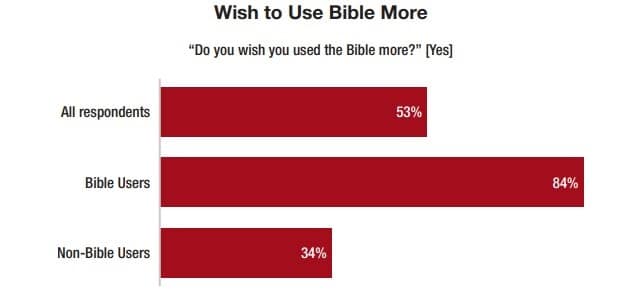
More than half of American adults (53%) say yes, they do wish they
Most American adults desire to read the Bible more frequently, including a substantial portion of those who rarely or never engage with it. (Source)
Bible ownership among practicing French Catholics has increased slightly since 1988, with two-thirds of this group owning a copy. (Source)
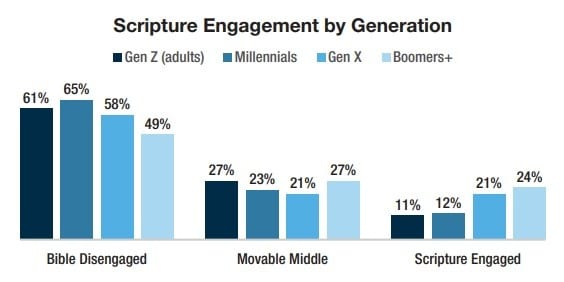
While Bible usage is growing among Gen Z, it is declining among Millennials. In contrast, a larger proportion of Gen Zers report increased Bible use compared to those who report decreased use. (Source)
A small but notable percentage of Americans find the Bible’s language challenging to connect with or uninteresting. (Source)
China is currently the biggest producer of Bibles in the world with over 600 employees. (Source)
Black Americans demonstrate the highest level of Bible engagement compared to other ethnic groups, with nearly one-third actively using Scripture. (Source)
The New Testament is the preferred section of the Bible among most Americans surveyed, although a significant minority admit to limited Bible familiarity. (Source)
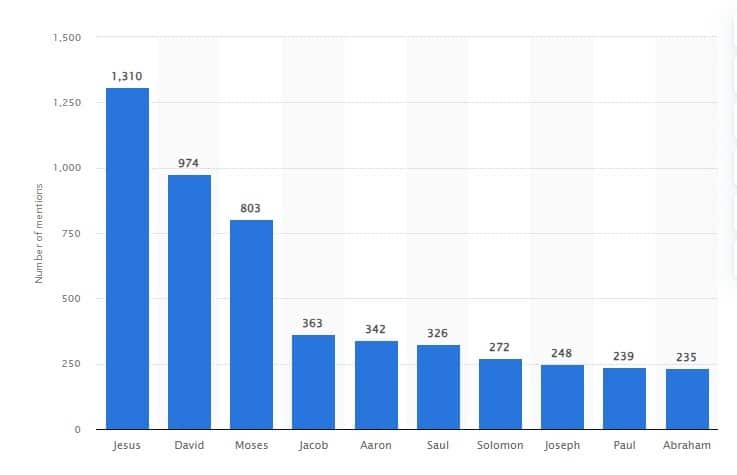
With 803 occurrences, Moses, the preeminent figure in Judaism, ranks as the Bible’s third most-mentioned name, following David, Israel’s third King. (Source)
The name Jesus dominates the biblical text, despite only appearing in the New Testament. (Source)
A notable 71% of Americans express a keen interest in delving deeper into the Bible and the life of Jesus, indicating a substantial public curiosity about spiritual matters. (Source)
The Bible’s influence spans the globe, with translations available in a staggering 3283 languages across 167 nations. (Source)
A significant portion of Americans, 44%, believe the nation would decline without the Bible, while only 14% disagree. (Source)
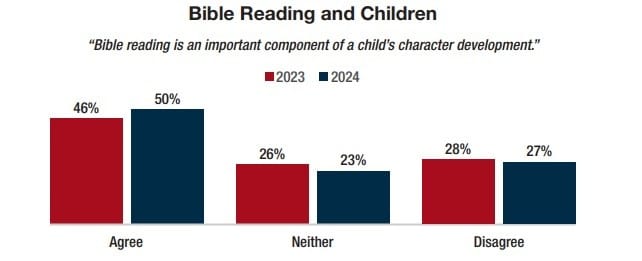
The belief in the Bible’s role in character development is prevalent among Americans, with 50% affirming its importance for children, an uptick from the previous year’s 46%. (Source)
The Bible’s enduring popularity is evident in its print circulation, with an estimated 5 to 7 billion copies distributed worldwide. (Source)
The Bible’s contemporary relevance is underscored by the exceptional sales of the “Message” translations, exceeding 20 million copies in just 25 years, according to Rev. Peterson’s literary agency. (Source)
Public opinion in the UK is skeptical of the Bible’s Christmas narrative, with over half doubting its historical accuracy. Conversely, less than a third find it wholly or partially believable. (Source)
The biblical figure Methuselah holds the record for the longest human lifespan, reaching an astonishing age of 969 years. (Source)
With annual sales surpassing 100 million copies, the Bible indisputably reigns as the world’s bestselling book. (Source)
Older generations (Boomers) exhibit higher levels of Bible engagement compared to younger generations (Millennials and Gen Z). (Source)
Up to 65 million American adults are open to the message of the Bible. (Source)
The biblical figure Methuselah holds the record for the longest human lifespan, reaching an astonishing age of 969 years. (Source)
The Bible’s transformative impact is evident in the lives of many, with 58% of people reporting positive life changes attributed to its message. This represents a slight increase from the previous year and a notable surge among Gen Z adults, rising to 54%. (Source)
The Bible holds the unfortunate distinction of being the world’s most stolen book. Its widespread availability in public spaces, such as hotels and hospitals, has made it an easy target for theft. (Source)
Reading The Bible Statistics
Regular Bible engagement correlates with increased spiritual engagement, as 22% of monthly readers reported heightened faith commitment and 13% indicated greater generosity. (Source)
A generational divide emerges in Bible reading habits, with Millennials and Gen X demonstrating a preference for digital formats (27% and 26% respectively), compared to the significantly lower adoption rates among Boomers and Elders (9% and 2%). (Source)
Traditional formats remain dominant among older Bible readers, with 91% expressing a preference for print over other mediums. (Source)
In 2024, half of Americans believe Bible reading is essential for their children’s development, an increase from 46% the previous year. (Source)
A consistent minority of Americans, comprising 11%, engage in daily Bible reading. (Source)
Demographic trends in Bible reading reveal a stark contrast between generations, with millennials exhibiting the lowest rates and those over 70 demonstrating the highest frequency. (Source)
The digital age has influenced Bible engagement, as 81% of online church attendees report independent Bible reading compared to 67% of primarily in-person attendees. (Source)
Despite evolving media, the desire to read the Bible persists, with 56% of Americans expressing interest in 2019. (Source)
Structured Bible engagement is common among Americans, with 27 million following specific schedules, study plans, or programs. (Source)
Personal preference dictates Bible reading for many Americans, with 31% of practicing Christians and 35% of non-practicing Christians admitting to selecting passages based on their mood. (Source)
The Bible has inspired compassion for those in need, with 130 million Americans citing its influence on their support for refugees and war victims. (Source)
Marital status significantly impacts Bible engagement among American adults, with the separated demonstrating the highest likelihood (52%) and never-married individuals exhibiting the lowest (30%). (Source)
The primary motivation for Bible reading among Americans is spiritual connection, with 47% citing a desire to draw closer to God. Seeking wisdom and finding comfort follow as secondary reasons, at 20% and 15% respectively. A small percentage (2%) read the Bible out of obligation. (Source)
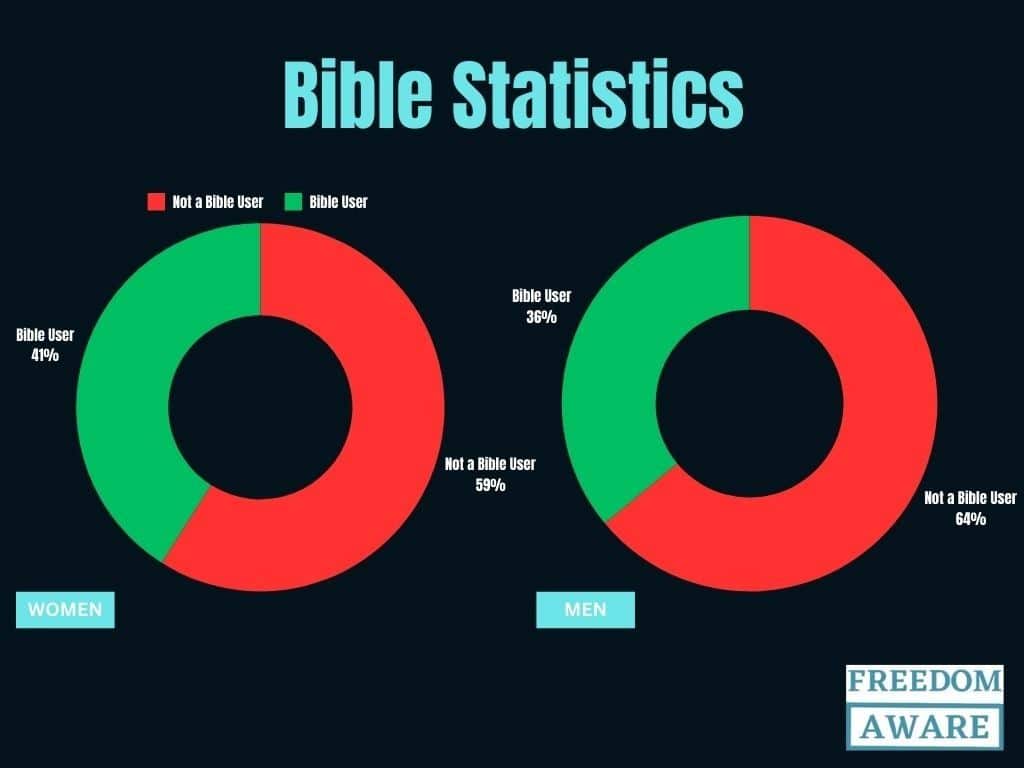
Women are more engaged with the Bible than men, with 41% of women identifying as Bible users compared to 36% of men. (Source)
Age correlates with Bible engagement, with older adults (Elders) displaying the highest usage (48%) and younger generations (Gen Z) the lowest (30%). (Source)
Religious affiliation strongly influences Bible use, with Evangelical and Historically Black Protestants exhibiting the highest rates (70% and 68% respectively), while Catholics demonstrate lower engagement (37%). (Source)
Racial disparities in Bible use are evident, with Black Americans leading at 57%, followed by Whites at 35% and Asians at 27%. (Source)
The King James Statistics and Facts (Bible Statistics)
The King James Version made its debut in 1611. (Source)
The King James Version of the Bible took seven years to complete its translation process. (Source)
The King James Bible is a cornerstone of the modern English language. (Source)
The King James Bible is a vast compilation, containing two sections, 66 books, 783,137 words, and a staggering 3,116,480 letters. (Source)
The Old Testament comprises 39 books, while the New Testament consists of 27. (Source)
The Bible’s rich linguistic tapestry includes 8,674 unique Hebrew words, 5,624 Greek words, and 12,143 English terms. (Source)
With 1,189 chapters and 31,102 verses, the Bible is a substantial literary work. (Source)
The Old Testament contains 929 chapters and 23,145 verses, while the New Testament has 260 chapters and 7,957 verses. (Source)
The structure of the Bible we know today is the result of careful organization. Cardinal Hugo de S. Caro introduced chapters in 1238, and Robertus Stephanus added verse divisions in 1551. (Source)
Psalms holds the distinction of being the longest book in the Bible with 150 chapters, while Psalm 119 claims the title of the longest chapter with 176 verses. (Source)
The Bible’s extremes of length are evident in Esther 8:9, the longest verse with 78 words, and John 11:35, the shortest with just two words: “Jesus wept.” (Source)
The books of 3 John and Psalm 117 are the shortest in terms of word count. (Source)
The Bible is a product of an extraordinary period, composed over 1,500 years by 40 diverse authors across three continents, using three languages (Hebrew, Aramaic [Chaldee], and Greek). (Source)
The Old Testament is a collection of historical, poetical, and prophetic writings, with 17 books in each category (Source).
The New Testament presents four Gospels, 21 letters, and the prophetic book of Revelation. (Source)
Final Thoughts (Bible Statistics)
The data presented here unveils a captivating portrait of the Bible – its historical depth, global reach, and enduring influence.
From impressive sales to linguistic complexity, the numbers tell a compelling story. Whether you approach the Bible as a scholar, a spiritual seeker, or simply an interested reader, these statistics offer a unique perspective on this timeless text. As you engage with its pages, consider the extraordinary journey it has undertaken and the profound impact it continues to make on the world.
Stay ahead of the curve with the latest marketing jobs statistics and trends.
In today’s digital age, a robust online presence is essential for businesses to thrive. Marketing professionals are the architects of this digital world, leveraging social media, content, and data to drive growth. The marketing industry is experiencing explosive growth, with job opportunities expanding rapidly. This article delves into the latest trends, salary insights, and in-demand skills to guide you through the exciting world of marketing.
Marketing Job Statistics (Editor’s Top Picks)
The US Marketing Consultants industry boasted a workforce of 577,899 in 2023, demonstrating a steady 6.3% annual growth since 2018.
Google commands a dominant 74% share of worldwide search traffic.
The technology industry offers the highest salaries for marketers.
A report highlighted writing and analytics as the most sought-after skills for senior content marketing roles, accounting for 29% and 25% of demand respectively.
Marketing Managers are consistently ranked as having the most desirable role in sales and marketing.
Companies with CEOs who prioritize marketing as a growth driver are twice as likely to achieve annual growth rates exceeding 5% compared to their industry counterparts.
General Marketing Job Statistics
Marketing Managers are consistently ranked as having the most desirable role in sales and marketing. (Source)
The demand for chief marketing officers is expected to grow by 3% until 2032, creating about 311,600 job openings annually. (Source)
Marketing manager positions were projected to increase by 6.62% in 2022. (Source)
Women dominated the U.S. marketing workforce, holding 60% of positions between May 2020 and May 2021, with real estate and wellness & fitness sectors showing the highest female representation at 71% and 70% respectively. (Source)
Marketing specialists are significantly more likely 48% to work for public companies rather than private ones. (Source)
A significant uptick in marketing recruitment is expected in the UK, with 81% of businesses planning to hire for these roles in the next year compared to 67% the previous year. (Source)
The demand for market research analysts is on the rise, with a projected 13% job growth creating 94,600 new positions annually until 2032. (Source)
Approximately 358,200 individuals held marketing manager positions in 2022. (Source)
55% of marketers are contemplating switching careers due to opportunities for better compensation, benefits, and perks. (Source)
The U.S. currently employs over 405,911 marketing specialists. (Source)
Companies with CEOs who prioritize marketing as a growth driver are twice as likely to achieve annual growth rates exceeding 5% compared to their industry counterparts. (Source)
The professional and business services industry, which encompasses marketing roles, experienced a surge in hiring, adding 74,000 new jobs in January 2024, surpassing the previous year’s monthly average. (Source)
Customer service and digital marketing roles dominate job searches globally, attracting over 66,900 and 57,800 average monthly searches respectively. Project management and content-related positions follow closely behind. (Source)
The project management marketing sector is poised for growth, with a projected 6% expansion leading to 34,000 new job openings annually until 2032. (Source)
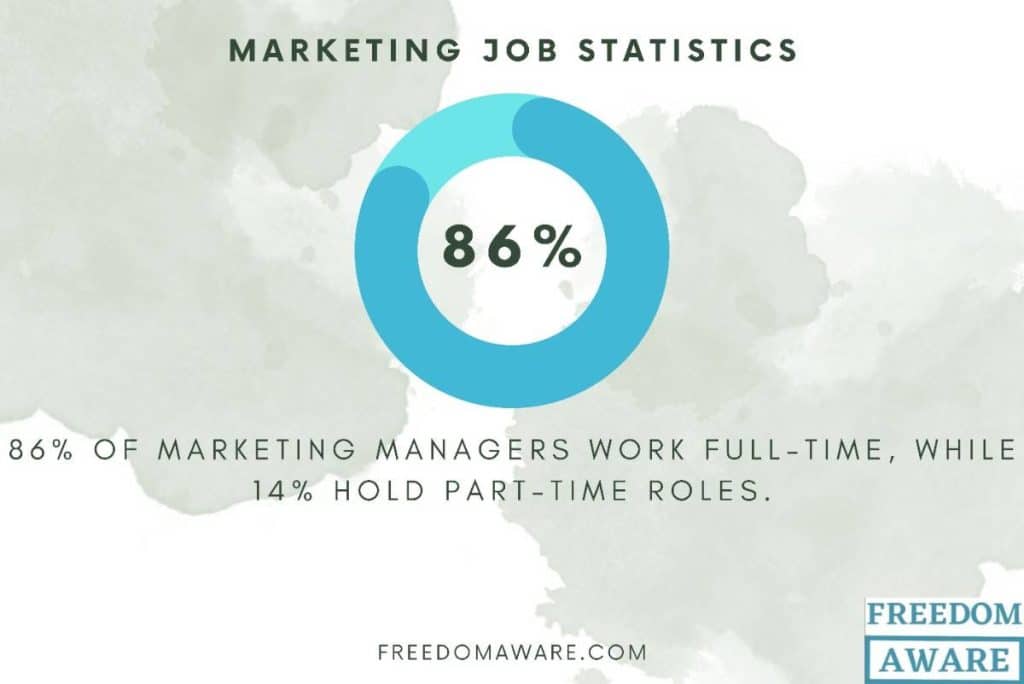
86% of marketing managers work full-time, while 14% hold part-time roles. (Source)
The advertising, PR, and related services industry reached a historic high in December 2023, with over 504,600 jobs. (Source)
Marketers are significantly more likely to be employed by private companies, with a 72% higher probability compared to public companies. (Source)
Core Competencies Marketing Job Statistics
A bachelor’s degree in marketing provides a foundation for entry-level roles across the marketing spectrum, encompassing creative functions such as media design and copywriting, as well as analytical areas like market research. (Source)
Bachelor’s degrees are the most common educational attainment for marketing managers, followed by graduate degrees and some college. (Source)
Social media, SEO, and strategy emerged as the most sought-after skills in content marketing job postings within the UK in 2020. (Source)
Technical degrees are the most required qualification for marketing positions in China, followed by undergraduate degrees, with master’s degrees being exceptionally rare. (Source)
Business, communications, and social sciences are the predominant majors for marketing managers. (Source)
Most marketing jobs in China demand between one and three years of experience, with a smaller proportion requiring three to five years. (Source)
While operations and finance dominate the backgrounds of Fortune 100 CEOs, marketing is underrepresented at the C-suite level. Only 10% of Fortune 250 CEOs have marketing experience, with a mere 4% holding CMO-equivalent roles. (Source)
A 2022 analysis identified writing and analytics as the most in-demand skills for senior content marketing roles, accounting for 29% and 25% of skill requirements respectively. (Source)
Women constitute the majority of marketing specialists, comprising 64.5% of the workforce, while men account for 35.5%. (Source)
The BLS reports that marketing manager positions are comparatively secure during company downsizing. (Source)
Similar to the overall marketing workforce, White individuals dominate the marketing specialist demographic, followed by Hispanic or Latino, Asian, and Black or African American. (Source)
The marketing manager role is predominantly held by women, with 61.8% of the 557,304 marketing managers in 2022 being female. (Source)
The marketing workforce is predominantly split between women (47.8%) and men (52.2%). (Source)
The marketing industry exhibits a diverse ethnic composition, with White individuals representing the largest group (66.9%), followed by Hispanic or Latino, Asian, and Black or African American. (Source)
Despite a higher proportion of women in marketing management roles, men exhibit a stronger preference for these positions, with a 1.69 to 1 ratio in terms of desire for the role. (Source)
While women hold a majority of marketing manager positions (69%), men still constitute a significant portion (31%). (Source)
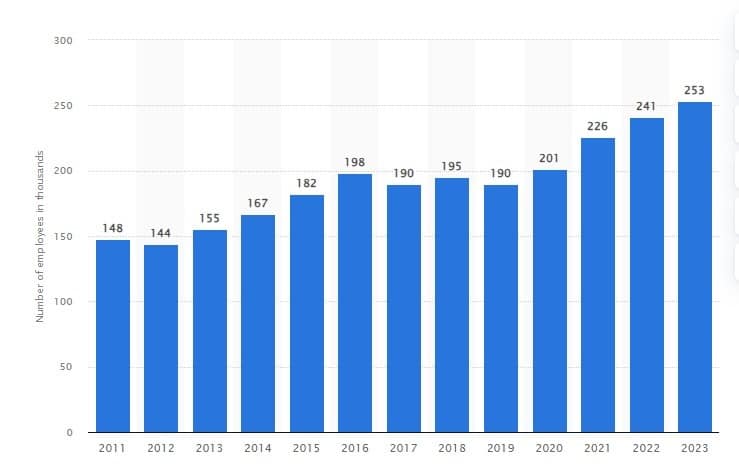
The advertising and marketing segment of the UK’s creative industries employed 201,000 people in 2020. (Source)
In 2023, 253 thousand people were employed in the advertising and marketing sub-sector of the UK’s creative industries. (Source)
The typical marketing specialist is 36 years old. (Source)
The UK advertising and market research industry demonstrates gender disparities, with more women employed overall but more men working as self-employed professionals. (Source)
Marketing Compensation and Earnings (Marketing Job Statistics)
While marketing managers across the U.S. achieved notable salaries, San Joaquin County, particularly the Lathrop and Manteca areas, offered the highest compensation. However, the majority of marketing managers were concentrated in San Francisco County, specifically the Chinatown, North Beach, and Russian Hill neighborhoods. (Source)
Marketing managers enjoyed substantial earnings in 2022, with an average salary of $111,944, significantly surpassing the national average by $47,261. (Source)
Compared to the national average, marketing managers exhibited a lower income inequality, as indicated by a GINI coefficient of 0.407 in 2022. (Source)
The median annual salary for all marketing positions in China stands at ¥155,000, equivalent to approximately $23,310. (Source)
Marketing Managers in China command an average annual salary of ¥238,717, or roughly $35,830. (Source)
The average annual income for Marketing Analysts in China is ¥201,126, translating to around $30,206. (Source)
Content Marketers in China typically earn an average annual salary of ¥184,126, which is about $27,711. (Source)
Marketing Assistants in China have an average annual salary of ¥116,750, or approximately $17,544. (Source)
Marketing specialists earned a median annual salary of $68,230 as of May 2022. (Source)
Email marketing directors command salaries between $86,000 and $147,000, with an average compensation of $107,963. (Source)
Marketing managers commanded a median annual wage of $157,620 in May 2023. Earnings were widely dispersed, with the lowest 10% earning less than $79,600 and the top 10% exceeding $239,200. (Source)
Marketing research directors enjoy substantial earnings, with salaries ranging from $84,000 to $183,000 and an average of $124,736. (Source)
The majority of marketing employers (78%) implemented salary increases in 2023, primarily driven by rising living costs (64%). (Source)
Female marketing specialists experienced a narrower gender pay gap compared to the overall marketing industry, earning 96% of their male counterparts’ salaries in 2022. (Source)
Marketing managers achieved substantial earnings in mid-2022, with a median annual wage exceeding $140,000. (Source)
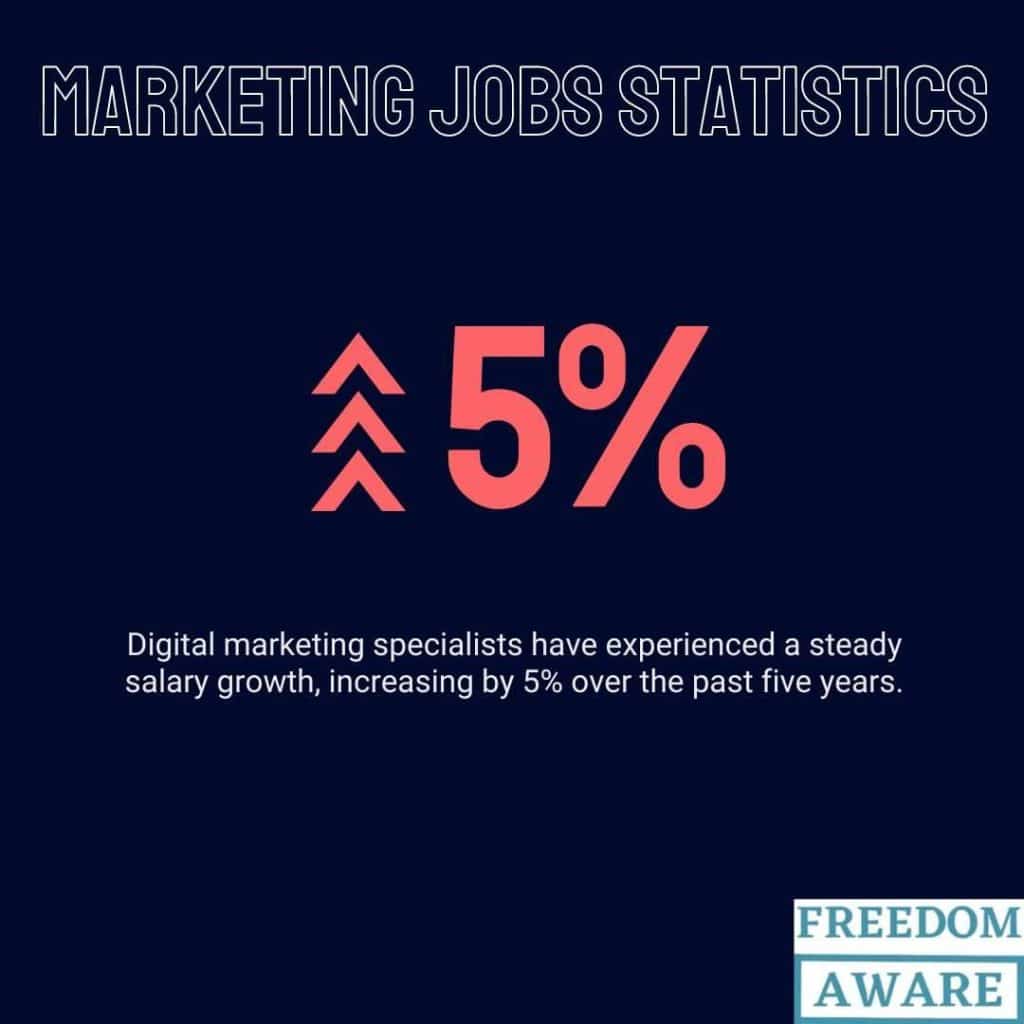
Digital marketing specialists have experienced a steady salary growth, increasing by 5% over the past five years. (Source)
While New York City boasts the highest average annual wage for marketers at $80,006, Delaware emerges as the most favorable state for marketers in terms of overall lifestyle and cost of living. (Source)
The technology sector stands out as the industry offering the most lucrative compensation for marketers. (Source)
The average marketing salary in the UK rose by 2.6% over the last year, below the UK average of 3.5%. (Source)
A gender pay gap persists in the marketing industry, with women earning 92% of men’s salaries in 2022. (Source)
Content marketing directors typically earn between $60,000 and $156,000, averaging $102,374 annually. (Source)
Demand generation managers typically earn between $64,000 and $119,000, averaging $86,624. (Source)
Digital marketing directors command salaries ranging from $65,000 to $161,000, with an average compensation of $108,676. (Source)
Brand marketing managers have a salary range of $54,000 to $116,000, with an average compensation of $78,714. (Source)
Marketing managers achieved a median salary of $140,040 in 2022, with top earners reaching $198,530 and the lowest quarter earning $103,060. (Source)
Product marketing managers enjoy salaries ranging from $65,000 to $135,000, with an average income of $95,940. (Source)
Product marketing roles in India offer competitive compensation, with salaries typically ranging from Rs 8 to 14 lakhs per annum. (Source)
Marketing professionals in the UK enjoy a salary spectrum ranging from £28,000 annually for marketing executives in medium-sized companies to a substantial £143,600 for Chief Marketing Officers in large corporations. (Source)
Marketing consultants in India command substantial salaries, with earnings ranging from Rs 10 to over 30 lakhs per annum, solidifying their position as one of the highest-paid professions. (Source)
Social media marketing managers are among the top earners in India’s marketing sector. (Source)
Chinese marketing specialists earn an average monthly salary of ¥14,233 RMB, equivalent to approximately $1,979 USD, with a median income of ¥12,180 RMB. (Source)
Individuals from working-class backgrounds face a significant salary disadvantage in marketing, earning 18.2% less than their counterparts from upper-class origins. (Source)
Content marketers typically earn around $58,000 annually, though compensation can vary widely based on individual qualifications. (Source)
While social media coordinator is an entry-level job, most professionals in this role make over $44,000 per year. As experience grows, average earnings can reach $51,000. (Source)
SEO specialists, with their expertise in search engine optimization, typically command an average salary of around $52,000. (Source)
Obstacles and Concerns in the Marketing Industry (Marketing Job Statistics)
The advertising industry is bracing for significant job losses due to AI, with clerical roles facing a 28% reduction and sales-related roles experiencing a 22% decline by 2030. (Source)
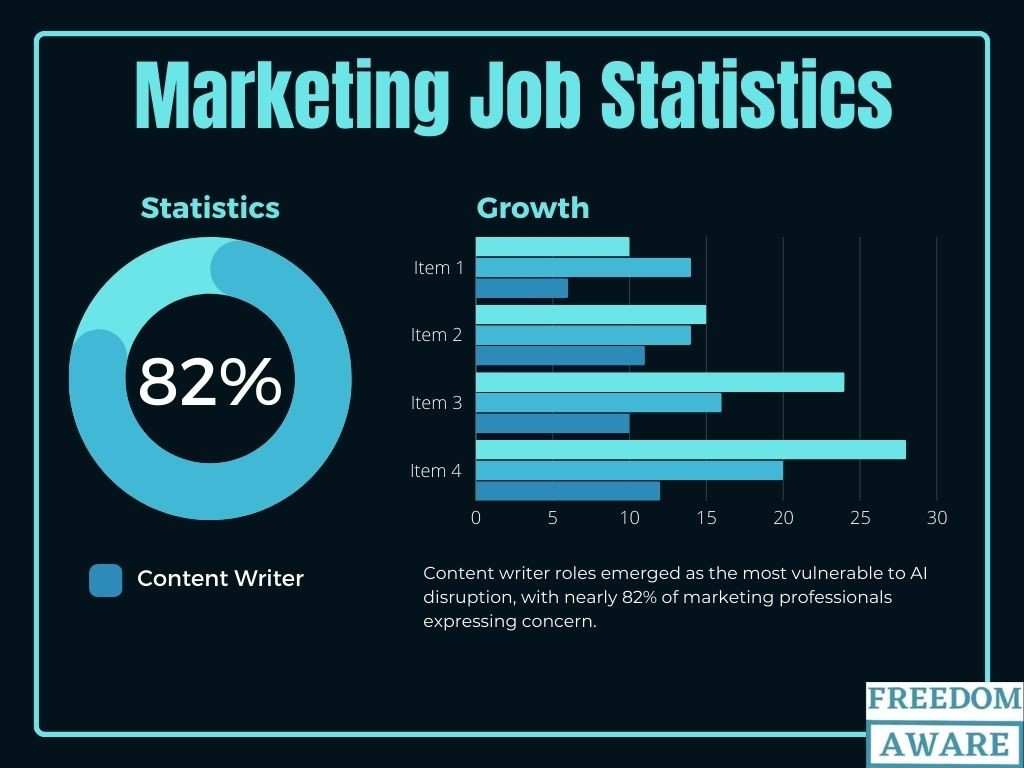
Content writer roles emerged as the most vulnerable to AI disruption, with nearly 82% of marketing professionals expressing concern. (Source)
Followed by email marketing roles at 43%. (Source)
The marketing industry is grappling with a widespread skills shortage, affecting 87% of employers. (Source)
The UK marketing landscape has been challenged by skills shortages, affecting 80% of employers and leading to a 40% productivity decline in the past year. (Source)
AI tools have significantly reduced the longevity of specialized skills, according to 53% of marketing employers. (Source)
The healthcare industry experienced the steepest decline in marketing job postings, with a 60% drop on LinkedIn in 2023 compared to the previous year. (Source)
Financial services and tech marketing roles also saw steep declines, with 56% and 52% fewer jobs being posted, respectively. (Source)
Marketing Job Opportunities By Industry(Marketing Job Statistics)
Computer Systems Design, Management consulting, and Advertising/PR firms are the primary employers of marketing managers. (Source)
The number of marketing manager positions is projected to reach 381,900 by 2032. (Source)
Organizations are increasingly relying on contract professionals, particularly in digital marketing, with 68% of managers planning to expand their use of these workers. (Source)
The professional, scientific, and technical services sector employs a quarter of all marketing managers, highlighting its significance in the industry. (Source)
The US Marketing Consultants industry has experienced rapid growth, with a workforce of 577,899 in 2023 and a consistent 6.3% annual increase since 2018. (Source)
Marketing Job Prospects Across Regions (Marketing Job Statistics)
Europe
The UK’s advertising and marketing sector experienced significant growth between 2011 and 2021, with employment numbers rising from 148,000 to 225,000. (Source)
The UK experienced a decline in sales, marketing, and related professionals between Q3 and Q4 2023, dropping from 947,900 to 917,900. (Source)
The number of market associate professionals in the UK saw minimal growth between Q3 and Q4 2023, rising slightly from 203,400 to approximately 203,700. (Source)
The UK job market experienced a significant downturn in the third quarter of 2022, with a 2.6% decrease in open positions, marking the largest quarterly decline since early 2020. The total number of vacancies fell to 1,266,000. (Source)
A UK survey revealed a higher propensity for remote hiring within the marketing industry, with 43% of employers adopting or planning to adopt remote work compared to the national average of 28%. (Source)
In the fourth quarter of 2022, 192,000 people in the UK worked in advertising and market research. (Source)
UK marketing budgets expanded by an average of 5% in 2023. (Source)
On average, marketing accounted for 13% of company budgets in the UK during 2023. (Source)
North America
The US advertising agency sector experienced significant growth in 2022, with employment numbers surging 10.4% from the previous year to surpass 195,280 employees. (Source)
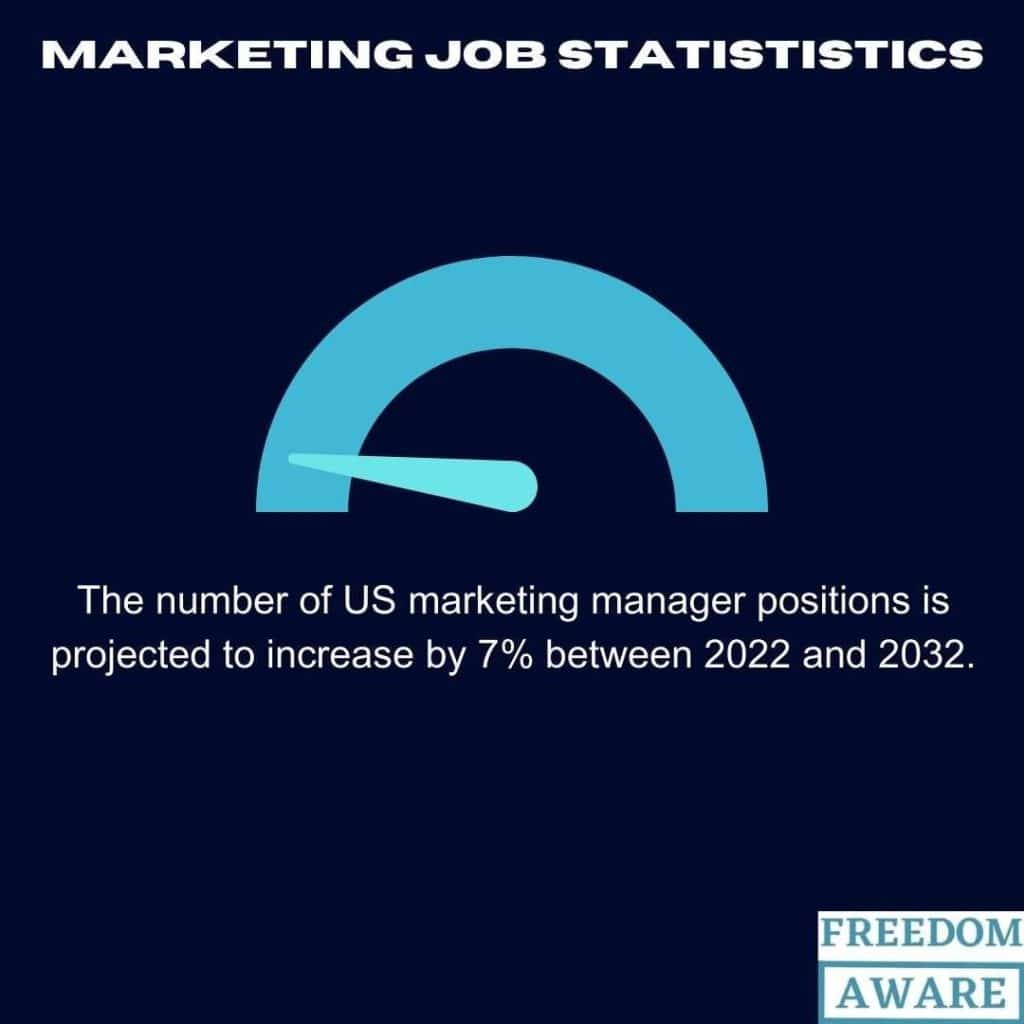
The number of US marketing manager positions is projected to increase by 7% between 2022 and 2032. (Source)
U.S. public relations firms experienced a significant employment surge of nearly 14%, reaching a total of 62,370 employees. (Source)
South America
Editorial and digital marketing roles dominated job search trends in Brazil between February 2022 and 2023, averaging around 444 and 377 monthly searches respectively. (Source)
Account Manager, Ad Ops Specialist, and Associate Advertising Manager emerged as the most sought-after marketing positions in Latin America, followed by Community Builder, Content Manager, and Copywriter. (Source)
Asia-Pacific
Marketing resumes ranked second in popularity in Singapore, accounting for 1.7% of all searched resumes. (Source)
The marketing consulting industry is poised for significant growth, reaching a projected value of $343.5 billion by 2025, making it a highly lucrative sector for marketing professionals in India. (Source)
Indian companies recruited 4,556 marketing professionals in May 2023. The year 2020 witnessed fluctuating employment trends within the marketing sector, with a downturn in April due to the COVID-19 pandemic followed by a subsequent recovery. (Source)
In-Demand Marketing Jobs (Marketing Job Statistics)
So, which marketing jobs are in the highest demand? Here are some of the most sought-after positions:
Digital Marketing Manager: With the rise of digital marketing, companies are looking for professionals who can develop and execute online marketing strategies.
Content Marketing Specialist: As content marketing continues to grow in importance, companies need professionals who can create engaging, high-quality content that resonates with their target audience.
SEO Specialist: With search engines constantly evolving, companies need experts who can optimize their websites and content for maximum visibility.
Social Media Manager: As social media becomes an increasingly important channel for customer engagement, companies are looking for professionals who can develop and execute social media strategies.
Skills Required for Marketing Jobs (Marketing Job Statistics)
To succeed in the marketing industry, professionals need to possess a range of skills, including:
Data Analysis: The ability to collect, analyze, and interpret data is crucial for making informed marketing decisions.
Content Creation: Marketing professionals need to be able to create high-quality, engaging content that resonates with their target audience.
Digital Literacy: With the increasing importance of digital marketing, professionals need to be proficient in digital tools and platforms.
Communication: Effective communication is essential for marketing professionals, who need to be able to convey their message to their target audience.
Conclusion (Marketing Job Statistics)
The marketing industry is experiencing a period of rapid transformation, driven by technology and shifting consumer behaviors. This presents an exciting opportunity for professionals who can adapt and embrace new trends. By staying informed about the latest job statistics and emerging skills, marketers can position themselves for success in this dynamic and rewarding field.
FAQ (Marketing Job Statistics)
Is there a demand for marketing jobs?
Yes, there is a strong demand for marketing jobs. The marketing landscape is constantly evolving, driven by technological advancements and changing consumer behaviors. This creates a consistent need for skilled professionals who can navigate these complexities.
Is There Money in a Marketing Career?
Yes, there can be significant earning potential in a marketing career. Marketing offers a vast array of opportunities, and with dedication and career progression, it can also be a lucrative field.
Which marketing field is the best?
There’s no definitive “best” marketing field. The ideal choice depends largely on your interests, skills, and career goals. Each area offers unique challenges and rewards.
Below, are some sales enablement statistics you should know;
In today’s fast-paced sales landscape, staying ahead of the competition requires more than a solid sales strategy – it demands a data-driven approach. Sales enablement has emerged as a crucial component of modern sales organizations, empowering teams to sell more effectively and efficiently. But what does the data say about the impact of sales enablement on business outcomes?
In this article, we’ll delve into the latest sales enablement statistics, uncovering key trends, benchmarks, and insights that will help you optimize your sales enablement strategy and drive revenue growth.
Key Sales Enablement Statistics (Editor’s Pick)
Organizations leveraging sales enablement technology are twice as likely to harness analytics to optimize sales strategies.
23% of companies with a formal Revenue Enablement program support Customer Success, 18% support presales, and 15% support marketers, among other functions. Additionally, 25% have enablement reporting to the Chief Revenue Officer (CRO).
70% of consumers prefer personalized experiences using their data.
81% of organizations see sales enablement as a revenue team efficiency booster.
The global sales enablement platform market is projected to grow from $3.41 billion in 2023 to $12.7 billion by 2030.
92% of executives credit sales enablement investments for boosting sales, and 84% plan continued or increased spending in this area.
90% of organizations now have a dedicated sales enablement team, reflecting a 20% annual growth and increased industry recognition.
General Sales Enablement Statistics
The sales enablement technology market is predicted to reach more than $3 billion by 2026. (Source)
The global sales enablement platform market, valued at $3.41 billion in 2023, is poised for rapid growth, reaching $12.7 billion by 2030 at a 19.70% CAGR. (Source)
A personalized shopping journey significantly influences customer loyalty, with 60% of consumers expressing intent to make repeat purchases. (Source)
While critical for optimization, analytics visibility into effective sales enablement practices is limited to just 43% of organizations, leaving a substantial gap in data-driven decision-making. (Source)
The industry is predicted to grow to $11 billion by 2032. (Source)
A vast majority (over 90%) of companies have implemented some form of enablement program. (Source)
Despite the growing emphasis on customer retention amid economic challenges, a surprising 79% of B2B companies overlook equipping their teams for customer success. (Source)
Only 10% of sales enablement content drives a surprising 50% of all prospect interaction. (Source)
A significant portion of B2B companies (65%) have adopted value-based selling (VBS). To quantify the value proposition, 33% of these businesses utilize ROI calculators when interacting with economic buyers and influencers. (Source)
Customer experience is paramount in today’s market. A significant 80% of customers equate its importance to product or service quality. (Source)
Staff compensation and benefits represent the largest allocation within sales enablement budgets. This trend is projected to persist, with nearly half of sales enablement leaders anticipating increased budget and staffing in the coming year. (Source)
Staff compensation and benefits represent the largest allocation within sales enablement budgets. This trend is projected to persist, with nearly half of sales enablement leaders anticipating increased budget and staffing in the coming year. (Source)
A strong majority (63%) of individuals expressed a higher propensity to share personal data when they perceive substantial value in return. Fostering trust is equally crucial in this exchange. (Source)
A positive experience can drive over a third (36%) of consumers back to a brand, regardless of price or convenience. (Source)
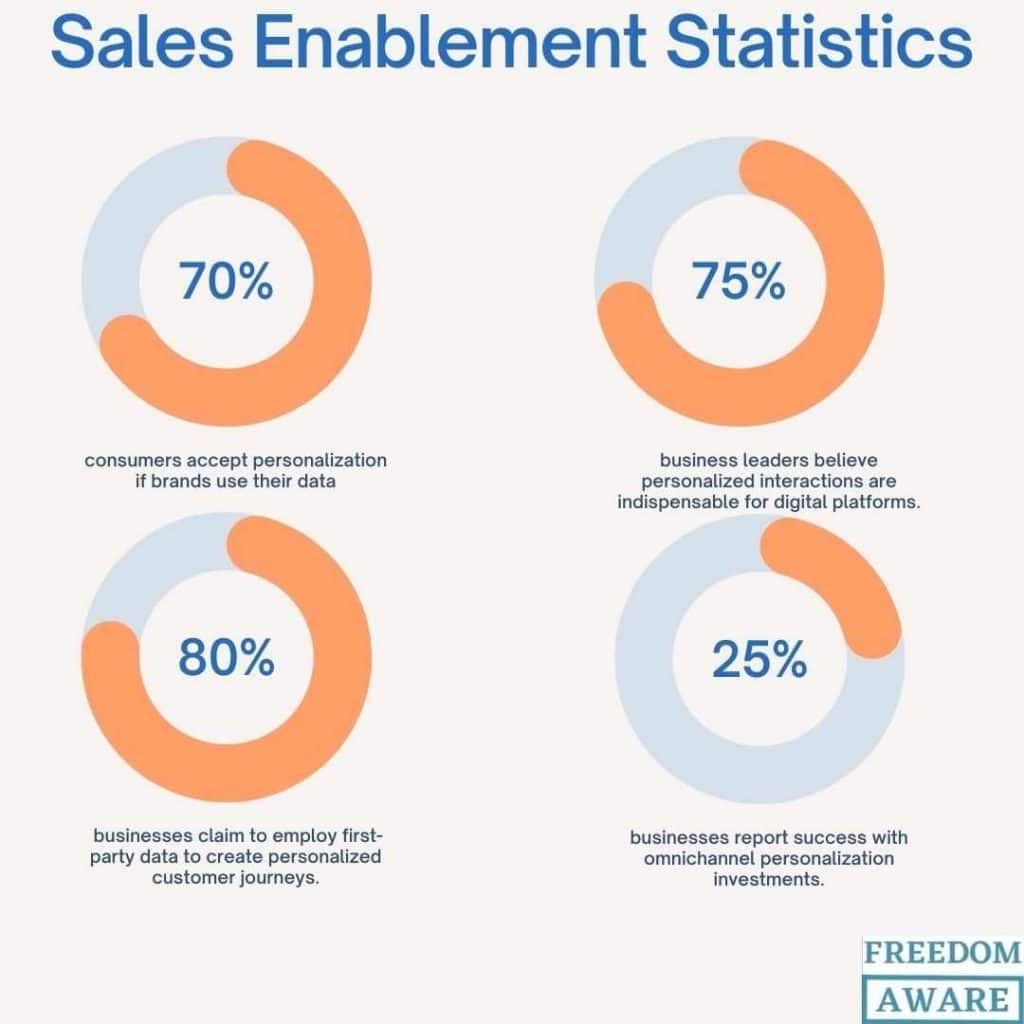
70% of consumers accept personalization if brands use their data. (Source)
A resounding 75% of business leaders believe personalized interactions are indispensable for digital platforms. (Source)
A vast majority (80%) of businesses claim to employ first-party data to create personalized customer journeys. (Source)
Only 25% of businesses report success with omnichannel personalization investments. (Source)
With an average of 9.2 sales interactions per deal, sales teams must be well-versed in market, product, customer, and competitor landscapes. (Source)
Overwhelmingly, 75% of buyers express a preference for virtual interactions with salespeople and the autonomy to explore products independently. (Source)
Sales enablement is predominantly managed by the sales team (38%), with marketing providing additional support. Nevertheless, there is clear evidence of growing cooperation between sales and marketing, as demonstrated by the 77% of respondents reporting collaborative efforts. (Source)
People & Teams represents the most significant opportunity for growth, with an average rating of 3.26 placing organizations between Standard and Advanced maturity levels. Only 10% of respondents achieved an Advanced rating in this area. (Source)
Over 90% of sales representatives surveyed reported a dramatic shift in buyer behavior within the past year and a half. (Source)
According to 88% of U.S. consumers, the amount of personal information they divulge is contingent upon their trust in a company. (Source)
Sales enablement generally affects 2.5 stages of the buyer’s journey, excelling in the early stages. Though less prominent in customer advocacy or post-loss contexts, its significance in post-sale and service aspects is undeniable. (Source)
Sales enablement is predominantly overseen by the Chief Sales Officer (CSO) in 35% of companies. A further 25% of organizations assign this role to Chief Revenue Officers (CROs) or Chief Growth Officers (CGOs), indicating a trend towards increased collaboration between sales and marketing. (Source)
Consumers are split on whether brands act in their best interest: 37% trust businesses to keep their data secure and use it responsibly, while another 37% do not trust online retailers with their data. (Source)
23% of companies with a formal Revenue Enablement program support Customer Success, 18% support presales, and 15% support marketers, among other functions. Additionally, 25% have enablement reporting to the Chief Revenue Officer. (Source)
A surprising 79% of B2B companies overlook customer success enablement, despite the growing emphasis on customer retention amidst economic challenges. (Source)
Currently, 35% of sales enablement teams also fulfill marketing responsibilities, but this dynamic is likely to evolve. A majority of CSOs anticipate sales enablement supporting marketing within the next three years, while nearly half foresee its expansion into customer success. (Source)
A clear majority (62%) of sales training is dedicated to personal selling skills like closing deals and negotiation, eclipsing the focus on customer understanding, ICPs, and personas (54%). This data implies a sales culture prioritizing interactions over product expertise, as evidenced by only 33% emphasizing product knowledge. (Source)
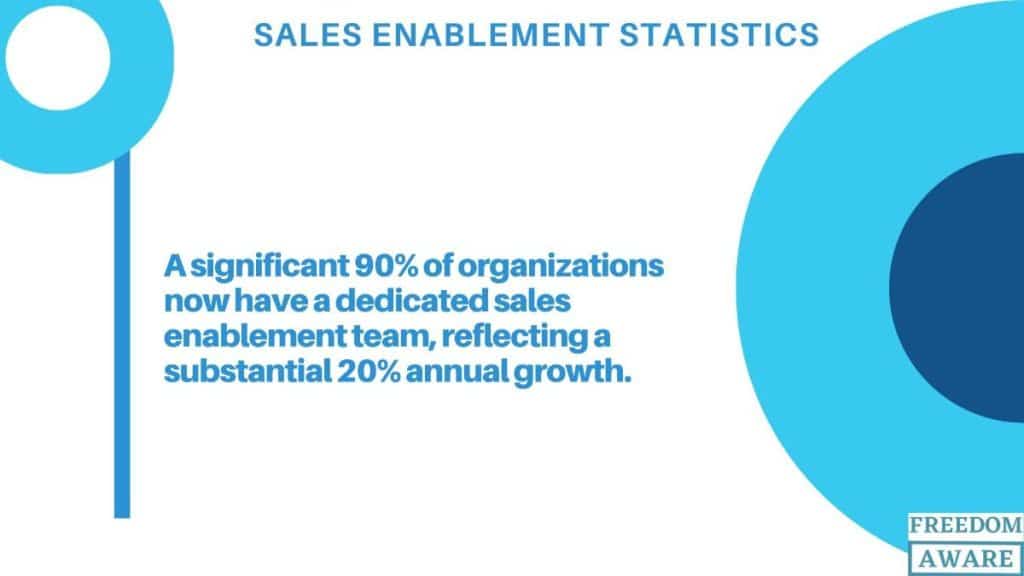
A significant 90% of organizations now have a dedicated sales enablement team, reflecting a substantial 20% annual growth. This trend underscores the increasing recognition of the critical role of sales enablement. (Source)
More than half of respondents (54%) intend to invest in AI-powered meeting scheduling tools to help salespeople optimize their time and pinpoint optimal meeting times. (Source)
A substantial 65% of survey participants agree that the evolving buyer landscape necessitates fresh sales methodologies. To thrive in this environment, businesses must engage customers on multiple platforms as buyers curate their journeys. (Source)
While direct/field (63%) and inside sales reps (59%) continue to be the primary beneficiaries of sales enablement, the function is expanding to support a broader range of roles. Notably, post-sales functions like account management (54%) and services/customer success (18%) are receiving increased attention. (Source)
Sales Enablement Statistics on Performance
Survey results confirm the powerful impact of sales enablement on business outcomes, with 68% of respondents highlighting the necessity of evolving sales enablement strategies. (Source)
Companies equipped with sales enablement programs significantly outperform their counterparts, boasting a 49% win rate on forecasted deals compared to the 42.5% win rate of those without such programs. (Source)
A majority of companies (62%) rate sales enablement as highly effective in cross-functional corporate initiatives. Furthermore, sales enablement excels at aligning initiatives with sales goals, with a strong above-average rating of 59%. (Source)
Tenure is a critical factor in sales enablement effectiveness. Teams with a track record of over two years in sales enablement outperform their counterparts by a significant five percentage points in terms of win rate. (Source)
A majority of companies, representing 87% across all scales, are committed to preserving or growing their sales enablement budgets in the next year. (Source)
Sales enablement platforms deliver a significant boost to win rates, with users outperforming their counterparts by a substantial seven percentage points. (Source)
A vast majority of executives (92%) affirm that sales enablement investments have positively impacted sales performance this past year. This confidence is reflected in the 84% of executives planning to sustain or expand these investments in the upcoming year. (Source)
Companies that plan to sustain or grow their sales enablement budgets enjoy a four percentage point higher win rate compared to those considering budget reductions. This data underscores the strategic importance of sales enablement, particularly in challenging economic climates. (Source)
Sales enablement is crucial as it prepares salespeople to use tools and resources for virtual engagement effectively. Research has shown that sales enablement functions that manage sales technology achieve win rates six percentage points higher than those that do not. (Source)
Sales enablement is a key driver of efficiency for revenue teams, with 81% of organizations recognizing its positive impact on streamlining sales processes. (Source)
Leading-edge companies are expanding their focus from traditional sales enablement to a comprehensive revenue enablement strategy. (Source)
Sales reps dedicate less than half (35.2%) of their time to active selling. (Source)
Enablement technology frees up nearly two extra workdays per week for sales reps to focus on customers, by automating content management and search, boosting productivity by 80%. (Source)
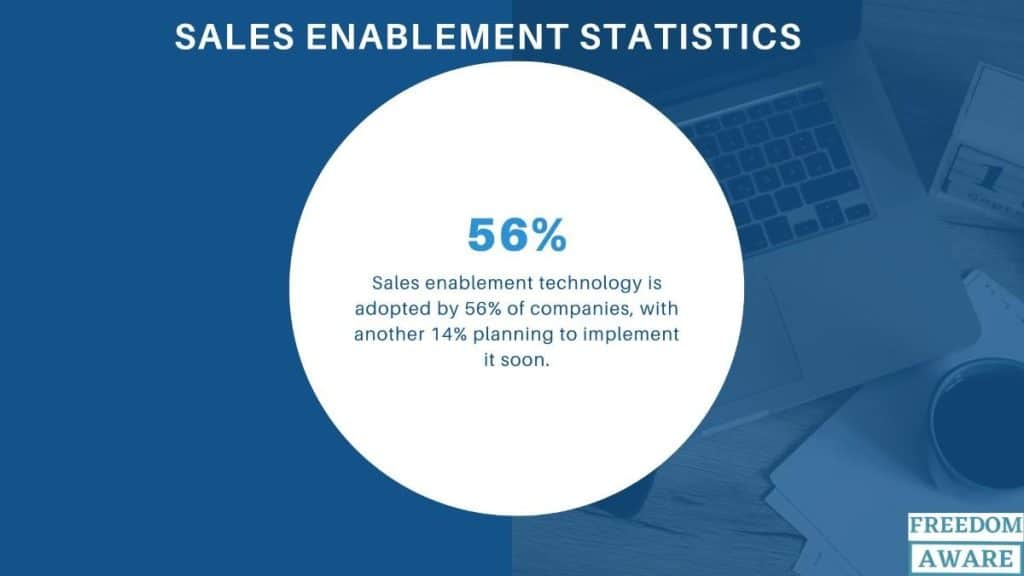
Sales enablement technology is adopted by 56% of companies, with another 14% planning to implement it soon. (Source)
While 58% of companies have a sales enablement function, only 19% leverage technology, hindering their ability to scale training and coaching for larger sales teams. (Source)
MindTickle’s sales readiness platform accelerates sales rep onboarding by 60% through remote development and coaching, boosting overall performance. (Source)
Less than half of executives grasp the potential of robotics and AI in enhancing customer experience, despite growing consumer expectations for seamless, personalized interactions. (Source)
Digital sales rooms and other sales engagement tools correlate with a 46% higher win rate over the past year. (Source)
Companies without sales enablement tools struggle with client retention, with 36% facing challenges in this area. (Source)
Enablement technology empowers sales reps with quick access to information, boosting confidence and knowledge. Ninety-seven percent of users report improved client interactions, while 68% appreciate reduced uncertainty. (Source)
Sales enablement technology doubles the likelihood of gaining insights into effective sales practices through analytics, driving data-driven improvements. (Source)
Sales teams juggle an average of six different tools, highlighting the complexity of modern sales technology stacks. (Source)
C-suite leaders prioritize sales enablement tools as the top tech investment for boosting sales productivity, with 55% supporting this view. (Source)
Sales enablement technology adoption is on the rise, with a 5% increase to 65% of organizations using these tools this year. (Source)
To streamline operations, 43% of companies plan to consolidate their technology stacks within the next 18 months. (Source)
The MarTech market is booming, expanding from $413.6 billion in 2023 to a projected $2.1 trillion by 2032, with a rapid growth rate of 19.4% annually. (Source)
As technology advances, customer expectations for personalized experiences are rising, with 73% demanding greater customization. (Source)
AI-powered chatbots are a popular choice for enhancing customer experience, with 47% of respondents favoring them for quick query resolution. (Source)
Insufficient data, poor training, and talent mismatches contribute to nearly half of sales reps missing quotas. (Source)
Privacy concerns hinder personalized experiences, with 43% of U.S. consumers resisting data collection. (Source)
Lack of staff and resources is also seen as one of the biggest barriers to sales enablement maturity as cited by 52% of salesforce. (Source )
Many sales enablement teams struggle to demonstrate value due to limited data analysis and ineffective communication of impact. (Source)
Sales reps face a trifecta of challenges: intense competition, economic headwinds, and customer retention pressures. (Source)
Sales enablement significantly impacts sales cycle time, quota attainment, and win rates, yet 42% of companies lack such programs. (Source)
Transparency in data usage builds trust, with 71% of customers more likely to share personal information with companies that clearly explain its purpose. (Source)
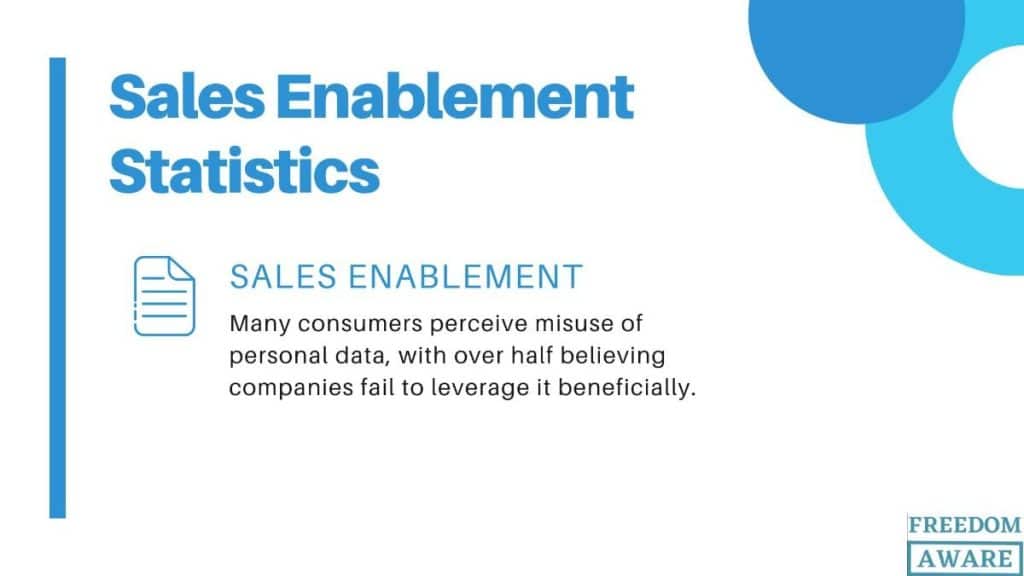
Many consumers perceive misuse of personal data, with over half believing companies fail to leverage it beneficially. (Source)
Access to accurate, unified customer data is a major hurdle for personalization, with many organizations struggling to provide a single source of truth. (Source)
Concerns over AI ethics are prevalent, with customers demanding human oversight in AI decision-making. (Source)
Trust is paramount in the age of AI, with customers expecting companies to maintain ethical standards. (Source)
A shortage of skilled sales enablement professionals with expertise in technology, data, content, and operations is hindering industry progress. (Source)
Inconsistent customer experiences across departments frustrate consumers, with frequent information repetition being a common pain point. (Source)
Access to content is a major challenge for sales reps without enablement technology, impacting productivity and knowledge sharing. (Source)
Increasing revenue, effective coaching, and accelerating sales cycles are top priorities for organizations. (Source)
Poor onboarding disrupts operations, leading to lost opportunities and hindered growth, according to 88% of respondents. (Source
A significant gap exists between customer needs and employee understanding, with less than half of consumers feeling understood by sales reps. (Source)
Limited staffing and resources are major obstacles to achieving sales enablement maturity. (Source)
While budgets exist, companies often struggle to implement sales technology due to cultural barriers and skill deficiencies. (Source)
Consumers are increasingly protective of their personal information. (Source)
Customers desire personalized experiences but often encounter impersonal interactions, highlighting a gap in customer-centric strategies. (Source)
Sales enablement specialists earn an average base salary of $84,365, with total compensation reaching $106,973. (Source)
Sales enablement certifications boost earnings by $9,733 annually, while non-managerial roles earn $17,275 less than the average. (Source)
Sales enablement managers earn an average base salary of $105,330, with total compensation reaching $146,791. (Source)
A majority (61.3%) believe sales enablement salaries undervalue the role’s business impact. (Source)
Additional earnings for sales enablement roles average $38,877 through bonuses and incentives. (Source)
U.S. sales enablement professionals earn an average of $119,689 annually, with a range from $90,000 to $179,144. (Source)
Over two-thirds of respondents receive bonuses or commissions. (Source)
The average annual sales enablement salary is $100,390, with total compensation reaching $139,267. (Source)
Conclusion (Sales Enablement Statistics)
Sales enablement is a critical component of a successful go-to-market strategy. With 87% of top cloud companies investing in this function, it’s evident that sales enablement is a key differentiator. By optimizing sales processes and equipping reps with the necessary resources, businesses can achieve substantial gains in revenue and win rates.
(QR Code Statistics)QR codes are here to stay: Here, are some of the latest QR code statistics;
I’ll never forget the thrill of scanning my first QR code. It felt like discovering a hidden universe of information. These tiny squares have become an everyday part of our lives. Incredible, isn’t it? QR code use has exploded over the past year, shooting up by 96%! It’s mind-boggling.
From being used to track vehicles during manufacturing to becoming one of the biggest marketing trends of the decade, QR codes have come a long way. You can’t escape them these days.
Let’s explore some of the latest QR code statistics.
QR Code Statistics (Editor’s Pick)
Almost nine of ten smartphone owners have scanned a QR code at least once.
Over a third of shoppers won’t buy if they can’t pay with a QR code.
Major social media platforms use built-in QR codes to add friends by scanning unique codes.
QR code payments are booming, with a global market value of $10.28 billion in 2022, and are expected to grow rapidly.
China is the QR code king, with billions of devices using them for payments.
QR code use in the U.S. is on the rise, with millions of households and consumers adopting the technology.
QR codes are driving big business, with billions of coupons redeemed in 2022 alone.
QR codes are taking the world by storm. Over 26 million scans were recorded across more than 50 countries.
What Is A QR Code? A QR code (Quick Respond Code) is a type of barcode that a digital device can scan. It looks like a square with a pattern of black and white squares. Unlike traditional barcodes, QR codes can store much more information, such as website links, contact details, files, images, audio, videos, and more.
It’s a quick and easy way to access information or take action with your smartphone.
QR Code Statistics, Usage, Trends, and Forecasts
Black is the most common color for QR codes, preferred by 85% of users. (Source)
Global QR code data reveals 26.95 million scans from over 50 countries. (Source)
With a 26% increase from 2020, almost 89 million Americans scanned QR codes via their smartphones in 2022. This upward trajectory is set to endure, as estimates predict the US user base to surpass 100 million by 2025. (Source)
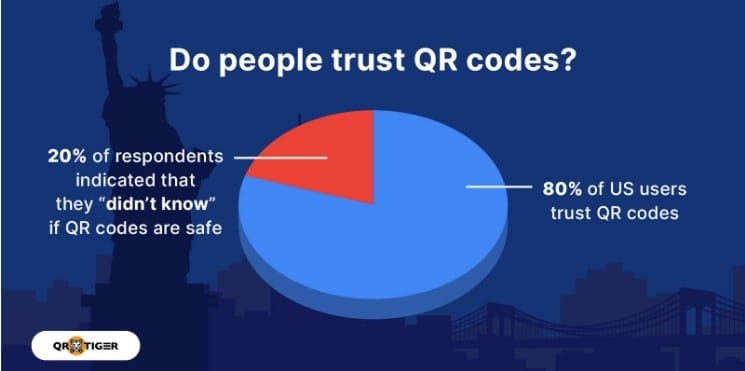
A vast majority, 86.66%, of smartphone users have experienced scanning a QR code, with 36.40% engaging in this activity weekly. Moreover, 46.81% of individuals perceive QR codes as facilitating a touchless lifestyle. (Source)
China reigned supreme in QR code payment adoption in 2022, boasting approximately 10 billion mobile devices equipped with this technology. (Source)
The survey revealed a marked disparity in QR code security perceptions, with 42.55% of participants feeling safest scanning at restaurants, bars, or cafés, while only 19.4% shared this sentiment for fitness centers. (Source)
A significant portion of consumers, representing 38.99% of respondents, expressed a desire for expanded QR code utilization going forward. (Source)
57% of consumers prefer merchants’ digital payment options while shopping from stores (Source)
The data revealed that 67% of participants found QR codes to simplify their lives. (Source)
More than 30% of Italian galleries and museums currently offer QR code services, with an additional 40% planning to implement them in the future. (Source)
QR codes have been integrated into the signage of Abu Dhabi. (Source)
Over 90% of iOS devices and 85% of Android devices come with pre-installed QR code scanners. (Source)
QR codes are now utilized by half of all restaurants in the United States. (Source)
According to Bitly, downloads for QR codes skyrocketed by 750% in the last 18 months. (Source)
QR codes play an instrumental role in making AR experiences available to users. The global AR and VR market is projected to grow by $162.71 billion by 2025. (Source)
Google Chrome is in the process of creating a feature for its Chrome Canary browser that allows users to share web pages by generating QR codes. (Source)
QR code payments in Japan have grown, reaching nearly 15 trillion yen in transaction value. (Source)
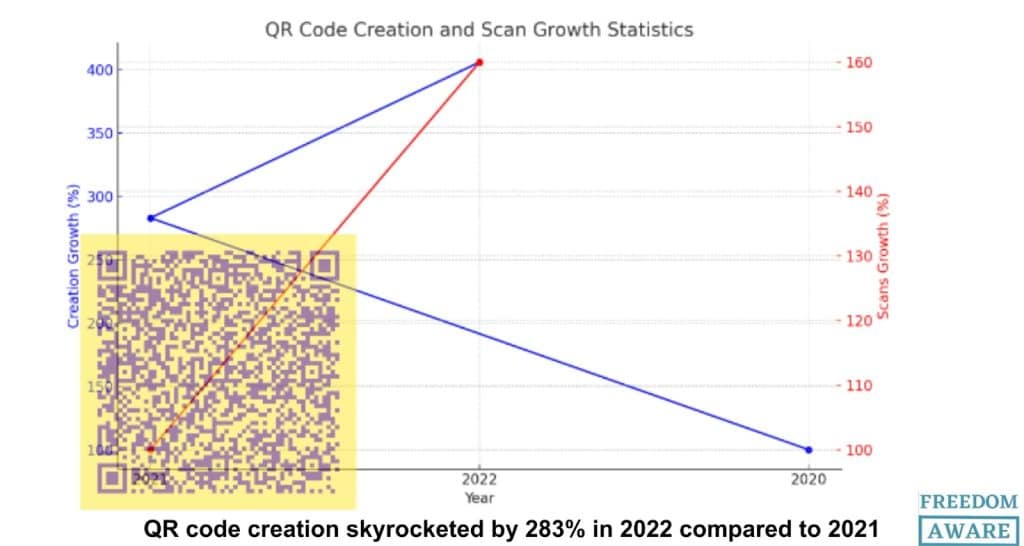
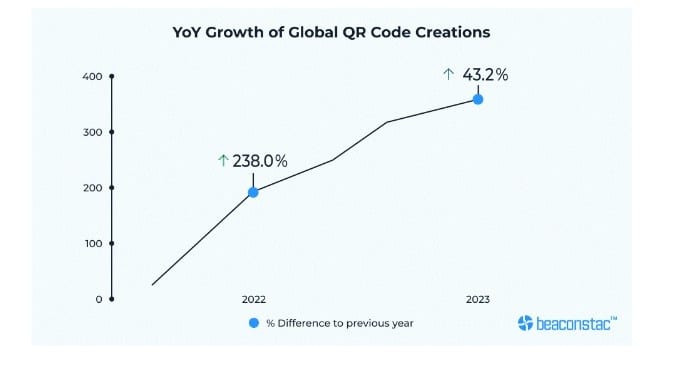
QR code creation skyrocketed by 283% in 2022 compared to 2021 and increased by an additional 43% the previous year. While global QR code scans surged by nearly 60% in the same period. (Source)
Website QR codes dominate the market, comprising a substantial 49% of all QR codes generated within the past year. (Source)
The prospect of increased QR code use resonates with 75% of adults. (Source)
This trend is more pronounced among younger age groups, with 82% of 18-44-year-olds expressing interest, while the figure drops to 64% for those aged 45 and above. (Source)
Similar to barcodes, QR codes incorporate error correction, allowing for data recovery even when up to 30% of the code is damaged or obscured. (Source)
While 54% of 18-24 year-olds have frequently used marketing-related QR codes, this figure drops to 48% for 30-44 year-olds and further declines to 44% for those aged 45-64. (Source)
Major social media platforms use built-in QR codes to add friends by scanning unique codes. (Source)
In Latin America, QR code transaction values were projected to surpass $1.4 billion by the same year. (Source)
A staggering 5.3 billion coupon codes were redeemed through QR codes in 2022. (Source)
Scantrust SA forecasted a robust 67% of Singaporeans were utilizing QR codes for mobile payments in 2018, anticipating an explosive surge in adoption during the following years. (Source)
The year 2019 saw the introduction of JPQR, a uniform QR code for all payment providers in Japan. (Source)
As stated by Peabody, Mezze and the entire Boqueria chain adopted QR code menus in place of printed ones during the COVID-19 crisis. (Source)
The global QR code payment market experienced significant growth, expanding from a valuation of $8.07 billion in 2020 to a projected $35.07 billion by 2030. This represents a robust compound annual growth rate (CAGR) of 16.1% from 2021 to 2030. (Source)
A 2021 survey found that 45% of US shoppers had used a marketing QR code in the past three months, with the highest usage among 18-29-year-olds. Additionally, 59% believed QR codes would become a permanent feature of mobile phone usage. (Source)
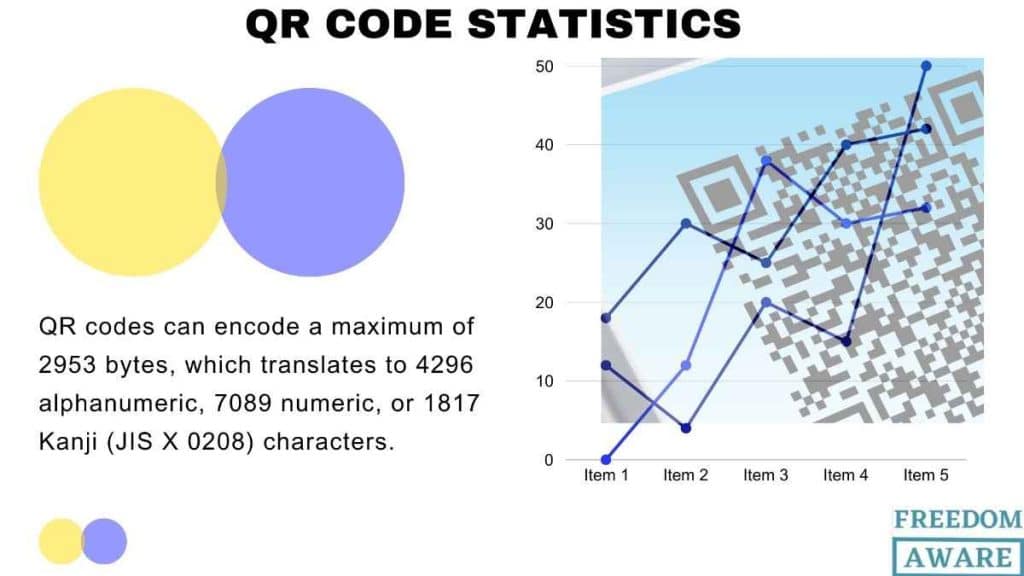
QR codes can encode a maximum of 2953 bytes, which translates to 4296 alphanumeric, 7089 numeric, or 1817 Kanji (JIS X 0208) characters. (Source)
The global QR code payment market experienced rapid growth, reaching a valuation of USD 10.28 billion in 2022. This upward trajectory is projected to continue, with an anticipated compound annual growth rate (CAGR) of 17.03% extending through 2028. (Source)
QR Code Adoption Across Nations (QR Code Statistics)
A substantial majority of consumers in China (81%), Hong Kong (78%), and Singapore (74%) have significantly increased their QR code usage. (Source)
In Spain, QR code usage has increased for 60% of consumers, while 25% maintain their previous usage levels. (Source)
A majority of consumers (67%) perceive QR codes as user-friendly, facilitating easy access to information. This trend is consistent across most markets, with notable exceptions in Denmark and the United States, where agreement levels dip to 50% and 44%, respectively. (Source)
Approximately 50% of Italians and Spaniards intend to increase their QR code usage, contrasting sharply with the more hesitant attitudes of Germans and French consumers. (Source)
Twenty percent of European consumers expressed uncertainty about increased QR code usage in the future. (Source)
16% of males and 10% of females used smartphones to scan QR codes for information. (Source)
In 2020, MobileAssist, a Bahamian financial technology firm, teamed with Super Value to allow customers to pay for groceries with QR codes. (Source)
QR code usage in the Bahamas is growing, with over 90,000 downloads and 7,500 registered users of MobileAssist’s app. (Source)
The Central Bank of the Bahamas introduced a digital Bahamian dollar using QR codes for payments and fund transfers. (Source)
AML Foods partnered with Kanoo to introduce QR code payments in their stores. (Source)
Mercado Pago and TodoPago are the leading QR code payment platforms in Argentina. (Source)
Mercado Pago achieved a significant milestone, processing 8.2 million QR code transactions within its first year of operation. By March 2019, the platform had already garnered a user base of 3 million. (Source)
TodoPago boasts a user base of 1.5 million buyers and 600,000 merchants. Its strategic focus on QR codes propelled app downloads to triple in 2018, and the platform continues to expand its reach. (Source)
A strong majority of 80% of US users express confidence in QR codes. (Source)
QR codes facilitate efficient inbound travel to the Bahamas. (Source)
QR code payments in Argentina witnessed rapid growth, with a user base expanding from 3% of adults in 2018 to a projected 24% in 2022. (Source)
Upon acceptance, international students bound for the Bahamas receive a unique QR code for expedited entry. (Source)
Consumers primarily use food QR codes to access product details (57%), followed by brand websites (43%). Other popular uses include product or company information (34%), recipes (25%), and interactive games (9%). (Source)
A significant portion of Canadians, 36%, shun retailers lacking contactless payment options, while half of the population consciously restricts purchases to stay within contactless spending limits. (Source)
According to GSMA 2020, Mexico’s overall annual QR code digital payment transaction growth rate is predicted to be 18.8% between 2020 and 2024. (Source)
Over half of Mexican consumers reported increased QR code usage, while roughly a quarter maintained previous levels. The country’s population is notably enthusiastic about future QR code adoption. (Source)
In India, the transaction value of QR code payments is expected to rise from $62 billion in 2022 to $125 billion in 2026. This is driven by a national QR code standard and reduced cash usage. (Source)
Predictions for 2020 indicated that QR code scanning would reach 11 million U.S. households. (Source)
The number of U.S. smartphone users scanning QR codes is projected to increase by 16 million between 2022 and 2025. (Source)
Contactless payments in the U.S. experienced a dramatic 150% increase since March 2019. This surge directly contributed to an 11% rise in QR code adoption since the onset of the pandemic. (Source)
Over a third of consumers strongly prefer QR code payments and will abandon a purchase if this option is unavailable. (Source)
Bharat QR code acceptance surged past 4.8 million in India by September 2022, with the goal of unifying QR code payments across all merchant locations. (Source)
India holds the second position with a staggering 1,101,723 million QR code scans. (Source)
Two-fifths of India’s population are familiar with and utilize QR codes. (Source)
In 2018, the BMC planned to digitize the Cooperage Bandstand in Colaba, Mumbai, with a QR code. Hindustan Petroleum introduced a customer feedback initiative via QR code that same year. (Source)
QR code generation has quadrupled between 2021 and 2024. (Source)
UPI QR codes experienced significant growth, surging 79% to reach 272 million by June 2023. (Source)
The Asia Pacific region witnessed an 83% surge in QR codes for packaging between 2014 and 2018. (Source)
Conclusion on QR Code Statistics
QR codes have rapidly gained prominence in recent years, emerging as versatile tools for businesses and individuals to share information and products effortlessly. The data presented in this article underscores the global surge in QR code adoption.
QR codes are an enduring trend, offering businesses the opportunity to enhance customer engagement and experiences through effective implementation.
FAQ (QR Code Statistics)
What percent of people use QR codes?
A vast majority, 86.66%, of smartphone users have encountered QR codes, with a significant portion, 36.40%, scanning at least once weekly.
How big is the QR code market?
The QR Code Solution market is projected to experience substantial growth, expanding from US$1,038.72 million in 2023 to US$2,247.17 million by 2030. This represents a compound annual growth rate (CAGR) of 11.44% over the forecast period.
What are the statistics of QR code menu?
Menu QR codes have become a staple in the food and beverage sector, particularly since the pandemic. By offering contactless menu access, they’ve transformed the dining experience. A substantial 75% of restaurants have adopted this technology, leading to a 30% decrease in menu printing costs and a remarkable 40% surge in customer engagement.
How can we check how many people have scanned a QR code?
Dynamic QR Codes offer advanced tracking capabilities. Unlike static codes, they display a total scan count and a link to detailed performance metrics within the dashboard. This real-time data provides valuable insights into code engagement.
Which country uses QR codes the most?
Determining the global leader in QR code usage is challenging due to varying data sources. While China boasts an impressive 10 billion mobile devices equipped for QR code payments, the United States leads in terms of total scans, reaching 2,880,960 million.
Do QR codes expire?
Static QR codes are permanent. Once created, they always direct users to the same fixed destination, such as a website or specific data.
Call centers remain a vital customer interaction channel. With millions of calls handled daily, the industry is constantly evolving. This article delves into key statistics, emerging trends, and challenges shaping the call center landscape.
Discover the latest insights and trends driving the call center industry.
Call Center Industry by the Numbers (Call Center Statistics)
The call center industry is experiencing significant growth. Here’s a snapshot of key statistics:
Market Growth: The global call center market is projected to reach $494.7 billion by 2030, growing at a CAGR of 5.8%.
Industry Size: The US boasts approximately 2.9 million call center employees.
Customer Preference: 86% of consumers value call center services.
AI Integration: The call center AI market is estimated to reach $2.8 billion by 2024.
Call Volume: The average call center handles about 4,400 calls monthly, with a 48-call miss rate.
These figures highlight the industry’s scale and the increasing demand for efficient and effective customer service.
Want to explore specific trends or challenges within the call center industry?
Call Center Industry: Key Statistics
The call center industry is a significant player in global customer service. Here’s a breakdown of key figures:
US Dominance: The US maintains a strong position in the call center industry regarding employment and expansion. (source)
Global Market Growth: The global call center market is booming and is expected to reach $494.7 billion by 2030 from $314.5 billion in 2022. (source)
US Workforce: Over 2.9 million people were employed in the US call center industry in 2022. (source)
Industry Leaders: Tata Consultancy Services and Genpact are leading players, generating billions in revenue. (source)
Job Growth Challenges: The US experienced a significant decline in call center job creation from 2016 to 2022. (source)
Global Market Growth: Valued at $314.5 billion in 2022, it’s projected to reach $494.7 billion by 2030, growing at a CAGR of 5.8%. (source)
US Workforce: Employed over 2.9 million people in 2022. (source)
Top Players: Companies like Tata Consultancy Services ($27 billion revenue) and Genpact ($4 billion revenue) are industry leaders. (source)
Job Market Fluctuations: The US experienced a significant decline in call center job creation from 2016 to 2022. (source)
Consumer Reliance: 86% value call center services, highlighting the need for human interaction. (source)
Call Transfers: The average caller is transferred 2.6 times before resolving their issue. (source)
Customer Preference: Most consumers prefer human interaction over automated systems. (source)
Increased Call Volumes: Call center leaders report increased call volumes since the pandemic. (source)
Average Handling Time (AHT): The typical call center benchmark for AHT is six minutes. (source)
Call Duration and Hold Times: Average call duration is 302 seconds, with an average hold time of 25.8 seconds. (source)
Generational Preferences: Millennials and Gen Z demonstrate varying confidence levels and reliance on call centers. (source)
Generational Differences: While Millennials have some confidence in call centers, Gen Z strongly prefers digital channels. (source)
Agent Productivity: Agents spend approximately 32 minutes on customer interactions per hour, with the remaining time allocated to after-call work, breaks, and meetings. (source)
Call Center Performance Metrics: First-call resolution rates, average handle time, and answer speed are critical performance indicators. (source)
Customer Preferences: Phone calls remain a preferred support channel, especially for complex issues. However, there’s a growing preference for faster response times and digital communication channels. (source)
These statistics show the industry’s size, growth trajectory, and employment landscape.
The Rise of AI in Call Centers (Call Center Statistics)
AI is transforming the call center industry. Here are key statistics:
Market Growth: The call center AI market is expected to reach $2.8 billion by 2024, growing at a CAGR of 23.1%. (source)
Automation Surge: AI automation in agent interactions will increase fivefold by 2026. (source)
Agent Empowerment: Two-thirds of contact center managers believe AI will enhance agent capabilities. (source)
Cost Savings: Conversational AI is projected to save $80 billion in labor costs by 2026. (source)
AI Adoption: One in ten agent interactions will be automated by AI by 2026. (source)
These statistics highlight the significant impact of AI on the call center landscape.
The Impact of Customer Experience on Call Center Success (Call Center Statistics)
Customer experience is a critical driver of business success. Here’s how call centers play a role:
Revenue and Market Share: Poor customer experience poses significant risks to revenue and market share. (source)
Customer Loyalty: Exceptional customer experiences can lead to a 16% price premium and increased customer loyalty. (source)
Customer Satisfaction: 95% of call center professionals prioritize customer satisfaction as a key performance indicator. (source)
Customer Churn: Negative call center experiences can lead to customer attrition, with 59% of US customers considering switching brands after multiple bad experiences. (source)
The Impact of Customer Experience on Brand Loyalty (Call Center Statistics)
Customer experiences significantly impact brand loyalty and purchasing decisions. Here’s a breakdown:
Global Impact: Negative call center experiences can lead to customer attrition, with 32% of Latin American and 59% of US customers considering switching brands. (source)
Customer Expectations: Speed, convenience, knowledge, and friendliness are key components of a positive call center experience. (source)
Purchase Influence: Excellent call center service can significantly influence purchasing decisions, with 83% of customers reporting a positive impact. (source)
Customer Sentiment: Poor call center experiences lead to negative emotions, such as disappointment, unhappiness, and anger. (source)
Word-of-mouth: Negative experiences are often shared with others, while positive experiences can drive brand loyalty and new customer acquisition. (source)
Key Call Center Performance Metrics (Call Center Statistics)
Measuring call center performance is crucial for identifying areas for improvement. Here are the key metrics:
Customer Satisfaction (CSAT): This metric gauges customer happiness and satisfaction. A good CSAT score typically falls between 75% and 85%. (source)
First Call Resolution (FCR): Measures the percentage of customer issues resolved on the first call. High-performing call centers aim for an FCR rate of 70% or higher. (source)
Average Handle Time (AHT): This represents the average duration of a customer call, including hold times, transfers, and after-call work. The industry average is around 6 minutes. (source)
Key Call Center Performance Metrics (Call Center Statistics)
Measuring call center performance is crucial for identifying areas for improvement. Here are the key metrics:
Customer Satisfaction (CSAT): This metric gauges customer happiness and satisfaction. A good CSAT score typically falls between 75% and 85%. (source)
First Call Resolution (FCR): Measures the percentage of customer issues resolved on the first call. High-performing call centers aim for an FCR rate of 70% or higher. (source)
Average Handle Time (AHT): This represents the average duration of a customer call, including hold times, transfers, and after-call work. The industry average is around 6 minutes. (source)
Occupancy Rate: Ideally, the rate is between 80-85%. This metric measures the percentage of time agents are actively engaged with customers. (source)
Average Speed of Answer (ASA): The target is under 28 seconds, representing customers waiting before their call is answered. (source)
Customer Abandonment Rate: Should be between 2-5%. Higher rates indicate poor call center performance. (source)
Service Level: Typically around 81.5%, this metric measures the percentage of calls answered within a specified time. (source)
Challenges Facing the Call Center Industry (Call Center Statistics)
The call center industry faces several challenges impacting operations and customer satisfaction:
High Attrition Rates: The sector struggles with a 42% attrition rate due to factors like burnout and lack of support. (source)
Service Strategy Gaps: Poor service strategies, such as limited personalization, negatively impact customer experience. (source)
Wait Time Impact: Longer wait times correlate with lower customer satisfaction scores and potential revenue loss. (source)
Personalization Challenges: Delivering personalized interactions is crucial but needs more customer understanding. (source)
Technical Issues: Technical glitches can disrupt operations and negatively impact customer experience. (source)
First Call Resolution (FCR): Measures the percentage of customer issues resolved on the first call. A higher FCR rate indicates efficient problem-solving and reduced customer effort. (source)
Average Handle Time (AHT): This represents the average duration of a customer call, including after-call work. Optimizing AHT enhances agent efficiency. (source)
Occupancy Rate: Measures the percentage of time agents are actively handling calls. Balancing occupancy is essential for agent well-being and operational efficiency. (source)
Average Speed of Answer (ASA): Reflects the average wait time for customers. Minimizing ASA improves customer satisfaction. (source)
Key Call Center Performance Metrics (Call Center Statistics)
Effective call center management relies on key performance indicators (KPIs). Here’s a breakdown of crucial metrics:
Service Level: Measures the percentage of calls answered within a specific timeframe. An 80% service level within 20 seconds is a common industry standard. (source)
Abandonment Rate: Indicates the percentage of callers who hang up before their call is answered. A rate below 5% is considered good. (source)
Abandonment Wait Time: Understanding when customers abandon calls (often at 30 and 60 seconds) helps optimize call handling. (source)
Schedule Adherence: Measures how closely agents adhere to their schedules, with a recommended rate of 85% or higher. (source)
Industry-Specific Performance Metrics (Call Center Statistics)
Financial Services: A 79% customer satisfaction score highlights the industry’s focus on customer satisfaction. (source)
Healthcare: A 7% abandonment rate indicates efficient call handling in the healthcare sector. (source)
E-commerce: A 75% first-call resolution rate demonstrates a focus on resolving customer issues quickly. (source)
Technology: A 79% service level reflects the industry’s commitment to timely call answering. (source)
Retail: A low customer satisfaction score of 39% indicates challenges in meeting customer needs. (source)
Telecom: An 80-90% occupancy rate suggests efficient agent utilization in the telecom industry. (source)
Automotive: A 78% customer satisfaction score highlights the industry’s focus on customer satisfaction. (source)
Emerging Trends in the Call Center Industry (Call Center Statistics)
The call center industry is undergoing significant transformation driven by technological advancements and evolving customer expectations. Key trends include:
Voice Assistant Integration: With over 8.4 billion voice assistants projected for use by 2024, businesses can leverage this technology to offer efficient self-service options. (source)
Cloud-Based Contact Centers: The shift towards cloud-based contact center solutions (CCaaS) is gaining momentum, offering scalability and enhanced customer experiences. (source)
Omnichannel Engagement: Customers expect seamless interactions across multiple channels, driving the growth of omnichannel customer engagement solutions. (source)
Remote Agent Workforce: The trend towards remote work is expanding the call center agent pool, offering flexibility and cost savings. (source)
Sentiment Analysis: Advancements in sentiment analysis enable businesses to better understand customer emotions, tailoring interactions accordingly. (source)
Call Centers: Evolving to Meet Modern Customer Demands (Call Center Statistics)
The call center landscape is undergoing a rapid transformation, driven by technological advancements and evolving customer expectations. To thrive in this dynamic environment, businesses must adapt to several key trends.
Automation and AI: Your New Call Center Powerhouse (Call Center Statistics)
Leveraging automation and artificial intelligence (AI) is no longer optional but essential for call centers. AI-powered tools like virtual agents and chatbots are revolutionizing customer interactions by providing instant, accurate responses to common queries. This frees up human agents to focus on more complex issues, enhancing overall efficiency and customer satisfaction. Furthermore, AI-driven analytics offer valuable insights into customer behavior, enabling data-driven decision-making and personalized service.
Personalization: Building Stronger Customer Relationships (Call Center Statistics)
Gone are the days of generic customer service. Today’s consumers crave personalized experiences. By harnessing customer data, call centers can tailor interactions to individual preferences, creating a sense of connection and loyalty. From recommending products based on purchase history to routing customers to agents familiar with their accounts, personalization is key to standing out in a crowded marketplace.
Omnichannel Excellence: Meeting Customers Where They Are (Call Center Statistics)
Consumers expect seamless interactions across multiple channels. Call centers must adapt by offering support through phone, email, chat, social media, and more. A consistent customer experience, regardless of the channel, is crucial for building trust and satisfaction. By integrating these channels, businesses can provide efficient and convenient support, increasing customer engagement and loyalty.
Cloud Power: Flexibility and Scalability at Your Fingertips (Call Center Statistics)
Cloud technology is reshaping the call center industry by offering unparalleled flexibility and scalability. By adopting cloud-based solutions, businesses can eliminate the need for costly on-premises infrastructure and quickly adapt to changing demands. Additionally, cloud platforms often incorporate advanced features like speech recognition and natural language processing, empowering call centers to deliver cutting-edge customer experiences.
Data-Driven Success: Unlocking Insights for Growth (Call Center Statistics)
Advanced analytics is transforming call centers into data-driven operations. By analyzing customer interactions, businesses can identify trends, preferences, and pain points. These insights enable call centers to optimize processes, improve agent performance, and deliver proactive support. Data-driven decision-making is essential for staying ahead of the competition and delivering exceptional customer experiences.
In conclusion, call centers that embrace these trends will be well-positioned to succeed in the evolving customer landscape. By investing in automation, personalization, omnichannel capabilities, cloud technology, and data analytics, businesses can create efficient, customer-centric operations that drive growth and loyalty.
Here are some Business Process Outsourcing statistics you should know;
The global business process outsourcing (BPO) market is booming, with staggering growth projected in the coming years.
BPO is no longer a niche strategy. It’s a key driver of efficiency, cost savings, and competitive advantage for businesses of all sizes.
Let’s explore the most recent BPO data to gain insights into this evolving sector.
BPO Industry Snapshot (Business Process Outsourcing Statistics)
The insurance BPO services market is valued at USD 7.08 billion in 2024 and is projected to expand to USD 8.94 billion by 2029.
The BPO industry is poised for substantial growth, with projected revenues reaching a staggering US$0.39 trillion by 2024.
Small businesses exhibited a strong preference for outsourcing partners in marketing (27%), IT services (22%), and design (21%).
Approximately 300,000 jobs are outsourced from the United States annually.
The UAE has solidified its position as a global business epicenter, attracting multinational corporations needing robust BPO support for their international operations.
The IT and telecom sector is projected to contribute over 32.7% of the total revenue generated by the Asia Pacific BPO market between 2022 and 2032.
The customer care BPO market in the Middle East and Africa is projected to experience significant growth, expanding from $1,986.49 million in 2023 to $2,618.71 million by 2028.
The healthcare-payer BPO market is growing, expanding from a valuation of USD 13.20 billion in 2021 to a projected USD 21.30 billion by 2030 at a robust CAGR of 9.5%.
The United States is expected to dominate global revenue, with an estimated US$146.30 billion in 2024.
BPO Market Trajectory ( Business Process Outsourcing Statistics)
The market is projected to expand at a compound annual growth rate (CAGR) of 4.67% from 2024 to 2029, culminating in a total market value of US$0.49 trillion. (Source)
The business process outsourcing market is projected to be worth approximately US$ 318.8 billion in 2024, and it is anticipated to grow at a consistent annual rate of 8% until it reaches US$ 688.2 billion by 2034. (Source)
Revenue within the Business Process Outsourcing industry is estimated to total US$0.39 trillion in 2024. (Source)
Expenditure on Business Process Outsourcing is projected to average US$110.50 per employee in 2024. (Source)
A combination of political stability, robust infrastructure, and a large consumer market within the United States fosters expansion in the BPO sector. (Source)
The escalating demand for tailored and streamlined services is anticipated to fuel growth within the US BPO market. (Source)
Before the COVID-19 pandemic, the global outsourcing market was assessed at a value of $92.5 billion. (Source)
The administrative outsourcing industry is projected to generate $21 billion in revenue during 2023. (Source)
The Healthcare payer BPO market, valued at USD 13.20 billion in 2021, is projected to attain USD 21.30 billion by 2030, demonstrating a compound annual growth rate of 9.5%. (Source)
The United States is expected to dominate global revenue, with an estimated US$146.30 billion in 2024. (Source)
Danish outsourcing giant ISS World reported approximately US$11.52 billion in revenue for 2023, marking a year-over-year increase of roughly US$570 million. (Source)
Valued at USD 56.80 billion in 2022, the Business Process as a Service market is poised to expand to USD 145.30 billion by 2031, exhibiting a compound annual growth rate of 11%. (Source)
With an estimated value of USD 92.49 billion in 2023, the global customer experience business process outsourcing market is anticipated to expand at a compound annual growth rate of 11.9% from 2024 to 2030. (Source)
Data security is cited as a key concern by 68% of outsourced businesses exploring cloud computing options. (Source)
BPO Across Industries (Business Process Outsourcing Statistics)
The insurance BPO sector continues to grow as insurance providers increasingly delegate non-core operations. (Source)
While less than one-third (29%) of businesses with 50 employees or fewer engage in outsourcing, this practice is adopted by two-thirds (66%) of businesses with 51 to 500 employees. (Source)
Business Process Outsourcing contributed approximately 29% to global IT Services revenue in 2022. (Source)
Driven by labor scarcity and escalating public sector outsourcing, IT-related BPO services sales in Japan are anticipated to exceed 3.2 trillion yen by the 2027 fiscal year. (Source)
Valued at USD 7.08 billion in 2024, the Insurance BPO Services Market is projected to reach USD 8.94 billion by 2029, demonstrating a compound annual growth rate of 4.76%. (Source)
Over half of executives (52%) utilize outsourcing for business operations. (Source)
Outsourcing Services for Businesses (Business Process Outsourcing Statistics)
Financial tasks are outsourced by approximately 44% of businesses. (Source)
Content marketing is a commonly outsourced function, with 30% of marketing professionals utilizing external providers. (Source)
Lead generation and cold calling are frequent outsourcing targets within operational departments. (Source)
Accounting functions are outsourced by 37% of businesses. (Source)
A significant portion of executives (81%) depend on external providers for some or all cybersecurity functions. (Source)
IT services are predominantly sourced through third-party delivery models, with 76% of surveyed executives adopting this approach. This trend is expected to mirror IT outsourcing rates, reaching up to 80% adoption. (Source)
Legal functions, tax services, HR operations, financial management, and supply chain management (including manufacturing and procurement) are the most sought-after outsourced business processes, with adoption rates ranging from 48% to 64%. (Source)
ISS World excels in facility services, while Accenture is a leading provider of IT, help desk, HR outsourcing, and consulting services. (Source)
Over 40% of larger organizations leverage outsourcing for HR and operational tasks, albeit without complete reliance on external partners. (Source)
Key Benefits of BPO (Business Process Outsourcing Statistics)
Cost Reduction (Business Process Outsourcing Statistics)
Cost minimization is a primary driver for outsourcing, cited by 70% of executives as a key reason. (Source)
Approximately 59% of global business leaders identify cost-cutting as a major benefit, alongside focusing on core competencies and addressing capacity constraints. (Source)
To reduce expenses, 28% of businesses outsource company development. (Source)
Operational Efficiency and Growth (Business Process Outsourcing Statistics)
Outsourced lead generation teams can boost lead generation by up to 43% compared to in-house efforts. (Source)
Companies leverage outsourcing to streamline operations, access new capabilities, and adapt to changing market conditions, with cost reduction (57%), capability expansion (51%), and strategic agility (49%) as primary motivations. (Source)
Talent and Resource Optimization (Business Process Outsourcing Statistics)
The significant cost of employee benefits, accounting for 29.4% of employer expenditures, according to the Bureau of Labor Statistics, drives many organizations to seek BPO solutions. (Source)
BPO Landscape and Future Directions (Business Process Outsourcing Statistics)
Global BPO Trends (Business Process Outsourcing Statistics)
The finance and accounting segment within South Africa’s BPO market is projected to expand rapidly, with a compound annual growth rate of 13% from 2021 to 2028. (Source)
North America captured more than 36.0% of the revenue in 2023 and is anticipated to maintain its leading position from 2024 to 2030, fueled by the increasing demand for BPO services from numerous major technology companies within the region. (Source)
The IT business process outsourcing (BPO) market share is expected to increase by USD 281.25 billion from 2021 to 2026, and the market’s growth momentum will accelerate at a CAGR of 8.12%. (Source)
The United Arab Emirates is embracing specialized BPO offerings, with Customer Experience Management (CXM) and Knowledge Process Outsourcing (KPO) gaining prominence. (Source)
The United States BPO market is experiencing accelerated growth fueled by advancing technology adoption. (Source)
South Africa’s BPO sector is characterized by surging demand for specialized services, particularly legal process outsourcing and healthcare outsourcing. (Source)
Automation and AI adoption is a notable trend in the European BPO market, aimed at enhancing efficiency and cutting costs. (Source)
Nigeria’s BPO market is witnessing a growing emphasis on voice-based services such as customer support and telemarketing. (Source)
Evolving Outsourcing Preferences (Business Process Outsourcing Statistics)
Small businesses demonstrated a strong preference for outsourcing marketing (27%), IT services (22%), and design (21%) functions in 2023. (Source)
In April 2020, Wipro, a business process outsourcing company, collaborated with Nutanix to provide digital database services. (Source)
92% of the top 2,000 global companies use IT outsourcing. (Source)
Today, more than 40% of banking and financial institution support desk employment is outsourced. (Source)
Business Process Outsourcing Statistics By Regions
Europe Business Process Outsourcing Trends (Business Process Outsourcing Statistics)
The UK’s BPO market is expected to generate $29.31 billion in revenue by 2024. (Source)
The market is projected to expand at a consistent annual rate of 5.67% from 2024 to 2029, culminating in a market size of US$38.61 billion by the end of the forecast period. (Source)
Eastern Europe’s BPO market is expected to reach $4.29 billion in 2024 and grow 3.32% annually to $5.05 billion by 2029. (Source)
European businesses are projected to spend an average of US$283.70 per employee on BPO services in 2024. (Source)
Europe’s BPO industry is set to expand significantly, increasing from $72.45 billion in 2023 to $132.57 billion by 2031, with an annual growth rate of 7.9% during this period. (Source)
The UK is projected to be the leading European BPO hub, driven by its robust business environment, skilled talent pool, and strategic geographic position. (Source)
The UK is projected to be the leading European BPO hub, driven by its robust business environment, skilled talent pool, and strategic geographic position. (Source)
HR outsourcing emerged as the dominant segment within the UK BPO market in 2022, contributing $3.5 billion or 26.3% to the overall market value. (Source)
The UK BPO services market generated $13.5 billion in revenue in 2022, demonstrating a consistent 5.1% annual growth from 2017. (Source)
A substantial majority, three out of five, of British B2B companies outsource critical business operations. (Source)
Poland is the leading BPO hub in Eastern Europe, with Romania and the Czech Republic following closely behind. (Source)
Southern Europe boasts the highest rate of adoption of BPO and future plans among European regions. (Source)
Businesses in Eastern Europe are expected to allocate an average of US$36.25 per employee to BPO services in 2024. (Source)
Europe’s BPO market is set to generate $118.60 billion in revenue this year. Looking ahead, the market is projected to expand at a consistent annual growth rate of 4.32% from 2024 to 2029, culminating in a total revenue of $146.50 billion by 2029. (Source)
The UK’s historical ties with developing countries, coupled with the shared English language, make it an ideal destination for businesses seeking to outsource their operations. (Source)
Eastern Europe’s BPO industry is characterized by its abundance of multilingual talent. (Source)
United States Business Process Outsourcing Trends (Business Process Outsourcing Statistics)
The Professional, Scientific, and Technical Services sector in the United States exhibits a market concentration level of 22%. (Source)
The BPO industry in the United States is experiencing rapid growth due to changing customer expectations. (Source)
The U.S. BPO Services market is fragmented, with no dominant players, as the combined market share of the top four companies is below 40%. (Source)
The U.S. BPO market experienced a dip in demand as the pandemic caused a decrease in both business formation and corporate profits. (Source)
The U.S. BPO industry is poised for consistent growth, reaching a market volume of $178.70 billion by 2029, with an estimated annual growth rate of 4.08%. (Source)
The United States is forecast to dominate the BPO market in 2024, accounting for $146.30 billion in revenue. (Source)
The anticipated average spending on each employee within the U.S. BPO market for 2024 is $840. (Source)
An estimated 300,000 jobs are relocated annually from the United States to overseas operations. (Source)
Asia And The Pacific Region Business Process Outsourcing Trends (Business Process Outsourcing Statistics)
India’s BPO industry is poised for significant growth, with a projected annual growth rate of 8.76%, leading to a market volume of $10.94 billion by 2029. (Source)
According to the National Investment Promotion Agency, India’s retail industry is on track for substantial growth, reaching $1.1 trillion by 2027 and doubling to $2 trillion by 2032, driven by a consistent 25% annual growth rate. (Source)
India and the Philippines are recognized global hubs for IT, customer service, and back-office services. (Source)
India, the Philippines, and China are the dominant forces in their respective regional BPO markets. (Source)
According to Data Bridge Market Research, India’s BPO market, valued at $6.08 billion in 2022, is projected to nearly double in size by 2030, reaching $12.38 billion. (Source)
India’s Business Process Outsourcing market is projected to spend an average of $13.19 per employee in 2024. (Source)
The BPO market in Japan is expected to reach $38 billion by 2025. (Source)
The Asia Pacific BPO market is expected to be dominated by customer services throughout the decade from 2022 to 2032. (Source)
China’s leading position in the Asia Pacific BPO market solidified in 2022, and it is expected to persist, with revenues on track to reach $35.054 billion by 2030. (Source)
With a projected compound annual growth rate of 9.8%, the Asia Pacific BPO market is poised to expand significantly, reaching $185.1 billion by 2032. (Source)
The Asia Pacific BPO market is anticipated to expand at a robust 9.8% annual rate from 2023 to 2030. (Source)
The Asia Pacific BPO market size in 2022 was at a valuation of $72.7 billion. (Source)
The Asia Pacific Business Process Outsourcing Market Size is expected to reach USD 185.1 Billion by 2032. (Source)
Japan’s IT-related BPO market clocked in at 2.78 trillion Japanese yen during the 2022 fiscal year. (Source)
China is quickly building a strong outsourcing industry, and emerging outsourcing players already have strong credentials. (Source)
The Japanese business process outsourcing market is predicted to grow at a steady annual rate of 9.1% between 2024 and 2034. By 2034, Japan will comprise 29.4% of East Asia’s overall business process outsourcing market. (Source)
Africa Business Process Outsourcing Trends (Business Process Outsourcing Statistics)
Nigeria’s strong foundation of skilled and educated labor positions it as a prime choice for businesses seeking BPO services. (Source)
Nigeria’s BPO industry is set to achieve a $0.70 billion valuation in 2024, followed by a robust growth period at an 11.93% compound annual growth rate, culminating in a market size of $1.23 billion by 2029. (Source)
South Africa’s BPO industry is poised for rapid growth, expanding at a 13.2% annual rate to reach a valuation of $3.6 billion by 2027. (Source)
Employing more than 270,000 people in 2020, South Africa’s BPO industry is a vital job creator. Government targets aim to boost this number to 500,000 by the decade’s end. (Source)
The 2021 EF English Proficiency Index placed South Africa in the 12th position, surpassing rival outsourcing locations, including Poland. (Source)
The average expenditure per employee within South Africa’s BPO market is projected to be $75.21 in 2024. (Source)
The time zone differential benefits South Africa’s BPO market considerably. (Source)
From a $2.16 billion valuation in 2022, South Africa’s BPO market is expected to soar to $6.49 billion by 2031. (Source)
South Africa is considered the leading African country for business outsourcing, according to service providers. Cape Town has become a preferred destination for BPO establishments. (Source)
South Africa’s BPO industry is forecast to attain a $1.89 billion valuation in 2024, followed by consistent annual growth of 3.64%, leading to a market size of $2.26 billion by 2029. (Source)
Customer service is the undisputed leader in South Africa’s BPO market, accounting for more than 31% of the market in 2019. This segment is expected to experience significant growth, with a high CAGR forecast for the period 2021 to 2028. (Source)
Nigerian BPO companies are projected to spend an average of $9.02 per employee in 2024. (Source)
Middle East Business Process Outsourcing Trends (Business Process Outsourcing Statistics)
The United Arab Emirates’ BPO market is projected to generate approximately $0.98 billion in revenue by 2024. (Source)
The customer care BPO market in the Middle East and Africa is projected to grow from $1.99 billion in 2023 to $2.62 billion by 2028 at a steady annual growth rate of 5.7%. (Source)
The Saudi Arabian business process outsourcing market is anticipated to grow significantly from 2024 to 2030. (Source)
The increasing number of new businesses is propelling the U.A.E. to the forefront of the Middle East and Africa’s BPO market. (Source)
Middle East and Africa BPO market, with a projected 7.1% compound annual growth rate between 2023 and 2030. (Source)
The market is expected to grow steadily at a 4.82% annual rate from 2024 to 2029, reaching a total value of approximately $1.24 billion by the end of the forecast period. In 2024, the average expenditure on each BPO employee will be $141.00. (Source)
Small and Medium Enterprises (SMEs) are increasingly turning to outsourcing, significantly contributing to expanding the UAE’s BPO market. (Source)
The UAE has emerged as a global business hub, attracting numerous multinational corporations seeking BPO services to support their worldwide operations. (Source)
Data Bridge Market Research forecasts substantial growth for the UAE’s BPO market, which is valued at $1.8 billion in 2023 and is expected to reach $3.3 billion by 2031. (Source)
Conclusion (Business Process Outsourcing Statistics)
The BPO market is evolving rapidly, driven by technological advancements and the ever-growing need for businesses to streamline operations and optimize costs.
Gain a competitive edge by keeping abreast of the newest BPO data and unleash your business’s maximum capabilities.
Frequently Asked Questions (Business Process Outsourcing Statistics)
What are the stats about business process outsourcing?
The U.S. BPO industry is poised for consistent growth, reaching a market volume of $178.70 billion by 2029, with an estimated annual growth rate of 4.08%.
What percentage of businesses outsource?
A significant portion of small businesses, around 37%, rely on external providers for IT services and accounting. Other functions commonly outsourced include digital marketing (34%), human resources (24%), and customer service (24%).
How big is the business process outsourcing industry?
The global Business Process Outsourcing (BPO) market, valued at a substantial USD 340.99 billion in 2022, is projected to grow at a steady CAGR of 6.13% until 2028, reaching a total market size of USD 487.14 billion.
What is the top 1 outsourcing country?
India is a premier outsourcing destination, offering a vast pool of highly skilled professionals, courtesy of its vast higher education system, which is the largest in the world.
Which industry outsources the most?
The IT sector outsources the most, followed by Health care, Finance, Retail, and Insurance.
Who gains from outsourcing?
By outsourcing to regions with lower labor costs, companies can significantly improve their profit margins while simultaneously offering consumers more affordable products or services.