Tag: leadership statistics

  • 60+ Top Women In Leadership Statistics (2026): Evidence, Trends & Strategies

    Women’s representation across leadership arenas has increased over time — but progress remains uneven and incomplete. The latest women in leadership statistics reveal systemic gaps, structural barriers, and opportunities for organizations and policymakers to accelerate gender equality in top roles.

    In this comprehensive data-driven guide, we analyze dozens of statistics from multiple trusted sources and global reports, showing where progress is strongest — and where inequality persists.


    Why Women in Leadership Statistics Matter

    Understanding women in leadership statistics is critical for:

    • Designing policies that promote gender equity
    • Improving diversity and inclusion outcomes
    • Closing pay and opportunity gaps
    • Strengthening organizational performance and innovation

    Today, these statistics reflect not just representation issues, but the real financial, cultural, and social impacts of gender leadership gaps.


    Workforce Representation vs. Leadership Representation (Women in Leadership Statistics)

    Global and Corporate Leadership Gaps

    1. Women represent 43.4% of the global workforce, yet occupy only 30.6% of leadership positions globally.(Source)
    2. In the U.S., women hold about 34.7% of leadership positions despite comprising roughly half of the labor force.(Source)
    3. Women hold only 29% of C-suite roles in corporate America as of 2025.(Source)
    4. In many companies, women make up 48% of entry-level roles but only 29% of C-suite executives, showing a leaky pipeline.(Source)
    5. For every 100 men promoted to manager, only 81 women receive that same promotion, demonstrating early pipeline losses.(Source)
    6. In senior leadership pipelines, women’s representation drops further: only 29% are senior managers or directors.(Source)
    7. Women earn 84 cents for every dollar earned by men in similar leadership roles, underscoring ongoing pay gaps.(Source)
    8. Women of color are significantly underrepresented in leadership roles compared to white women.(Source)

    💡 Takeaway: Even as women enter the workforce in near-equal numbers, their representation steeply declines the higher the leadership level — a pattern known as the “broken rung” effect.


    C-Suite & Boardroom Leadership Statistics (Women in Leadership)

    Executive Leadership and Board Representation

    1. Only about 10% of Fortune 500 CEOs are women.(Source)
    2. Women hold 33% of board seats in the Fortune 500, up significantly from two decades ago.(Source)
    3. Women of color occupy less than 8% of board director positions in large U.S. companies.(Source)
    4. Among the largest 100 companies, only 6 have achieved gender parity in leadership roles.(Source)
    5. Female CEOs tend to have shorter tenures — averaging about 5 years vs. 8 years for men.(Source)
    6. Women are more likely to lead in non-profit or HR-focused executive tracks versus revenue-generating roles.(Source)
    7. Women of color represent only about 3% of all C-suite leaders, highlighting intersectional disparities.(Source)

    📊 Key Insight: Women’s representation in top leadership has improved, but true parity in CEO and executive roles remains distant.


    Gender Diversity and Business Performance(Women in Leadership)

    Benefits of Women in Leadership

    1. Companies in the top quartile for gender diversity are 9% more likely to outperform financially than those with lower representation.(Source)
    2. Organizations with gender-diverse boards are 27% more likely to outperform financially.(Source)
    3. Diverse executive teams often correlate with higher innovation outcomes.(Source)

    Why it matters: Multiple studies show that gender diversity isn’t just a fairness goal — it’s linked to measurable business performance. Leaders with diverse perspectives contribute to better decision-making and stronger financial results.


    Political Leadership and Public Office Statistics (Women in Leadership)

    Women’s Representation in Politics

    1. Only 25 countries are led by women as of 2025.(Source)
    2. Women make up just 22.9% of Cabinet ministers worldwide.(Source)
    3. Men continue to outnumber women significantly in executive and legislative roles globally.(Source)
    4. Only 14 countries have had more than one woman head of state or government simultaneously in 2025.(Source)

    Implication: Even in government leadership, women remain a minority, underscoring the political dimension of gender leadership gaps.


    Regional & Sector Variations (Women in Leadership)

    1. Women’s leadership representation is higher in sectors like healthcare and education but significantly lower in finance and technology.(Source)
    2. In finance and technology leadership, women make up under 20% of senior roles.(Source)
    3. Leadership gaps are wider in manufacturing and heavy industries.(Source)

    Takeaway: Progress varies dramatically by industry — showing that sector-specific strategies are needed to accelerate women in leadership.


    Women in Leadership Pipeline Challenges (Women in Leadership)

    1. Women hold only about 26% of national parliamentary seats globally.(Source)
    2. Only 31 countries have a woman serving as Head of State or Government.(Source)
    3. Female startup founders make up about 17% of all startups, contributing to leadership challenges in entrepreneurship.(Source)
    4. Female-led startups receive only 2% of total VC funding, hindering female leadership in tech entrepreneurship.(Source)
    5. For every 100 men promoted to manager, only 87 women are promoted, even in more recent data.(Source)

    Insight: The leadership gap emerges early and compoundingly affects opportunity as careers advance.


    Leadership Support, Recognition & Burnout (Women in Leadership)

    1. Women leaders report higher levels of burnout compared to men, with 60% of senior women frequently feeling exhausted.(Source)
    2. Women in leadership positions often receive less sponsorship and mentorship than men.(Source)

    Conclusion: Support systems and cultural shifts are critical to sustain women’s career growth and prevent burnout.


    Forward Indicators & Recognition (Women in Leadership)

    1. The Executive Woman Power 100 list highlights 100 high-potential women leaders accelerating toward top executive roles in 2025.(Source)
    2. Lists like the Forbes World’s Most Powerful Women rank influential female leaders setting global agendas.(Source)
    3. In 2025, women accounted for 11% of Fortune 500 CEOs (55 companies) — a record high but still a small share.(Source)
    4. Only 7.8% of S&P 500 CEO positions are held by women, despite higher overall representation in senior roles.(Source)
    5. Women hold roughly 24% of corporate board seats worldwide — a slow rise but still well below parity.(Source)
    6. Gender-diverse leadership teams are associated with an average 25% higher profitability compared with less diverse peers.(Source)
    7. Women CEOs are 45% more likely to be removed from their role than male CEOs and often have shorter tenures (around 5 years vs. 8 for men).(Source)
    8. At current rates, global gender parity in senior management roles in mid-market firms isn’t expected until 2051.(Source)
    9. Women occupy about 29% of C-suite roles in corporate America and remain underrepresented at higher levels.(Source)
    10. In many firms, women make up 39% of senior manager/director roles, showing a gradual decline with seniority.(Source)
    11. Women represent 35% of vice president positions, further illustrating leadership drop-off by level.(Source)
    12. Only about 32% of leadership roles in FTSE 350 firms are held by women, despite board representation targets.(Source)
    13. Women hold approximately 43% of board seats in FTSE 350 companies, surpassing the voluntary 40% target.(Source)
    14. Representation gains in board chair and finance director roles have been stronger than in CEO roles.(Source)
    15. Only 25 countries globally were led by women heads of state or government as of early 2025. (Source)
    16. There were only 19 countries with women serving as head of state and 22 with women serving as head of government in 2025. (Source)
    17. Women comprise around 22.9% of Cabinet ministers globally, underscoring political leadership gaps.(Source)
    18. Political participation gains are slow — if current trends continue, gender parity in top political roles may take over 130 years. (Source)
    19. In many corporate ecosystems, women still earn 82 cents for every dollar earned by men in similar leadership roles.(Source)
    20. Only about 18% of C-suite roles at Fortune 500 companies are filled by women.(Source)
    21. Women hold around 42% of director positions in Fortune 500 firms but far fewer CEO spots.(Source)
    22. Women hold only about 6.3% of CEOs at S&P 500 companies, reflecting deep executive gaps.(Source)
    23. In the US, women occupy roughly 25.8% of board seats, showing progress but continued underrepresentation.(Source)

    These recognition programs reflect ongoing efforts to elevate women’s leadership profiles and highlight role models that inspire future generations.


    What These Women in Leadership Statistics Really Tell Us

    The data underscores that progress is real but uneven. Women are increasingly present in leadership — boardrooms, C-suites, and political offices — yet growth is far from uniform. Structural barriers, pipeline limitations, and underinvestment continue to restrict women’s ascent to the highest-ranking roles.

    Key patterns from 60+ women in leadership statistics:

    ✔ Leadership gaps persist even as workforce parity improves.
    ✔ C-suite and CEO roles remain heavily skewed toward men.
    ✔ Gender diversity correlates with stronger performance — but representation lags.
    ✔ Women in leadership still face burnout and limited sponsorship.

    The solution requires strategic investment, inclusive policies, cultural shifts, and accountability metrics to accelerate progress.


  • 70+ Crucial Leadership Statistics 2026: The Ultimate Data-Driven Guide To Building High-Performance Leaders

    70+ Crucial Leadership Statistics 2026: The Ultimate Data-Driven Guide To Building High-Performance Leaders

    Leadership Statistics

    Leadership isn’t optional — it’s measurable, strategic, and one of the strongest predictors of business performance. Companies with strong leadership outperform competitors, retain talent, and cultivate resilient cultures. Those without it face disengagement, burnout, turnover, and declining productivity.

    Here are 70+ data-backed leadership statistics that reveal what works and what doesn’t in modern leadership. Each number links to credible research.


    Why Leadership Numbers Matter (Leadership Statistics)

    Leadership Statistics

    Leadership increasingly drives employee engagement and business results — more than perks, office design, or isolated programs.

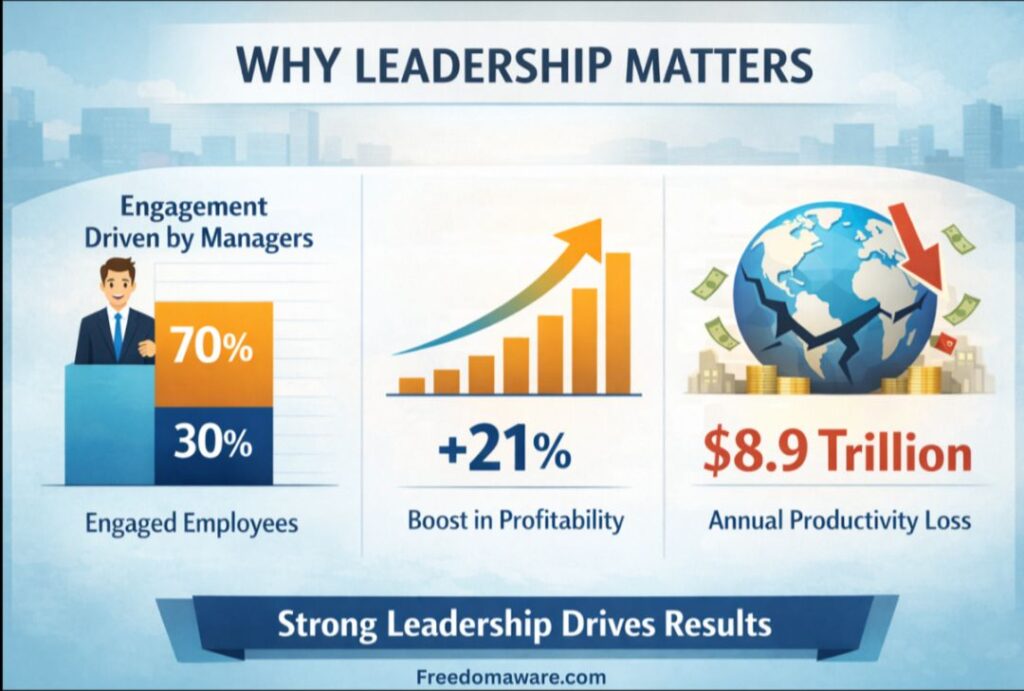
    1. 70% of employee engagement is directly influenced by leadership quality, not benefits or perks. (source)
    2. Only 30% of global employees are actively engaged at work, highlighting an engagement crisis. (Source)
    3. A disengaged workforce can cost the global economy more than $8.9 trillion annually due to lower productivity. (Source)
    4. Managers alone explain around 70% of variation in engagement scores between teams. Source
    5. Organizations with engaged teams are 21% more profitable and 17% more productive. Source

    These data highlight the urgency of leadership focus — especially as many companies chase “culture fixes” without addressing leadership quality.


    Leadership Perception vs. Reality (Leadership Statistics)

    Employees and leaders often see leadership effectiveness very differently.
    6. Only 31–40% of leaders are perceived as effective by their teams. Source
    7. Many employees rate their leaders as ineffective at communication and development. Source
    8. Leaders working in hybrid roles report lower engagement than fully onsite or remote counterparts. Source
    9. Less than half of leaders communicate success expectations clearly to their teams. Source
    10. Only about 30–50% of employees feel appreciated by their leaders. Source

    This perception gap eats trust, slows performance, and increases turnover.


    Leadership Development — The Gap & ROI (Leadership Statistics)

    Companies know leadership matters; many just don’t invest enough.

    11. Only 44% of managers globally have received formal leadership training, despite its impact on engagement and performance. Source

    12. Managers under age 35 saw engagement drop by 5 percentage points, and female managers saw a 7-point decline, showing demographic variations in leadership engagement. Source

    13. Approximately 60% of organizations view employee disengagement as resulting from poor management, while 75% of managers believe leadership drives engagement — revealing a perception gap. Source

    14. Teams led by managers who provide regular feedback achieve up to 23% higher performance than teams with infrequent feedback. Source

    15. Leadership programs on average increase employee retention by 59% and profitability by around 21% among organizations that invest in training. Source

    16. 71% of Millennial employees say they would likely leave within three years if leadership development programs are lacking. Source

    17. External hires into leadership roles are 61% more likely to fail within 18 months compared to internally promoted leaders. Source

    18. Only about 10% of people are natural leaders, yet roughly 20% can become effective leaders with proper development. Source
    19. 77% of organizations report leadership gaps at all levels. Source
    20. Only a minority provide robust leadership development programs. Source
    21. 93% of organizations consider leadership training a priority. Source
    22. Investing in leadership development correlates with 29–34% higher employee retention. Source
    23. Leadership programs improve team performance by 20–25% on average. Source
    24. Companies with strong leadership development see managers outperform peers by 28–37% in key competencies. Source

    Effective leadership learning isn’t an expense — it’s measurable ROI.


    Skills Modern Leaders Actually Need (Leadership Statistics)

    Leadership today blends technical savvy with emotional and relational skills.
    25. 70% of leadership skills required today are new or evolving compared to traditional models. Source
    26. Soft skills now outweigh technical skills for leadership success. Source
    27. Emotional intelligence (EQ) is consistently ranked as a top leadership attribute. Source
    28. Leadership communication ability predicts engagement and productivity. Source
    29. Leaders must also be digitally fluent due to remote/hybrid work structures. Source

    This shift means leadership development must focus on people skills, not just processes.


    Emotional Intelligence: The Invisible Multiplier (Leadership Statistics)

    Emotional intelligence now sits at the heart of leadership success.
    30. Leaders with high EQ outperform peers by up to 25–40% in key outcomes. Source
    31. Emotional intelligence strongly predicts trust, collaboration, and psychological safety. Source
    32. Organizations that prioritize EQ create more engaged and resilient teams. Source

    Emotional intelligence isn’t soft — it’s strategic.


    Recognition & Motivation Leadership Statistics

    Recognition and motivational behaviors have measurable outcomes.
    33. 94% of employees would stay longer if their organization invested in learning and development. Source
    34. Managers who provide frequent feedback see stronger performance outcomes. Source
    35. Effective recognition programs directly correlate with higher engagement scores. Source

    Leading with appreciation is one of the lowest-cost, highest-impact leadership behaviors.


    Diversity, Inclusion & Leadership (Leadership Statistics)

    True leadership today embraces diversity and inclusive practices.
    36. Diverse leadership teams generate up to 19–35% higher revenue compared to less diverse peers. Source
    37. Inclusive leaders drive higher innovation and retention rates. Source
    38. Organizations with focused diversity programs improve inclusion metrics by ~29%. Source

    Inclusive leadership isn’t a trend — it’s measurable business value.


    Remote & Hybrid Leadership Realities (Leadership Statistics)

    Remote work dramatically changes leadership expectations.
    39. Remote leadership increased by ~80% since the pandemic. Source
    40. Hybrid leadership requires new communication and trust-building skills. Source
    41. Leaders unprepared for digital leadership risk engagement drop-offs. Source

    42.Only 27% of leaders feel very effective at leading hybrid or virtual teams, despite hybrid work being widespread. Source

    43. Around 36% of companies operate entirely remotely, with another 28% using hybrid models, reflecting diverse organizational leadership landscapes. Source

    44. 63% of leadership professionals believe remote and hybrid work has had a high or very high impact on leadership effectiveness. Source

    45. Remote workers who regularly hear from leadership report 58% higher trust and alignment than those with infrequent communication. Source

    46. Only 19% of remote workers feel comfortable giving leadership feedback, highlighting a major trust and communication gap. Source

    As workplaces evolve, leadership must evolve faster.


    Burnout & Leadership Well-Being (Leadership Statistics)

    Leadership effectiveness depends on leader resilience.
    47. Many leaders report high levels of burnout and exhaustion. Source
    48. Burnout correlates with lower engagement and higher turnover risk. Source
    49. Leaders overloaded with work are significantly more likely to make poor decisions. Source

    Leading while depleted undermines performance and culture.


    Advanced Leadership Performance Metrics (Leadership Statistics)

    Organizations that measure leadership like a business KPI achieve stronger outcomes.
    50. Organizations with leadership feedback loops are 2× more agile. Source
    51. Leadership alignment improves strategic execution by ~44%. Source
    52. Transparent leaders build ~38% more trust with stakeholders. Source

    Metrics make leadership measurable and improvable.


    Leadership Development & Training Insights (Leadership Statistics)

    53. Only 44% of managers globally have received formal leadership training, despite its impact on engagement and performance. Source
    54. Managers under age 35 saw engagement drop by 5 percentage points, and female managers saw a 7-point decline, showing demographic variations in leadership engagement. Source
    55. Approximately 60% of organizations view employee disengagement as resulting from poor management, while 75% of managers believe leadership drives engagement — revealing a perception gap. Source
    56. Teams led by managers who provide regular feedback achieve up to 23% higher performance than teams with infrequent feedback. Source
    57. Leadership programs on average increase employee retention by 59% and profitability by around 21% among organizations that invest in training. Source
    58. 71% of Millennial employees say they would likely leave within three years if leadership development programs are lacking. Source
    59. External hires into leadership roles are 61% more likely to fail within 18 months compared to internally promoted leaders. Source
    60. Only about 10% of people are natural leaders, yet roughly 20% can become effective leaders with proper development. Source


    Additional Impact (Leadership Statistics)

    Here’s even more data reshaping the leadership landscape:
    61. Leadership training reduces team turnover by up to 25%.Source
    62. Leaders with better conflict-resolution skills see 15% fewer team departures. Source
    63. Highly engaged managers see teams with 59% lower turnover. Source
    64. Leadership programs can reduce time-to-promotion by 6–12 months. Source
    65. 80% of executives say leadership improvement is a top business priority. Source

    66.Organizations with comprehensive leadership development programs enjoy 218% higher income per employee than those without formal training. Source

    67. Companies that invest in manager training report 23% higher profitability compared to peers who don’t. Source

    68. Leadership development can reduce voluntary turnover by 27% in organizations that invest in training. Source

    69. Effective leadership development participants report 28% higher job satisfaction compared with non-participants. Source

    70. Strong leadership development is linked to a 32% improvement in innovation metrics in organizations that emphasize leadership capability. Source


    What These 70+ Leadership Statistics Really Tell Us (Leadership Statistics)

    After analyzing the data, several themes emerge:

    • Leadership drives engagement, not perks.
    • Soft skills and EQ matter more than ever.
    • Investment in development delivers measurable ROI.
    • Diversity, inclusion, and psychological safety aren’t optional.
    • Leaders must adapt to digital, hybrid, and human realities.

    Leadership isn’t abstract — it’s measurable and strategic.


    Practical Actions You Can Take Today (Leadership Statistics)

    If you want to improve leadership outcomes in your organization:

    • Incorporate regular coaching and development plans
    • Prioritize emotional intelligence training
    • Build feedback and recognition systems
    • Invest in inclusive leadership practices
    • Measure leadership outcomes like KPIs
    • Support leader well-being and resilience

    Small improvements compound — even a 5–10% engagement boost dramatically improves productivity and bottom-line results.


    Final Thoughts (Leadership Statistics)

    Leadership determines organizational success. When leaders inspire trust, cultivate psychological safety, and invest in development, performance soars. When they don’t, performance stagnates.

    Use these statistics not as numbers, but as guidance.
    Build leadership that creates engaged, motivated, high-performing teams — because in 2026, leadership isn’t just a role — it’s measurable performance.